
NOTE: This article was original published on July 3, 2013. It was afterwards heavily updated and republished on December 28, 2025.
If you want to find dinosaur bones, one of the best places to look for them is the Morrison Formation, which encompasses an utterly massive area in western North America and dates to the late Jurassic Period 157-147 million years ago. Rock layers from the Morrison Formation have been found in Montana, North Dakota, South Dakota, Wyoming, Utah, Colorado, Nebraska, Kansas, New Mexico, and Oklahoma (Parrish et al. 2004, pages 137-162; Turner and Peterson 2004, pages 309-355). Like many geologic formations, the Morrison Formation is divided into units called “members”. Since the Morrison Formation spans such a massive geographic area, some members are found only in certain areas and not others. For example, the Unkpapa Sandstone Member is found only in western South Dakota and the northeastern corner of Wyoming, and the Kenton Member is found only in western Oklahoma. Within the Colorado Plateau, which is where the majority of the Morrison Formation is located, the three principal members are the Tidwell Member on the bottom, the Salt Wash Member in the middle, and the Brushy Basin Member on the top.
Dinosaurs aren’t the only fossils found within the Morrison Formation. Fossils of plants, fish, amphibians, reptiles, and mammals have also been found here. Of these various other animals that shared the landscape with the dinosaurs, the pterosaurs – the flying reptiles – are especially intriguing because very few of them have been found here.
In 1878, Samuel W. Williston discovered a partial pterosaur bone at Como Bluff, Wyoming, where a multitude of dinosaur fossils had been found. The pterosaur bone, which measures just 1.26 inches (32mm long) was found within the Brushy Basin Member of the Morrison Formation in strata dating to the upper Kimmeridgian Stage, close to the Kimmeridgian-Tithonian boundary, about 152 MYA (Carpenter et al. 2003, page 46). This discovery was noteworthy because this was the first pterosaur fossil that had ever been found within the Morrison Formation. Later that year, Professor Othniel Charles Marsh of Yale University wrote an article briefly describing this bone, which he identified as a distal portion of a metacarpal from the right wing. He named it Pterodactylus montanus, believing it to be from the same genus as Pterodactylus, which was known only from Europe (Marsh 1878, pages 233-234). However, a few years later, Marsh had his doubts about this, so in 1881, he wrote a follow-up article in which he re-named the animal as Dermodactylus montanus, “the skin-finger of the mountain” (Marsh 1881, page 342).
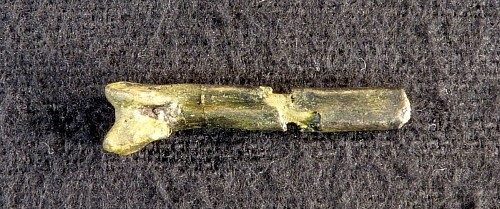
The partial metacarpal bone of Dermodactylus montanus. Photograph ID number: USNM-V16797. Smithsonian National Portrait Gallery.
https://npg.si.edu/object/nmnhpaleobiology_3447917.
So far, the only fossil collected of this species is that single metacarpal bone found in 1878, which is currently housed within the collections of the Yale Peabody Museum (collections ID code: YPM 2020). No other pterosaur fossils found within the Morrison Formation have been ascribed to this genus since then. Curiously, Marsh states in his 1881 article that several bones belonging to Dermodactylus were found, not just one: “The known remains are all fragmentary, but some of them indicate the general characteristics of species and genus. Among the remains now in the Yale Museum are portions of the wing bones, including the characteristic wing metacarpal and first phalanx. These bones, although pneumatic, show much thicker walls than the corresponding bones of other Pterodactyls, even those from the same formation in Europe, this suggesting a less degree of specialization…The scapula and coracoid do not appear to have been ankylosed. The vertebrae referred provisionally to this species are procoelian. The teeth found near the remains, and apparently belonging with them, are elongate, and more rounded than in most Pterodactyls” (Marsh 1881, page 342). In 1890, the German paleontologist Karl Alfred von Zittel stated Procöle Wirbel, Knochen des Brustgürtels und der Flugfinger aus dem oberen Jura von Colorado vorhanden. Dieselben zeichnen sich durch ansehnliche Grösse und verhältnissmässig solide, dickwandige Structur aus D. (Pterodactylus) montanus (“Procoelous vertebrae, bones of the pectoral girdle, and phalanges of the wing fingers from the Upper Jurassic of Colorado are present. These are characterized by their considerable size and relatively solid, thick-walled structure, typical of D. (Pterodactylus) montanus”) (Zittel 1890, page 798). In 1916, Charles Mook reiterated that a multitude of remains were ascribed to Dermodactylus, including “various remains of wings, teeth, and vertebrae” (Mook 1916, page 149). So where are all of these other bones? Why is only the wing bone found in 1878 listed in the Yale Peabody Museum’s collections? It’s possible that these bones have been lost. That’s right, even stored away in museum collections, fossils can just disappear. Fossils which were not given collection ID numbers (there’s no evidence that the above-mentioned fossils ever were), or which were not entered correctly into the museum’s records, or which were stuck away on some random shelf and then forgotten about and nobody can remember where they are, or which were taken out and then not put back in their appropriate place so nobody can find them, all of these things can and still do happen.
How big was Dermodactylus? In his 1878 paper, Marsh hypothesized that Dermodactylus may have had a wingspan of 4 or 5 feet (Marsh 1878, page 233). In his follow-up paper from 1881, he enlarged it to a wingspan of 5 to 6 feet (Marsh 1881, page 342). However in 1991, the German pterosaur expert Peter Wellnhofer said that a wingspan of just 1 meter (3.28 feet) was much more likely (Wellnhofer 1991, page 105). With regards to weight, it was first proposed that it might weigh 3.3 kilograms (Foster 2003, page 37), but this was afterwards halved to 1.5 kg (Foster 2020, page 208).
Where did Dermodactylus fit into the pterosaur tree? In 1890, Karl Alfred von Zittel hypothesized that Dermodactylus might belong to the pterosaur family Ornithocheiridae (Zittel 1890, page 798). In 1991, Peter Wellnhoffer identified Dermodactylus as a pterodactyloid pterosaur, meaning that it was more closely related to Pterodactylus than to Rhamphorhynchus, but due to the incompleteness of the remains, it was impossible to narrow the classification down further to a family (Wellnhoffer 1991, page 105). In 1998, Dermodactylus was again identified as a pterodactyloid pterosaur, based upon the length of the bone in relation to its diameter, but aside from that, the bone didn’t possess any diagnostic features (Padian 1998, page 58). Because of this, in 2003, Dermodactylus was listed as a nomen dubium, meaning “doubtful name” (Carpenter et al. 2003, page 52). This is a classification used when scientists aren’t sure if a certain species or genus actually existed. Because several pterosaurs from the Morrison Formation have since been named, and since all of the Morrison Formation pterosaurs are known from only fragmentary remains, and since the bone ascribed to Dermodactylus is incomplete and doesn’t possess any distinguishing anatomical features, it is possible that this metacarpal bone might have come from another pterosaur and was misidentified.
In his 1878 paper, Marsh hypothesized that Dermodactylus may have had a wingspan of 4 or 5 feet. In his follow-up paper from 1881, he said that it had a wingspan of 5 to 6 feet. However, considering the small size of the bone, and comparing it to the bones of other pterosaurs, a smaller wingspan of around 3 feet is more likely. So far, the only fossil collected of this species is that single finger bone found in 1878, which is currently housed within the collections of the Yale Peabody Museum (collections ID code: YPM 2020). No other pterosaur fossils found within the Morrison Formation have been ascribed to this genus since then. Because of this, many paleontologists today classify Dermodactylus as a nomen dubium – a classification used when scientists aren’t sure if a certain species or genus actually existed. The finger bone in question might have come from another pterosaur, and was misidentified. The only way that we can be sure is if more pterosaur fossils are found in the Morrison Formation which can be examined and compared. So get out there and start digging!
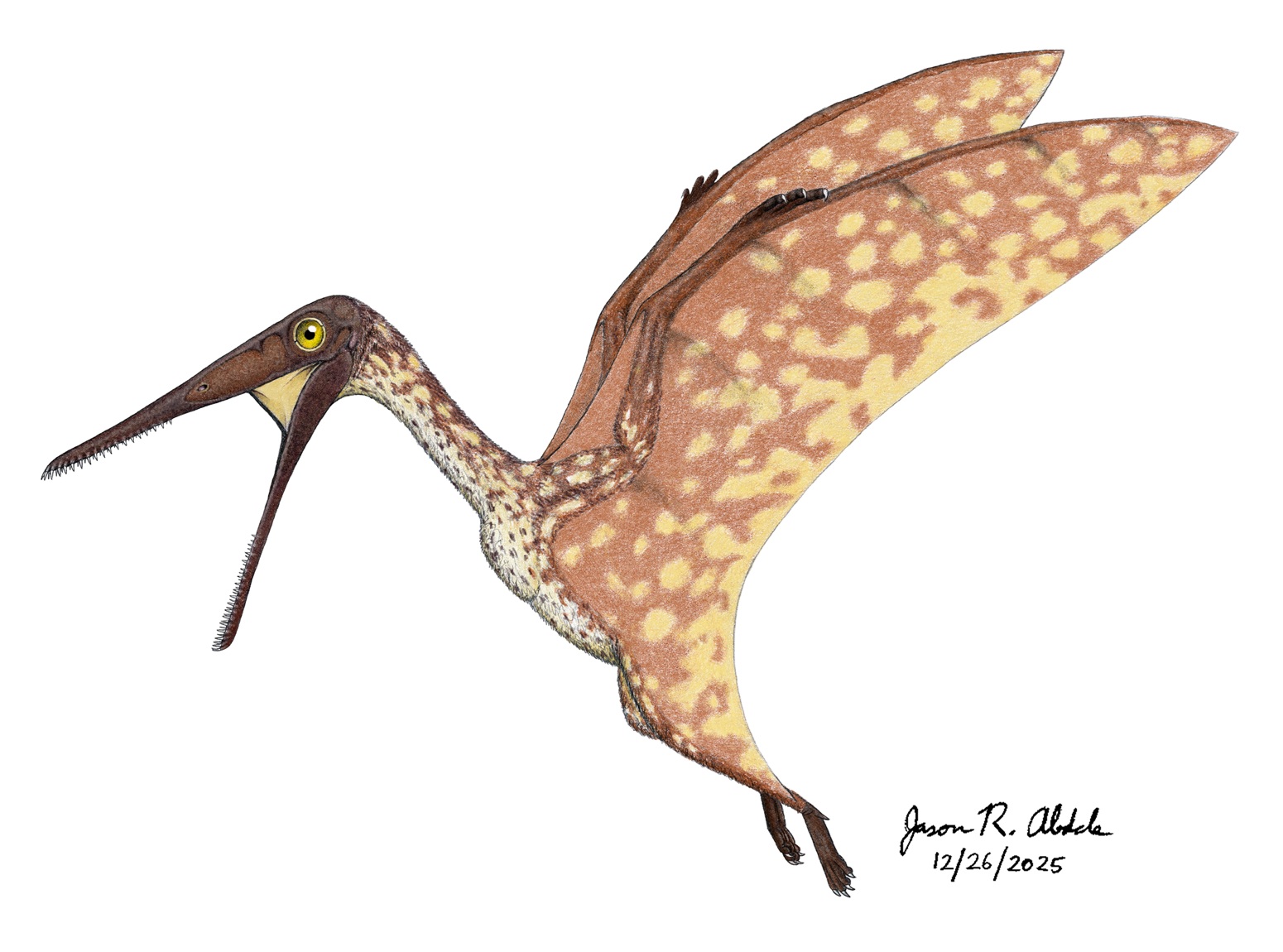
Dermodactylus montanus. © Jason R. Abdale (December 26, 2025).
I truly enjoy writing my articles and drawing my art, but it’s increasingly clear that I can’t keep this up without your gracious financial assistance. Kindly check out my pages on Redbubble and Fine Art America if you want to purchase merch of my artwork. Consider buying my ancient Roman history books Four Days in September: The Battle of Teutoburg and The Great Illyrian Revolt if you or someone that you know loves that topic, or my ancient Egyptian novel Servant of a Living God if you enjoy action and adventure. Please consider becoming a patron on my Patreon page so that I can continue to purchase the art supplies and research materials that I need. Professional art supplies are pricey, many research articles are “pay to read”, and some academic journals are rather expensive. My Patreon membership is just $1 per month – that’s it. If everybody who likes this drawing donates just one dollar per month, it would go a long way to keeping my blog “Dinosaurs and Barbarians” running and preventing my career in paleo-art from going extinct.
Keep your pencils sharp, everybody.
Bibliography
Books
Foster, John. Jurassic West: The Dinosaurs of the Morrison Formation and Their World, Second Edition. Indianapolis: Indiana University Press, 2020.
Wellnhofer, Peter. The Illustrated Encyclopedia of Pterosaurs. London: Salamander Books, Ltd., 1991.
https://archive.org/details/illustratedencyc0000well.
Zittel, K. A. (1890). Handbuch der Palaeontologie. I. Abteilung Paleozoologie. III. Band. Vertebrata (Pisces, Amphibia, Reptilia, Aves) [Handbook of Paleontology. Division I. Paleozoology. Volume III. Vertebrata (Pisces, Amphibia, Reptilia, Aves)]. Pages xii-900.
https://www.biodiversitylibrary.org/item/124860#page/11/mode/1up.
Articles
Carpenter, Kenneth; Unwin, David; Cloward, Karen; Miles, Clifford; Miles, Clark (2003). “A new scaphognathine pterosaur from the Upper Jurassic Morrison Formation of Wyoming, USA”. In Buffetaut, Eric; Mazin, Jean-Michel, eds. Geological Society Special Publications 217: Evolution and Palaeobiology of Pterosaurs. London: The Geological Society, 2003. Page 45-54.
https://www.google.com/books/edition/Evolution_and_Palaeobiology_of_Pterosaur/8CKYxcylOycC?hl=en&gbpv=1&dq=Dermodactylus+nomen+dubium&pg=PA52&printsec=frontcover.
Foster, John R. (2003). “Paleoecological Analysis of the Vertebrate Fauna of the Morrison Formation (Upper Jurassic), Rocky Mountain Region, U.S.A.”. New Mexico Museum of Natural History and Science Bulletin, number 23 (2003). Pages 1-95.
https://www.google.com/books/edition/Paleoecological_Analysis_of_the_Vertebra/tWQfCgAAQBAJ?hl=en&gbpv=1.
Marsh, Othniel Charles (1878). “New pterodactyl from the Jurassic of the Rocky Mountains”. The American Journal of Science, volume 16. Pages 233-234.
https://ajsonline.org/article/63552-new-pterodactyl-from-the-jurassic-of-the-rocky-mountains.
Marsh, Othniel Charles (1881). “Note on American pterodactyls”. The American Journal of Science, volume 31. Pages 342-343.
https://ajsonline.org/article/64088.
Mook, Charles Craig (1916). “A Study of the Morrison Formation”. Annals of the New York Academy of Sciences, volume 27 (June 12, 1916). Pages 39-191.
https://www.google.com/books/edition/A_Study_of_the_Morrison_Formation/Hx4QAAAAIAAJ?hl=en&gbpv=1.
Padian, Kevin (1998). “Pterosaurians and ?avians from the Morrison Formation (Upper Jurassic, Western U.S.)”. Modern Geology, volume 23 (1998). Pages 57-68.
https://books.google.com/books?id=CLEPeg_SjTcC&pg=PA57&source=gbs_toc_r&cad=2#v=onepage&q&f=false.
Parrish, Judith Totman; Peterson, Fred; Turner, Christine E. (2004). “Jurassic ‘savannah’—plant taphonomy and climate of the Morrison Formation (Upper Jurassic, Western USA)”. Sedimentary Geology, volume 167, issues 3-4 (May 15, 2004). Pages 137-162.
Turner, Christine E.; Peterson, Fred (2004). “Reconstruction of the Upper Jurassic Morrison Formation extinct ecosystem—a synthesis”. Sedimentary Geology, volume 167, issues 3-4 (May 15, 2004). Pages 309-355.
Websites
Smithsonian National Portrait Gallery. “Dermodactylus montanus Marsh, 1878”. https://npg.si.edu/object/nmnhpaleobiology_3447917.
Categories: Paleontology, Uncategorized
 DINOSAURS AND BARBARIANS
Leave a comment