
Harpactognathus was a rhamphorhynchid pterosaur which lived in the Morrison Formation of western North America during the late Jurassic Period.
In 1996, the front of a pterosaur’s upper jaw was discovered at Bone Cabin Quarry, a famous fossil site in Wyoming where thousands of dinosaur bones have been dug up. Stratigraphically, the fragment was found within the upper part of the Salt Wash Member of the Morrison Formation in a rock layer that date to the middle of the Kimmeridgian Stage of the Jurassic Period about 155 million years ago. This would make it the oldest pterosaur from the Morrison Formation, as the other pterosaur genera found here were recovered from the younger Brushy Basin Member. This upper jaw fragment was also notable for its sheer size, being far larger than other pterosaur fossils known from the Morrison Formation, and also due to the presence of a low ridge of bone running up the middle of the jaw’s upper surface. In overhead view, the snout resembled a Gothic arch.
A cursory glance at the upper jaw fragment showed similarities to a European pterosaur named Scaphognathus whose fossils are known from Germany in rocks dating to the late Jurassic Period 155-150 MYA. Scaphognathus, meaning “boat jaw” due to its keeled structure, is the eponymous species of the pterosaur sub-family Scaphognathinae. The scaphognathines are differentiated from other rhamphorhynchoid pterosaurs by having proportionally larger and shorter skulls with fewer and larger teeth. Just like the curious remains found in Wyoming, Scaphognathus also had a ridge of bone running along the middle of the top of its skull, and it also had large teeth which were widely spaced apart. Another notable scaphognathine pterosaur is Dorygnathus, meaning “spear jaw”, which had large teeth and a rather spatulate duckbill-like set of jaws somewhat similar in shape to the Gothic arch-shaped upper jaw of the pterosaur from Wyoming.
In 1999, a fragment of a pterosaur’s lower jaw was discovered less than a meter away from the piece of the upper jaw. While it was initially assumed that they belonged to the same animal, closer examination showed that the upper and lower jaws didn’t fit together, and they likely belonged to two different species.
In 2003, the upper jaw fragment from Wyoming was named Harpactognathus, meaning “grappling/seizing jaw”. The scientific name gentryii was in honor of Joe Gentry, who worked as a volunteer for the western Paleontological Laboratories in Lehi, Utah.
Although Harpactognathus is only known from fragmentary remains, paleontologists suspect that it was one of the largest pterosaurs that lived in North America during the late Jurassic Period. By comparing the fossil remains with those belonging to its relative Scaphognathus, it’s hypothesized that Harpactognathus had a wingspan of 8.2 feet (2.5 meters), making it the size of an eagle, and it may have had a skull measuring 30 cm long. As to how long its entire body would have been, that’s uncertain. Rhamphorhynchoid pterosaurs are known for having long tails, often ending in diamond-shaped or kite-shaped fins, which were likely brightly colored. Unfortunately, no remains of Harpactognathus’ tail have been found yet. However, scaphognathine rhamphorynchoids tended to have proportionally shorter tails than other rhamphorhynchoids.
Based upon the appearance of its skull, with long interlocking teeth resembling a Venus fly trap, it is almost certain that Harpactognathus was a fish-eater.
There have been numerous comparisons made over the years between Late Jurassic North America and the modern-day African savanna. Therefore, I decided to portray Harpactognathus with a color scheme similar to the African Fishing Eagle.
NOTE: The drawing which was originally posted here dated to August 30, 2019 has been removed for being anatomically inaccurate. The updated drawing is below.
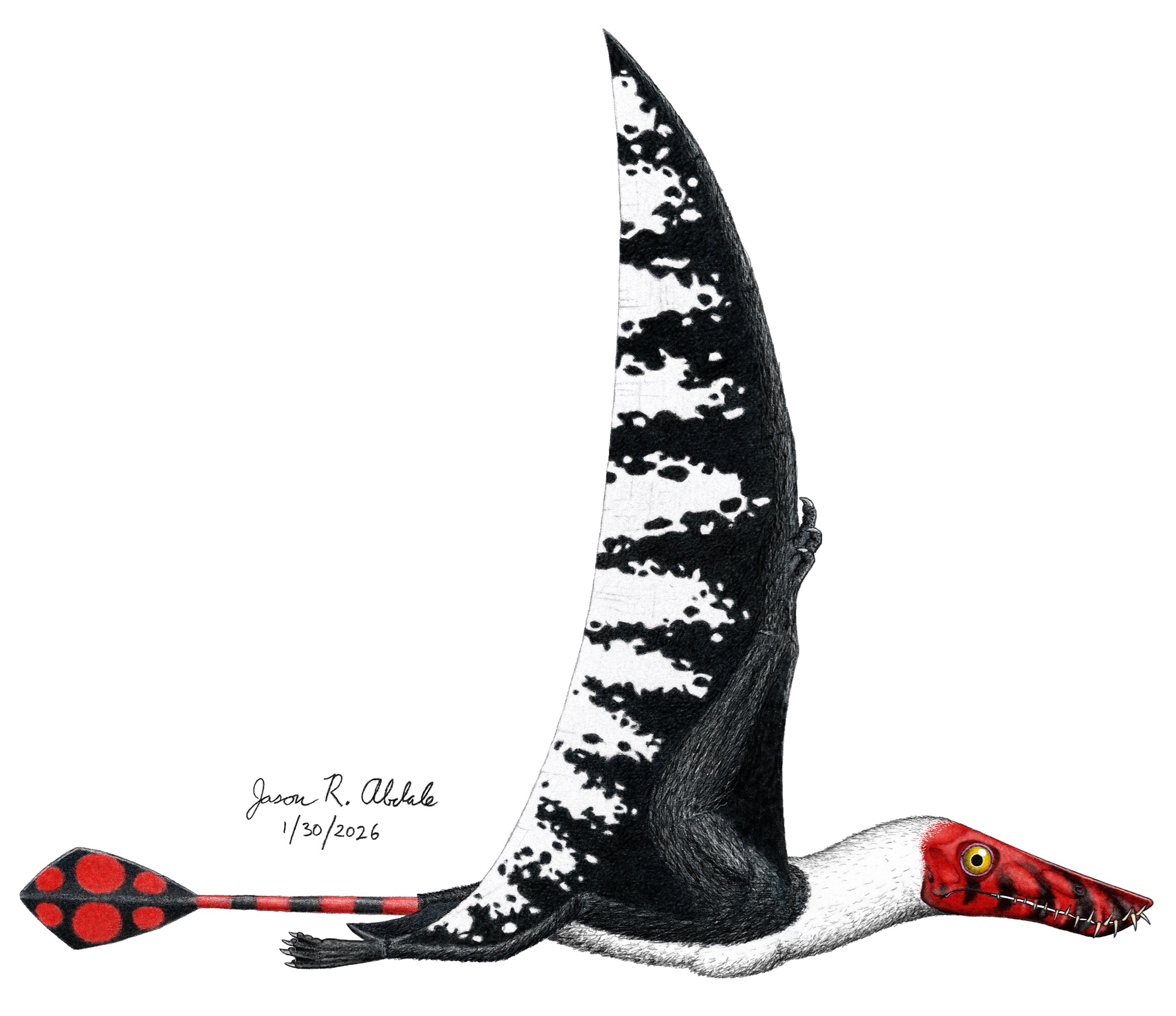
Harpactognathus gentryii. © Jason R. Abdale (January 30, 2026).
Categories: Paleontology, Uncategorized
 DINOSAURS AND BARBARIANS
Leave a comment