
NOTE: This article was originally published on August 3, 2023. It was substantially revised on February 3, 2026.
Kepodactylus was a pterosaur which lived in western North America during the late Jurassic Period 155-152 million years ago.
In 1992, a nearly-complete Stegosaurus skeleton was discovered in Garden Park, Colorado within the rocks of the Morrison Formation. This is a famous geological formation which dates to the late Jurassic Period approximately 157-147 million years ago (MYA). The rocks in this specific quarry were from the uppermost part of the Salt Wash Member, the second-youngest member of the Morrison Formation, which would date the fossils to the uppermost part of the Kimmeridgian Stage about 153 or 152 MYA. Alongside this Stegosaurus skeleton were a handful of smaller fossilized bones belonging to a pterosaur, consisting of a single neck vertebra, one humerus, a few finger bones, and one metatarsal (collection ID code: DMNH 21684). In 1996, Jerald Harris and Kenneth Carpenter officially designated this creature as a new species called Kepodactylus insperatus. The genus name means “garden finger”, named after Garden Park where it was discovered. The species name insperatus means “unhoped for” or “unexpected” since its discovery was so surprising. Based upon the size of the bones which were recovered and comparing them to the bones of other pterosaurs, Kepodactylus is estimated to have had a wingspan of 2.5 meters (8 feet) (Harris and Carpenter 1996, pages 473-475).
In 1996, it was believed that Kepodactylus was a member of the pterosaur super-family Pterodactyloidea, but the authors could narrow it down to anything more specific than that (Harris and Carpenter 1996, page 475).
Then in 1999, it was proposed that Kepodactylus might be a dsungaripteroid because its humerus was similar in shape to the humeri belonging to that group of pterosaurs (Unwin and Heinrich 1999, page 134). The dsungaripteroids, named after Dsungaripterus of China, were believed to be the nutcrackers of the pterosaur world, feeding on hard-shelled animals like snails and clams. Several freshwater mollusks have been found within the Morrison Formation (Chure 2026, pages 453-454), so it’s possible that Kepodactylus ambled along the riverbanks snapping them up. In the early 2000s, there seemed to be additional evidence to back up assigning Kepodactylus as a snail-cracking or shellfish-cracking dsungaripteroid: “As yet undescribed material of Kepodactylus, including fragments of a coracoid, wing metacarpal, wing phalanges, a femur, a metatarsal and ribs also exhibits distinctive dsungaripteroid characters. It seems likely therefore that Kepodactylus belongs within Dsungaripteroidea, although its relationship to other members of this clade is still unclear. Kepodactylus is to the first record of dsungaripteroids in North America, and possibly also one of the earliest” (Carpenter et al. 2003, page 52).
However, according to a phylogenic analysis of pterosaurs conducted in 2018, Kepodactylus was determined to be a close relative of Moganopterus, a pterosaur from northeastern China which lived during the early Cretaceous Period 125 MYA (Longrich et al. 2018: e2001663). Moganopterus was a member of the pterosaur family Ctenochasmatidae. The ctenochasmatids, meaning “comb jaws”, are known mostly from Europe and Asia in rocks dating to the late Jurassic and early Cretaceous Periods, and are distinctive for possessing long jaws packed with hundreds of small needle-like teeth – perfect for grabbing small slippery fish. Several species of small fish inhabited the Morrison Formation, including the minnow-sized Hulettia and the hand-sized Morrolepis.
In addition to the bones found at Garden Park, Colorado, another fossil specimen has been uncovered which might belong to Kepodactylus, and this has implications for potentially confirming Kepodactylus as a ctenochasmatid. In 1996, fossils were uncovered at Bone Cabin Quarry near Como Bluff, Wyoming. The rocks in this quarry lay within the Salt Wash Member, the exact rock layer that the bones were found in dated to the middle of the Kimmeridgian Stage about 155 MYA. Among the fossils found here was the front end of a pterosaur’s upper jaw, which was given the name Harpactognathus in 2003. In 1999, paleontologists returned to the site to do some more digging, and they uncovered the front end of a pterosaur’s lower jaw. Because this fragment was found barely a meter away from the upper jaw of Harpactognathus, they initially assumed that the two belonged to the same skull. However, upon closer examination, they realized that the two bones didn’t match up. Neither the fragmentary upper jaw nor the fragmentary lower jaw had any teeth preserved. However, it was noted that the tooth sockets in the upper jaw were larger and spaced far apart, while the tooth sockets in the lower jaw were smaller and packed close together. Moreover, the lower jaw possessed “a narrow elongate mandibular symphasis”. The symphysis, meaning “together formed”, is the front of the lower jaw where the left side and right side are fused together. The symphysis on this particular lower jaw was narrow, far narrower in comparison to the fragment of the upper jaw of Harpactognathus which was rather wide and shaped like a Gothic arch. The tooth sockets in the lower jaw were also strongly laterally compressed, like flattened ovals, whereas the tooth sockets in the upper jaw were rounded ovals. Because of these differences, it was suspected at the time that this lower jaw belonged to a second large as-yet-unidentified rhamphorhynchoid pterosaur which shared the landscape with Harpactognathus (Carpenter et al. 2003, pages 45-46, 48, 50). However, it must be noted that the shape of this lower jaw and its closely-packed teeth are similar to the front ends of lower jaws seen in ctenochasmatid pterosaurs. Since Kepodactylus was classified as a ctenochasmatid in 2018, and since Kepodactylus was a large pterosaur which is estimated to have grown to be as large as Harpactognathus (both are assumed to have had an 8 foot wingspan), it’s possible that this lower jaw fragment also belongs to Kepodactylus or to some other large ctenochasmatid pterosaur.
If Kepodactylus was a ctenochasmatid which fed primarily on fish, and if it was also the same size as the 8 foot wide rhamphorhynchoid pterosaur Harpactognathus, and if the two genera inhabited the same landscape at the same time, then this has some implications concerning niche partitioning and competition for resources. It’s possible that Kepodactylus fed almost exclusively on small fish while Harpactognathus, which had larger teeth which were spaced further apart from each other, preferred to eat larger fish.
Below is an illustration of what Kepodactylus might have looked like. A lot of this illustration is guesswork, especially the small crest on the top of its head. However, since several ctenochasmatid pterosaurs possessed head crests, the presence of one here is plausible. The shape of the head is based upon that of Moganopterus which is believed to be a close relative of Kepodactylus. However, since Moganopterus is known only from a skull and a couple of neck vertebrae, the rest of the body and the wing proportions are based upon Moganopterus’ relative Beipiaopterus.
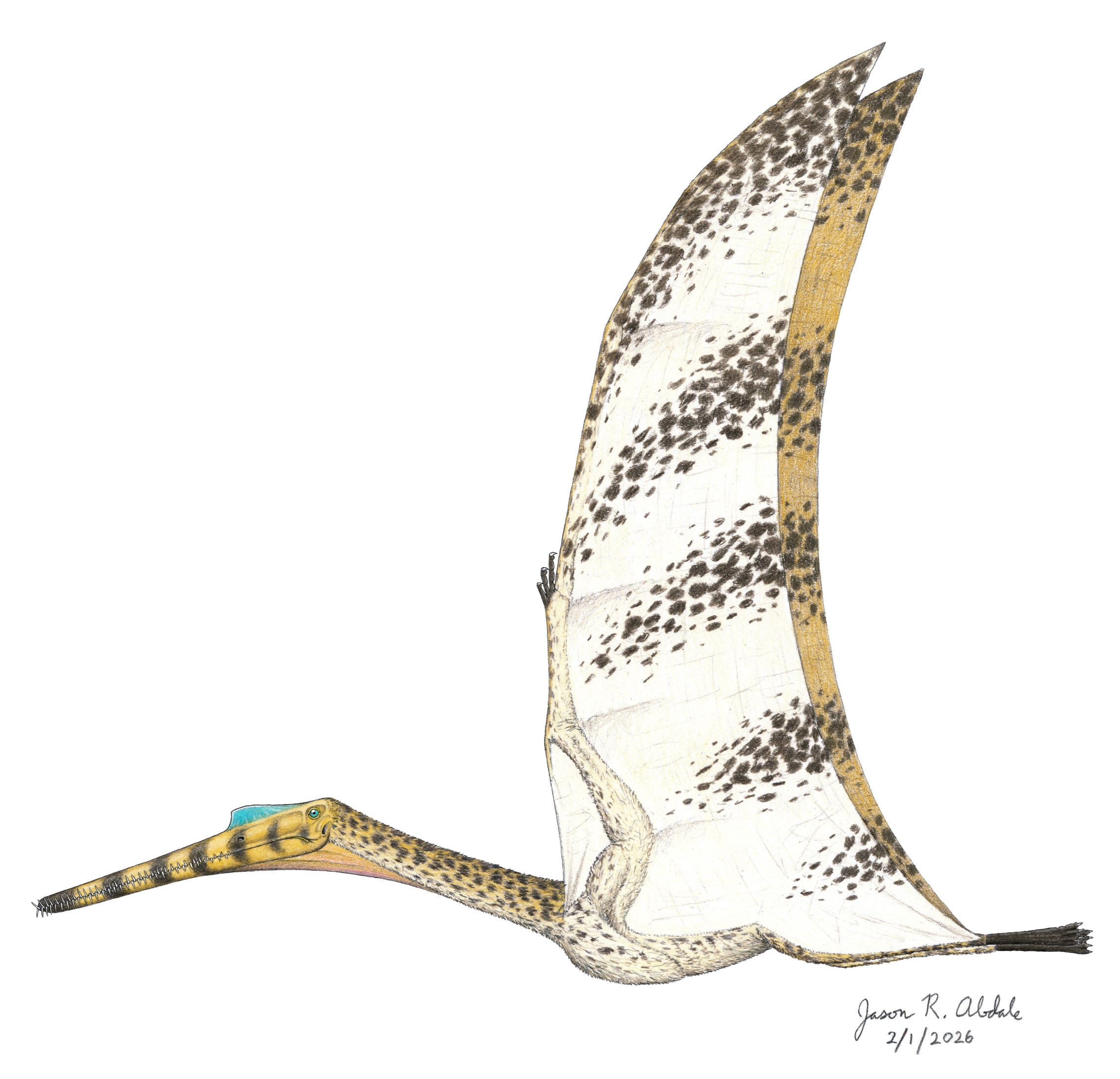
Kepodactylus insperatus. © Jason R. Abdale (February 1, 2026).
If you enjoy these drawings and articles, please click the “like” button, and leave a comment to let me know what you think.
I truly enjoy writing my articles and drawing my art, but it’s increasingly clear that I can’t keep this up without your gracious financial assistance. Kindly check out my pages on Redbubble and Fine Art America if you want to purchase merch of my artwork. Consider buying my ancient Roman history books Four Days in September: The Battle of Teutoburg and The Great Illyrian Revolt if you or someone that you know loves that topic, or my ancient Egyptian novel Servant of a Living God if you enjoy action and adventure. Please consider becoming a patron on my Patreon page so that I can continue to purchase the art supplies and research materials that I need. Professional art supplies are pricey, many research articles are “pay to read”, and some academic journals are rather expensive. My Patreon membership is just $1 per month – that’s it. If everybody who likes this drawing donates just one dollar per month, it would go a long way to keeping my blog “Dinosaurs and Barbarians” running and preventing my career in paleo-art from going extinct.
Keep your pencils sharp, everyone.
Bibliography
Carpenter, Kenneth; Unwin, David; Cloward, Karen; Miles, Clifford; Miles, Clark (2003). “A new scaphognathine pterosaur from the Upper Jurassic Formation of Wyoming, USA”. Geological Society of London, Special Publications, number 217 (2003). Pages 45-54.
https://www.researchgate.net/publication/249551378_A_new_scaphognathine_pterosaur_from_the_Upper_Jurassic_Morrison_Formation_of_Wyoming_USA.
Chure, Daniel J. (2026). “The Fauna and Flora of the Morrison Formation: 2026”. New Mexico Museum of Natural History and Science Bulletin, number 102 (January 2026). Pages 453-470.
https://www.researchgate.net/publication/400047479_THE_FAUNA_AND_FLORA_OF_THE_MORRISON_FORMATION_2026.
Harris, Jerald D.; Carpenter, Kenneth (1996). “A large pterodactyloid from the Morrison Formation (Late Jurassic) of Garden Park, Colorado”. Neues Jahrbuch für Geologie und Paläontologie – Monatshefte 1996, volume 8 (August 1996). Pages 473-484.
https://www.researchgate.net/publication/40662963_A_large_pterodactyloid_from_the_Morrison_Formation_Late_Jurassic_of_Garden_Park_Colorado.
Longrich, Nicholas R.; Martill, David M.; Andres, Brian (2018). “Late Maastrichtian pterosaurs from North Africa and mass extinction of Pterosauria at the Cretaceous-Paleogene boundary”. PLOS Biology, volume 16, issue 3: e2001663 (March 13, 2018).
https://journals.plos.org/plosbiology/article%3Fid%3D10.1371/journal.pbio.2001663.
Unwin, David M.; Heinrich, Wolf-Dieter (1999). “On a pterosaur jaw from the Upper Jurassic of Tendaguru (Tanzania)”. Mitteilungen aus dem Museum flir Naturkunde, Berlin, Geowissenschaftenliche, volume 2 (October 19, 1999). Pages 121-134.
https://fr.pensoft.net/article/30192/download/pdf/.
Categories: Paleontology, Uncategorized
 DINOSAURS AND BARBARIANS
I love the contrast of the blue crest against the yellow body. I always find reconstructions of incomplete fossils interesting. For one, it gives us something to imagine as an animal in an ecosystem. Then later as more fossils are found, and it is better understood, we can then make comparisons and see how our understanding of the animal has changed. 🙂