
Neovenator salerii was a 25 foot long meat-eating dinosaur which lived in England (and possibly other parts of Europe) during the early Cretaceous Period 125 million years ago.
Fossils of this animal were first discovered in 1978 on the Isle of Wight, off England’s southern coast, following a cliff collapse. The rock and clay layers that the bones were deposited in were part of the Wessex Formation and dated to the Barremian Stage of the early Cretaceous Period 125 MYA. Some fossils were shown to belong to an iguanodont dinosaur, while others belonged to a meat-eating theropod dinosaur. During the remainder of the 1970s and throughout the 80s, fossils were uncovered which were determined to belong to four partial skeletons of this new theropod. In 1996, it was named Neovenator, “the new hunter” (Hutt et al 1996, pages 635-644).
In 1996, Neovenator was believed to be an allosaur. This was unusual because it was believed that most allosaurs went extinct at the end of the Jurassic Period (Hutt et al 1996, pages 635-644; Naish et al 2001, pages 242-309). In 2008, the anatomy of animal was redescribed in great detail (Brusatte et al 2008, pages 1-75). A study published in 2010 stated that Neovenator was a carcharodontosaur, and that the megaraptorans of South America were closely related to it. This led to the creation of a new carcharodontosaur family, Neovenatoridae, with Megaraptora as a sub-group within that family (Smith 2010, page 307). Argentinian paleontologist Fernando Novas re-affirmed Neovenator’s position as a carcharodontosaur (Novas 2013, pages 174-215). In 2024, the Italian paleontologist Andrea Cau stated that Neovenator was a basal carcharodontosaur (Cau 2024, pages 1-19).
In 2012, teeth were discovered near the small village of Angeac-Charente in west-central France (about 60 miles northeast of the city of Bordeaux) which are identical to the teeth of Neovenator. This could be evidence that Neovenator was much more widespread throughout western Europe during the early Cretaceous Period than was previously believed (Néraudeau et al 2012, page 10).
Neovenator shared its world with the larger theropod Baryonyx, the dromaeosaurid raptor Vectiraptor, the primitive tyrannosaur Eotyrannus, the ornithopod dinosaurs Iguanodon, Hypsilophodon, Mantellisaurus, and Valdosaurus, and the armored dinosaurs Polacanthus and Vectipelta.
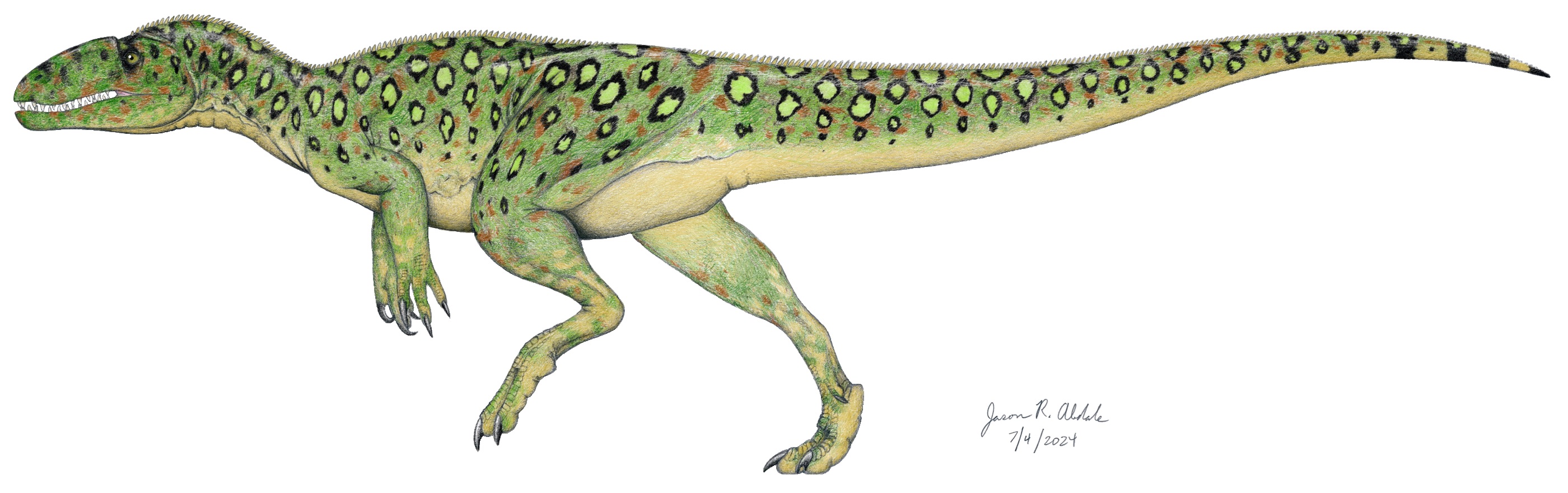
Neovenator salerii. © Jason R. Abdale (July 4, 2024).
If you enjoy these drawings and articles, please click the “like” button, and leave a comment to let me know what you think. Subscribe to this blog if you wish to be immediately informed whenever a new post is published. Kindly check out my pages on Redbubble and Fine Art America if you want to purchase merch of my artwork. Also, please consider becoming a patron on my Patreon page so that I can afford to purchase the art supplies and research materials that I need to keep posting art and articles onto this website. And, as always, keep your pencils sharp.
Bibliography
Brusatte, Stephen L.; Benson, Roger B. J.; Hutt, Steve (2008). “The osteology of Neovenator salerii (Dinosauria: Theropoda) from the Wealden Group (Barremian) of the Isle of Wight”. Monograph of the Palaeontographical Society, volume 162, article number 631. Pages 1-75.
Cau, Andrea (2024). “A Unified Framework for Predatory Dinosaur Macroevolution”. Bollettino della Società Paleontologica Italiana, volume 63, issue 1 (2024). Pages 1-19.
Hutt, S; Martill, D.; Barker, M. (1996). “The first European allosaurid dinosaur (Lower Cretaceous, Wealden Group, England)”. Neues Jahrbuch für Geologie und Paläontologie, Monatschefte (1996). Pages 635-644.
Naish, Darren; Hutt, Stephen; Martill, David (2001). “Saurischian Dinosaurs 2: Theropods”. In Martill, David; Naish, Darren, eds. Dinosaurs of the Isle of Wight. London: The Palaeontological Association, 2001. Pages 242-309.
Néraudeau, Didier; Allain, Ronan; Ballèvre, Michel; Batten, David; Buffetaut, Eric; Colin, Jean-Paul; Dabard, Marie Pierre; Daviero-Gomez, Véronique; El Albani, Abderrazak; Gomez, Bernard; Grosheny, D; Le Loeuff, Jean; Leprince, A; Martín-Closas, Carles; Masure, Edwige; Mazin, J.-M; Philippe, Marc; Pouech, Joane; Tong, Haiyan; Vullo, Romain (2012). “The Hauterivian-Barremian lignitic bone bed of Angeac (Charente, south-west France): Stratigraphical, palaeobiological and palaeogeographical implications”. Cretaceous Research, 37 (October 2012). Pages 1-14.
https://www.agso.net/sites/agso.net/IMG/pdf/angeac.pdf.
Novas, Fernando E. (2013). “Evolution of the carnivorous dinosaurs during the Cretaceous: The evidence from Patagonia”. Cretaceous Research, volume 45. Pages 174-215.
Smith, David (2010). “A Review of ‘The Osteology of Neovenator salerii (Dinosauria: Theropoda) from the Wealden Group (Barremian) of the Isle of Wight'”. Journal of Vertebrate Paleontology, volume 30, issue 1 (January 1, 2010). Page 307.
Categories: Paleontology, Uncategorized
 DINOSAURS AND BARBARIANS
Leave a comment