
Gualolepis was a prehistoric freshwater fish which lived in western Argentina during the middle of the Triassic Period 235-234 million years ago.
Only two specimens of this fish have been found (collection ID codes: PULR 106 and PULR 107), and both of them are incomplete. They were discovered embedded within sandstone concretions found within Cañón del Gualo within the Bermejo Basin in La Rioja Province in western Argentina. The rocks here belong to the Los Rastros Formation, which is dated to the middle of the Triassic Period around 235-234 million years ago. This geologic formation is most well-known for its fossils of prehistoric insects, but fossils of a few species of fish have also been found here, including Gualolepis, Rastrolepis, and Challaia. In 2006, the two aforementioned specimens were officially named Gualolepis carinaesquamosa, meaning “Gualo scale with keeled scales” in a combination of Spanish, ancient Greek, and Latin. The specimens are held in the Paleontological collection of the Universidad Nacional de La Rioja (PULR) in La Rioja, Argentina.
Both specimens only preserve the front part of the body. According to López-Arbarello et al (2006), “PULR106 includes the anterior portion of the body without fins, with some skull bones and partially preserved elements of the pectoral girdle. PULR 107 includes imprints of the skull and anterior portion of the trunk. Scale features are somewhat better preserved in this specimen”. I should state that I disagree with the paper’s statement that the lower jaw was both thinner and shorter than it seems it was – at least based upon the photo of it that I saw in their article. The scales are Gualolepis‘ most distinctive feature. Curiously, the central ridge which runs down the middle of each individual scale runs vertically rather than horizontally, which is what you would naturally expect. Like the central rib running up the middle of an ancient Roman legionnaire’s shield or the central rib running up the length of an ancient Bronze Age sword, this thickened spine was likely meant to give the scales structural strength and rigidity.
In contrast to the beefy boxy skulls of its neighbors such as Rastrolepis and Challaia, the skull of Gualolepis is much more dorso-ventrally flattened and it also appears to be much more weakly-built. In contrast to the circular eye sockets seen in Rastrolepis and Challaia, the eye sockets of Gualolepis are oblong and oval, and they also appear to be situated further towards the roof of the skull rather than on the skull’s sides. The eyes seem to be geared more towards looking up rather than looking forwards. Focusing your vision on what is above you rather than what is in front of you is a trait that is seen in many bottom-dwelling or “benthic” fish species.
The opercular bones – the bones which form the gill covering – were unusually small. This indicates that Gualolepis largely led an inactive lifestyle on or close to the river or lake bottom, moving slowly or perhaps lying stationary for prolonged periods of time. Active swimmers need large gills in order to absorb as much oxygen from the water as possible to fuel their high-paced lifestyle. By contrast, bottom-dwelling or “benthic” fish don’t need to exert that much energy, and consequently, they don’t need to intake massive amounts of oxygen every second. As such, their gill openings tend to be smaller.
Gualolepis‘ teeth were very small – so small that, at first glance, it doesn’t look like it has any teeth. These small cone-shaped teeth, which are barely a few millimeters long, would be sufficient for grabbing worms and other soft-bodied prey. This lends further weight to the hypothesis that Gualolepis was a benthic feeder.
López-Arbarello et al (2006) noted that there is a strong similarity in the skull bones (in particular, the opercular bones) to those seen in members of the prehistoric fish family Peipiaosteidae. The peipiaosteids were members of a much larger group called the acipenseriforms, meaning “sturgeon-shaped”. The acipenseriforms include modern-day sturgeons and all of their close relatives. This would make Gualolepis a distant ancestor of sturgeons and paddlefish. However, the article noted that it might be safer to classify Gualolepis as “Actinopterygii incertae sedis”, meaning “belongs to Actinopterygii, placement uncertain”, for the time being until more complete remains are found.
However, let’s proceed from here onwards under the assumption that Gualolepis is a member of Peipiaosteidae. How big would it have been? Considering that this species is known from only fragmentary remains, this is not an easy question to answer. However, based upon the size of the remains, and by comparing them to other well-fossilized specimens of other peipiaosteid species, Gualolepis likely grew to be 16.5 inches long.
Below is my reconstruction of how Gualolepis may have looked in life. The reconstruction of the body is based upon the peipiaosteid fishes Peipiaosteus pani and Yanosteus longidorsalis. This reconstruction is purely hypothetical, so this image needs to be taken with a few grains of salt. However, given the evidence presented, I feel that this reconstruction is certainly plausible.
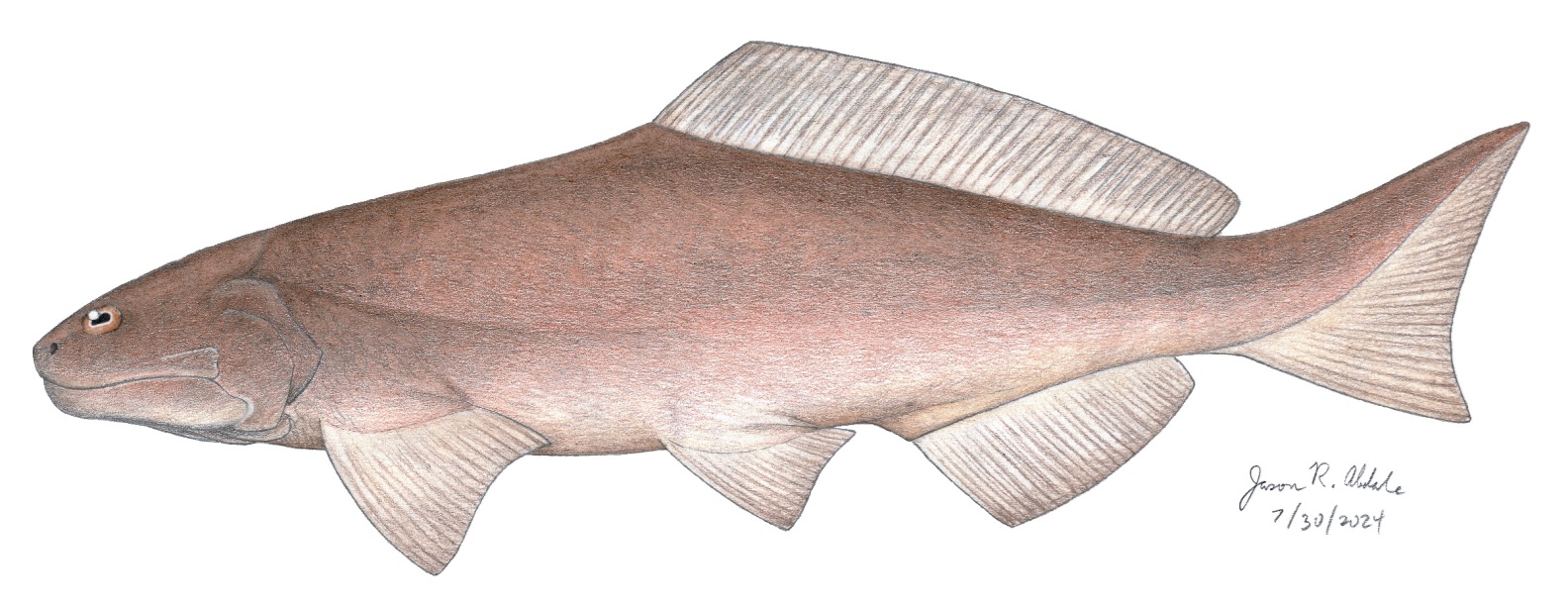
Gualolepis carinaesquamosa. © Jason R. Abdale (July 30, 2024).
If you enjoy these drawings and articles, please click the “like” button, and leave a comment to let me know what you think. Subscribe to this blog if you wish to be immediately informed whenever a new post is published. Kindly check out my pages on Redbubble and Fine Art America if you want to purchase merch of my artwork. Also, please consider becoming a patron on my Patreon page so that I can afford to purchase the art supplies and research materials that I need to keep posting art and articles onto this website. And, as always, keep your pencils sharp.
Bibliography
López-Arbarello, Adriana; Rogers, Raymond R.; Puerta, Pablo (2006). “Freshwater actinopterygians of the Los Rastros Formation (Triassic), Bermejo Basin, Argentina”. Fossil Record, volume 9, issue 2 (August 2006). Pages 238-258.
https://rogerslab.weebly.com/uploads/9/1/9/3/91932718/los_rastros_fish2.pdf.
Categories: Paleontology, Uncategorized
 DINOSAURS AND BARBARIANS
Leave a comment