
Chinlea was a freshwater coelacanth fish measuring 2.5 feet long which lived in North America during the late Triassic Period approximately 210-201 million years ago. Fossils which might belong to Chinlea have also been found in rocks dating to the beginning of the Jurassic Period, but their identity is still uncertain.
The remains of Chinlea were discovered in 1958 within the Dolores River Canyon near Bedrock, Montrose County, Colorado. The specimen consisted of a single pterygoid bone (collection ID code: AMNH 3201) which was found within the rocks of the late Triassic Chinle Formation approximately fifty feet below the base of the overlying Wingate Sandstone. Comparative analysis of the Chinle Formation strata in Colorado and the Chinle strata in Utah suggests that the rock layer where the pterygoid bone was found in dates to the same time as the Utah’s Church Rock Member (Schaeffer and Gregory 1961, pages 1, 14-15). This was the final phase of the Chinle Formation, dated to the Rhaetian Stage of the late Triassic Period, from 207-202 MYA (Martz and Parker 2017, page 39).
Later, more specimens of this prehistoric fish were uncovered within Utah and New Mexico. In 1967, Bobb Schaeffer officially named it Chinlea sorenseni. The genus name was in reference to the Chinle Formation where it was first discovered, and the species name was in honor of Walter Sorensen who worked in the American Museum of Natural History’s vertebrate paleontology lab and who also assisted in collecting the specimens. Fossils of Chinlea sorenseni have been found within the uppermost part of the Chinle Formation within Lisbon Valley, Utah and Paradox Valley, Colorado, the Dolores Formation in southwestern Colorado, the uppermost part of the Redonda Formation of eastern New Mexico, and possibly from the Chinle Formation’s Petrified Forest Member in Ghost Ranch, New Mexico (Schaeffer 1967, pages 289, 322-323; Stewart et al. 1972, page 80; Elliot 1987, pages 47-52; Johnson et al. 2002, page 111; Martz et al. 2017, page 136).
Examination of Chinlea shows that it belongs to a group of coelacanths called the mawsoniids, named after the genus Mawsonia (Miguel et al. 2014, pages 159-170; Cavin et al. 2019, pages 3-13). Bobb Schaeffer remarked that Chinlea’s overall bodyplan was similar to that of the mawsoniid Diplurus, and he estimated that Chinlea reached 800 mm in length, or approximately 2.5 feet long (Schaeffer 1967, page 322-323, 326)

Skeleton of the holotype specimen of Chinlea sorenseni (collection ID code: AMNH 5652). Found in the upper part of the Chinle Formation in Little Valley, San Juan County, Utah. Schaeffer 1967, plate 26.
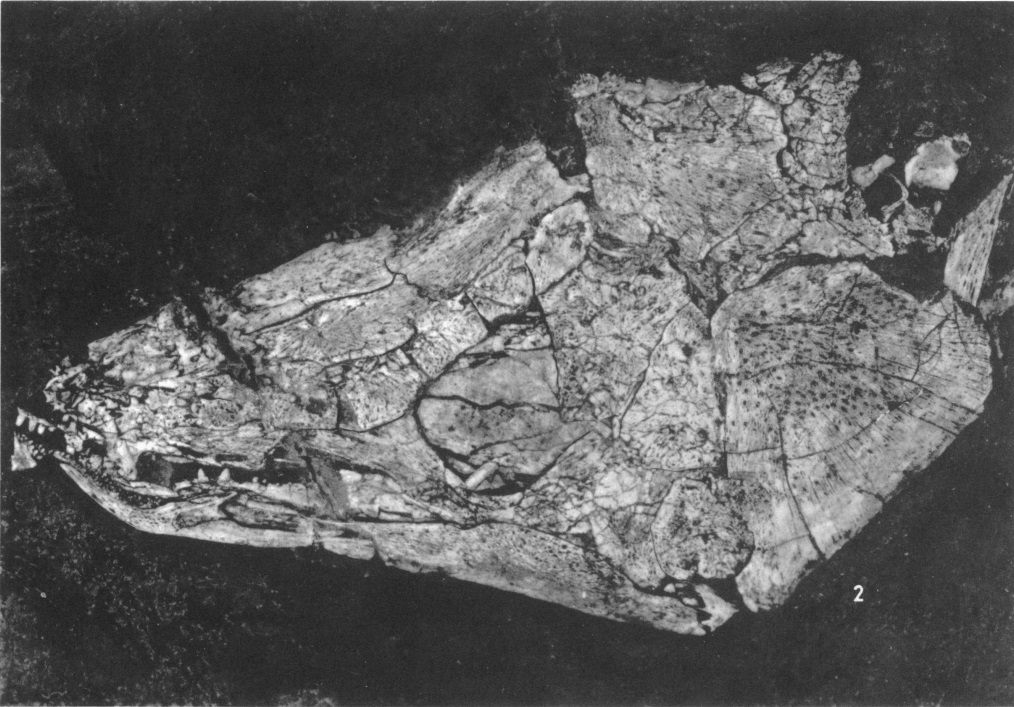
Close-up of the skull of the holotype specimen of Chinlea sorenseni (collection ID code: AMNH 5652). Schaeffer 1967, plate 28.
In addition to fossils found within the late Triassic Chinle Formation, isolated fossils of what might be another species of Chinlea have also been found in Utah within the overlying Moenave Formation. This formation spans from the Rhaetian Stage of the late Triassic Period to the Hettangian Stage of the early Jurassic Period (McCall and Kodama 2014, page 3). According to the National Parks Department, the Moenave Formation dates from 210-195 MYA (“Zion National Park”). The Moenave Formation is divided into two sub-units called “members”. These are the lower Dinosaur Canyon Member and the upper Whitmore Point Member. The Dinosaur Canyon Member comprises the bulk of the Moenave Formation’s thickness within the majority of its geographic range. In fact, at the formation’s type locality, the DCM comprises the entire thickness of the Moenave Formation. It is only within northwestern Arizona and southwestern Utah that the Dinosaur Canyon Member is overlain by another member called the Whitmore Point Member. This member was formed from lacustrine deposits laid down within a very large lake which paleo-geographers have christened Lake Dixie. The coelacanth fossils found within the Whitmore Point member indicate that this was an unusually large coelacanth, possibly measuring 5 feet long, making it one of the largest freshwater fish in Jurassic North America. In fact, the coelacanth bones were so large that they were initially believed to be dinosaur bones (Milner and Kirkland 2006, pages 510, 518; Martz et al. 2017, pages 163-164). In 2020, this animal was given the unofficial name “Chinlea johnsonorum”, named in reference to the Johnson farm where the fossil was discovered, but this name has not yet been officially recognized by the scientific community (“St. George Dinosaur Discovery Site at Johnson Farm: Preserving the Early Jurassic World on the Shores of Lake Dixie”). A partial coelacanth specimen consisting of several skull bones was recently found in Zion National Park within the rocks of the Whitmore Point Member of the Moenave Formation, dated to about 200 MYA at the beginning of the Jurassic Period. It is currently being described by Andrew Milner and Jim Kirkland (“Prehistoric fish fossil unearthed at Zion National Park”).
Isolated coelacanth remains have also been found within the overlying Kayenta Formation, dated to 198-180 MYA. At a place called “Sarah’s Fish Bed” (named after Sarah Gibson who found the site), multiple fish fossils were found including palaeoniscoids, semionotids, and coelacanths. It was reported that a partial coelacanth braincase was found here which might represent a new species. The rock layer that these fossils were found in was situated within the lower part of the Silty Facies Member about 1 meter above the top of the Springdale Sandstone Member, which is the lowermost member of the Kayenta Formation. (Milner et al. 2012, page 90).
Below is my reconstruction of Chinlea sorenseni. The coloration is based upon the Smallmouth Bass (Micropterus dolomieu).
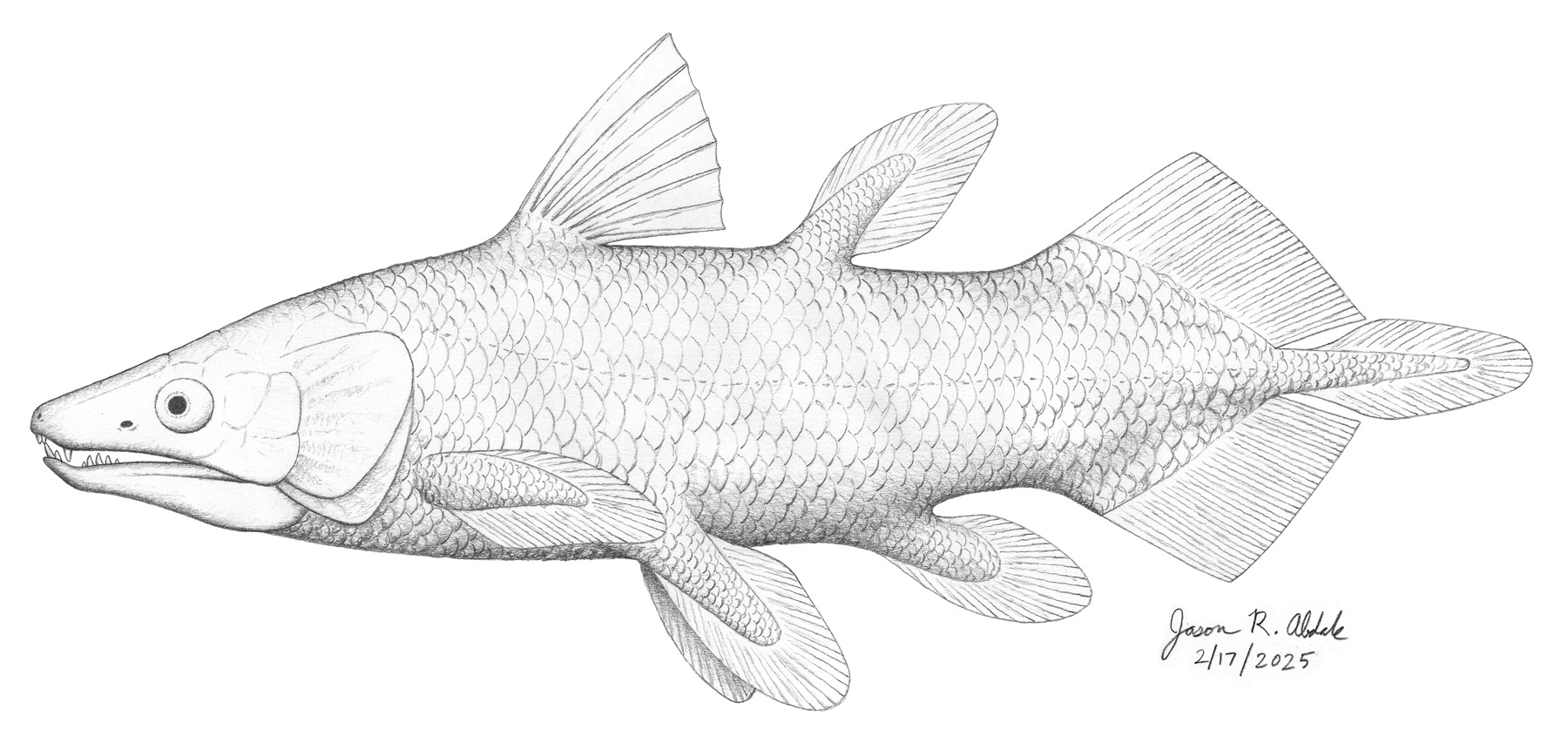
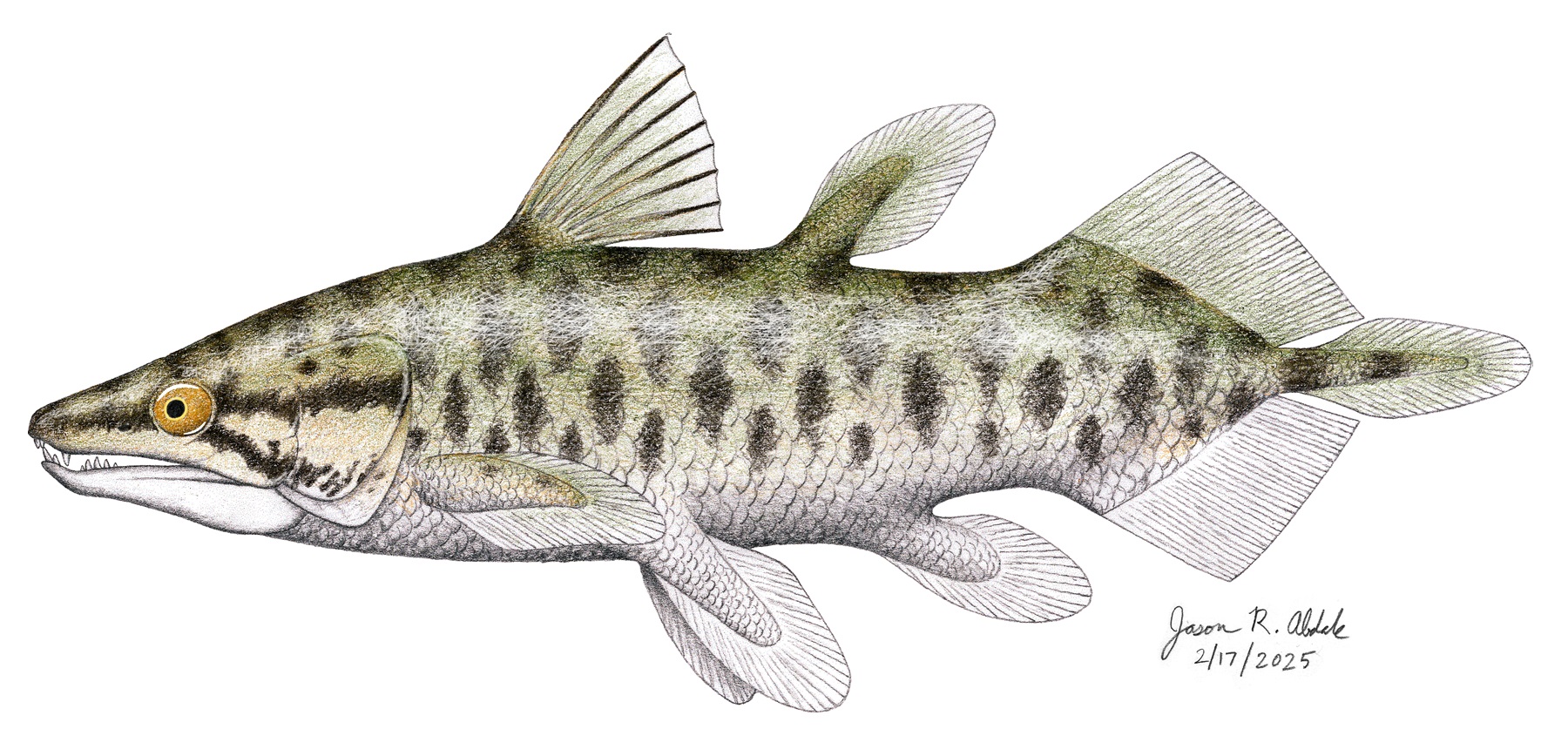
Chinlea sorenseni. © Jason R. Abdale (February 17, 2025).
I truly enjoy writing my articles and drawing my art, but it’s increasingly clear that I can’t keep this up without your gracious financial assistance. Kindly check out my pages on Redbubble and Fine Art America if you want to purchase merch of my artwork. Consider buying my ancient Roman history books Four Days in September: The Battle of Teutoburg and The Great Illyrian Revolt if you or someone that you know loves that topic. Also, please consider becoming a patron on my Patreon page so that I can afford to purchase the art supplies and research materials that I need to keep posting art and articles onto this website.
Take care, and, as always, keep your pencils sharp.
Bibliography
Articles
Cavin, Lionel; Cupello, Camila; Yabumoto, Yoshitaka; Fragoso, Léo Galvão Carnier; Deesri, Uthumporn; Brito, Paulo M. (2019). “Phylogeny and evolutionary history of mawsoniid coelacanths”. Bulletin of the Kitakyushu Museum of Natural History and Human History, volume 17 (March 31, 2019). Pages 3-13.
https://www.researchgate.net/publication/332380486_Phylogeny_and_evolutionary_history_of_mawsoniid_coelacanths.
Elliot, David K. (1987). “A New Specimen of Chinlea sorenseni from the Chinle Formation, Dolores River, Colorado”. Journal of the Arizona-Nevada Academy of Science, volume 22, issue 1 (January 1987). Pages 47-52.
Johnson, Sally C.; Lucas, Spencer G.; Hunt, Adrian P. (2002). “Macro-fish fauna of the upper Triassic (Apachean) Redonda Formation, eastern New Mexico”. New Mexico Museum of Natural History and Science Bulletin, issue 21 (2002). Pages 107-114.
https://books.google.com/books?id=imIfCgAAQBAJ&newbks=0&printsec=frontcover&pg=PA111&dq=Chinlea+sorenseni&hl=en#v=onepage&q=Chinlea%20sorenseni&f=false.
Martz, Jeffrey W.; Kirkland, James I.; Milner, Andrew R. C.; Parker, William G.; Santucci, Vincent L. (2017). “Upper Triassic Lithostratigraphy, Depositional Systems, and Vertebrate Paleontology Across Southern Utah”. Geology of the Intermountain West, volume 4 (2017). Pages 99-180.
https://www.researchgate.net/profile/Andrew-Milner-3/publication/338757482_Upper_Triassic_lithostratigraphy_depositional_systems_and_vertebrate_paleontology_across_southern_Utah/links/60a7e08c299bf1031fbb1428/Upper-Triassic-lithostratigraphy-depositional-systems-and-vertebrate-paleontology-across-southern-Utah.pdf.
Martz, Jeffrey W.; Parker, William G. (2017). “Revised Formulation of the Late Triassic Land Vertebrate ‘Faunachrons’ of Western North America: Recommendations for Codifying Nascent Systems of Vertebrate Biochronology”. In Zeigler, Kate E.; Parker, William G., eds. Terrestrial Depositional Systems: Deciphering Complexities Through Multiple Stratigraphic Methods. Amsterdam: Elsevier, 2017. Pages 39-125.
McCall, Andrea; Kodama, Kenneth P. (2014). “Anisotropy-based inclination correction for the Moenave Formation and Wingate Sandstone: implications for Colorado Plateau rotation”. Frontiers in Earth Science, volume 2, article 15 (July 28, 2014). Page 1-10.
https://www.researchgate.net/publication/273515632_Anisotropy-based_inclination_correction_for_the_Moenave_Formation_and_Wingate_Sandstone_implications_for_Colorado_Plateau_rotation.
Miguel, Raphael; Gallo, Valéria; Morrone, Juan J. (2014). “Distributional patterns of †Mawsoniidae (Sarcopterygii: Actinistia)”. Anais da Academia Brasileira de Ciências, volume 86, issue 1 (January 2014). Pages 159-170.
https://www.researchgate.net/publication/260149514_Distributional_patterns_of_Mawsoniidae_Sarcopterygii_Actinistia.
Milner, Andrew R. C.; Birthisel, Tylor A.; Kirkland, James I.; Breithaupt, Brent H.; Matthews, Neffra A.; Lockley, Martin G., Santucci, Vincent L.; Gibson, Sarah Z.; DeBlieux, Donald D.; Hurlbut, Melinda; Harris, Jerald D.; Olsen, Paul E. (2012). “Tracking Early Jurassic dinosaurs across southwestern Utah and the Triassic Jurassic Transition”. In Bonde, J. W.; Milner, Andrew R. C., eds. Field Trip Guide Book, 71st Annual Meeting of the Society of Vertebrate Paleontology, Las Vegas, Nevada – November 2-5, 2011. Nevada State Museum Paleontological Papers, volume 1. Pages 1-107.
https://www.researchgate.net/publication/265551081_Tracking_Early_Jurassic_dinosaurs_across_southwestern_Utah_and_the_Triassic-Jurassic_Transition.
Milner, Andrew R. C.; Kirkland, James I. (2006). “Preliminary Review of the Early Jurassic (Hettangian) freshwater Lake Dixie Fish Fauna in the Whitmore Point Member, Moenave Formation in Southwest Utah”. New Mexico Museum of Natural History and Science Bulletin, issue 37 (2006). Pages 510-521.
https://www.researchgate.net/publication/40663278_Preliminary_review_of_the_Early_Jurassic_Hettangian_freshwater_Lake_Dixie_fish_fauna_in_the_Whitmore_Point_Member_Moenave_Formation_in_southwest_Utah.
Murry, Phillip A. (1986). “Vertebrate Paleontology of the Dockum Group, Western Texas and Eastern New Mexico”. In Padian, Kevin, ed. The Beginning of the Age of Dinosaurs. Cambridge: Cambridge University Press, 1986. Pages 109-137.
https://www.google.com/books/edition/The_Beginning_of_the_Age_of_Dinosaurs/Npp7EWkJhcwC?hl=en&gbpv=1&bsq=Chinlea.
Schaeffer, Bobb (1967). “Late Triassic Fishes from the western United States”. Bulletin of the American Museum of Natural History, volume 135, article 6 (1967). Pages 322-328.
https://digitallibrary.amnh.org/items/8404895d-0c38-4d35-995e-aa2a7a9126ff.
Schaeffer, Bobb; Gregory, Joseph T. (1961). “Coelacanth fishes from the continental Triassic of the western United States”. American Museum Novitates, number 2036 (July 7, 1961). Pages 1-18.
https://digitallibrary.amnh.org/items/a71ff881-02d6-4e18-b125-9d0ed8597b3b.
Stewart, J. H.; Poole, F. G.; Wilson, R. F. (1972). “Stratigraphy and Origin of the Chinle Formation and Related Upper Triassic Strata in the Colorado Plateau Region”. Geological Survey Professional Paper 690. Washington, DC: United States Government Printing Office, 1972. Pages 1-330.
https://www.google.com/books/edition/Geological_Survey_Professional_Paper/1jJSAQAAIAAJ?hl=en&gbpv=1&dq=chinlea+fish+chinle+formation+member&pg=PA80&printsec=frontcover.
Websites
National Parks Service. “Zion National Park”. https://www.nps.gov/zion/learn/nature/moenave.htm. Accessed on February 19, 2025.
St. George News. “Prehistoric fish fossil unearthed at Zion National Park”, by Stephanie McGraw (October 23, 2023). https://www.stgeorgeutah.com/news/local/prehistoric-fish-fossil-unearthed-at-zion-national-park/article_5885b5c1-adc9-5ab1-922a-19a7c31c0aa1.html. Accessed on February 13, 2025.
Videos
YouTube. Utah Friends of Paleontology. “Jim Kirkland St. George Dinosaur Discovery Talk – ‘St. George Dinosaur Discovery Site at Johnson Farm: Preserving the Early Jurassic World on the Shores of Lake Dixie’” (March 14, 2020). https://www.youtube.com/watch?v=-ngjvqJWwZI. Accessed on March 25, 2022.
Categories: Paleontology, Uncategorized
 DINOSAURS AND BARBARIANS
Leave a comment