
Protosuchus richardsoni was a 3 foot long primitive crocodylomorph which lived in North America during the early Jurassic Period 200-195 million years ago. Fossils of it have been found within the upper part of the Moenave Formation in northern Arizona. Additional specimens which might belong to Protosuchus have also been found within the overlying Kayenta Formation and the Navajo Sandstone Formation, but the remains are fragmentary and their identity is uncertain. Unlike its semi-aquatic relatives, Protosuchus was a terrestrial crocodylomorph. Its strong jaw muscles and forward-facing eyes suggest that it was an active predator, and its long back legs means that it might have ran on its hind legs for short distances. In its early Jurassic environment, it probably occupied the same ecological niche that monitor lizards and small wildcats do today.
In 1930, a Navajo Indian (whose name was apparently never recorded) discovered fossils of what looked like a small crocodile eleven miles northeast of Cameron, Arizona on the Navajo Indian Reservation. This Indian reported this discovery to Hubert Richardson, who owned the trading post in Cameron. Richardson also happened to be friends with the famed paleontologist Barnum Brown, who worked at the American Museum of Natural History in New York City. Richardson sent word to Barnum Brown of this intriguing find, and in June 1931, Brown visited the site and collected five specimens, which were brought back to the AMNH to be analyzed (collection ID codes: AMNH 3024, 3025, 3026, 3027, and 3028). In 1933, Barnum Brown officially named this small reptile Archaeosuchus richardsoni, “Richardson’s ancient crocodile” (Brown 1933, pages 1-4). However, he afterwards learned that the name Archaeosuchus was already taken, having been coined by Robert Broom in 1905 to refer to a mid-Permian dinocephalian therapsid from South Africa; incidentally, the genus Archaeosuchus is nowadays classified as a nomen dubium. So in 1934, Brown re-named the animal from Arizona Protosuchus, “first crocodile”. That same year, Brown returned to the locality where he excavated the five specimens, and he found another two, which he likewise brought back to the AMNH (collection ID codes: AMNH 3056 and 3057) (Brown 1934, page 80; Colbert and Mook 1951, pages 149, 157).

The holotype specimen of Protosuchus richardsoni (collection ID code: AMNH 3024). Brown 1933, page 2.
A total of seven specimens of Protosuchus richardsoni were excavated by Barnum Brown in the 1930s. Then in 1941, Samuel P. Welles of the University of California Museum of Paleontology visited the same locality, and he found an eighth specimen (collection ID code: UCMP 36717) (Colbert and Mook 1951, pages 149, 157). Then a ninth specimen was found in 1979 at a place called Tonahakaad Wash in Coconino County, Arizona consisting of a well-preserved skull and portions of the rest of the body (collection ID code: MCZ 6727) (“MNA 79/2A Protosuchus locality, UCMP V84245 (Triassic to of the United States)”). Considering that most prehistoric animals are known from only one or two specimens, having nine is a real boon for paleontologists who can study the animal’s anatomy and make deductions about where it fits in the reptilian tree. Since the seven specimens uncovered by Brown were found within a small area, this indicates that Protosuchus was relatively common in its environment and that it also tended to congregate like modern-day crocodilians or Komodo Dragons today.
Barnum Brown initially believed that the rocks which these fossils were found in belonged to the Chinle Formation which dates to the late Triassic Period (Brown 1933, page 1). However, examination of the locality by Edwin H. Colbert and Charles Mook in 1949 showed that the rocks in this area actually date to the early Jurassic Period. The following year in 1950, Joseph Callahan of the University of Arizona further refined this date when he reported that the strata that the Protosuchus fossils were found in belonged to the Kayenta Formation (Colbert and Mook 1951, pages 149, 151-152, 154). This was reiterated by Samuel P. Welles in 1954. However, Welles stated that the Kayenta directly overlies the Chinle in Arizona (Welles 1954, page 591), which is incorrect – it actually overlies the Moenave Formation, so Welles’ assessment is not reliable. In 2005, Spencer Lucas and his colleagues stated that the fossils of Protosuchus richardsoni which were discovered eleven miles northeast of Cameron, Arizona were situated within the upper part of the Dinosaur Canyon Member of the Moenave Formation (Lucas et al. 2005, pages 95-96).
The Moenave Formation, named after the village of Moenave, Arizona where the rocks were first classified, is a trans-period geologic formation, spanning from the Rhaetian Stage of the late Triassic Period to the Hettangian Stage of the early Jurassic Period, from about 210-195 MYA (McCall and Kodama 2014, page 3; “Zion National Park”). The Moenave Formation is divided into two sub-units called “members”. These are the lower Dinosaur Canyon Member and the upper Whitmore Point Member. The Dinosaur Canyon Member comprises the bulk of the Moenave Formation’s thickness within the majority of its geographic range. In fact, at the formation’s type locality, the Dinosaur Canyon Member comprises the entire thickness of the Moenave Formation. It is only within northwestern Arizona and southwestern Utah that the Dinosaur Canyon Member is overlain by another member called the Whitmore Point Member. This member was formed from sediments deposited at the bottom of a very large lake which paleo-geographers have christened Lake Dixie (Tanner and Lucas 2009, page 13). Since the area where the Protosuchus specimens were found was in a region where the Whitmore Point Member isn’t present, and since the Dinosaur Canyon Member takes up the entire breadth of the thickness of the Moenave Formation in that area, and since Spencer Lucas and his colleagues stated that the fossils were found within the upper part of the Dinosaur Canyon Member, it therefore follows that these fossils date to the latter part of the formation’s timespan, to the Hettangian Stage of the early Jurassic Period, sometime between 200-195 MYA.
In addition to the fossils from the Moenave Formation, Spencer Lucas and his colleagues stated that fossils of Protosuchus richardsoni have also been found within the overlying Kayenta Formation, and possibly within the Navajo Sandstone, which overlies the Kayenta Formation (Lucas et al. 2005, page 95-96). The Kayenta Formation, named after the town of Kayenta, Arizona, dates to the Sinemurian and Pliensbachian Stages of the early Jurassic Period (Padian 1989, page 438), about 195-180 MYA. This formation is likewise divided into members including the lower Springdale Sandstone Member (Lucas and Tanner 2006, pages 71-76; Milner et al. 2012, page 90), the Typical Facies Member, and the Silty Facies Member. The Typical Facies is seen in northeastern Arizona and southeastern Utah, while the Silty Facies is seen in north-central Arizona and southwestern Utah (Marsh et al. 2024, page 45). In 1958, a short abstract by G. E. Lewis was published stating that Protosuchus is known from the upper part of the Kayenta Formation in Arizona, but no further information was given (Lewis 1958, page 1,735). A report published in 1986 by James Clark and David Fastovsky provided more information on this find, stating that a partial specimen ascribed to Protosuchus was found near the town of Kayenta, the type locality of the Kayenta Formation, and that the fossils were found near the top of the Kayenta Formation’s strata, just three meters below its contact with the overlying Navajo Sandstone. In the 1986 report, it states that the crocodylomorph specimen is housed in the collections of the US Geological Survey in Denver, Colorado, but neither a collection ID code nor a description of the specimen were provided. However, Clark and Fastovsky stated that the specimen is not complete enough to properly diagnose it at the genus level, so it either may or may not belong to Protosuchus (Clark and Fastovsky 1986, page 289). Further comparative analysis of the specimen is needed to determine its identity.
Finally, at least one specimen which might belong to Protosuchus was uncovered from the Navajo Sandstone. The Navajo Sandstone is believed to represent a vast desert of heaving sand dunes measuring hundreds of square miles in area (Camp 1936, page 40). Most professional papers which address the Navajo Sandstone broadly state that it dates to the early Jurassic Period, but exact dates are seldomly given. In 1989, Kevin Padian stated that the Navajo Sandstone dates to the Pliensbachian and Toarcian Stages of the early Jurassic Period (Padian 1989, page 438). In 2005, Spencer Lucas and his colleagues stated that the Navajo Sandstone dated to approximately 195-174 MYA (Lucas et al. 2005, page 100). In 2019, Judith Parrish and her colleagues stated that the beginning of the formation dates to around 200-195 MYA, but they couldn’t narrow it down further (Parrish et al. 2019, page 1,017). The general dates of approximately 200-174 MYA are concurrent with both the Moenave Formation (210-195 MYA) and the Kayenta Formation (198-180 MYA), and finally overlies the Kayenta Formation. In fact, the lower part of the Navajo Sandstone inter-fingers the upper part of the underlying Kayenta Formation (Parrish et al. 2019, page 1,015), indicating times when the desert expanded southwards and inundated the lands of the Kayenta Formation, and then retreated. This back-and-forth advance-and-retreat of the desert apparently occurred several times until the desert expanded southwards to such an extent that it swallowed up the Kayenta Formation completely. A fragmentary specimen consisting of some dorsal scutes and a partial right foot (collection ID code: UCMP 61229) was collected by Charles Camp at Cobra Head Canyon, which is a branch of Tsegi Canyon. The rocks here belong to the Navajo Sandstone Formation, and the fossils were found in the same stratigraphic layer that the holotype of Segisaurus was found in. In 1971, Peter M. Galton classified this specimen as Protosuchus, but he didn’t give a species name (Galton 1971, pages 785-786). However, James Clark and David Fastovsky noted that the handful of remains uncovered at Tsegi Canyon were similar to the scutes and foot bones of other crocodylomorphs found within the Kayenta Formation, and therefore the specimen from the Navajo Sandstone cannot be identified with certainty (Clark and Fastovsky 1986, page 290).

Protosuchus specimens from the Navajo Sandstone Formation (collection ID code: UCMP 61299). A) dorsal scutes of dermal armor from about cervical segments 6 to 9. B) right pes in dorsal view. Galton 1971, page 785.
Protosuchus was made the eponymous member of its own family, Protosuchidae, by Barnum Brown in 1934 (Brown 1934, page 80), which has since grown to encompass numerous primitive crocodylomorph genera. The holotype specimen of Protosuchus richardsoni measured approximately 32 inches long, and Colbert and Mook postulated that it likely never exceeded 3 feet in length. The skull measured 4 inches long. The back of the skull was wide, but the snout was narrow, and the eyes faced forwards at approximately a 45 degree angle giving it stereoscopic vision – good for an active predator. Most of the teeth were small, but one of the incisors in the upper jaw and the canine in the lower jaw were noticeably larger. Like many early crocodylomorphs, Protosuchus had a double row of rectangular scutes running down the middle of its back from the base of the skull to the tip of the tail. The scutes overlaid the vertebrae beneath them, and the row of scutes in front slightly overlapped the row behind, like roof shingles. The lateral ends of these scutes terminated in a small raised ridge. Additionally, there were smaller square scutes covering its belly and lining the underside of the tail. The humerus was slightly longer than the radius and ulna, and the hand had five fingers. The femur was slightly longer than the tibia and fibula, but the back leg as a whole was substantially longer than the front leg. The heel had an enlarged calcaneum and astragalus to accommodate enlarged flexor tendons. There were four toes on each foot, with somewhat elongated metatarsal bones. The foot as a whole was twice the size of the hand. The total structure of the hind limb suggests that Protosuchus had a digitigrade stance, unlike modern crocodilians which are plantigrade. Indeed, Colbert and Mook suggested that Protosuchus might have walked on all fours but was capable of running on only its hind legs (Colbert and Mook 1951, pages 151-174, figures 3 and 4). Several species of modern lizards including the Australian Frilled Lizard (Chlamydosaurus kingii), the Common Basilisk Lizard (Basiliscus basiliscus), and the Common Collared Lizard (Crotaphytus collaris) are also capable of running on only their back legs for short periods of time.
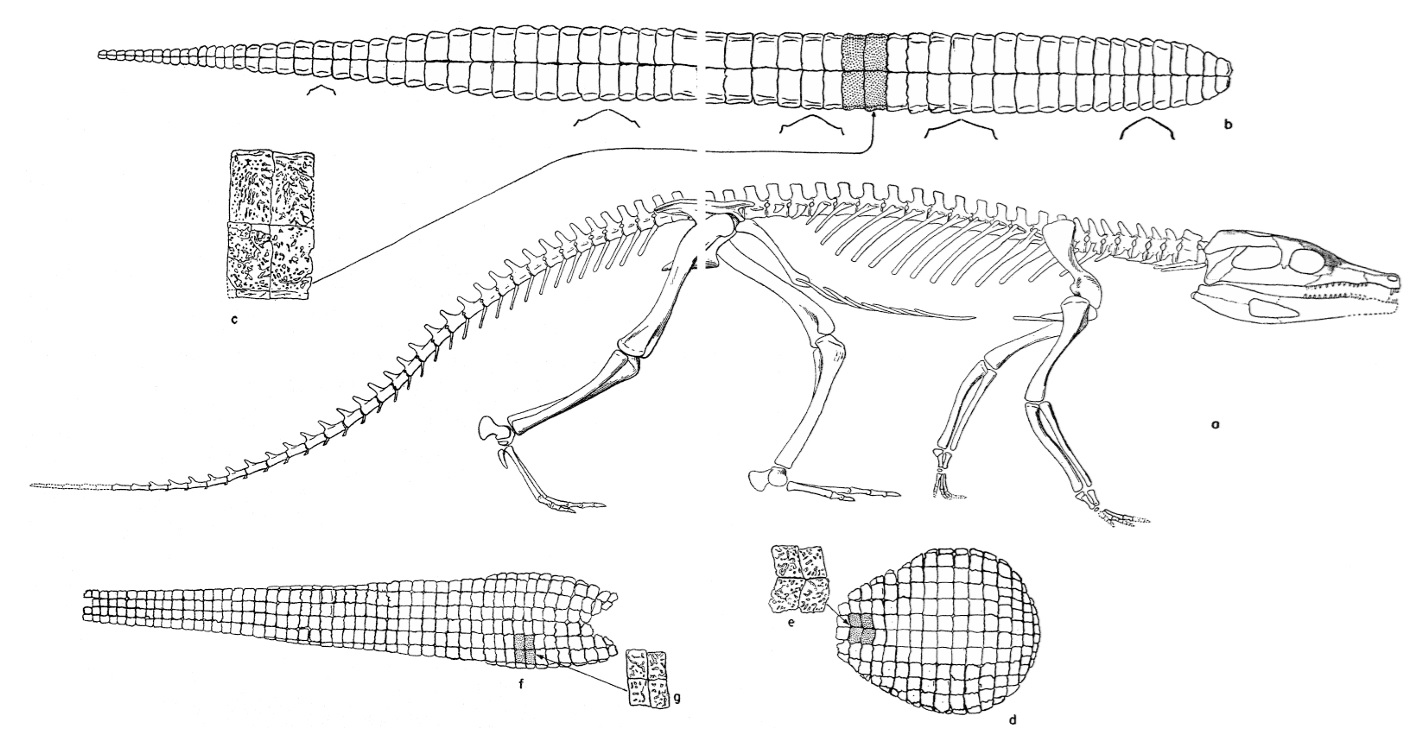
Skeleton of Protosuchus richardsoni showing the position and arrangement of the rectangular dorsal scutes and the smaller square scutes on the underside of its belly and tail. Colbert and Mook 1951, figure 4.


Skull of Protosuchus richardsoni from Tonahakaad Wash, Coconino County, Arizona (collection ID code: MCZ 6727). Note the enlarged incisors in the upper jaw and the enlarged canine in the lower jaw. Photos by Dr. Jim Kirkland (September 9, 2022). https://x.com/Paleojim/status/1568351745298022400. Images used with permission.


Protosuchus richardsoni. © Jason R. Abdale (February 24, 2025).
Protosuchus didn’t just inhabit the American Southwest. In 1984, Arthur B. Busbey III and Christopher Gow gave the name Baroqueosuchus haughtoni to a crocodylomorph (collection ID code: BP-1-4746) found in the upper part of the Elliot Formation of South Africa, 187-173 MYA (Busbey III and Gow 1984, pages 127-149). In 2000, it was decided that this animal was actually an African species of Protosuchus, so it was re-named to Protosuchus haughtoni (Gow 2000, pages 49-56).
In 1996, another species, Protosuchus micmac, was named from the Brook Formation of Nova Scotia within strata dated to the Hettangian Stage of the early Jurassic, about 200 MYA. Protosuchus micmac is one of the most common species within the formation, similar to how Protosuchus richardsoni is one of the most common species in the Moenave Formation (Sues et al. 1996, pages 34-41; Olsen et al. 2005, pages 29-30, 32).
Considering the wide geographic distribution of the three species to each other, it’s very likely that Protosuchus inhabited a large swath of western Pangaea during its initial phase of breakup in the early Jurassic Period. It’s probable that fossils of Protosuchus may also be found in other early Jurassic deposits in North America, South America, Europe, and Africa. Some formations worth looking at are the Portland Formation of Massachusetts and Connecticut, the La Boca Formation of Tamaulipas, Mexico, and the Charmouth Mudstone Formation of England.
In addition to body fossils, we might have fossilized footprints belonging to Protosuchus or possibly to another species closely related to it. Many times, we cannot tell which species of animal made a footprint, so paleontologists give separate names to footprint fossils than to physical body fossils. This footprint shape is ascribed the name Batrachopus, which rather oddly means “frog foot”. These footprints have been uncovered from the Whitmore Point Member of the Moenave Formation and are believed to represent a small primitive crocodylomorph like Protosuchus (“St. George Dinosaur Discovery Site at Johnson Farm: Preserving the Early Jurassic World on the Shores of Lake Dixie”).
I truly enjoy writing my articles and drawing my art, but it’s increasingly clear that I can’t keep this up without your gracious financial assistance. Kindly check out my pages on Redbubble and Fine Art America if you want to purchase merch of my artwork. Consider buying my ancient Roman history books Four Days in September: The Battle of Teutoburg and The Great Illyrian Revolt if you or someone that you know loves that topic. Also, please consider becoming a patron on my Patreon page so that I can afford to purchase the art supplies and research materials that I need to keep posting art and articles onto this website.
Take care, and, as always, keep your pencils sharp.
Bibliography
Articles
Brown, Barnum (1933). “An Ancestral Crocodile”. American Museum Novitates, number 638 (June 29, 1933). Pages 1-4.
https://digitallibrary.amnh.org/items/6c29a7a9-e39f-4b8c-80ec-aac422da6b71.
Brown, Barnum (1934). “A change of names”. Science, volume 79, number 2039 (1934). Page 80.
https://www.science.org/doi/10.1126/science.79.2039.80.a.
Busbey III, Arthur B.; Gow, Chris (1984). “A new protosuchian crocodile from the Upper Triassic Elliot Formation of South Africa”. Palaeontologia Africana, volume 25 (1984). Pages 127-149.
https://core.ac.uk/download/pdf/39674735.pdf.
Camp, Charles L. (1936). “A new type of small bipedal dinosaur from the Navajo sandstone of Arizona”. University of California Publications in Geological Sciences, volume 24, issue 2 (1936). Pages 39-56.
https://azmemory.azlibrary.gov/nodes/view/126405.
Clark, James M.; David E. Fastovsky (1986). “Vertebrate biostratigraphy of the Glen Canyon Group in northern Arizona”. In Padian, Kevin, ed. The Beginning of the Age of Dinosaurs: Faunal Change across the Triassic-Jurassic Boundary. Cambridge: Cambridge University Press, 1986. Pages 285-302.
Colbert, Edwin Harris; Mook, Charles Craig (1951). “The ancestral crocodilian Protosuchus”. Bulletin of the American Museum of Natural History, volume 97, article 3 (July 2, 1951). Pages 145-182.
https://digitallibrary.amnh.org/items/20006d1a-ab4a-4bf0-8508-274e74de6930.
Galton, Peter M. (1971). “The prosauropod dinosaur Ammosaurus, the crocodile Protosuchus, and their bearing on the age of the Navajo Sandstone of northeastern Arizona”. Journal of Paleontology, volume 45, issue 5 (September 1971). Pages 781-795.
https://www.jstor.org/stable/1302773.
Gow, C. E. (2000). “The Skull of Protosuchus haughtoni, an Early Jurassic Crocodyliform from Southern Africa”. Journal of Vertebrate Paleontology, volume 20, issue 1 (March 1, 2000). Pages 49-56.
Lewis, G. E. (1958). “American Triassic mammal-like vertebrates”. Bulletin of the Geological Society of America, volume 69, issue 12, part 2 – Abstracts of papers submitted for the meeting in Golden, Colorado, May 8-10, 1958 (Rocky Mountain Section GSA) (December 1958). Page 1,735.
https://archive.org/details/sim_geological-society-of-america-bulletin_1958-12_69_12/page/1735/mode/1up.
Lucas, Spencer G.; Heckert, Andrew B.; Tanner, Lawrence H. (2005). “Arizona’s Jurassic Fossil Vertebrates and the Age of the Glen Canyon Group”. New Mexico Museum of Natural History and Science Bulletin, issue 29 (2005). Pages 94-103.
https://books.google.com/books?hl=en&lr=&id=dPj5CQAAQBAJ&oi=fnd&pg=PA94&dq=navajo+toarcian+age&ots=C6Su_2zTyO&sig=m_nS5eFPzHSFudBmZ0nzH84IpkQ#v=onepage&q=navajo%20toarcian%20age&f=false.
Lucas, Spencer G.; Tanner, Lawrence H. (2006). “The Springdale Member of the Kayenta Formation, Lower Jurassic of Utah-Arizona”. New Mexico Museum of Natural History and Science Bulletin, issue 37 (2006). Pages 71-76.
https://www.researchgate.net/publication/281624884_The_Springdale_member_of_the_Kayenta_Formation_Lower_Jurassic_of_Utah-Arizona.
Marsh, Adam D.; DeBlieux, Donald D.; Kirkland, James I. (2024). “The first dinosaur postcranial body fossils from the Lower Jurassic Kayenta Formation of Utah”. Geology of the Intermountain West, volume 11 (August 2024). Pages 45-57.
https://www.researchgate.net/publication/383208638_The_first_dinosaur_postcranial_body_fossils_from_the_Lower_Jurassic_Kayenta_Formation_of_Utah/.
McCall, Andrea; Kodama, Kenneth P. (2014). “Anisotropy-based inclination correction for the Moenave Formation and Wingate Sandstone: implications for Colorado Plateau rotation”. Frontiers in Earth Science, volume 2, article 15 (July 28, 2014). Page 1-10.
https://www.researchgate.net/publication/273515632_Anisotropy-based_inclination_correction_for_the_Moenave_Formation_and_Wingate_Sandstone_implications_for_Colorado_Plateau_rotation.
Olsen, Paul E.; Whiteside, Jessica H.; Fedak, Timothy (2005). “Triassic-Jurassic Faunal and Floral Transition in the Fundy Basin, Nova Scotia”. North American Paleontology Conference – Halifax, Nova Scotia. June 19-26, 2005. Pages 1-52.
https://www.ldeo.columbia.edu/~polsen/nbcp/NAPC_new_sm.pdf.
Padian, Kevin (1989). “Presence of dinosaur Scelidosaurus indicates Jurassic age for the Kayenta Formation (Glen Canyon Group, northern Arizona)”. Geology, volume 17, issue 5 (May 1989). Pages 438-441.
https://pubs.geoscienceworld.org/gsa/geology/article-abstract/17/5/438/204877/Presence-of-the-dinosaur-Scelidosaurus-indicates?redirectedFrom=fulltext.
Parrish, Judith Totman; Rasbury, E. T.; Chan, Marjorie A.; Hasiotis, Stephen T. (2019). “Earliest Jurassic U-Pb ages from carbonate deposits in the Navajo Sandstone, southeastern Utah, USA”. Geology, volume 47, issue 11 (September 4, 2019). Pages 1,015-1,019.
https://pubs.geoscienceworld.org/gsa/geology/article/47/11/1015/573442/Earliest-Jurassic-U-Pb-ages-from-carbonate.
Sues, Hans-Deiter; Shubin, Neil H.; Olsen, Paul E.; Amarel, W. W. (1996). “On the cranial structure of a new protosuchid (Archosauria: Crocodyliformes) from the McCoy Brook Formation (Lower Jurassic) of Nova Scotia, Canada”. Journal of Vertebrate Paleontology, volume 16, issue 1 (March 19, 1996). Pages 34-41.
https://www.jstor.org/stable/4523689.
Tanner, Lawrence H.; Lucas, Spencer G. (2009). “The Whitmore Point Member of the Moenave Formation: Early Jurassic Dryland Lakes on the Colorado Plateau, Southwestern USA”. Volumina Jurassica, volume 6 (January 2009) Pages 11-21.
https://www.researchgate.net/publication/242126605_The_Whitmore_Point_Member_of_the_Moenave_Formation_Early_Jurassic_Dryland_Lakes_on_the_Colorado_Plateau_Southwestern_USA.
Welles, Samuel P. (1954). “New Jurassic Dinosaur from the Kayenta Formation of Arizona”. Bulletin of the Geological Society of America, volume 65, issue 6 (June 1, 1954). Pages 591-598.
https://pubs.geoscienceworld.org/gsa/gsabulletin/article-abstract/65/6/591/4633/NEW-JURASSIC-DINOSAUR-FROM-THE-KAYENTA-FORMATION?redirectedFrom=fulltext.
Websites
National Parks Service. “Zion National Park”. https://www.nps.gov/zion/learn/nature/moenave.htm. Accessed on February 19, 2025.
Paleobiology Database. “MNA 79/2A Protosuchus locality, UCMP V84245 (Triassic to of the United States)”. https://paleobiodb.org/classic/basicCollectionSearch?collection_no=46392&is_real_user=1. Accessed on March 1, 2025.
Videos
YouTube. Utah Friends of Paleontology. “Jim Kirkland St. George Dinosaur Discovery Talk – ‘St. George Dinosaur Discovery Site at Johnson Farm: Preserving the Early Jurassic World on the Shores of Lake Dixie’” (March 14, 2020). https://www.youtube.com/watch?v=-ngjvqJWwZI. Accessed on March 25, 2022.
Categories: Paleontology, Uncategorized
 DINOSAURS AND BARBARIANS
Leave a comment