
Sarcosaurus was a 10-12 foot long meat-eating dinosaur which lived in England during the beginning of the Jurassic Period about 198 million years ago.
In the early years of the 20th Century, some fossil bones were discovered by S. L. Wood near the village of Barrow-on-Soar in Leicestershire, England. The remains included a single posterior dorsal vertebra, a partial left ilium, a partial right ilium, and the upper part of a right femur (collection ID code: BMNH 4840/1). These fossils were situated within the Scunthorpe Mudstone Formation which spans the Triassic/Jurassic boundary from 205-195 MYA. The stratum which these bones were found in dates to the earliest part of the Sinemurian Stage of the early Jurassic Period approximately 198 MYA (Ezcurra et al. 2021, page 118). The British paleontologist Charles William Andrews (October 30, 1866 –May 25, 1924) examined these bones and determined that they belonged to a meat-eating dinosaur. In 1921, he officially named this animal Sarcosaurus woodi, “Wood’s flesh lizard” in reference to the animal’s carnivorous diet (Andrews 1921, pages 570-576).
Other fragmentary remains which either may or may not belong to Sarcosaurus have been found in other locations within England as well as in northern Ireland and Luxembourg. During the late 19th Century, a single tooth (collection ID code: NHMUK OR 41352, formerly BMNH 41352) was discovered in Lyme Regis, Dorset within the rocks of the Lower Lias. This single tooth was ascribed the name Zanclodon (Lydekker 1888, page 173), but is now assigned to the mid-Jurassic megalosaur Magnasaurus (“Magnasaurus non”). However, since the tooth dates to early Jurassic, it might actually belong to Sarcosaurus. An isolated tibia (collection ID code: NHMUK PV R3542, formerly BMNH R3542) was found in Wilmcote, Warwickshire (Woodward 1908, pages 257-259; Von Huene 1932, page 361), and a fragmentary skeleton was found in the same area consisting of two legs, a partial pubis, a dorsal vertebra, a tail vertebra, and a few fragmentary ribs (collection ID code: WARMS G667–690) (Ezcurra et al. 2021, pages 113-149). Most recently in the late 20th Century, a partial tibia (collection ID code: BELUM K12493) was found in County Antrim in northern Ireland which might belong to Sarcosaurus (Simms et al. 2021, pages 771-779). Additionally, a single toe bone and a single tooth were found in Luxembourg with either may or may not belong to Sarcosaurus (Delsate and Ezcurra 2014, pages 175-181).
During the beginning of the Jurassic Period, the area of England where Sarcosaurus lived lay along the coast of a warm semi-tropical sea. Bones belonging to the ichthyosaur Wahlisaurus (Lomax 2017, pages 387-401) and large numbers of seashells (especially those belonging to the oyster Gryphaea and the ammonite Psiloceras planorbis) have been found in the same rock layers (Harrison 1877, pages 38-39; Trueman 1918, page 67; Radley 2008, pages 107-112). It’s also possible that Sarcosaurus lived alongside other early Jurassic British dinosaurs such as the 12 foot long armored dinosaur Scelidosaurus, the 10 foot long coelophysid theropod Dracoraptor, and the 18 foot long basal tetanuran theropod Dornraptor.
Due to the fragmentary nature of the remains, attempts to discern where Sarcosaurus fits into the dinosaur tree have been difficult. In 1921, Charles William Andrews stated that it belonged to the family Megalosauridae (Andrews 1921, pages 570, 575), but then again, this family and the genus Megalosaurus specifically were treated by paleontologists as “waste basket taxa” for many years. In 1984, Samuel P. Welles hypothesized that Sarcosaurus was a relative of Coelophysis (Welles 1984). In 1986, Jacques Gauthier stated that Sarcosaurus belonged somewhere within the large group Ceratosauria, but he couldn’t narrow it down further to a specific family (Gauthier 1986, page 9). In 2012, Martin Ezcurra stated that Sarcosaurus was a basal ceratosaur, possibly the most primitive ceratosaurian known up to that point (Ezcurra 2012, page 91). In 2018, Cristiano Dal Sasso and colleagues said that Sarcosaurus was a close relative of Dilophosaurus and Cryolophosaurus (Dal Sasso et al. 2018: e5976). In 2021, Martin Ezcurra and his colleagues stated that Sarcosaurus was more advanced than Dilophosaurus but not as advanced as the ceratosaurians (Ezcurra et al. 2021, page 141). The only way that we can get a better handle on where Sarcosaurus cladistically fits is to find more bones, so get out there and start digging!
Because Sarcosaurus is known from only a handful of bones, much of its appearance is subject to artistic interpretation. While paleo-art reconstructions from the 1980s to the early 2000s depict Sarcosaurus as a ceratosaur, often shown sporting a rudimentary nasal horn, more recent reconstructions give it a more lithe limber Coelophysis-like appearance. My own reconstruction which you see below is based upon Dilophosaurus.
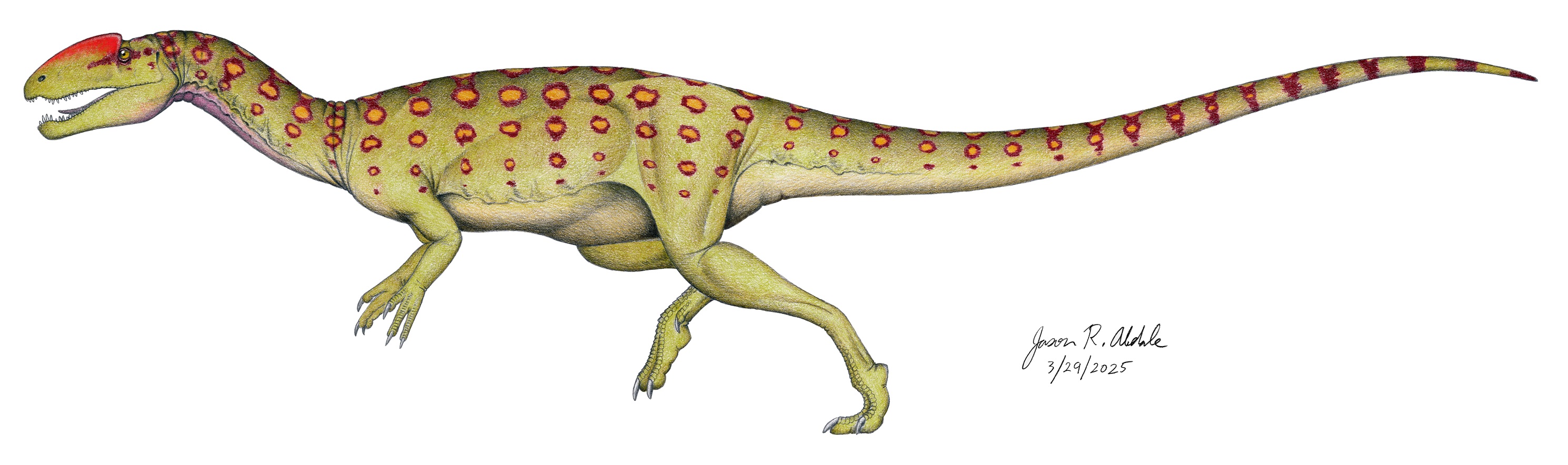
Sarcosaurus woodi. © Jason R. Abdale (March 29, 2025).
I truly enjoy writing my articles and drawing my art, but it’s increasingly clear that I can’t keep this up without your gracious financial assistance. Kindly check out my pages on Redbubble and Fine Art America if you want to purchase merch of my artwork. Consider buying my ancient Roman history books Four Days in September: The Battle of Teutoburg and The Great Illyrian Revolt if you or someone that you know loves that topic. Also, please consider becoming a patron on my Patreon page so that I can afford to purchase the art supplies and research materials that I need to keep posting art and articles onto this website.
Take care, and, as always, keep your pencils sharp.
Bibliography
Books
Harrison, William Jerome. A Sketch of the Geology of Leicestershire and Rutland. Sheffield: William White, 1877.
https://www.google.com/books/edition/A_Sketch_of_the_Geology_of_Leicestershir/FX4yAQAAMAAJ?hl=en&gbpv=1.
Lydekker, Richard. Catalogue of the Fossil Reptilia and Amphibia in the British Museum, Part 1. London: British Museum, 1888. Page 173, figure 28.
https://www.google.com/books/edition/Catalogue_of_the_Fossil_Reptilia_and_Amp/Qjd1JPjB2FwC?hl=en&gbpv=1&bsq=41352.
Articles
Andrews, Charles W. (1921). “On some Remains of a Theropodous Dinosaur from the Lower Lias of Barrow-on-Soar”. The Annals & Magazine of Natural History, volume 8, issue 47 (November 1921). Pages 570-576.
https://www.google.com/books/edition/The_Annals_Magazine_of_Natural_History/QROQYDwZiJkC?hl=en&gbpv=1&dq=Sarcosaurus&pg=PA575&printsec=frontcover.
Dal Sasso, Cristiano; Maganuco, Simone; Cau, Andrea (2018). “The oldest ceratosaurian (Dinosauria: Theropoda), from the Lower Jurassic of Italy, sheds light on the evolution of the three-fingered hand of birds”. PeerJ, volume 6: e5976 (December 19, 2018).
https://peerj.com/articles/5976/.
Delsate, Dominique; Ezcurra, Martin D. (2014). “The first Early Jurassic (late Hettangian) theropod dinosaur remains from the Grand Duchy of Luxembourg”. Geologica Belgica, volume 17, issue 2 (2014). Pages 175-181.
https://mnhn.lu/wp-content/uploads/2014/03/ULG-GEOLOGICA-VOL-17-2-DELSATE-P175-181-1-2-2.pdf.
Ezcurra, Martin D. (2012). “Phylogenetic analysis of Late Triassic–Early Jurassic neotheropod dinosaurs: Implications for the early theropod radiation”. Journal of Vertebrate Paleontology, 72nd Annual Meeting Program and Abstracts (October 17-20, 2012). Pages 1-207.
https://vertpaleo.org/wp-content/uploads/2021/04/SVP-Abstract-Book_12_web.pdf.
Ezcurra, Martin D.; Butler, Richard J.; Maidment, Susannah C. R.; Sansom, Ivan J.; Meade, Luke E.; Radley, Jonathan D. (2021). “A revision of the early neotheropod genus Sarcosaurus from the Early Jurassic (Hettangian–Sinemurian) of central England”. Zoological Journal of the Linnean Society, volume 191, issue 1 (January 2021). Pages 113-149.
https://academic.oup.com/zoolinnean/article/191/1/113/5861188.
Gauthier Jacques A. (1986). “Saurischian monophyly and the origin of birds”. Memoirs of the California Academy of Science, volume 8, issue 1 (1986). Pages 1-55.
https://www.biodiversitylibrary.org/page/15651737#page/287/mode/1up.
Lomax, Dean R. (2017). “A new leptonectid ichthyosaur from the Lower Jurassic (Hettangian) of Nottinghamshire, England, UK, and the taxonomic usefulness of the ichthyosaurian coracoid”. Journal of Systematic Palaeontology, volume 15, issue 5 (May 4, 2017). Pages 387-401.
Radley, J. D. (2008). “Gryphaea beds (upper Scunthorpe Mudstone Formation; Lower Jurassic) at Scunthorpe, North Lincolnshire, north-east England”. Proceedings of the Yorkshire Geological Society, volume 57, issue 2 (November 2008). Pages 107-112.
Simms, Michael J.; Smyth, Robert S. H.; Martill, David M.; Collins, Patrick C.; Byrne, Roger (2021). “First dinosaur remains from Ireland”. Proceedings of the Geologists’ Association, volume 132, issue 6 (December 2021). Pages 771-779.
Trueman, A. E. (1918). “The Lias of South Lincolnshire”. The Geological Magazine, volume 5, issue 2 (February 1918). Pages 64-73.
https://www.google.com/books/edition/Geological_Magazine/ajrzAAAAMAAJ?hl=en&gbpv=1.
Von Huene, Baron Frederick (1932). “Die fossile Reptil-Ordnung Saurischia, ihre Entwicklung und Geschichte”. Monographien zur Geologie und Paläontologie, volume 1, issue 4. Page 361.
Von Huene, Baron Frederick (1926). “On several known and unknown reptiles of the order Saurischia from England and France”. The Annals & Magazine of Natural History, volume 17, issue 101 (May 1926). Pages 473-489.
https://www.google.com/books/edition/The_Annals_and_Magazine_of_Natural_Histo/1WejAedvJT0C?hl=en&gbpv=1.
Welles, Samuel P. (1984). “Dilophosaurus wetherilli (Dinosauria, Theropoda): Osteology and comparisons”. Palaeontographica Abteilung A., volume 185 (November 1984). Pages 85-180.
Woodward, Arthur S. (1908). “Note on a Megalosaurian tibia from the lower Lias of Wilmcote, Warwickshire”. The Annals & Magazine of Natural History, volume 1, issue 3 (March 1908). Pages 257-259.
https://www.google.com/books/edition/The_Annals_Magazine_of_Natural_History/nEe0h1yp_68C?hl=en&gbpv=1&dq=Note+on+a+Megalosaurian+tibia+from+the+lower+Lias+of+Wilmcote,+Warwickshire&pg=PA257&printsec=frontcover.
Websites
Paleofile. “Magnasaurus non”. http://www.paleofile.com/Dinosaurs/Theropods/Magnosaurusnon.asp. Accessed on March 28, 2025.
Categories: Paleontology, Uncategorized
 DINOSAURS AND BARBARIANS
Leave a comment