
Ichthyosaurus, the quintessential prehistoric reptilian dolphin analog, was a marine reptile which lived in the seas around England during the early Jurassic Period approximately 200-190 million years ago. The first fossils were discovered in 1814 by Mary Anning in Lyme Regis, Dorset, England. In 1821, Henry De La Beche and William Conybeare named it Ichthyosaurus, “the fish lizard”.
Over the years, several species have been ascribed to the genus Ichthyosaurus. At one time, the genus contained over fifty different species! However, most of these were eventually reclassified as different genera. At present, only six species are still considered valid (arranged according to date):
- I. breviceps – 6 feet long; Hettangian Stage, 200-198 MYA.
- I. larkini – 8 feet long; Hettangian Stage 200-198 MYA.
- I. somersetensis – 10 feet long; Hettangian Stage, 200-198 MYA.
- I. communis (type species) – 6 feet long; Hettangian Stage to lower Sinemurian Stage 200-196 MYA.
- I. conybeari – 5 feet long; Sinemurian Stage 197-192 MYA.
- I. anningae – 6 feet long; lower Pliensbachian Stage 192-190 MYA.
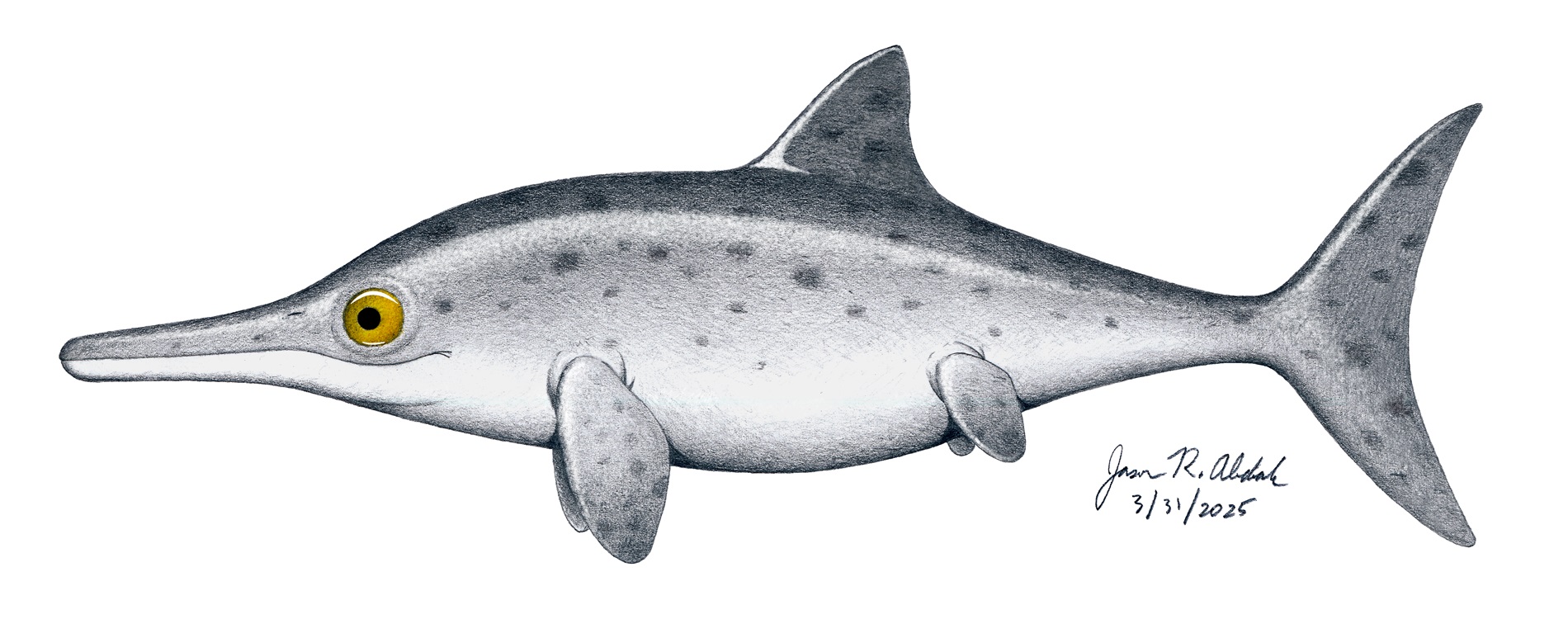
Ichthyosaurus communis. © Jason R. Abdale (March 31, 2025).
I truly enjoy writing my articles and drawing my art, but it’s increasingly clear that I can’t keep this up without your gracious financial assistance. Kindly check out my pages on Redbubble and Fine Art America if you want to purchase merch of my artwork. Consider buying my ancient Roman history books Four Days in September: The Battle of Teutoburg and The Great Illyrian Revolt if you or someone that you know loves that topic. Also, please consider becoming a patron on my Patreon page so that I can afford to purchase the art supplies and research materials that I need to keep posting art and articles onto this website.
Take care, and, as always, keep your pencils sharp.
Categories: Paleontology, Uncategorized
 DINOSAURS AND BARBARIANS
Leave a comment