
Plesiosaurus was a 10 foot long marine reptile which swam in the seas around England during the early Jurassic Period about 195 million years ago.
During the early 19th Century, isolated fossil bones were discovered scattered in various locations on the southern coast of the county of Dorset, England. Examining the bones’ shape determined that they clearly belonged to a prehistoric reptile, but they didn’t look like bones belonging to any known reptile, including the recently-discovered Ichthyosaurus. In 1821, Henry De La Beche and William Conybeare coined the name Plesiosaurus to apply to these intriguing finds. The name means “near/almost lizard” because they believed that the animal was a distant cousin of lizards; this was later proven to be incorrect.
In December 1823, Mary Anning discovered a nearly complete skeleton of a Plesiosaurus in the cliffs outside the seaside town of Lyme Regis, Dorset, England. In 1824, due to the need to have a binomial genus and species name for all creatures according to the Linnaean system of classification, the species name dolichodeirus (meaning “long-necked” in ancient Greek) was given to the genus Plesiosaurus. Due to the completeness of the skeleton found by Mary Anning, it was decided to make that specimen the official holotype specimen for that species, the specimen by which all other future specimens would be compared to.
For many years, the genus Plesiosaurus was regarded by paleontologists as a “waste basket taxon”. If a partial or fragmentary specimen of a Jurassic-aged plesiosaur of any sort was found which could not be positively identified, it was automatically placed under the name Plesiosaurus. At one point, the genus Plesiosaurus encompassed twenty-seven different species. Later, as more specimens were found and as our classification methods became more precise, it was shown that many of these specimens were mis-identified and ought to be given their own names, or it was shown that different bones which were ascribed different species names actually belonged to the same animal. Currently, Plesiosaurus dolichodeirus is the only species of that genus which is considered valid.
As far as members of the plesiosaur group go, Plesiosaurus itself was rather small, measuring just 10 feet long. Later, members of this group would grow much larger, such as Elasmosaurus which grew to an impressive 40 feet long! Plesiosaurus had a head which was small in proportion with body size, and its teeth were an interlocking comb of needles – perfect for catching slippery fish or squid-like belemnites.
All fossils of Plesiosaurus dolichodeirus are found in rocks dated to the Sinemurian Stage of the early Jurassic Period approximately 197-192 MYA. During this time, England’s southern coast stood upon the edge of a semi-tropical sea similar to the Caribbean or the sun-kissed Mediterranean Riviera. It shared its environment with numerous species of fish as well as other marine reptiles like the ichthyosaurs Ichthyosaurus and Temnodontosaurus.
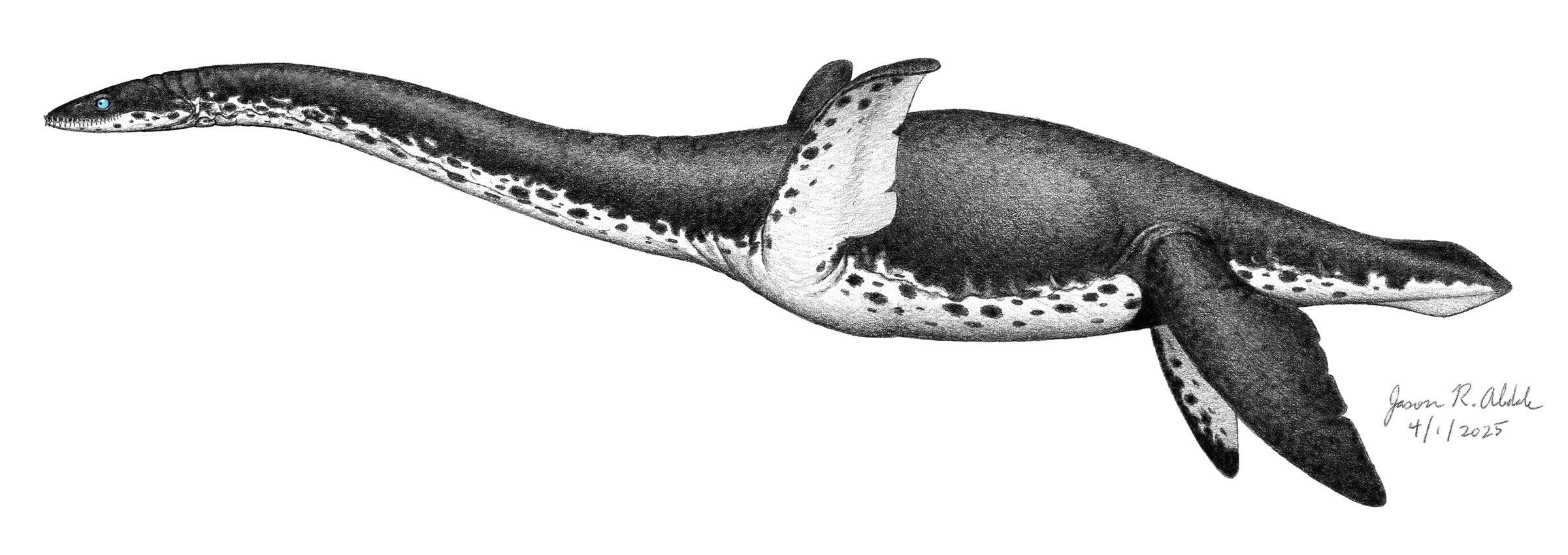
Plesiosaurus dolichodeirus. © Jason R. Abdale (April 1, 2025).
I truly enjoy writing my articles and drawing my art, but it’s increasingly clear that I can’t keep this up without your gracious financial assistance. Kindly check out my pages on Redbubble and Fine Art America if you want to purchase merch of my artwork. Consider buying my ancient Roman history books Four Days in September: The Battle of Teutoburg and The Great Illyrian Revolt if you or someone that you know loves that topic. Also, please consider becoming a patron on my Patreon page so that I can afford to purchase the art supplies and research materials that I need to keep posting art and articles onto this website.
Take care, and, as always, keep your pencils sharp.
Categories: Paleontology, Uncategorized
 DINOSAURS AND BARBARIANS
Leave a comment