
Temnodontosaurus was a massive 30 foot long ichthyosaur which lived in the seas around western Europe during the early Jurassic Period approximately 200-180 million years ago.
The time from the middle Triassic to the early Jurassic Periods, approximately 240-175 million years ago, was the golden age of the ichthyosaurs. It was during this time that the legendary “fish lizards” were the dominant megafauna of the world’s prehistoric oceans. Some ichthyosaurs grew to truly enormous sizes rivalling the sizes of the great whales of our modern age, such as Shonisaurus, Shastasaurus, Ichthyotitan, Cymbospondylus, and the subject of this article, Temnodontosaurus.
The first specimen of this animal was discovered in the early 1810s by Joseph Anning (Mary Anning’s brother) embedded within the cliffs in between the seaside towns of Charmouth and Lyme Regis on Dorset’s southern coast. The specimen consisted of a well-preserved skull, the left shoulder, some neck and dorsal vertebrae, and the front half of the rib cage. In 1822, William Conybeare classified the fragmentary remains as belonging to the recently-named Ichthyosaurus. However in 1889, Richard Lydekker noted that the teeth were differently-shaped compared to the teeth of Ichthyosaurus, and so he coined a new name for this creature – Temnodontosaurus, “cutting tooth lizard”.
Over the years, paleontologists have discovered several species belonging to the genus Temnodontosaurus, including the following:
- T. crassimanus. Yorkshire, England.
- T. nuertingensis. Lower Saxony and Baden-Württemberg, Germany
- T. platyodon (type species). Dorset, England; Arlon, Belgium.
- T. trigonodon. Rutland, England; Yonne, France; Baden-Württemberg, Germany.
- T. zetlandicus. Yorkshire, England; Schouweiler, Luxembourg.
In addition to the confirmed species listed above, there are several dubious species including T. acutirostris, T. azerguensis, T. burgundiae, T. eurycephalus, and T. risor. There is controversy amongst paleontologists as to whether or not these are valid species, or if they are misidentified specimens of other species, or if they perhaps are entirely new genera altogether. This is compounded by the fact that formal descriptions of the various species of Temnodontosaurus are, shall we say, not as rigorous and detailed as they could be. Moreover, there are several fossil specimens which have been vaguely assigned to Temnodontosaurus that haven’t been studied and described yet. Because of all of these difficulties and confusions, several paleontologists have called for a comprehensive re-examination of the genus Temnodontosaurus to assess just exactly how many different species there really are and for determining which fossils specimens belong to which species.
Regardless of the phylogenetic complications, one thing can be agreed upon – Temnodontosaurus was big. It was, perhaps, the largest marine predator within its particular environment during the early Jurassic. Multiple adult specimens of different species have been found and most of them measure around 30 feet long, the same size as a modern-day Killer Whale. One wonders if, like these beautiful piebald mega-dolphins, Temnodontosaurus traveled and hunted in groups. Facing down a single giant carnivorous ichthyosaur would be daunting enough, but having an entire pod of them chasing after you would be downright terrifying.
The drawing that you see below represents Temnodontosaurus trigonodon, which appears to have been the most widespread species. Multiple complete or near-complete skeletons (such as this and that) have been found belonging to T. trigonodon, and they all show it as having an elongated sleek streamlined body, unlike the more dolphin-like bodies of other ichthyosaurs. It had a large head that appeared to be bolted directly onto the shoulders – the front flippers are directly behind its chin – back flippers which were just slightly smaller than the front flippers, and a strongly crescent moon-shaped tail. Note that T. trigonodon had front flippers located directly behind the chin, while T. platyodon had flippers that were positioned a bit further back. It’s unknown what shape or size the dorsal fin would have been. However, there is a well-preserved specimen of the dubious species T. acutirostris which shows that its dorsal fin was strongly angled backwards, presumably to reduce water resistance as it cut through the surf.
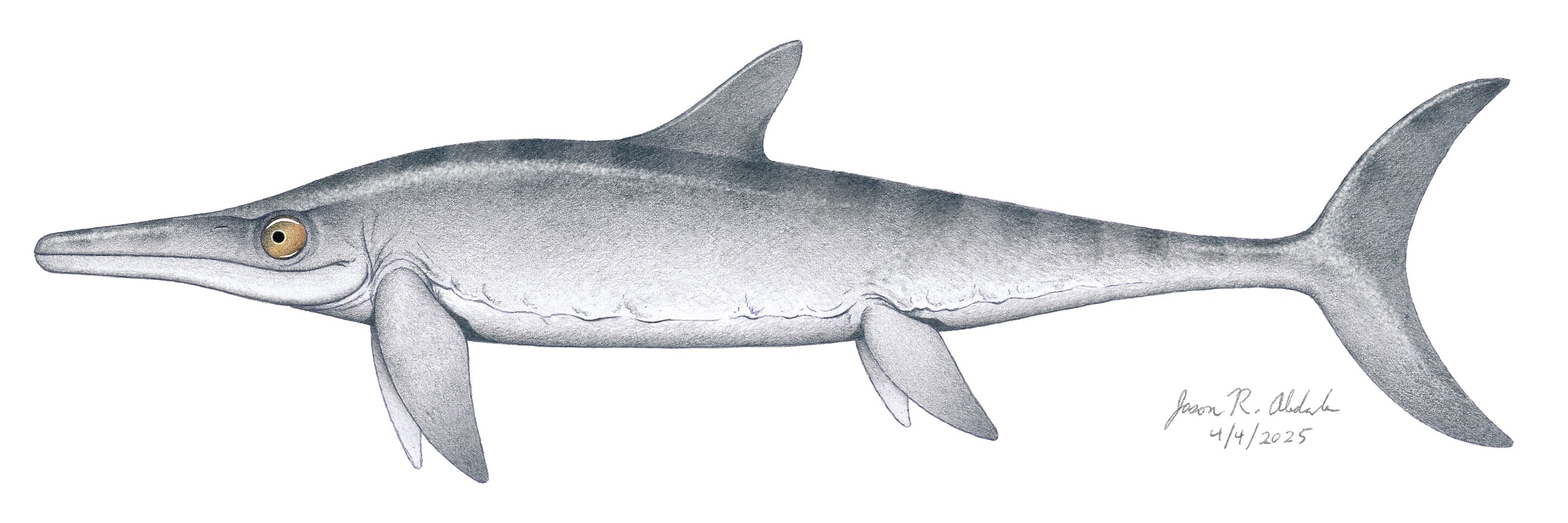
Temnodontosaurus trigonodon. © Jason R. Abdale (April 4, 2025).
I truly enjoy writing my articles and drawing my art, but it’s increasingly clear that I can’t keep this up without your gracious financial assistance. Kindly check out my pages on Redbubble and Fine Art America if you want to purchase merch of my artwork. Consider buying my ancient Roman history books Four Days in September: The Battle of Teutoburg and The Great Illyrian Revolt if you or someone that you know loves that topic. Also, please consider becoming a patron on my Patreon page so that I can afford to purchase the art supplies and research materials that I need to keep posting art and articles onto this website.
Take care, and, as always, keep your pencils sharp.
Categories: Paleontology, Uncategorized
 DINOSAURS AND BARBARIANS


.jpg)
Well described Jason, thank you for taking the time to share. If possible could you kindly add the ichthyosaur I helped excavate with a small team of palaeontologists in the summer of 2021 nicknamed ‘The Rutland Sea Dragon’, this almost fully articulated skeleton is another example of the large-bodied Early Jurassic ichthyosaur
Temnodontosaurus.