
Macroplata was a 15 foot long plesiosaur which lived around England during the early Jurassic Period 199 million years ago.
In either late 1927 or early 1928, a plesiosaur skeleton was discovered in a limestone quarry in Harbury, Warwickshire, England. The rocks were from the Blue Lias Formation and were dated to the Hettangian Stage of the early Jurassic Period. Even more specifically, the bones were found within the same layer as the ammonite Schlotheimia angulata, which would date the skeleton to the upper third of the Hettangian, approximately 199 million years ago. (Delsate and Ezcurra 2014, page 175; Ketchum and Smith 2010, pages 1,069-1,070). The skeleton was afterwards sent to the British Museum in London (collection ID code: BMNH R5488), and in 1930, the Scottish paleontologist William Elgin Swinton named this animal Macroplata tenuiceps and gave a very brief description of it (Swinton 1930, page 206). The genus name Macroplata means “large plate”, named in reference to the combination of the scapula and clavicle which formed a large bony plate. The species name tenuiceps means “tenuous headed”, and refers to its thin, nearly flat head. At present, Macroplata tenuiceps is the only recognized valid species of Macroplata.
Swinton’s original diagnosis of this species reads as follows: “Sauropterygian with a long skull and a long neck tapering from back to front. Cervical vertebrae moderately long, centra broader than high and narrow across the neurapophyses. Articular faces only slightly concave, and the anterior and posterior margins of the centrumrugose. Dorsals smooth and with constricted centra; articular faces not deeply concave; neural spines moderately high; transverse processes wholly supported by the arch. Sacral vertebrae with large rib-facets on the centra, and large and stout ribs. Caudals with rugose anterior and posterior margins to centra, articular faces more deeply cupped than the other vertebrae” (Swinton 1930, page 206).
According to Ketchum and Smith (2010), there are three distinguishing autopomorphies for Macroplata tenuiceps (Ketchum and Smith 2010, pages 1,069-1,070):
- A triangular emargination in the posterior border of the coracoid.
- A triangular emargination in the posterior border of the ischium.
- Posterior convergence of the long axes of the posterior interpterygoid vacuities.
Additionally, there is a combination of ten anatomical features (some of which are shared by other genera) which are seen in Macroplata tenuiceps, which include the following (Ketchum and Smith 2010, page 1,070):
- Six teeth in each premaxilla (distinguishing it from BMNH 49202, which has four teeth, and other plesiosaurians from the lower Lias Group, which have five where known.
- Seven or eight dentary tooth pairs adjacent to the mandibular symphysis (which distinguishes it from ‘Rhomaleosaurus’ megacephalus, which has five).
- Lateral constriction of the snout at the premaxilla-maxilla suture in dorsal view (distinguishing it from ‘Plesiosaurus’ longirostris in which there is no lateral constriction).
- Raised posterior process of the premaxilla that forms a triangular-shaped ridge that tapers to a point midway between the orbits and contacts the frontals (distinguishing it from ‘Rhomaleosaurus’ megacephalus in which the premaxillae lie flush with the surrounding elements, and distinguishing it from Archaeonectrus rostratus in which the premaxillary ridge is much less pronounced).
- Basisphenoid entirely obscured by the parasphenoid in ventral view (shared only with BMNH 49202 and ‘Rhomaleosaurus’ megacephalus among plesiosaurians where this is known).
- Body of the basioccipital forming the posterior palatal margin (pterygoids do not meet posterior to the posterior interpterygoid vacuities; as in BMNH 49202, but unlike ‘Rhomaleosaurus’ megacephalus and ‘Plesiosaurus’ longirostris MCZ 1033).
- 26 cervical vertebrae (differing from all other Lower Jurassic plesiosaurians but closest in number to Archaeonectrus rostratus, which has 24; and we note that these counts can show intraspecific variation in plesiosaurians, e.g., Plesiosaurus dolichodeirus, Storrs, 1997:170).
- A deep sub-oval emargination on the midline of the posterior border of the clavicular arch (possibly shared with Attenborosaurus conybeari, Sollas, 1881, but no other Lower Jurassic plesiosaurian taxon where known).
- A broad sub-rectangular preglenoidal extension of the coracoid (present only in Lower Jurassic plesiosaurians).
- Very small subcentral foramina in square-shaped depressions separated by a ventral keel in the cervical centra (distinguishing it from Plesiosaurus dolichodeirus and Eretmosaurus rugosus).
The skeleton BMNH R5488 measured 4.65 meters long, with the skull measuring 56 cm in length, the neck and pectoral vertebrae measuring 1.24 meters, the trunk 1.61 meters, and the tail 1.22 meters (Ketchum and Smith 2010, page 1,071).
Because plesiosaurs had just appeared on Planet Earth during the beginning of the Jurassic Period, it’s a bit uncertain as to where exactly Macroplata fits into the plesiosaur tree. In 1988, Robert L. Carroll said that Macroplata was a member of the family Pliosauridae (Carroll 1988, page 619). In 2002, J. J. Sepkoski stated that Macroplata belonged somewhere in Plesiosauria, but he didn’t narrow it down to a specific family (Sepkoski 2002, page 461). In 2012, Roger Benson and his colleagues stated that Macroplata was an early member of the plesiosaur family Rhomaleosauridae (Benson et al. 2012: e31838).
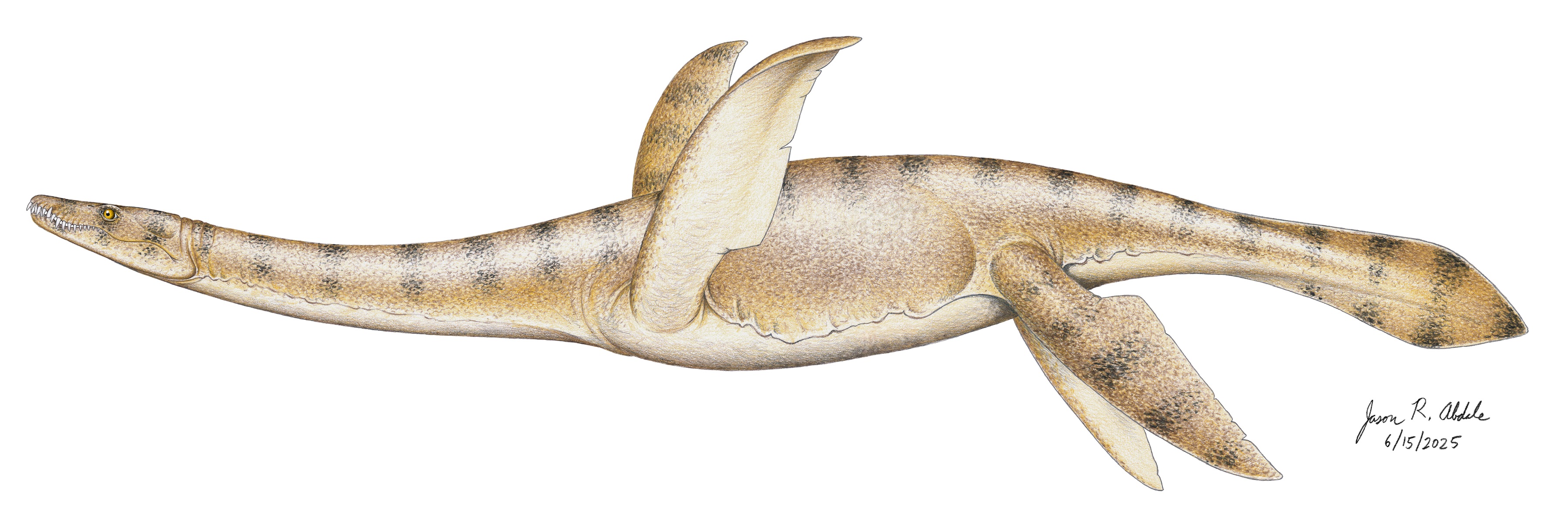
Macroplata tenuiceps. © Jason R. Abdale (June 15, 2025).
During the beginning of the Jurassic Period 199 MYA, England stood upon the edge of a semi-tropical sea similar to the Caribbean or the sun-kissed Mediterranean Riviera. The 15 foot long Macroplata shared its environment with numerous species of fish as well as other marine reptiles such as the 6 foot long ichthyosaur Ichthyosaurus and the much larger 30 foot long ichthyosaur Temnodontosaurus.
I truly enjoy writing my articles and drawing my art, but it’s increasingly clear that I can’t keep this up without your gracious financial assistance. Kindly check out my pages on Redbubble and Fine Art America if you want to purchase merch of my artwork. Consider buying my ancient Roman history books Four Days in September: The Battle of Teutoburg and The Great Illyrian Revolt if you or someone that you know loves that topic, or my ancient Egyptian novel Servant of a Living God if you enjoy action and adventure.
Please consider becoming a patron on my Patreon page so that I can afford to purchase the art supplies and research materials that I need to keep posting art and articles onto this website. Professional art supplies are pricey, and many research articles are “pay to read”, and some academic journals are rather expensive. Patreon donations are just $1 per month – that’s it. If everyone gave just $1 per month, it would go a long way to purchase the stuff that I need to keep my blog “Dinosaurs and Barbarians” running.
Take care, and, as always, keep your pencils sharp.
Bibliography
Benson, Roger B. J.; Evans, Mark; Druckenmiller, Patrick S. (2012). “High Diversity, Low Disparity and Small Body Size in Plesiosaurs (Reptilia, Sauropterygia) from the Triassic–Jurassic Boundary”. PLOS One, volume 7, issue 3: e31838 (March 16, 2012).
https://journals.plos.org/plosone/article?id=10.1371/journal.pone.0031838.
Carroll Robert L. Vertebrate Paleontology and Evolution. New York: W. H. Freeman and Company, 1988.
https://archive.org/details/Vertebrate.Paleontology.Evolution.
Delsate, Dominique; Ezcurra, Martín D. (2014). “The first Early Jurassic (late Hettangian) theropod dinosaur remains from the Grand Duchy of Luxembourg”. Geologica Belgica, volume 17, issue 2 (2014). Pages 175-181.
https://popups.uliege.be/1374-8505/index.php?id=4595&file=1&pid=4569.
Ketchum, Hilary F.; Smith, Adam S. (2010). “The anatomy and taxonomy of Macroplata tenuiceps (Sauropterygia, Plesiosauria) from the Hettangian (Lower Jurassic) of Warwickshire, United Kingdom”. Journal of Vertebrate Palaeontology, volume 30, issue 4 (July 2010). Pages 1,069-1,081.
https://plesiosauria.com/pdf/ketchum&smith_2010_macroplata.pdf.
Sepkoski Jr., J. J. (2002). “A compendium of fossil marine animal genera”. Bulletins of American Paleontology, issue 363. Pages 1-560.
https://webstatic.niwa.co.nz/library/Bap363.pdf.
Swinton, William Elgin (1930). “Preliminary account of a new genus and species of plesiosaur”. Annals and Magazine of Natural History, series 10, volume 6, issue 32 (1930). Pages 206-209.
https://www.tandfonline.com/doi/abs/10.1080/00222933.1930.11070799.
Categories: Paleontology, Uncategorized
 DINOSAURS AND BARBARIANS
Leave a comment