
Shonisaurus was an absolutely gargantuan ichthyosaur which swam off North America’s Pacific coast during the middle of the Triassic Period 227 million years ago. Shonisaurus was one of the largest ichthyosaurs to have existed, measuring 45 feet long. Only a couple of other species such as Shastasaurus and the recently-named Ichthyotitan were larger.
The remains of Shonisaurus were found in 1920 within the Luning Formation, which dates to the late Carnian and early Norian Stages of the Triassic Period 227 million years ago. With names like “Shoni” and Luning”, you might be forgiven for thinking that Shonisaurus was found somewhere in eastern Asia, possibly China or Japan. However, the Luning Formation is located in Nevada, USA, named after the small town of Luning in Mineral County, about 96.25 miles southeast of Carson City. The name “Shoni” refers to the Shoshone Mountains of western Nevada, which in turn are named in honor of the Shoshone Indians who lived there (and still do). Shonisaurus popularis was named in 1976 by Charles Lewis Camp.
Several skeletons of Shonisaurus were found together, possibly resulting from a beaching event similar to that tragically seen in modern-day whales and dolphins. This indicates that, like whales and dolphins, Shonisaurus lived and travelled in groups.
Contrary to what was said in earlier reports, Shonisaurus wasn’t toothless. In fact, it did possess short recurved teeth measuring nearly an inch long. It had a large gut, but it was laterally compressed like a fish rather than having a rounded belly. So, viewed head-on, Shonisaurus would have appeared somewhat flattened. Even so, Shonisaurus was massive and it likely had a massive appetite to match. What on earth was such an enormous creature feeding on? More to the point, if Shonisaurus really did live in groups, what on earth was a whole pod of these creatures feeding on? Preserved stomach contents from an ichthyosaur skeleton (collection ID code: UAMES 2437) found in Triassic-aged rocks in northern Alaska mostly consisted of hooklets from cephalopod tentacles. Although this skeleton was only partial, it’s estimated that the entire animal would have measured around 7.3 meters (23.9 feet) long and might have been related to Shonisaurus, Shastasaurus, or Guizhouichthyosaurus. This shows that even big ichthyosaurs such as the as-yet-unidentified creature from Alaska fed mostly on small prey. One wonders if there were any giant squids which lived in the world’s oceans during this time, and if Shonisaurus was perhaps a prehistoric analog of a Sperm Whale. However, at the moment, there is no fossilized evidence of giant squids living in the oceans’ depths during the Triassic Period.
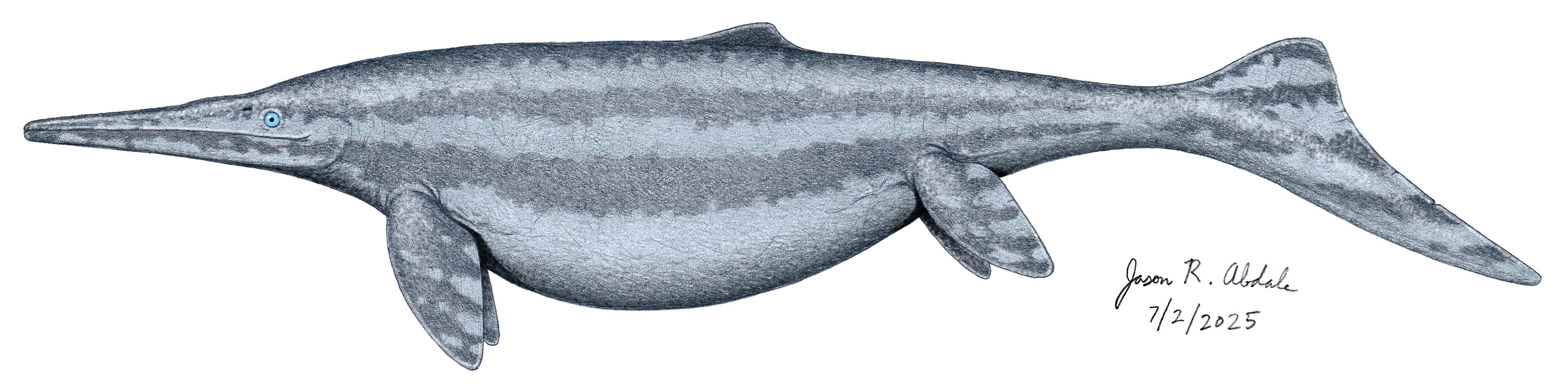
Shonisaurus popularis. © Jason R. Abdale (July 2, 2025).
I truly enjoy writing my articles and drawing my art, but it’s increasingly clear that I can’t keep this up without your gracious financial assistance. Kindly check out my pages on Redbubble and Fine Art America if you want to purchase merch of my artwork. Consider buying my ancient Roman history books Four Days in September: The Battle of Teutoburg and The Great Illyrian Revolt if you or someone that you know loves that topic, or my ancient Egyptian novel Servant of a Living God if you enjoy action and adventure.
Please consider becoming a patron on my Patreon page so that I can afford to purchase the art supplies and research materials that I need to keep posting art and articles onto this website. Professional art supplies are pricey, and many research articles are “pay to read”, and some academic journals are rather expensive. Patreon donations are just $1 per month – that’s it. If everyone gave just $1 per month, it would go a long way to purchase the stuff that I need to keep my blog “Dinosaurs and Barbarians” running.
Take care, and, as always, keep your pencils sharp.
Categories: Paleontology, Uncategorized
 DINOSAURS AND BARBARIANS
Leave a comment