
Todiltia schoewei was a small prehistoric saltwater fish which lived in North America during the middle Jurassic Period 165 million years ago.
Fossils of this fish have been found in Colorado and New Mexico within the Todilto Limestone Member of the Wanakah Formation within strata dated to the lower part of the Callovian Stage of the middle Jurassic Period, approximately 165 MYA (Schaeffer and Patterson 1984, page 51), and also within the Ralston Creek Formation (also known as the Summerville Formation) of southeastern Colorado (Kuntz et al. 1989, page 11; Hunt and Lucas 1993, page 71). Curiously, Todiltia is absent from the Sundance Formation, which was the major marine formation within the center of North America (Schaeffer and Patterson 1984, page 12).
Current evidence suggests that the Ralston Creek Formation and the Todilto Limestone Member of the Wanakah Formation were deposited within a large salt lake which once covered much of southern Colorado and northern New Mexico during the middle Jurassic. This salt lake, which was christened Lake Todilto by William F. Tanner in 1965 (Tanner 1965, pages 564, 573), was separate from the nearby Sundance Sea, which inundated much of the center of North America during that same time. It’s possible that Lake Todilto was once part of the Sundance Sea, but became separated from it when the Sundance Sea receded in size. Freshwater streams flowing into Lake Todilto kept it more-or-less stable in terms of both size and salinity levels, which explains why there is evidence of both saltwater and freshwater deposits within the same areas. However, little by little, Lake Todilto dried up, possibly from the streams which once fed it being diverted, similar to what happened to the modern-day Aral Sea. Lake Todilto became increasingly saline and incapable of supporting life, and it eventually disappeared leaving large flat pans of limestone and gypsum behind (Gilluly and Reeside Jr. 1928, pages 70-72; Johnson 1962, pages 49-53; Lucas et al. 1985, pages 216-228).
In 1942, David H. Dunkle classified the fish fossils which were found in the Todilto Limestone as Leptolepis schoewei. The genus Leptolepis has long served as a “wastebasket taxon” for vaguely herring-shaped Mesozoic fish; the species name schoewei was named in honor of Kansas paleontologist Walter Henry Schoewe (Dunkle 1942, pages 61-64). Then in 1984, Bobb Schaeffer and Colin Patterson renamed it to Todiltia for the Todilto Limestone where its fossils were frequently found (Schaeffer and Patterson 1984, page 51).
Todiltia is a common find within the Todilto Limestone of Colorado and New Mexico and the Pony Express Limestone of southwestern Colorado (Schaeffer and Patterson 1984, page 12), which appears to be concurrent or possibly the same as the Todilto Limestone (Condon and Huffman Jr. 1988, page 5). Numerous specimens from various growth stages have been discovered, with the largest (collection ID code: NMNH 17899) measuring just 124 mm (4.88 inches) long – perfect for a moderate-sized home aquarium (Schaeffer and Patterson 1984, page 54). The overall shape of Todiltia was similar to a modern-day herring or shad, and it probably lived a similar lifestyle. Although no scales are preserved, Todiltia likely had cycloid scales similar to its relative Leptolepis. One report says that Todiltia lacked scales (Lucas et al. 2000, page 42), but that might just be because no scales have been preserved, as they seldom are. Preserved gut contents infer that Todiltia likely fed on plankton (Hunt and Lucas 2021, page 194). The abundant fossils of Todiltia suggest that it was a common species and it possibly lived in schools. It would have been a key source of food for larger fish, marine reptiles, fish-eating pterosaurs, and possibly even carnivorous dinosaurs patrolling the shore. Fossil footprints belonging to theropod dinosaurs have been found in New Mexico within the Todilto Limestone, but no bones have been discovered so far. The footprints are similar to the ichnofossil footprint form designated as Eubrontes, but they are substantially larger. Eubrontes tracks typically reach 15 inches long, while the footprints from New Mexico measure 22 inches long (Gregory 1917, page 56; Lucas et al. 1985, page 220). Eubrontes is commonly attributed to Dilophosaurus or a creature closely resembling it. Since Dilophosaurus measured 20 feet long, the as-yet-undiscovered theropod from New Mexico might have measured 25-30 feet long and was perhaps the top predator within North America during the middle Jurassic Period.
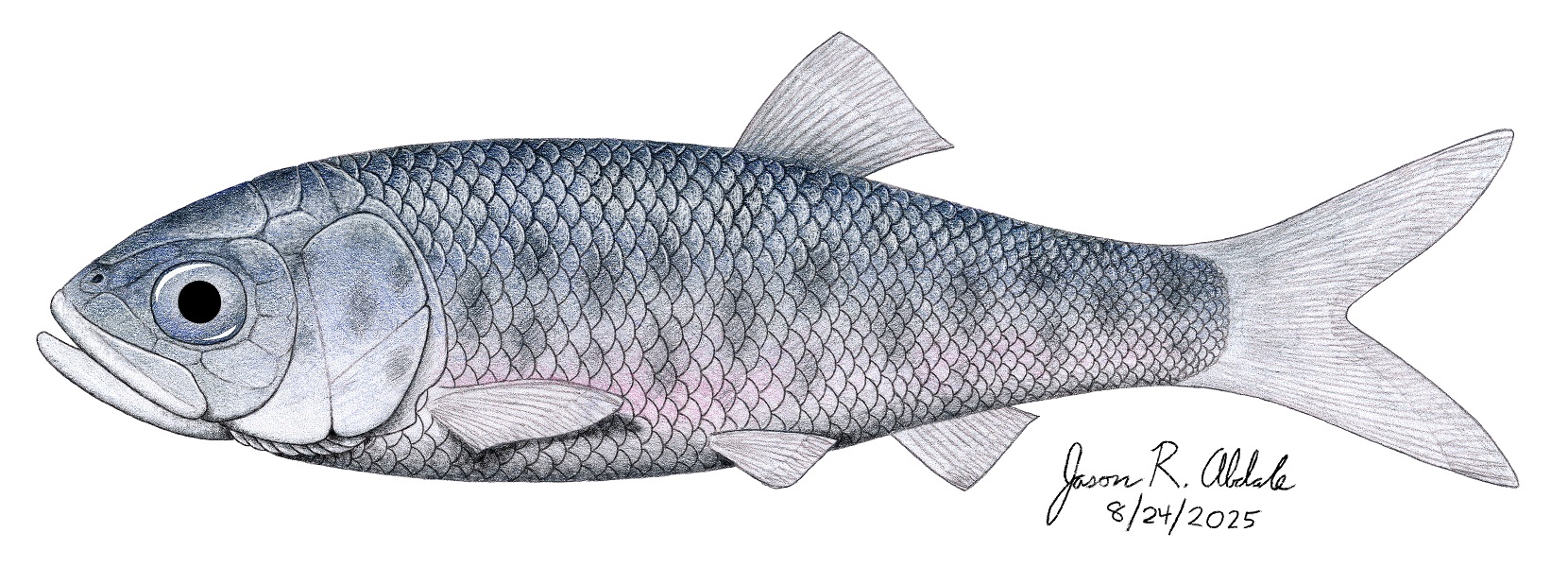
Todiltia schoewei. © Jason R. Abdale (August 24, 2025).
I truly enjoy writing my articles and drawing my art, but it’s increasingly clear that I can’t keep this up without your gracious financial assistance. Kindly check out my pages on Redbubble and Fine Art America if you want to purchase merch of my artwork. Consider buying my ancient Roman history books Four Days in September: The Battle of Teutoburg and The Great Illyrian Revolt if you or someone that you know loves that topic, or my ancient Egyptian novel Servant of a Living God if you enjoy action and adventure.
Please consider becoming a patron on my Patreon page so that I can afford to purchase the art supplies and research materials that I need to keep posting art and articles onto this website. Professional art supplies are pricey, and many research articles are “pay to read”, and some academic journals are rather expensive. Patreon donations are just $1 per month – that’s it. If everyone gave just $1 per month, it would go a long way to purchase the stuff that I need to keep my blog “Dinosaurs and Barbarians” running.
Take care, and, as always, keep your pencils sharp.
Bibliography
Condon, Steven M.; Huffman Jr., A. Curtis (1988). “Revisions in nomenclature of Middle Jurassic Wanakah Formation, northwest New Mexico and northeast Arizona”. U.S. Geological Survey Bulletin, 1633-A: Revisions to stratigraphic nomenclature of Jurassic and Cretaceous rocks of the Colorado Plateau. Washington, D.C.: United States Government Printing Office, 1988. Pages 1-12.
https://pubs.usgs.gov/bul/1633a-c/report.pdf.
Dunkle, David H. (1942). “A new fossil fish of the family Leptolepidae”. Scientific Publications of the Cleveland Museum of Natural History, volume 8, issue 5 (1942). Pages 61-64.
Gilluly, James; Reeside Jr, John B. (1928). “Sedimentary Rocks of the San Rafael Swell and some Adjacent Areas in Eastern Utah”. U.S. Geological Survey Professional Paper 150: Shorter Contributions to General Geology, 1927. Washington, D.C.: United States Government Printing Office, 1928. Pages 61-110.
https://pubs.usgs.gov/pp/0150d/report.pdf.
Gregory, Herbert E. (1917). “Geology of the Navajo Country”. U.S. Geological Survey Professional Paper 93. Washington, D.C.: United States Government Printing Office, 1917. Pages 1-161.
https://pubs.usgs.gov/pp/0093/report.pdf.
Hunt, Adrian P.; Lucas, Spencer G. (1993). “Jurassic Vertebrates of New Mexico”. New Mexico Museum of Natural History and Science Bulletin, number 2 (1993). Pages 71-75.
https://www.google.com/books/edition/Vertebrate_Paleontology_in_New_Mexico/da79CQAAQBAJ?hl=en&gbpv=1.
Hunt, Adrian P.; Lucas, Spencer G. (2021). “The Ichnology of Vertebrate Consumption: Dentalites, Gastroliths, and Bromalites”. New Mexico Museum of Natural History and Science Bulletin, number 87 (2021). Pages 1-216.
https://www.google.com/books/edition/THE_ICHNOLOGY_OF_VERTEBRATE_CONSUMPTION/M4dNEAAAQBAJ?hl=en&gbpv=1.
Johnson, Ross B. (1962). “The Ralston Creek (?) Formation of Late Jurassic age in the Raton Mesa region and Huerfano Park, south-central Colorado”. Articles 60-119: U.S. Geological Survey Professional Paper 450-C: Geological Survey Research 196–Short papers in geology, hydrology, and topography. Washington, D.C.: United States Government Printing Office, 1962. Pages 49-53.
https://pubs.usgs.gov/pp/0450c/report.pdf.
Kuntz, David W.; Armstrong, Harley J.; Athearn, Frederic J., eds. (1989). “Faults, Fossils, and Canyons: Significant Geologic Features on Public Lands in Colorado”. Bureau of Land Management Cultural Resource Series, number 25 (1989). Pages 1-63.
https://www.google.com/books/edition/Faults_Fossils_and_Canyons/qH7CA97LTlEC?hl=en&gbpv=1.
Lucas, Spencer G.; Kietzke, K. K.; Hunt, A. P. (1985). “The Jurassic System in east-central New Mexico”. In Lucas, Spencer G.; Zidek, J., eds. New Mexico Geological Society, 36th Annual Fall Field Conference Guidebook: Santa Rosa-Tucumcari Region. Pages 213-242.
https://www.researchgate.net/publication/280234042_The_Jurassic_System_in_east-central_New_Mexico.
Lucas, Spencer G.; Rinehart, Larry F; Estep, John W. (2000). “Paleoecological Significance of Middle Jurassic Insect Locality, Todilto Formation, North-Central Mexico”. New Mexico Museum of Natural History and Science Bulletin, number 16 (2000). Pages 41-44.
https://www.google.com/books/edition/New_Mexico_s_Fossil_Record_2/El8fCgAAQBAJ?hl=en&gbpv=1.
Schaeffer, Bobb; Patterson, Colin (1984). “Jurassic Fishes from the Western United States, with Comments on Jurassic Fish Distribution”. American Museum Novitates, no. 2796 (November 13, 1984). Pages 1-86.
https://www.biodiversitylibrary.org/item/317403#page/1/mode/1up.
Tanner, William F. (1965). “Upper Jurassic Paleogeography of the Four Corners Region”. Journal of Sedimentary Petrology, volume 35, issue 3 (September 1965). Pages 564-574.
https://citeseerx.ist.psu.edu/document?repid=rep1&type=pdf&doi=711dbf0c56e90993d8386ece9f72a2ae95b1dbf9.
Categories: Paleontology, Uncategorized
 DINOSAURS AND BARBARIANS
Leave a comment