
Onchopristis was a 4 meter (13 foot) long sawfish which lived during the middle Cretaceous Period approximately 105-95 million years ago.
Onchopristis belonged to the sub-order Sclerorhynchoidei of the order Rajiformes, “ray-shaped”. Despite a superficial resemblance to a modern-day sawfish, examination of their bones shows that they’re not closely related. In fact, the closest relatives of the sclerorhynchoids are actually skates. Furthermore, in the recent 2025 remake of Walking With Dinosaurs, Onchopristis was referred to as a “sawskate” rather than a “sawfish”.
The name Onchopristis means “barbed sawfish”, because each of the teeth along both edges of its elongated sword-like rostrum had backward pointing barbs on them, as opposed to modern sawfish which have simple straight or slightly recurved teeth. The genus Onchopristis is divided into two species, O. numidus and O. dunklei, both of which are found in rocks dating from the middle of the Albian Stage to the end of the Cenomanian Stage of the middle Cretaceous Period approximately 105-95 MYA. The species Onchopristis numidus is found in Morocco, Algeria, and Egypt. The species Onchopristis dunklei is found in Texas, and also possibly from Spain, France, and Tunisia. The two species are differentiated from each other by the number of barbs on their rostral teeth. Onchopristis numidus has just one large backwards-pointing barb on each rostral tooth, while O. dunklei has several small barbs. Some of O. numidus’ rostral teeth measure up to 7 cm (2.75 inches) long. Specimens of Onchopristis have also been found within the Cenomanian-aged Mizdah Formation in western Libya, but it’s uncertain which species it is at the moment.
In addition to its barbed harpoon-like teeth along either side of its rostrum, Onchopristis also possessed rows of enlarged dermal denticles along its back like a modern-day Thornback Ray (Raja clavata) or Thornback Guitarfish (Platyrhinoidis triseriata). These denticles typically measured 2 cm long at their base.
In the first episode of the 2011 BBC documentary series Planet Dinosaur hosted by John Hurt, it was stated that Onchopristis measured 8 meters (25 feet). However, the largest bones which we have from Onchopristis indicate that it reached only half that size. I haven’t been able to learn why the series’ writers and producers decided to double the animal’s size, but that isn’t the first time that the BBC’s staff have blown up the size of prehistoric animals for dramatic effect. Remember when the Walking With Dinosaurs team said that Liopleurodon measured 80 feet long when it actually measured just 25?
During the middle Cretaceous Period, the Bahariyah Formation of western Egypt was the location of a large river emptying into the Tethys Sea subject to strong marine tides, similar to the modern-day Hudson River of New York. This would explain why we have freshwater and saltwater organisms found in the same area. In the 2011 BBC documentary series Planet Dinosaur, it was hypothesized that Onchopristis swam upriver to breed. However, a more likely suggestion is that the animal simply followed the tides, swimming upriver when the tide came in to take advantage of unavailable food sources, and then swimming back out to sea when the tide went out. Onchopristis was just one of numerous sawfish species which were found in Egypt’s Bahariya Formation, the others being Aegyptobatus, Baharipristis, Distobatus, Isidobatus, Marckgrafia, Peyeria, Ptychotrygon, Renpetia, and Schizorhiza. Why there were so many different genera of the same specialized niche creature is unclear. It’s possible that many of these animals have been misidentified and are actually different individuals of the same species. A comprehensive re-examination of all sawfish genera from the Bahariya Formation will need to be undertaken to see if they really were as diverse as they are presently believed to be.
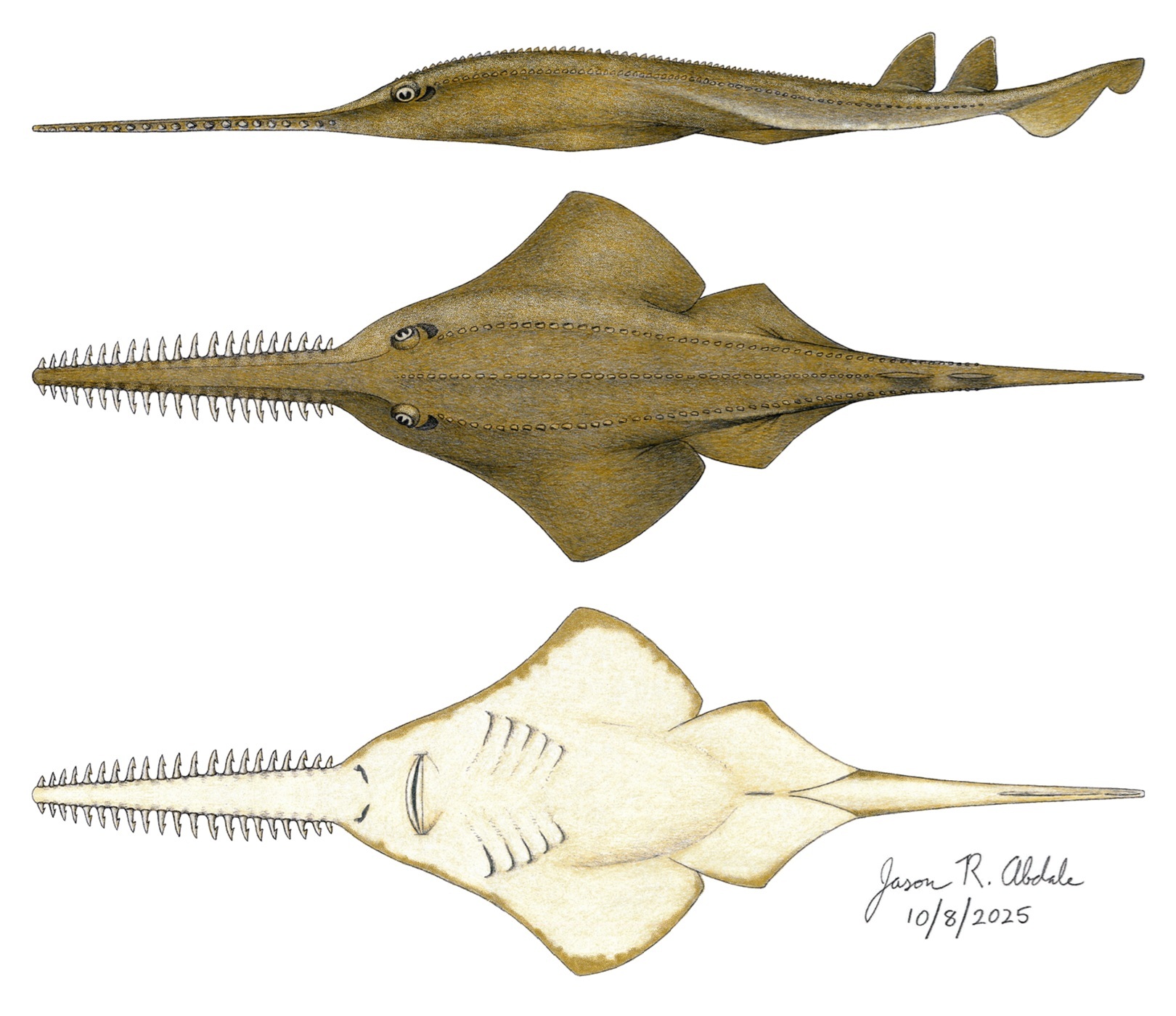
Onchopristis numidus. © Jason R. Abdale (October 8, 2025).
I truly enjoy writing my articles and drawing my art, but it’s increasingly clear that I can’t keep this up without your gracious financial assistance. Kindly check out my pages on Redbubble and Fine Art America if you want to purchase merch of my artwork. Consider buying my ancient Roman history books Four Days in September: The Battle of Teutoburg and The Great Illyrian Revolt if you or someone that you know loves that topic, or my ancient Egyptian novel Servant of a Living God if you enjoy action and adventure.
Please consider becoming a patron on my Patreon page so that I can afford to purchase the art supplies and research materials that I need to keep posting art and articles onto this website. Professional art supplies are pricey, and many research articles are “pay to read”, and some academic journals are rather expensive. Patreon donations are just $1 per month – that’s it. If everyone gave just $1 per month, it would go a long way to purchase the stuff that I need to keep my blog “Dinosaurs and Barbarians” running.
Keep your pencils sharp.
Categories: Paleontology, Uncategorized
 DINOSAURS AND BARBARIANS
Leave a comment