
Quetzalcoatlus was a massive pterosaur which lived in North America at the end of the Cretaceous Period 72-66 million years ago. Fossils of it were first discovered in 1971 within the Javelina Formation of Big Bend National Park, Texas within rocks dating to the Maastrichtian Stage of the late Cretaceous Period. In 1975, Douglas Lawson officially named it Quetzalcoatlus northropi, named in honor of the Aztec feathered serpent god Quetzalcoatl and the aviation engineer Jack Northrop who designed the XB-35 tail-less bomber.
A second specimen Quetzalcoatlus was discovered by Douglas Lawson in 1972 just twenty-five miles away from where the first specimen was found. This one was smaller than the first one that had been found but it was also much more complete, and its fossils gave us a very good idea of what this animal looked like. However, it wasn’t until nearly fifty years later that it was determined to belong to a separate species, which was named Quetzalcoatlus lawsoni in 2021.
Quetzalcoatlus northropi gained fame in the final quarter of the 20th Century as the largest known pterosaur, with wingspan estimates commonly given at 40 feet wide or possibly even wider. However, more modern estimates claim that the wingspan was actually around 35 feet wide or thereabouts.
Due to the animal’s large size, large head, long neck, small body, and relatively small wings in proportion to body size compared to other pterosaurs, some have hypothesized that Quetzalcoatlus was incapable of flight and was gradually evolving to become a terrestrial predator similar to a carnivorous giraffe. However, numerous studies have been made of Quetzalcoatlus‘ anatomy and flight mechanics, and it’s been determined that it could still fly regardless of its bizarre proportions.
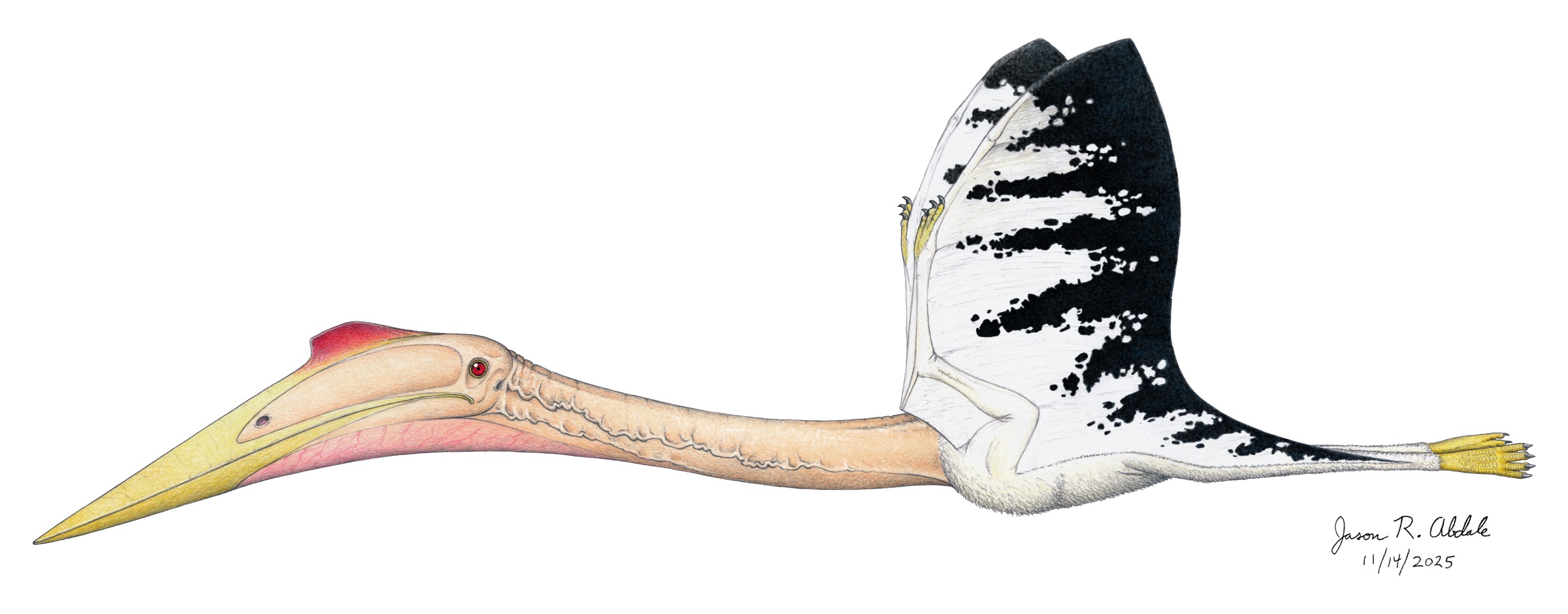

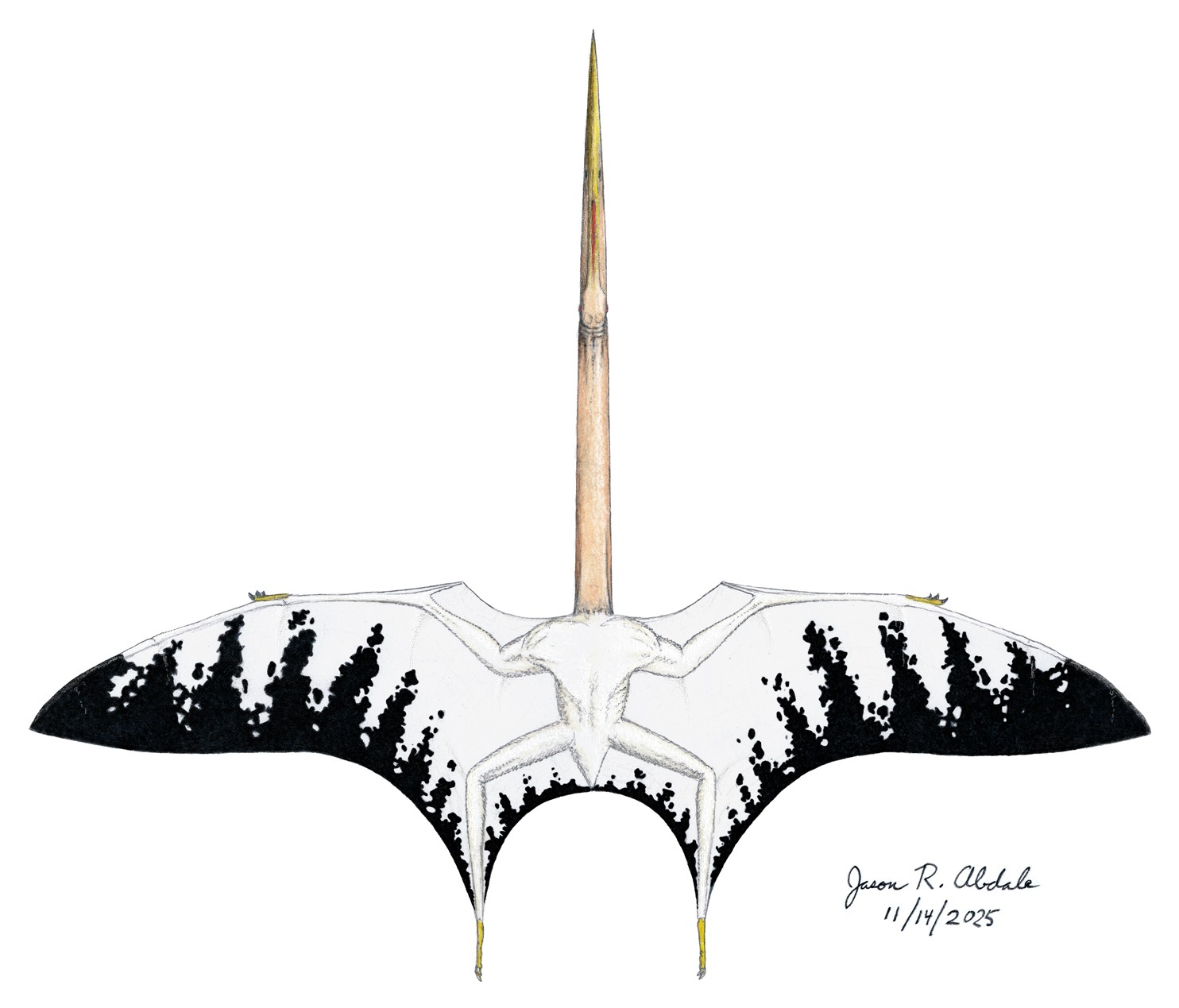
Quetzalcoatlus northropi. © Jason R. Abdale (November 14, 2025).
I truly enjoy writing my articles and drawing my art, but it’s increasingly clear that I can’t keep this up without your gracious financial assistance. Kindly check out my pages on Redbubble and Fine Art America if you want to purchase merch of my artwork. Consider buying my ancient Roman history books Four Days in September: The Battle of Teutoburg and The Great Illyrian Revolt if you or someone that you know loves that topic, or my ancient Egyptian novel Servant of a Living God if you enjoy action and adventure. Please consider becoming a patron on my Patreon page so that I can continue to purchase the art supplies and research materials that I need. Professional art supplies are pricey, many research articles are “pay to read”, and some academic journals are rather expensive. My Patreon membership is just $1 per month – that’s it. If everybody who likes this drawing donates just one dollar per month, it would go a long way to keeping my blog “Dinosaurs and Barbarians” running and preventing my career in paleo-art from going extinct.
Keep your pencils sharp, everybody.
Categories: Paleontology, Uncategorized
 DINOSAURS AND BARBARIANS
Leave a comment