
Alamodactylus was a pterosaur which lived in Texas during the late Cretaceous Period 90 million years ago. A handful of fossils of this animal were found within the Atco Formation, which contains rocks dating to the Coniacian and Santonian Stages of the late Cretaceous Period.
Originally this formation was designated as the Atco Chalk Member of the Austin Formation (Smith 1981, page 5). The name “Atco” was proposed by Clarence Durham Jr. in his 1957 PhD dissertation, named in reference to the Atlas Cement Company which operated quarries within central Texas. The name “Atco” afterwards appeared in the scientific literature in 1961 when it was mentioned by G. E. Murray, and in 1969, Emile Pessagno Jr. provided a description of the Atco Chalk and designated it as a unit of the Austin Formation (Pessagno Jr. 1969, page 77). In 1981, the Atco Chalk Member was reclassified by Charles Smith as a separate formation (Smith 1981, page 5), and the Austin Formation was reclassified as a group composed of several formations located in central Texas. The Atco Formation itself is divided into two smaller units called “members”: the lower Bruceville Marl Member and the upper Vinson Chalk Member, both of which were named by Clarence Durham Jr. in his 1957 PhD thesis, and then appeared in the public scientific literature for the first time in 1961 (Murray 1961, page 353).
The rock layers of the Atco Formation were deposited in the salty waters of the Western Interior Seaway 90 million years ago. Microscopic fossils from a multitude of plankton species have been found within the Atco Formation, and this plankton helped to form the chalky rock layers that the Atco Formation is made of (Smith 1981, pages 1-96). Ammonites found within the Atco Formation include Peroniceras westphalicum, possibly Peroniceras haasi, Prionocycloceras gabrielense and perhaps an indeterminate species of Protexanites. Other mollusks included the inoceramid bivalves Cremnoceramus inconstans, “Inoceramus” stantoni, Mytiloides aviculoides, and Mytiloides striatoconcentricus (Smith 1981, page 21).However, the Atco Formation is probably most well-known for its superb fossils of shark and ray teeth. Twenty-nine different species of sharks and rays have been found within the lower levels of the Atco Formation at the same time that Alamodactylus was alive. Rays include the sawfish Ischyrhiza schneideri, Kiestus texanus, Ptychotrygon triangularis, and an indeterminate species of Sclerorhynchus, the guitarfish Rhinobatos lobatus and an indeterminate species of Pseudohypolophus, and an indeterminate ray Texatrygon hooveri whose exact classification is still uncertain. Sharks are much more diverse, belonging to numerous groups. These include the bamboo shark Chiloscyllium greeni, the nurse shark Cantioscyllium decipiens, the goblin shark Scapanorhynchus raphiodon, the sand tiger shark Johnlongia parvidens, an indeterminate species of the bullhead shark Heterodontus, and the mackerel sharks Cretalamna appendiculata, Cretodus crassidens, Cretoxyrhina mantelli, Dallasiella willistoni, Protolamna compressidens, Pseudocorax laevis, and Squalicorax falcatus. Five different species of the shellfish-eating shark Ptychodus have been found here (Hamm 2009, pages 16-18; Hamm 2020, pages 51-55). Considering this area possessed a multitude of hard-shelled mollusks, it’s no wonder that we would have animals specifically adapted to feed on them. Additionally, there are four as-yet indeterminate shark species which have been tentatively classified as “cf. Ginglymostoma”, “cf. Meristodonoides”, “cf. Microcorax”, and “cf. Paraisurus” (Hamm and Cicimurri 2011, pages 107-127). While the majority of marine fossils found within the Atco Formation belong to cartilaginous fish, marine reptiles are also known from this formation. Those which are found at the base of the Atco Formation (the same time that Alamodactylus is found in) are fragmentary and difficult to identify, but they appear to belong to mosasaurs from the sub-families Plioplateacarpinae and Tylosaurinae. Unfortunately, more specific identification is impossible at the moment. Other mosasaurs which are found in higher/later Atco Formation strata can be more confidently assigned to Platecarpus planifrons and Tylosaurus nepaeolicus (Jacobs et al. 2013, page 12).
The only fossils which we have of Alamodactylus at the moment are a left humerus, a distal metacarpal IV, and a proximal first phalanx of digit IV (collection ID code: SMU 76476), which were dated to the early part of the Coniacian Stage of the late Cretaceous Period. These fossils were originally identified by Timothy Myers in 2010 as “cf. Pteranodon”, meaning “similar in shape to Pteranodon”. (Myers 2010, pages 1,071-1,079). In 2013, these bones were reclassified as a new genus and species named Alamodactylus byrdi. Unlike the giant sauropod Alamosaurus, which is often mistakenly thought to be named after the famous Alamo mission in Texas but is actually named after the Ojo Alamo Formation of New Mexico, Alamodactylus is truly named in honor of the Alamo where Davy Crockett and Jim Bowie made their famous last stand. The species name byrdi is in honor of Gary Byrd who found the fossils (Andres and Myers 2013, pages 391-394).
All phylogenic analyses of Alamodactylus have placed it within the pterosaur super-family Pteranodontia. However, when one tries to narrow things down further, things get complicated, which isn’t surprising due to Alamosaurus being known from only a handful of bones. In 2013, Andres and Myers placed Alamodactylus as a non-pteranodontoid pteranodontian (Andres and Myers 2013, page 388). In 2018, it was placed as a basal member of the pteranodontian family Nyctosauridae (Longrich et al. 2018: e2001663). In 2022, Alamodactylus was placed within Pteranodontia, but outside Nyctosauridae (Fernandes et al. 2022, pages 14-15). In 2024, it was placed as a basal member of the family Pteranodontidae (Pêgas 2024, page 18).
No skull bones are currently known from Alamodactylus, so it’s not clear if Alamodactylus had a crest on its head, although it likely did due to its relationships to the pteranodontians and to Pteranodon specifically. It should be noted that the genus Pteranodon first appears in the fossil record around 86 MYA, not long after Alamodactylus became extinct. It’s possible that Alamodactylus directly evolved into Pteranodon, but this hypothesis is difficult to prove. If this is true, then it’s possible that Alamodactylus looked similar to Pteranodon’s overall shape and possibly possessed a rudimentary cranial crest, but this is just conjecture at the moment.
Did Alamodactylus have fingers? As stated before, one possibility is that Alamodactylus was a member of the pterosaur family Nyctosauridae, and the nyctosaurids are distinctive not just for their very large head crests, but also for having no fingers on their arms aside from the very long with finger. When on the ground, they basically walked on their wrists. By contrast, the pteranodontids, which are close relatives of the nyctosaurids, had very small fingers. However, the majority of sources which illustrate Alamodactylus’ placement on the pterosaur tree show it as being outside Nyctosauridae, so it likely had three very small fingers on each arm. Even so, until a complete arm of Alamodactylus is found, we cannot be sure.
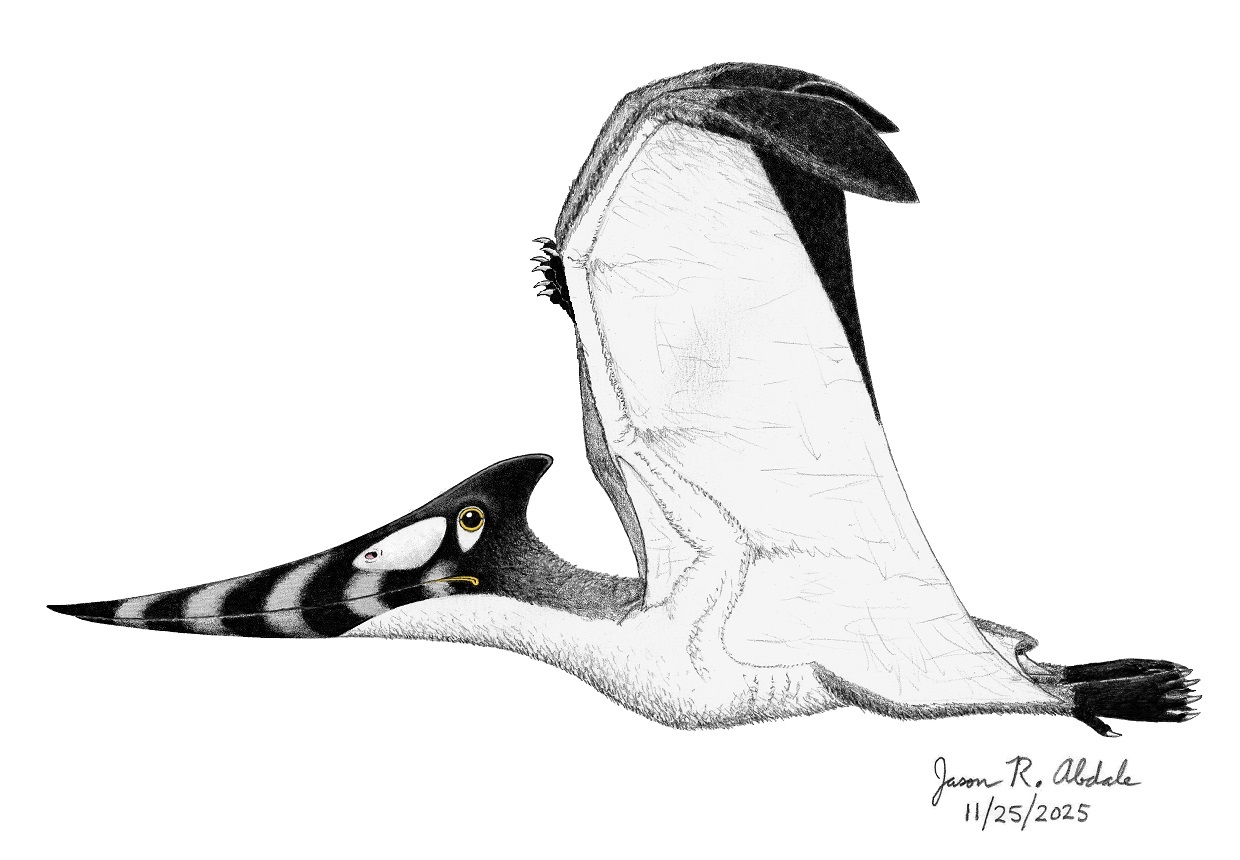
Alamodactylus byrdi. © Jason R. Abdale (November 25, 2025).
I truly enjoy writing my articles and drawing my art, but it’s increasingly clear that I can’t keep this up without your gracious financial assistance. Kindly check out my pages on Redbubble and Fine Art America if you want to purchase merch of my artwork. Consider buying my ancient Roman history books Four Days in September: The Battle of Teutoburg and The Great Illyrian Revolt if you or someone that you know loves that topic, or my ancient Egyptian novel Servant of a Living God if you enjoy action and adventure. Please consider becoming a patron on my Patreon page so that I can continue to purchase the art supplies and research materials that I need. Professional art supplies are pricey, many research articles are “pay to read”, and some academic journals are rather expensive. My Patreon membership is just $1 per month – that’s it. If everybody who likes this drawing donates just one dollar per month, it would go a long way to keeping my blog “Dinosaurs and Barbarians” running and preventing my career in paleo-art from going extinct.
Keep your pencils sharp, everybody.
Bibliography
Andres, Brian; Myers, Timothy S. (2013). “Lone Star Pterosaurs”. Earth and Environmental Science Transactions of the Royal Society of Edinburgh, volume 103, issue 3-4 (2013). Pages 383-398.
https://www.researchgate.net/publication/259437218_Lone_Star_Pterosaurs.
Fernandes, Alexandra E.; Mateus, Octávio; Andres, Brian; Polcyn, Michael J.; Schulp, Anne S.; Gonçalves, António Olímpio; Jacobs, Louis L. (2022). “Pterosaurs from the Late Cretaceous of Angola”. Diversity, volume 14, issue 741 (2022). Pages 1-27.
https://www.researchgate.net/publication/363422636_Pterosaurs_from_the_Late_Cretaceous_of_Angola.
Hamm, Shawn A. (2009). “New Data on the Occurrence and Distribution of Ptychodus from the Upper Cretaceous (Coniacian-Santonian) of Texas”. Dallas Paleontological Society, Occasional Papers, 8 (2009). Pages 1-31.
https://www.researchgate.net/publication/296314709_NEW_DATA_ON_THE_OCCURRENCE_AND_DISTRIBUTION_OF_PTYCHODUS_FROM_THE_UPPER_CRETACEOUS_OF_TEXAS.
Hamm, Shawn A. (2020). “Stratigraphic, Geographic, and Paleoecological Distribution of the Late Cretaceous Shark Genus Ptychodus within the Western Interior Seaway, North America”. New Mexico Museum of Natural History and Science Bulletin, number 81 (2020). Pages 1-96.
https://www.google.com/books/edition/STRATIGRAPHIC_GEOGRAPHIC_AND_PALEOECOLOG/Bd4xEAAAQBAJ?hl=en&gbpv=0.
Hamm, Shawn A.; Cicimurri, Dave (2011). “Early Coniacian (Late Cretaceous) Selachian Fauna from the basal Atco Formation, Lower Austin Group, North Central Texas”. Paludicola, volume 8, issue 3 (October 2011). Pages 107-127
https://www.researchgate.net/publication/311405951_EARLY_CONIACIAN_LATE_CRETACEOUS_SELACHIAN_FAUNA_FROM_THE_BASAL_ATCO_FORMATION_LOWER_AUSTIN_GROUP_NORTH_CENTRAL_TEXAS.
Jacobs, Louis L.; Polcyn, Michael J.; Winkler, Dale A.; Myers, Timothy S.; Kennedy, Jamell G.; Wagner, John B. (2013). “Late Cretaceous Strata and Vertebrate Fossils of North Texas”. In Hunt, B. B.; Catlos, E. J., eds. The Geological Society of America, Field Guide 30: Late Cretaceous to Quaternary Strata and Fossils of Texas – Field Excursions Celebrating 125 Years of GSA and Texas Geology. GSA South-Central Section Meeting, Austin, Texas, April 2013 (2013). Pages 1-13.
https://www.academia.edu/4673372/Late_Cretaceous_strata_and_vertebrate_fossils_of_North_Texas.
Longrich, Nicholas R.; Martill, David M.; Andres, Brian (2018). “Late Maastrichtian pterosaurs from North Africa and mass extinction of Pterosauria at the Cretaceous-Paleogene boundary”. PLOS Biology, volume 16, issue 3: e2001663 (March 13, 2018).
https://journals.plos.org/plosbiology/article%3Fid%3D10.1371/journal.pbio.2001663.
Murray, G. E. Geology of the Atlantic and Gulf Coastal Plain Province of North America. New York: Harper and Brothers Geoscience Series, 1961.
Myers, Timothy S. (2010). “Earliest occurrence of the Pteranodontidae (Archosauria: Pterosauria) in North America: New material from the Austin Group of Texas”. Journal of Paleontology, volume 84, issue 6 (2010). Pages 1,071-1,081.
https://www.researchgate.net/publication/281842992_Earliest_Occurrence_of_the_Pteranodontidae_Archosauria_Pterosauria_in_North_America_New_Material_from_the_Austin_Group_of_Texas.
Pêgas, Rodrigo V. (2024). “A taxonomic note on the tapejarid pterosaurs from the Pterosaur Graveyard site (Caiuá Group, ?Early Cretaceous of Southern Brazil): evidence for the presence of two species”. Historical Biology, volume 37, issue 5 (June 10, 2024). Pages 1,277-1,298.
https://www.researchgate.net/publication/381306918_A_taxonomic_note_on_the_tapejarid_pterosaurs_from_the_Pterosaur_Graveyard_site_Caiua_Group_Early_Cretaceous_of_Southern_Brazil_evidence_for_the_presence_of_two_species.
Pessagno Jr., Emile A. (1969). “Upper Cretaceous stratigraphy of the western Gulf Coast area of Mexico, Texas, and Arkansas.” Geological Society of America Memoir, volume 111 (1969). Pages 1-139.
https://pubs.geoscienceworld.org/gsa/books/book/120/Upper-Cretaceous-Stratigraphy-of-the-Western-Gulf.
Smith, Charles C. (1981). “Calcareous Nannoplankton and Stratigraphy of Late Turonian, Coniacian, and early Santonian Age of the Eagle Ford and Austin Groups of Texas”. Geological Survey Professional Paper 1075. Washington, D.C.: United States Government Printing Office, 1981. Pages 1-96.
https://www.google.com/books/edition/Geological_Survey_Professional_Paper/OkRSAQAAMAAJ?hl=en&gbpv=1&bsq=Atco.
Categories: Paleontology, Uncategorized
 DINOSAURS AND BARBARIANS
Leave a comment