
Stenopterygius, meaning “narrow fin”, was a genus of ichthyosaur which lived around Europe during the early to middle Jurassic Period 184-175 million years ago. Multiple fossils of this marine reptile including whole skeletons have been found in England, France, Luxembourg, and Germany. It was originally named as a species of Ichthyosaurus in 1856, being called Ichthyosaurus quadriscissus, referring to the four rows of mosaic-like bones which made up the “fingers” inside its flippers. In 1904, it was re-classified as a new genus, Stenopterygius.
Further discoveries showed that the genus Stenopterygius was composed of more than one species. In fact, it quickly transformed into becoming a “wastebasket taxon”, with twelve different species assigned to it at one point. Today, only four are still considered valid, which are the following:
- S. aaleniensis, from the Opalinuston Formation of southwestern Germany; dated to the earliest part of the Aalenian Stage of the middle Jurassic Period, 175 MYA; length unknown due to incomplete remains, but likely around 3 meters (10 feet) long.
- S. quadriscissus, from the lower and middle Posidonia Shale of Luxembourg and Germany; Lias units I.2 to II.12 (Dactylioceras tenuicostatum phase to Harpoceras falcifer phase); dated to the lower third of the Toarcian Stage of the early Jurassic Period, 184-179 MYA; measured 3.5 meters (11.5 feet) long.
- S. triscissus, from England, France, Luxembourg, and the middle Posidonia Shale of Germany; Lias units II.1 to II.12; dated to the lower third of the Toarcian Stage early Jurassic Period, 182-179 MYA; measured 3.5 meters (11.5 feet) long, but had longer jaws in proportion to body size than S. quadriscissus.
- S. uniter, from southwestern Germany; dated to the second-lowest quarter of the Toarcian Stage (Harpoceras falcifer phase) of the early Jurassic Period, 180-179 MYA; Lias units II.6 to II.12; measured 4.47 meters (14.6 feet) long.
As you can see above, there was a time 180-179 MYA when there were three different species of Stenopterygius swimming around Europe at the same time.
There might be a fifth species, S. cayi, which dates to the Bajocian Stage of the middle Jurassic 170-168 MYA. In 1994, Marta Fernández coined the name Chacaicosaurus cayi to refer to Bajocian ichthyosaur remains found in the Neuquén Basin of Argentina. Then in 2007, it was decided that the differences between Chacaicosaurus and Stenopterygius were so minor that it was reclassified as a species of Stenopterygius. Paleontologists are divided as to what the real answer is. It’s possible that this animal might belong to either Stenopterygius or Chacaicosaurus, or possibly to another genus such as Mollesaurus or Temnodontosaurus. Whatever it was, it was big. With a jaw length of 99 cm, and scaling this to match the sizes of other well-known Stenopterygius remains, this animal, whatever name it was, possibly reached 6.14 meters (20.14 feet) long.
Stenopterygius is possibly the ichthyosaur which we know the most about concerning its overall anatomy. Numerous well-preserved specimens have been found which show us exactly what the outline of the body and the fins would have looked like. For this reason, Stenopterygius became the archetypal ichthyosaur in paleo-art for many years. Even more remarkably, Stenopterygius is one of the few prehistoric marine reptiles which we have hard evidence for what color it was! A well-preserved specimen from the Toarcian Stage in Holzmaden, Germany (collection ID code: MH 432) shows evidence that it was counter-shaded with dark back and sides and a light underbelly.
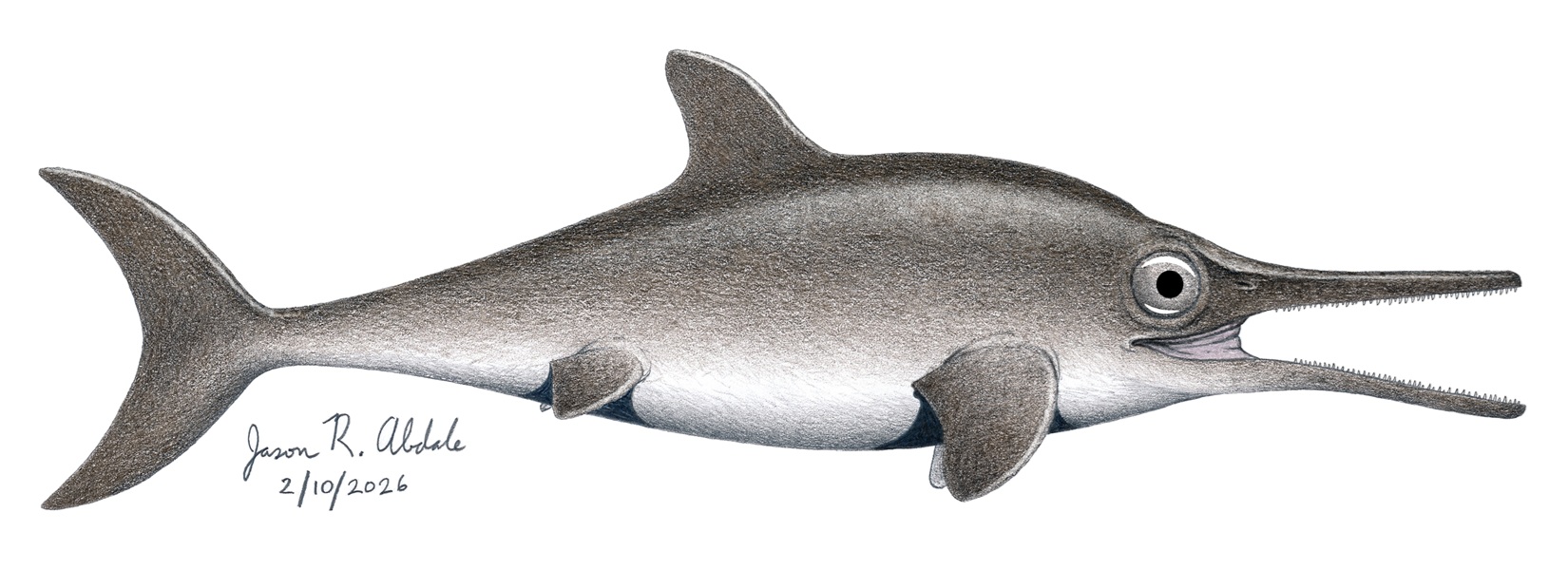
Stenopterygius quadriscissus. © Jason R. Abdale (February 10, 2026).
I truly enjoy writing my articles and drawing my art, but it’s increasingly clear that I can’t keep this up without your gracious financial assistance. Kindly check out my pages on Redbubble and Fine Art America if you want to purchase merch of my artwork. Consider buying my ancient Roman history books Four Days in September: The Battle of Teutoburg and The Great Illyrian Revolt if you or someone that you know loves that topic, or my ancient Egyptian novel Servant of a Living God if you enjoy action and adventure. Please consider becoming a patron on my Patreon page so that I can continue to purchase the art supplies and research materials that I need. Professional art supplies are pricey, many research articles are “pay to read”, and some academic journals are rather expensive. My Patreon membership is just $1 per month – that’s it. If everybody who likes this drawing donates just one dollar per month, it would go a long way to keeping my blog “Dinosaurs and Barbarians” running and preventing my career in paleo-art from going extinct.
Keep your pencils sharp, everybody.
Categories: Paleontology, Uncategorized
 DINOSAURS AND BARBARIANS
Leave a comment