
In the prehistoric past, the center of North America has been underwater on several occasions. Perhaps the most well-known of these instances was during the late Cretaceous Period when North America was cut in half by the Western Interior Seaway which connected the Arctic Ocean with the Gulf of Mexico. yet there was another time, during the middle to late Jurassic Period, when the middle of North America was underwater. This was the Sundance Sea, named after the town of Sundance, Wyoming where these marine rick layers were first discovered. This was a sea which inundated the center of North America approximately 170-157 million years ago.
A multitude of fossils have been found within the rock layers of the Sundance Formation, mostly invertebrates such as bivalves, ammonites, and belemnites. However, other animals lived here too including fish and marine reptiles. The largest marine animal found within the Sundance Formation was the pliosaur Megalneusaurus rex. Estimated to have measured 30 feet long, it likely would have been the top predator within its environment.
In 1895, Wilbur C. Knight, a geology professor at the University of Wyoming, discovered fossils of a large prehistoric animal at a place known as the Dutton Oil Basin. In his reports, Knight said that the locality was near Ervay, Natrona County, Wyoming. However, the land was re-surveyed afterward and the borders of the various counties shifted. Now, the locality (T33N, R90W) sits just inside of the eastern border of Fremont County, Wyoming within an area known as the Gas Hills due to the petroleum found there (Wahl et al. 2007, page 95).
These fossils turned out to be a partial skeleton of a large marine reptile, consisting of one complete front flipper, a portion of the pelvic girdle, a few ribs, and some vertebrae from the neck, back, and tail. Knight identified these bones as belonging to a plesiosaur, which was noteworthy because, until then, no plesiosaur fossils from the Jurassic Period had been found in the United States. However, due to the skeleton’s fragmentary nature, Prof. Knight was not certain which species these bones belonged to (Knight 1898, page 380; Wahl et al. 2007, pages 94-95).
Apparently, there was a lot more of this skeleton there, but one of Knight’s workers stole it! A fossil digger named Mr. Stewart who worked for the famous (or infamous, depending on your perspective) Edward D. Cope accompanied Wilbur Knight on his expedition. Knight left Stewart and two other men in one area while he trekked on his own into the Dutton Oil Basin, and there he found the remains of the giant plesiosaur as well as some shark teeth scattered about close by. In fact, there were so many bones of this animal that Prof. Knight was obliged to go door-to-door to the various ranchers in the area asking for boxes and packing materials as well as wagons to transport the finds. Due to an inability to get the entire animal out of the ground, Prof. Knight was obliged to cover up the skeleton once more with dirt until he had the means to continue the excavation. Later, when Prof. Knight was on his way, Stewart came to the same place and asked where the professor was. One of the local land-owners told him that Prof. Knight had found many bones of a large animal, dug up some of them, and left the rest behind, intending on digging up the rest later. Stewart decided that he would dig up and take away whatever fossils were still there. The two workers who were with him wanted nothing to do with this wholly unethical behavior and they left him. These remains eventually found their way into the collections of the American Museum of Natural History in New York City. It wasn’t long before Prof. Knight found out about this, and he sent a letter to Henry Fairfield Osborn at the AMNH demanding that the fossils be returned to him. Evidently, they weren’t (Wahl et al. 2007, page 95).
Later that same year, Prof. Knight published his findings in a short bulletin in the academic journal Science, in which he gave this animal a provisional identification of Cimoliosaurus rex (Knight 1895, page 449). Cimoliosaurus, also spelled Cimoliasaurus, was a large plesiosaur related to Elasmosaurus which had been named in 1851. The genus was composed of several species, and served as a “wastebasket taxon” for any plesiosaur of uncertain identity (“Cimoliasaurus Leidy 1851”). In 1898, Prof. Knight wrote a more detailed description of the fossils that had been found in Wyoming. Here, he re-classified the animal as a pliosaur, not a plesiosaur, and it was given a new genus name: Megalneusaurus, meaning “great swimming lizard” (Knight 1898, pages 378-381). The type specimen is housed at the University of Wyoming (collection ID code: UW 4602) (Wahl et al. 2007, page 94).
In 1895, Knight stated that the fossils of Megalneusaurus were found in the Baptanodon Beds (Knight 1895, page 449), which was an older way to refer to the Sundance Formation. In 1898, he clarified this by saying that the bones were found within “the uppermost band of the marine beds of the Jurassic” (Knight 1898, page 380). This would place the fossils within the uppermost layer of the Redwater Shale Member of the Sundance Formation (Wahl et al. 2007, pages 94-95, 97), which would date the fossils to the later part of the Oxfordian Stage (Weems and Blodgett 1996, pages 173-174) of the Jurassic Period around 158-157 MYA. When the locality was re-examined in 1996, it was confirmed that the strata was within the upper part of the Redwater Shale, ten meters below the contact with the Windy Hill Sandstone Member of the Morrison Formation. No pliosaur fossils of any sort have been found within the Sundance Formation in rocks that are older than this layer, which indicates that Megalneusaurus may have been a late arrival to the Sundance Sea (Wahl et al. 2007, pages 94, 97, 101). It has even been suggested that it was only an occasional visitor to the area rather than an endemic species (Massare et al. 2014, page 175).
In Prof. Knight’s original summary of the fossils written in 1895, he stated that the centrum of the dorsal vertebrae measured 130mm horizontally in diameter, and measured 108mm in length. One of the cervical vertebrae, which he judged to be placed nearer to the skull than to the shoulder, possessed a centrum which was deeply concave on one side and was nearly flat on the opposite side (he did not specify which particular sides he was referring to). It measured 65mm in length and 80mm across. Another bone, which he judged to be a femur, was incomplete but he estimated that it would have had a total length of about 1,200mm. The hip joint measured 300mm wide, while the knee joint measured 35mm wide (Knight 1895, page 449).
Knight’s 1898 description of the Megalneusaurus fossils provides even more information. Here is the complete description which he provides on the first page of his article: “Vertebra over two-thirds as long as wide; height of the centra nearly equalling (sic) the transverse diameter. Anterior cervical vertebra deeply cupped anteriorly and slightly concave posteriorly; neural arches united by suture and always found detached. Dorsal vertebra cylindrical with a forward over-hanging of the upper part of the centra; anterior faces slightly concave, posterior flat; both faces with mammilla; zygapophyses poon shaped; neural arches firmly sutured to the centra; neural spines low and nearly as long as the centra. Caudle (sic) vertebra with slightly concave faces and mammilla. Coracoids produced in front of the glenoid cavity. Joints of the digits alternate with each other. Phalanges concave proximally, convex distally. Ulna and radius short, broad, heavy bones, nearly equal in size, and separated by a small central opening. Below this opening the two bones are united by rugose surfaces; above they are united by a horn-like projection extending from the ulna and fitting into a depression in the radius. Ulna concave proximally and convex distally. Radius, inner one-fourth of the proximal end concave; outer three-fourths convex. Carpal bones six in number and all angular. Humerus a powerful bone with a prismatic shaft; distally broad and flat; proximally expanded into a spherical head. The anterior side of the head of humerus with a groove; the posterior side with a broad shallow indentation. This genus in many respects resembles Pliosaurus, but it also has characters that are common to Peloneustes and Plesiosaurus. It represents the largest known animals of the order Sauropterygia” (Knight 1898, page 378).
Regrettably, the vertebrae, ribs, and pelvic girdle appear to have been lost (Wahl et al. 2007, page 98; Wahl et al. 2010, page 170).
Professor Wilbur Knight stated in 1898 that the flipper which he found was a front flipper, which he measured precisely at 2.209 meters (7.25 feet) in length from the shoulder to the tip of its longest phalanges (Knight 1898, pages 379-380). Wahl et al. (2010) asserts that the flipper was actually a rear flipper (Wahl et al. 2010, pages 172-173). It’s believed that the hind flippers were slightly larger than the front flippers, and evidence suggests that Megalneusaurus’ front flipper was 15% smaller than the hind flipper (Wahl et al. 2010, pages 171-172). If that’s the case, then if the rear flipper found by Knight measured exactly 2.209 meters (7.25 feet) long, then a complete front flipper would measure 1.878 meters (6.16 feet).
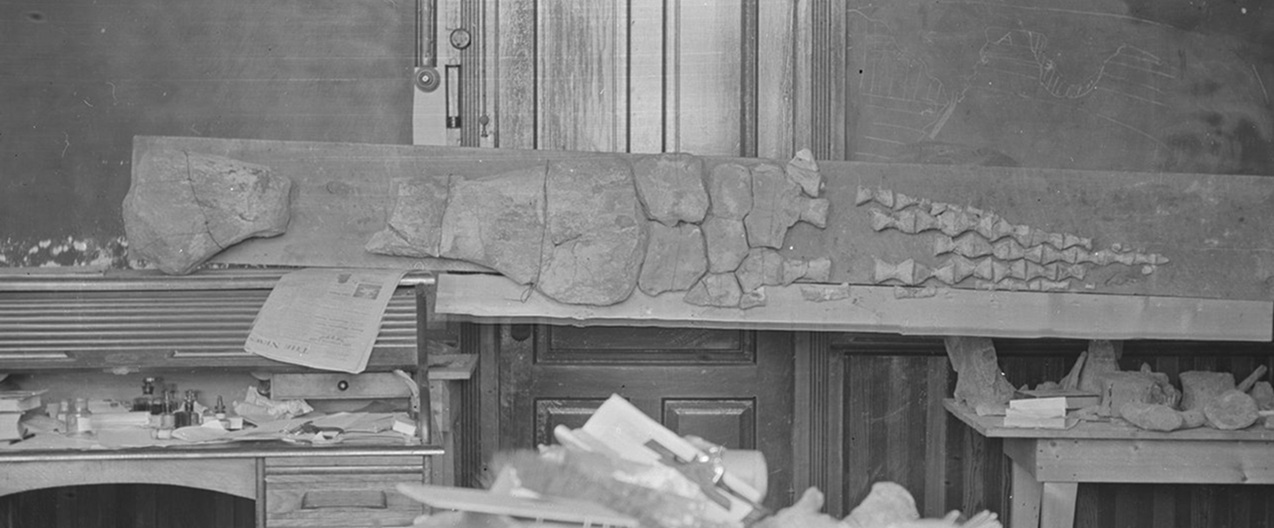
Flipper of Megalneusaurus rex. Samuel H. Knight Papers. University of Wyoming Digital Collections.
https://digitalcollections.uwyo.edu/luna/servlet/detail/uwydbuwy~22~22~564119~187695:Megalosaurus-Paddle?sort=rid%2Ctitle%2Cdate_original%2Csource&qvq=w4s:/what%2FPaleontology;sort:rid%2Ctitle%2Cdate_original%2Csource;lc:uwydbuwy~22~22&mi=88&trs=128.
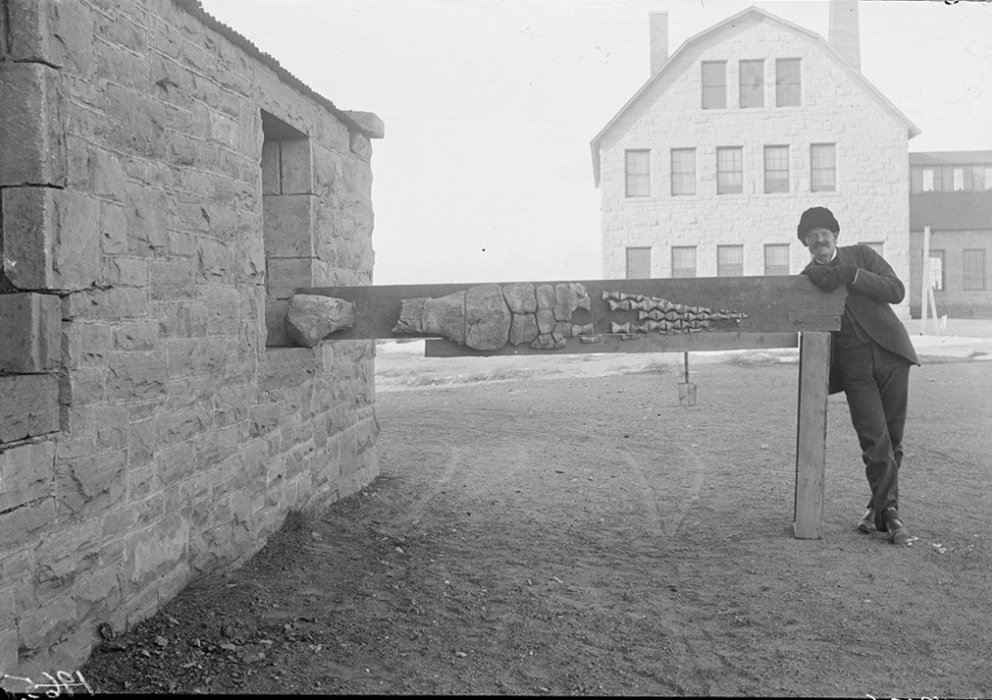
Flipper of Megalneusaurus rex. Samuel H. Knight Papers. University of Wyoming Digital Collections.
https://digitalcollections.uwyo.edu/luna/servlet/detail/uwydbuwy~22~22~567961~187914?sort=rid%2Ctitle%2Cdate_original%2Csource&qvq=sort:rid%2Ctitle%2Cdate_original%2Csource;lc:uwydbuwy~22~22&mi=1031&trs=3277.
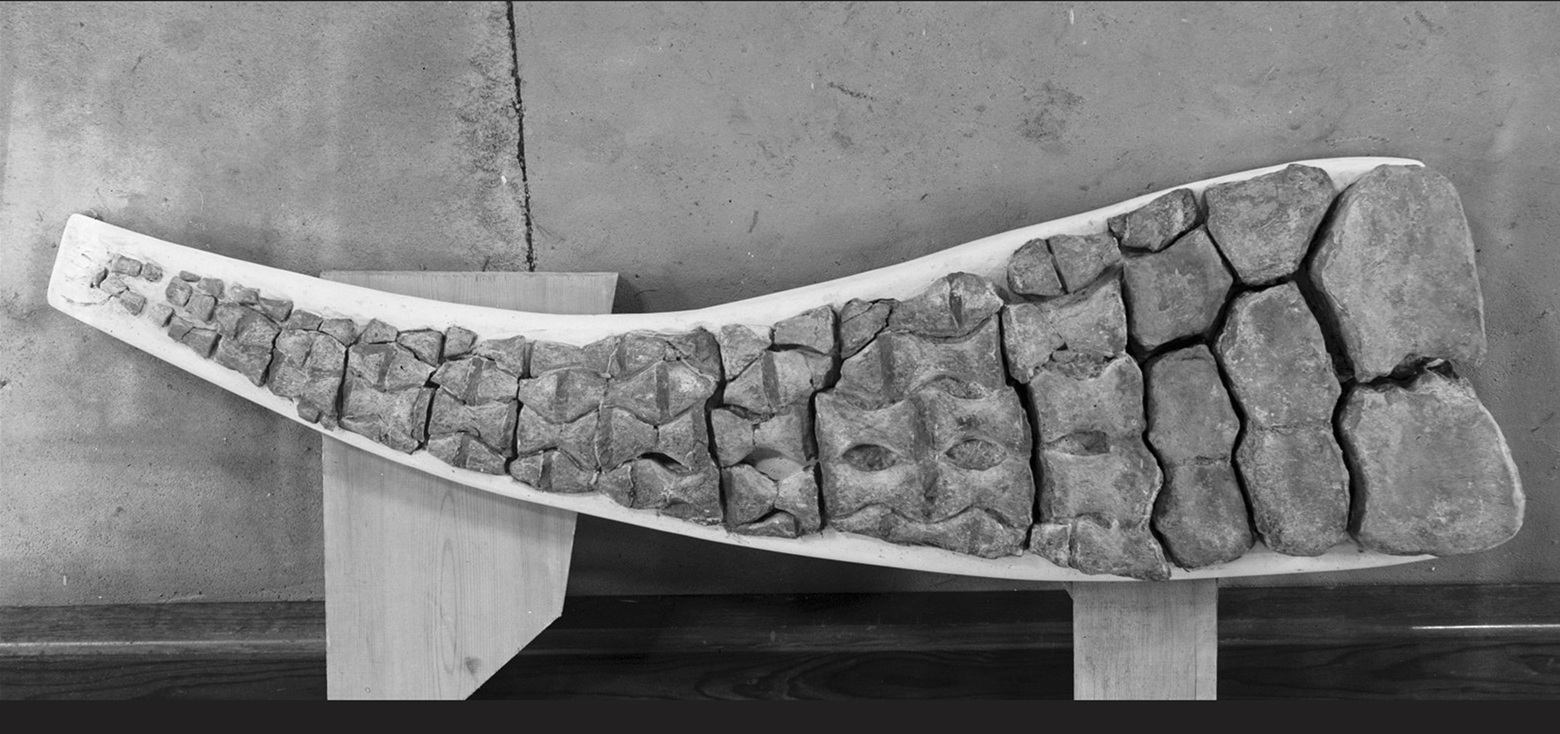
Flipper of Megalneusaurus in the process of being prepared for mounting. Samuel H. Knight Papers. University of Wyoming Digital Collections.
https://digitalcollections.uwyo.edu/luna/servlet/detail/uwydbuwy~22~22~567978~187915?sort=rid%2Ctitle%2Cdate_original%2Csource&qvq=sort:rid%2Ctitle%2Cdate_original%2Csource;lc:uwydbuwy~22~22&mi=1032&trs=3277.
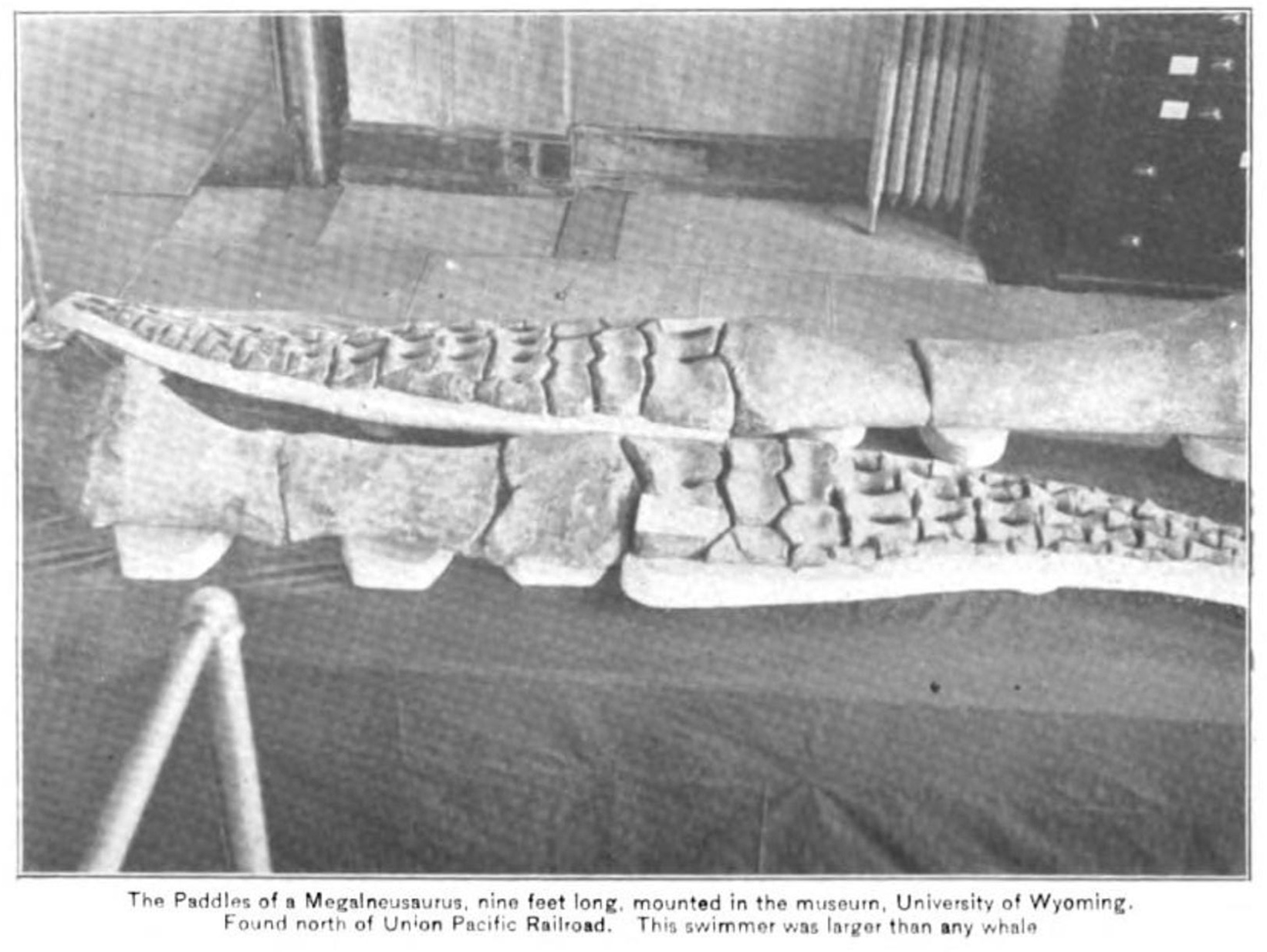
The left and right rear flippers of the pliosaur Megalneusaurus, ready to be mounted within the museum of the University of Wyoming. Reports by Members of the Union Pacific Expedition. The Fossil Fields of Wyoming. Omaha: Union Pacific Railroad Company, 1909. Page 30.
https://www.google.com/books/edition/The_Fossil_Fields_of_Wyoming/PYpGAQAAMAAJ?hl=en&gbpv=1&dq=Megalneusaurus&pg=PA30&printsec=frontcover.
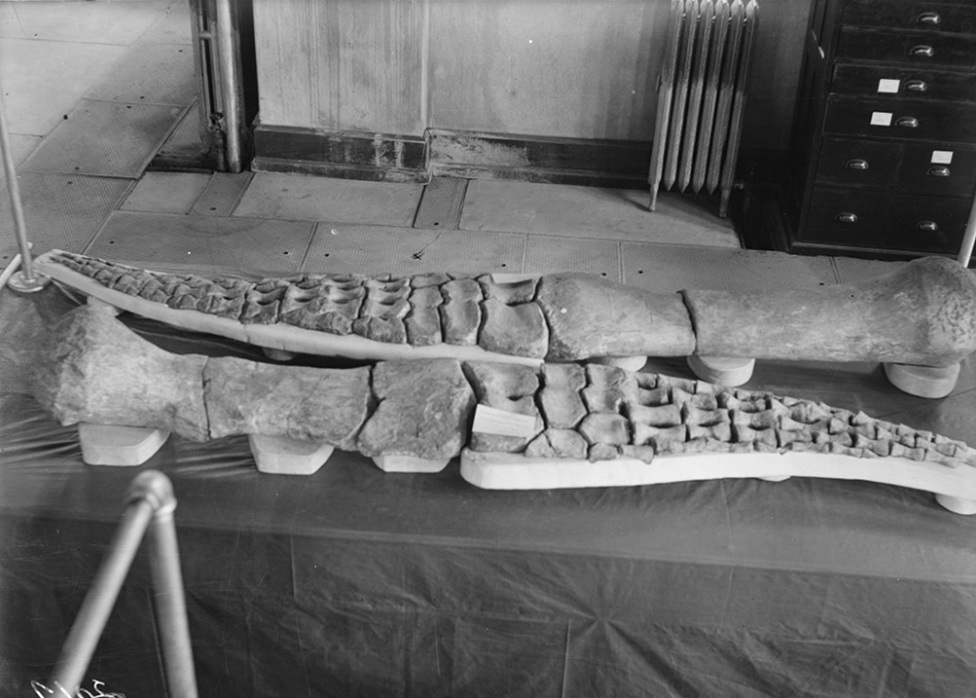
The left and right rear flippers of the pliosaur Megalneusaurus, ready to be mounted within the museum of the University of Wyoming. Samuel H. Knight Papers. University of Wyoming Digital Collections.
https://digitalcollections.uwyo.edu/luna/servlet/detail/uwydbuwy~22~22~564461~187713:Megalneusaur-Paddles?sort=rid%2Ctitle%2Cdate_original%2Csource&qvq=w4s:/what%2FPaleontology;sort:rid%2Ctitle%2Cdate_original%2Csource;lc:uwydbuwy~22~22&mi=106&trs=128.
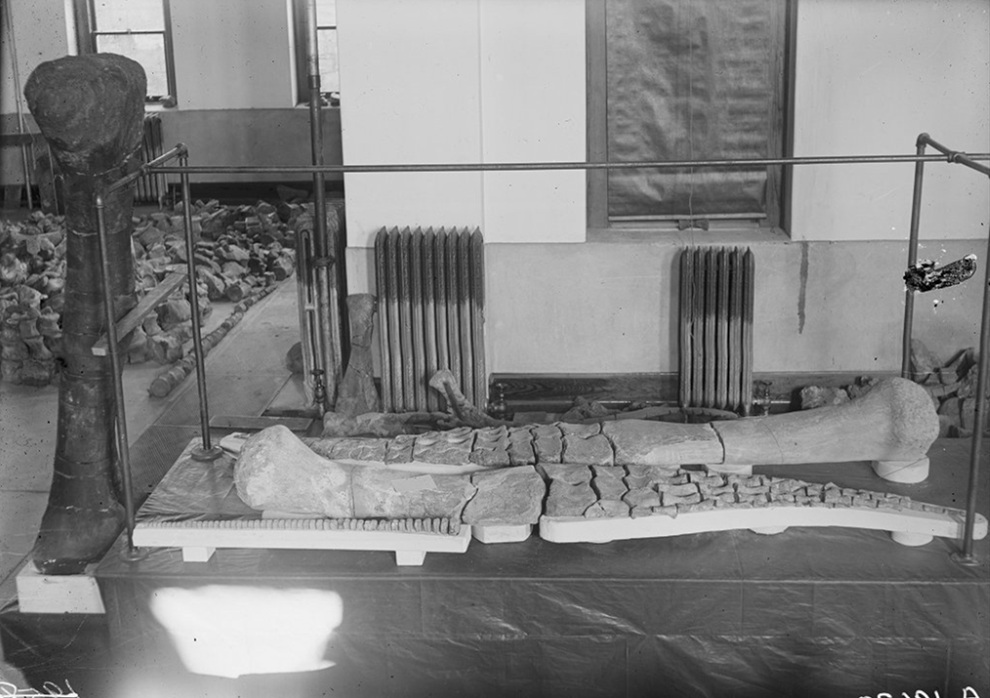
The left and right rear flippers of the pliosaur Megalneusaurus, ready to be mounted within the museum of the University of Wyoming. Samuel H. Knight Papers. University of Wyoming Digital Collections.
https://digitalcollections.uwyo.edu/luna/servlet/detail/uwydbuwy~22~22~567162~187867?sort=rid%2Ctitle%2Cdate_original%2Csource&qvq=sort:rid%2Ctitle%2Cdate_original%2Csource;lc:uwydbuwy~22~22&mi=984&trs=3277.
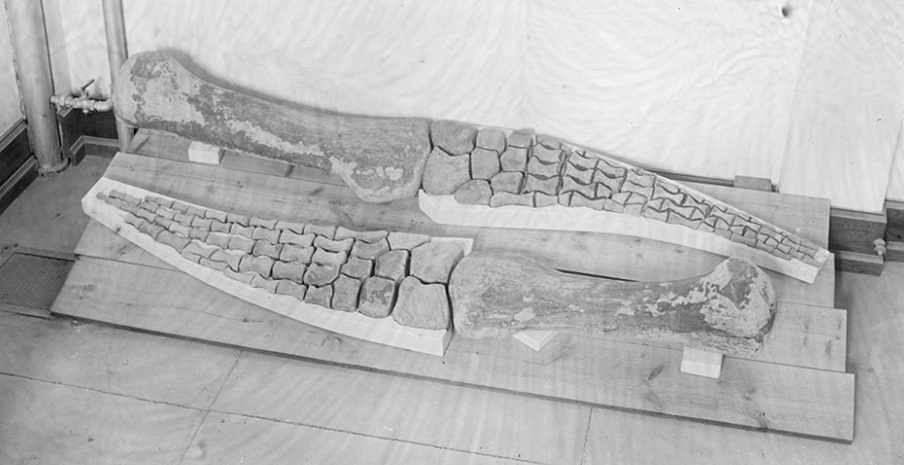
The reconstructed left and right rear flippers of Megalneusaurus rex. Samuel H. Knight Papers. University of Wyoming Digital Collections.
https://digitalcollections.uwyo.edu/luna/servlet/detail/uwydbuwy~22~22~564062~187692:Cast-of-Megalosaur-Paddles?sort=rid%2Ctitle%2Cdate_original%2Csource&qvq=w4s:/what%2FPaleontology;sort:rid%2Ctitle%2Cdate_original%2Csource;lc:uwydbuwy~22~22&mi=85&trs=128.
Knight stated in 1898 that Megalneusaurus was larger than the largest European pliosaur (Knight 1898, page 378), but did not specify which species of pliosaur he was referring to. The largest pliosaur from Europe is Pliosaurus funkei, which is commonly stated to have attained a length of 35-40 feet and is recognized as one of the largest pliosaurs that ever existed. If Knight was correct in stating that Megalneusaurus was even larger, then this would make it the largest pliosaur ever. In fact, a short book published in 1899 by the Union Pacific Railroad about the various fossils found in Wyoming proclaimed “The Megalneusaur represents the largest swimming Saurian known” (Union Pacific Railroad Company Passenger Department 1899, page 23). Another report by the Union Pacific Railroad from 1909 stated “This swimmer was larger than any whale” (Reports by Members of the Union Pacific Expedition 1909, page 30).
But just how big would Megalneusaurus have been? A report from 2006 said that Megalneusaurus measured a whopping 13 meters (42.7 feet) long (Wahl 2006, page 255). In their 2007 article, Wahl, Ross, and Massare estimated that Megalneusaurus measured more than 10 meters (32.8 feet) in size (Wahl et al. 2007, page 98). A later article from 2014 suggested a slightly smaller length of 9.2 meters (29.5 feet) (Massare et al. 2014, page 173-174). Based upon the size of the bones and the ontogenetic characteristics of the bones themselves, it is believed that the specimen was an adult (Wahl et al. 2007, page 98).
In addition to the obvious problems in determining size due to incomplete remains, another problem in determining size is phylogeny because different pliosaurs had different physical proportions. It was noted that the bones of Megalneusuarus were similar in certain respects to those of Peloneustes (Knight 1898, page 378; Longman 1930, page 7), which proportionally had a longer neck and smaller head to Pliosaurus. Indeed, the paddle of Megalneusaurus seems to be similar in overall shape to those of Peloneustes, except that the femur was substantially longer. In 1940, Charles Lewis Camp and Vertress Lawrence Vanderhoof classified Megalneusaurus as a member of the family Pliosauridae but outside of the sub-family Pliosaurinae (Camp and Vanderhoof 1940, pages 410, 444). However, no explanation was given in their report as to why they believed this was the case, and subsequent phylogenic analyses have shown numerous errors in their overall placement of different plesiosaurian genera.
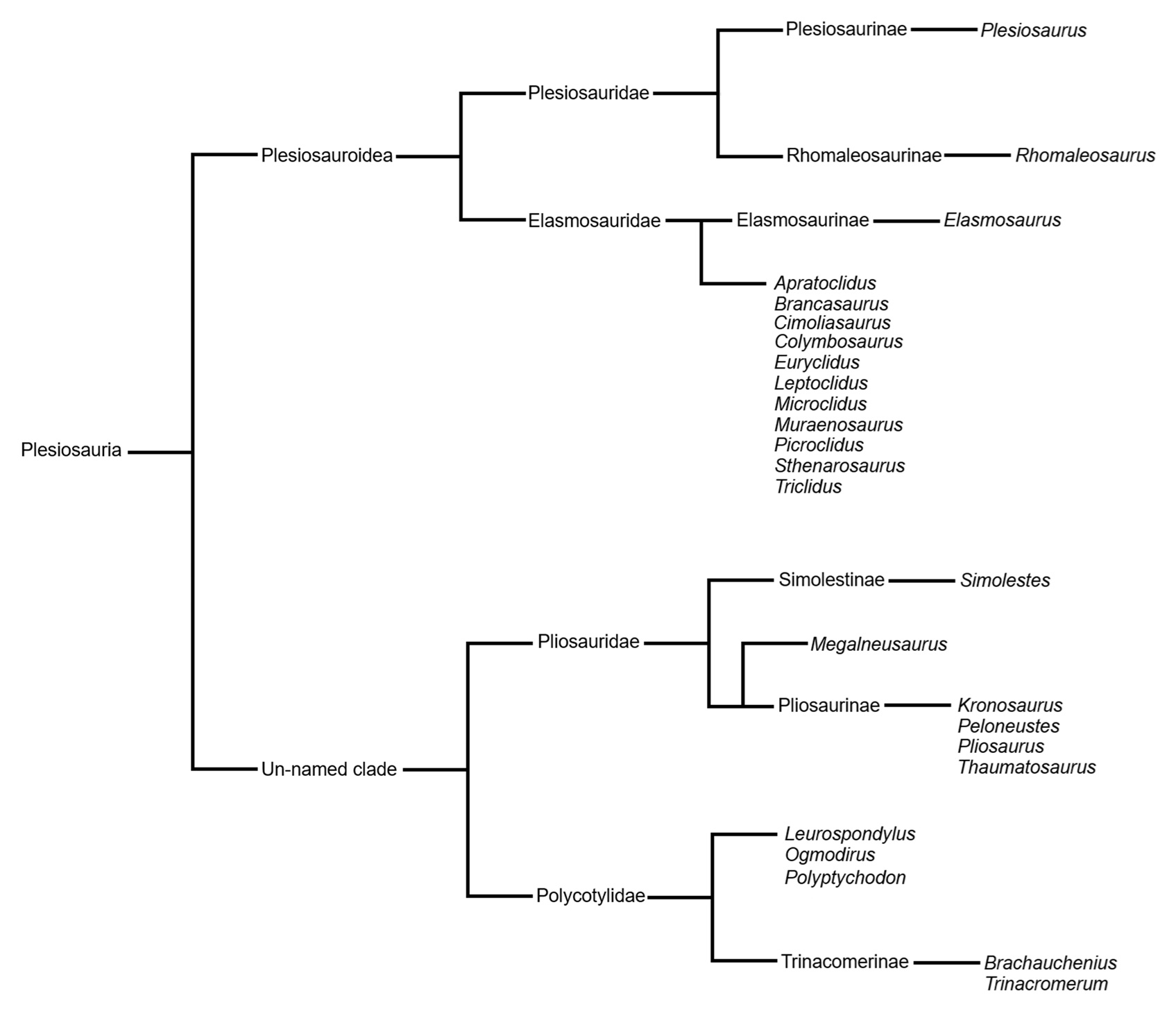
The complete phylogeny of Plesiosauria, according to Charles Lewis Camp and Vertress Lawrence Vanderhoof in 1940. A lot has changed since then: many more names have been added onto this chart, some of the names seen here have since been declared invalid or dubious, and some of their positions have been shuffled around. Note that in this graph, the genus Megalneusaurus is listed as a member of the family Pliosauridae, but outside of the sub-family Pliosaurinae. However the authors didn’t explain how they determined this to be so. Camp, C. L.; Vanderhoof, V. L. (1940). “Bibliography of Fossil Vertebrates, 1928-1933”. Geological Society of America Special Papers, no. 27 (November 20, 1940). Pages 325, 335-336, 348, 351, 367, 374, 399, 402-403, 410, 414, 417, 435, 439, 443-445, 458, 464, 470, 476, 480-481.
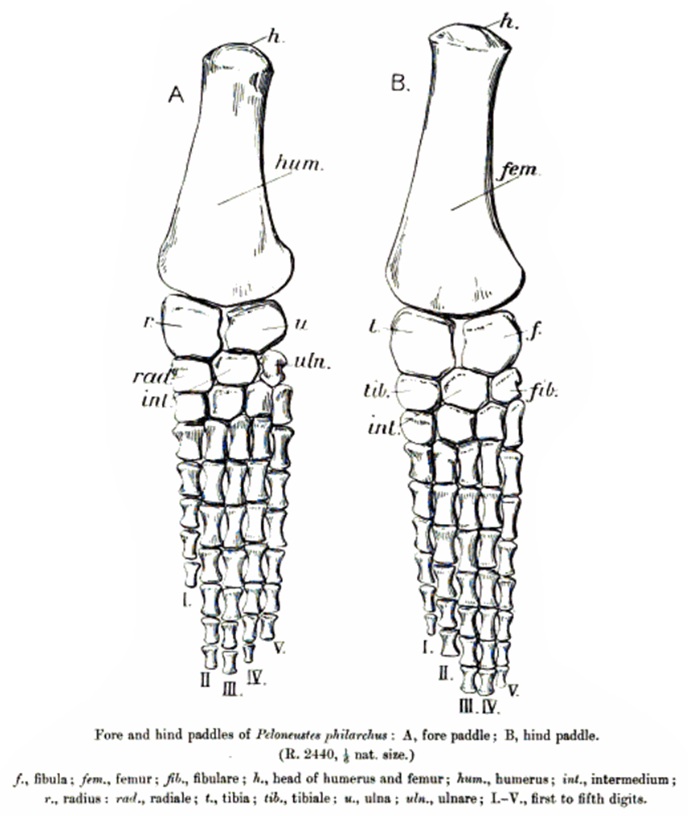
Front and rear flippers of Peloneustes philarchus. Andrews, Charles William. A Descriptive Catalogue of the Marine Reptiles of the Oxford Clay, Part II. London: Longmans, Green, and Co., 1913. Page 57.
In addition to similarities to Peloneustes, the femur of Megalneusaurus is also similar to that of Pliosaurus macromerus, as figured in Lydekker (1889), found at Kimmeridge Bay within the Kimmeridge Clay Formation. The total length of Pliosaurus macromerus’ hind limb is 6.5 feet (1.96 meters), with a femur measuring 37 inches (93 cm) (Lydekker 1889, page 138); the whole animal is estimated to have measured26 feet (8 meters) (Paul 2022, page 102). Megalneusaurus had a rear flipper measuring 7.25 feet (2.209 meters) and a femur measuring 39 inches (99.1 cm). If we extrapolate Megalneusaurus’ size based upon its overall fin length and femur length, and comparing it with the fin of the 26 foot long Pliosaurus macromerus, this would result in Megalneusaurus having a total length of 28-30 feet (8.52-9 meters).
However, if Megalneusaurus was more closely related to Peloneustes than Pliosaurus, this would change its body proportions and also increase its overall length. The femur of Peloneustes philarchus measured 39 cm with a width of 19.3 cm (Andrews 1913, page 64). Megalneusaurus’ femur (erroneously recorded in Knight 1898 as a humerus) measured over two and a half times longer at 99.1 centimeters with a width of 36.5 cm (Knight 1898, page 379). If we extrapolate Megalneusaurus’ size based upon its femur length of 99.1 cm, and comparing it with the femur of the 4 meter long Peloneustes philarchus which measured 39 cm, this would result in Megalneusaurus having a total length of 33.3 feet (10.16 meters).
Curiously, Camp and Vanderhoof’s 1940 statement of Megalneusaurus’ placement within the pliosaur tree may have inadvertently been right all along. Megalneusaurus’ flipper construction shows features seen in middle-grade pliosaurus like Peloneustes and more advanced pliosaurus like Pliosaurus. A combination of basal and derived features is often indicative of an animal being an intermediate species. In this case, Megalneusaurus was more advanced than Peloneustes, but not quite as advanced as Pliosaurus. This also corresponds well with the timelines of the respective genera. Therefore, Camp and Vanderhoof’s statement that Megalneusaurus was placed within Pliosauridae but outside of the sub-family Pliosaurinae might be accurate after all.
A magazine article from 1900 reads as follows: “Megalneusaurus rex, a new genus discovered by Professor Knight and described by him in the ‘American Journal of Science,’ has just been restored by Frank Bond, of Cheyenne. The fossil animal stands in a lifelike pose and is shown swallowing a shark. The shark was contemporaneous with him, for shark’s teeth are found in the grave of the monster” (Bell 1900, page 275). Frank Bond was a noted naturalist who came to Cheyenne, Wyoming in 1882 and stayed until 1905. He had a colorful career, working as a surveyor, newspaper publisher, a member of the Wyoming state legislature when the territory gained statehood, and his fascination with birds led him to serve as the president of the Wyoming Audubon Society. Eventually he took a job in Washington D.C. as a member of the Department of the Interior (Dorn 1978, pages 327-328).
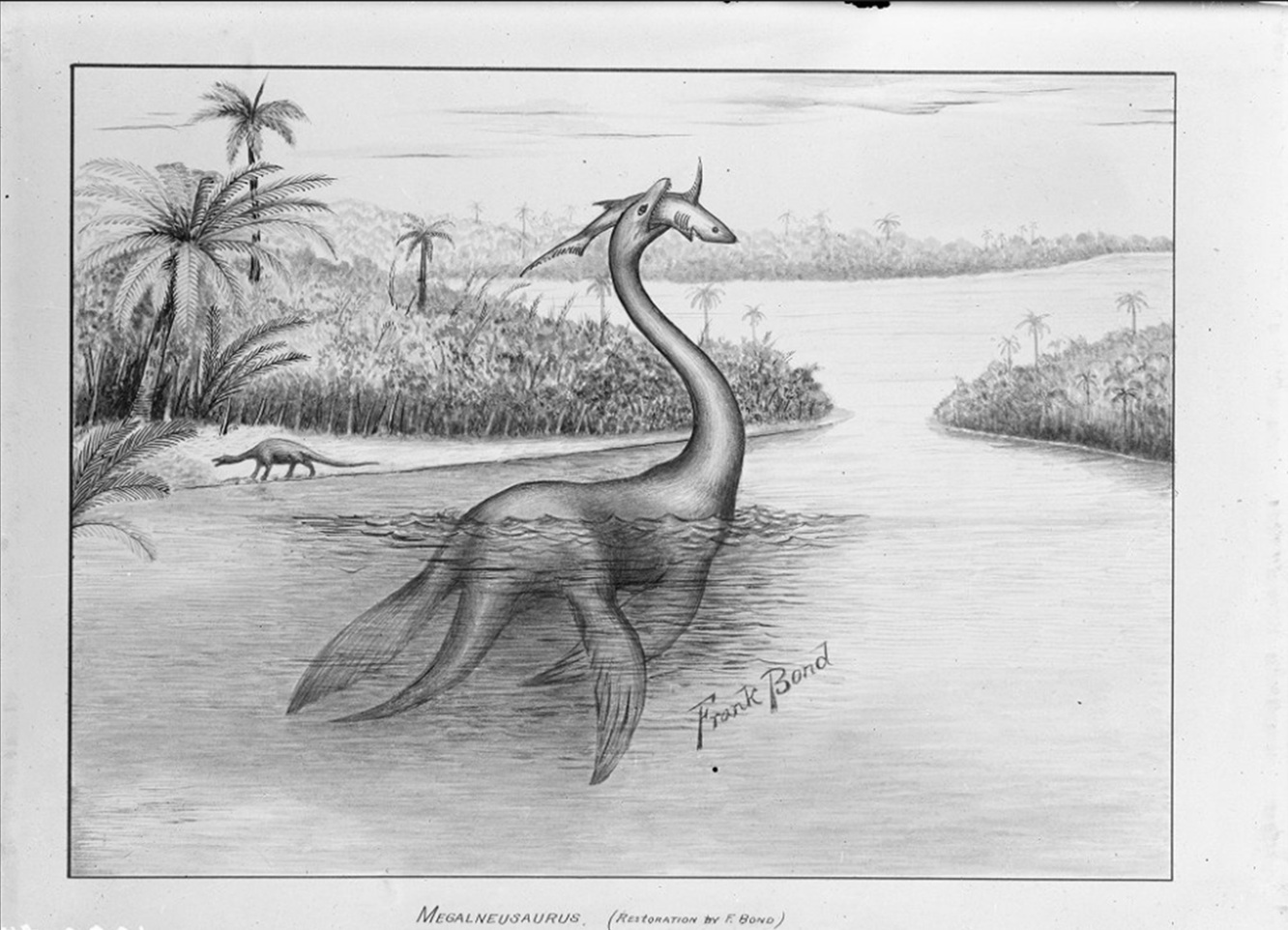
The oldest-known paleo-art of Megalneusaurus, illustrated by Frank Bond in 1900. Here it is reconstructed as a traditional long-necked plesiosaur instead of as a short-necked pliosaur. Samuel H. Knight Papers. University of Wyoming Digital Collections.
https://digitalcollections.uwyo.edu/luna/servlet/detail/uwydbuwy~22~22~562722~187619:Megalneusaurus?sort=rid%2Ctitle%2Cdate_original%2Csource&qvq=w4s:/what%2FPaleontology;sort:rid%2Ctitle%2Cdate_original%2Csource;lc:uwydbuwy~22~22&mi=59&trs=128.
Remarkably, more specimens of Megalneusaurus were found in the same type locality as the holotype which had been missed in earlier excavations: “In 2008, an articulated distal forelimb of the type specimen of the large pliosauromorph Megalneusaurus rex (UW 4602) was discovered adjacent to the original excavation pit from which two hindlimbs had been collected in 1895. The new material includes six complete or partial carpals, four metacarpals, and nearly all of the phalanges” (Wahl et al. 2010, page 170).
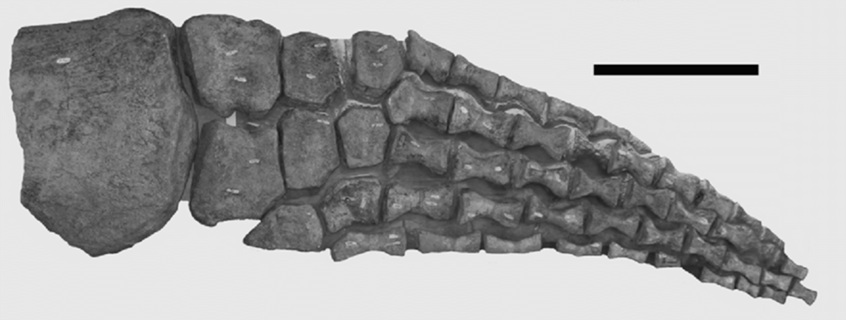
Megalneusaurus rex hind flipper found in 1895 (UW4602). Scale bar = 30 cm. Wahl et al. 2010, page 178.
https://www.researchgate.net/publication/267723458_New_material_from_the_type_specimen_of_Megalneusaurus_rex_Reptilia_Sauropterygia_from_the_Jurassic_Sundance_Formation_Wyoming.
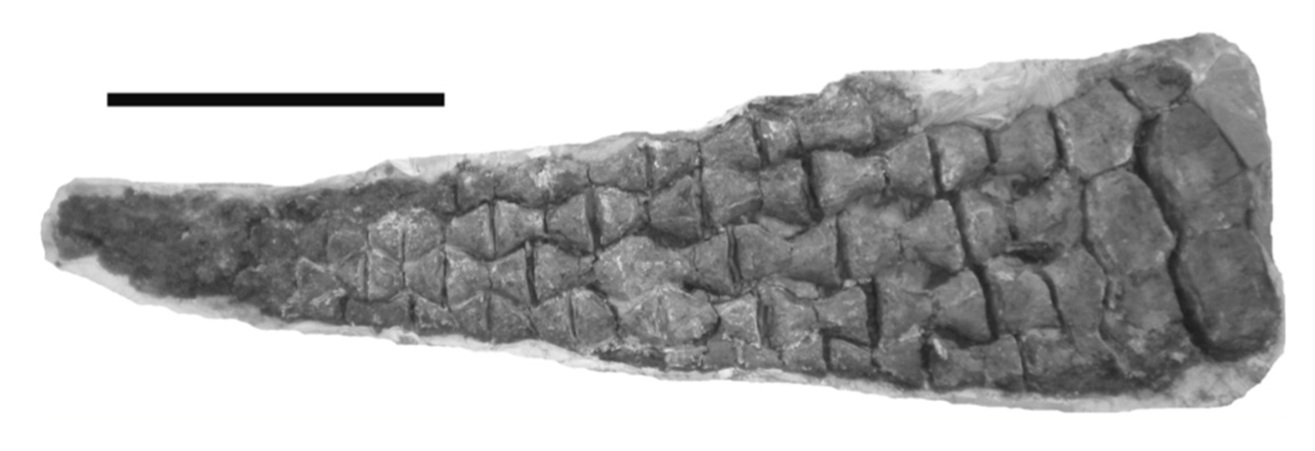
Megalneusaurus rex front flipper found in 2008. Scale bar = 30 cm. Wahl et al. 2010, page 173.
https://www.researchgate.net/publication/267723458_New_material_from_the_type_specimen_of_Megalneusaurus_rex_Reptilia_Sauropterygia_from_the_Jurassic_Sundance_Formation_Wyoming.
Aside from the fins and the now-lost body remains that were found in the Dutton Oil Basis, the only physical evidence that we have attributed to pliosaurs from Wyoming are an isolated neural arch (collection ID code: UW24238) found in the upper part of the Redwater Shale Member (Wahl et al. 2007, page 94) and a weathered propodeal fragment (collection ID code: WDC SS019) (Wahl et al. 2010, page 170).
Yet Wyoming isn’t the only place where Jurassic pliosaur remains are found within North America. In southern Alaska in June of 1922, a man named Jack Mason discovered some fossilized bone fragments near the mouth of the Kejulik River northeast of Becharof Lake, consisting of the proximal and distal end of a large humerus – the central third of the bone was missing. These bones were found within a layer of shale in Alaska’s Naknek Formation, which dates to the late Jurassic Period and which was deposited in a shallow water environment close to the shore (Smith and Baker 1924, pages 169, 172-173, 178-184). These bones were sent to W. R. Smith of the US Geological Survey, who happened to be doing research in the nearby area, and he gave a preliminary identification of it as a dinosaur bone. These bones were afterwards sent to the Smithsonian Institution in Washington, D.C., and the paleontologist J. W. Gidley wrote a report in which he proposed that these two bone fragments belonged to a large plesiosaur, although he could not determine which species it belonged to. Gidley wrote that these bone fragments were found in the uppermost layer of the Naknek Formation, meaning that these bones dated to the end of the Jurassic Period. However, this was likely a mistake, because the rocks where these bones were reportedly found were from the middle of the Naknek Formation, which is dated from the late Oxfordian to early Kimmeridgian Stages, 160-155 MYA. The two humerus fragments were analyzed further, and they were determined to have definitely belonged to a pliosaur, just as J. W. Gidley suspected. Megalneusaurus, whose fossils had hitherto only been found in Wyoming, proved to be the closest match in terms of appearance, although the humerus of Megalneusaurus and this partial humerus found in Alaska were not exactly identical (Weems and Blodgett 1996, pages 169-174).
The fins which were recovered in Wyoming show that Megalneusaurus’ flippers were curved backwards like shark fins, and they were stiff rather than floppy (Wahl et al. 2010, pages 175-177). Furthermore, the long length of the humeri and femora resulted in Megalneusaurus having proportionally long flippers compared to many other pliosaurs, and likely resulted in the animal being a powerful swimmer (Weems and Blodgett 1996, page 173).
One reason for this was that Megalneusaurus chased after fast-moving prey. Stomach contents showed that it was filled with hooklets from cephalopod tentacles, which are indicative of belemnites (Wahl et al. 2007, page 101). A skeleton of Peleneustes also contained a large amount of hooklets and belemnite shells (Andrews 1913, page 64), showing that these distant relatives of squid were a common food source for marine reptiles. Would Megalneusaurus have hunted in packs, like modern-day killer whales? A single Megalneusaurus would have been terrifying enough, but a whole pod of them would have been something out of a nightmare. Personally, I don’t believe that these animals possessed the intellectual capacity to form social groups and hunt cooperatively, so it’s more likely that they would have been solitary hunters, possibly congregating upon a kill site like crocodiles.
Many cephalopods live in deep water, and belemnites were probably no different. But diving deep in search of prey could lead to problems. A report from 2003 stated that both of Megalneusaurus’ femora (mistakenly identified as humeri) showed signs of avascular necrosis, a condition where cells die from lack of bloodflow (Rothschild and Storrs 2003, page 326). This is a condition that often results from decompression sickness, commonly known as “the bends”, in which bubbles of gas form in the blood due to ascending from a deep dive too quickly. This can potentially cause a reduction or stoppage of bloodflow resulting in tissues dying. In the preserved specimens of Megalneusaurus, the femoral heads which attached to the hip sockets showed evidence that the bone tissue had died and was breaking apart; this is called “subsidence” (Rothschild and Storrs 2003, page 326). This would have caused intense excruciating pain in the hip joints and would have made movement difficult, if not impossible. The evidence, therefore, is that the individual which had been discovered by Knight in 1895 was a mature adult, possibly fully grown, which was suffering from debilitating physical ailments and had to endure horrible chronic pain. The bone, which was literally decomposing inside its own body, likely led to sepsis, and eventually death.
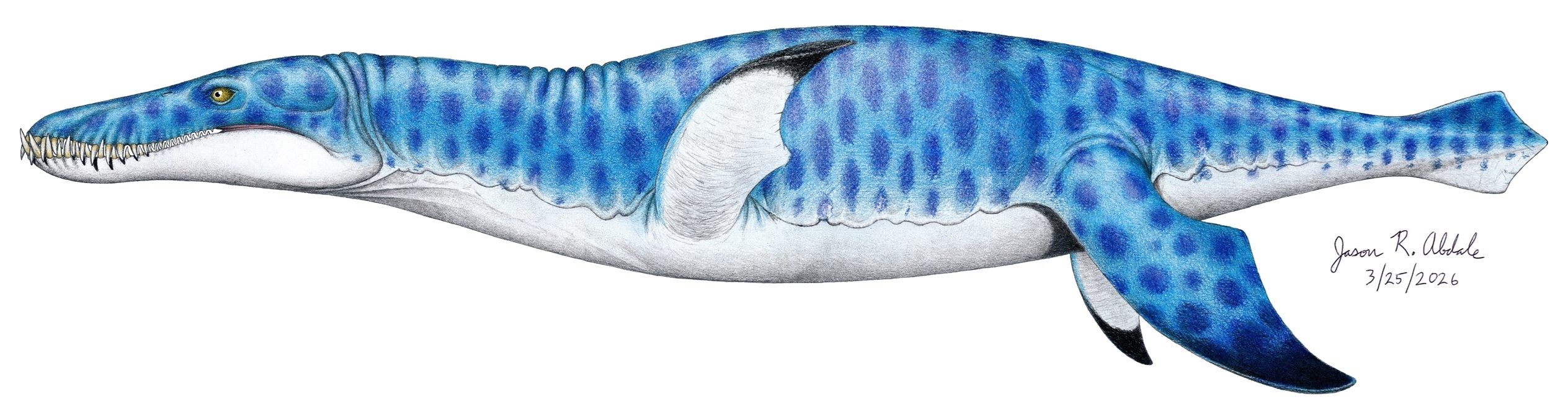
Megalneusaurus rex. © Jason R. Abdale (March 25, 2026).
I truly enjoy writing my articles and drawing my art, but it’s increasingly clear that I can’t keep this up without your gracious financial assistance. Kindly check out my pages on Redbubble and Fine Art America if you want to purchase merch of my artwork. Consider buying my ancient Roman history books Four Days in September: The Battle of Teutoburg and The Great Illyrian Revolt if you or someone that you know loves that topic, or my ancient Egyptian novel Servant of a Living God if you enjoy action and adventure. Please consider becoming a patron on my Patreon page so that I can continue to purchase the art supplies and research materials that I need. Professional art supplies are pricey, many research articles are “pay to read”, and some academic journals are rather expensive. My Patreon membership is just $1 per month – that’s it. If everybody who likes this drawing donates just one dollar per month, it would go a long way to keeping my blog “Dinosaurs and Barbarians” running and preventing my career in paleo-art from going extinct.
Take care, and as always, keep your pencils sharp.
Bibliography
Books
Andrews, Charles William. A Descriptive Catalogue of the Marine Reptiles of the Oxford Clay, Part II. London: Longmans, Green, and Co., 1913.
https://www.google.com/books/edition/A_Descriptive_Catalogue_of_the_Marine_Re/RkjnAAAAMAAJ?hl=en&gbpv=1.
Dorn, Jane Logan. Wyoming Ornithology. Washington, D.C.: U.S. Bureau of Land Management, 1978.
https://www.google.com/books/edition/Wyoming_Ornithology/BtixTwk7o68C?hl=en&gbpv=1.
Lydekker, Richard. Catalogue of the Fossil Reptilia and Amphibia in the British Museum (Natural History), Part II. London: Longmans & Co., 1889.
https://www.google.com/books/edition/Catalogue_of_the_Fossil_Reptilia_and_Amp/g7wPQEe5BdMC?hl=en&gbpv=1.
Paul, Gregory S. The Princeton Field Guide to Mesozoic Sea Reptiles. Princeton: Princeton University Press, 2022.
Reports by Members of the Union Pacific Expedition. The Fossil Fields of Wyoming. Omaha: Union Pacific Railroad Company, 1909.
https://www.google.com/books/edition/The_Fossil_Fields_of_Wyoming/PYpGAQAAMAAJ?hl=en&gbpv=1&dq=Megalneusaurus&pg=PA30&printsec=frontcover.
Union Pacific Railroad Company Passenger Department. Some of Wyoming’s Vertebrate Fossils. Omaha: Union Pacific Railroad Company, 1899.
https://www.google.com/books/edition/Some_of_Wyoming_s_Vertebrate_Fossils/JIksAAAAYAAJ?hl=en&gbpv=1.
Articles
Bell, Howard W. (1900). “Fossil-Hunting in Wyoming”. The Cosmopolitan, volume 28 (November 1899-April 1900). Pages 265-275.
https://www.google.com/books/edition/Cosmopolitan/6iFNAQAAMAAJ?hl=en&gbpv=1&dq=Megalneusaurus&pg=PA275&printsec=frontcover.
Camp, C. L.; Vanderhoof, V. L. (1940). “Bibliography of Fossil Vertebrates, 1928-1933”. Geological Society of America Special Papers, no. 27 (November 20, 1940). Pages 1-503.
https://www.google.com/books/edition/Bibliography_of_Fossil_Vertebrates_1928/i4gQAAAAIAAJ?hl=en&gbpv=1&dq=Longman+1930+Megalneusaurus&pg=PA410&printsec=frontcover.
Knight, W. C. (1895). “A new Jurassic plesiosaur from Wyoming”. Science, volume 2, issue 40 (October 4, 1895). Page 449.
https://www.science.org/doi/10.1126/science.2.40.449.a.
Knight, Wilbur C. (1898). “Some new Jurassic vertebrates from Wyoming, second paper”. American Journal of Science, series 4, volume 5 (1898). Pages 378-381.
https://www.biodiversitylibrary.org/item/124698#page/412/mode/1up.
Longman, Herber A. (1930). “Kronosaurus queenslandicus: A Gigantic Cretaceous Pliosaur”. Memoirs of the Queensland Museum, volume 10, part 1 (1930). Pages 1-7.
https://www.google.com/books/edition/Memoirs_of_the_Queensland_Museum/8_QoAQAAMAAJ?hl=en&gbpv=1.
Massare, Judy A.; Wahl, William R; Ross, Mike; Connely, Melissa V. (2014). “Palaeoecology of the marine reptiles of the Redwater Shale Member of the Sundance Formation (Jurassic) of central Wyoming, USA”. Geological Magazine, volume 161, issue 1 (January 2014). Pages 167-182.
https://www.researchgate.net/publication/272010903_Palaeoecology_of_the_marine_reptiles_of_the_Redwater_Shale_Member_of_the_Sundance_Formation_Jurassic_of_central_Wyoming_USA.
Rothschild, Bruce M.; Storrs, Glenn W. (2003). “Decompression syndrome in plesiosaurs (Sauropterygia: Reptilia)”. Journal of Vertebrate Paleontology, volume 23, issue 2 (June 2003). Pages 324-328.
https://www.researchgate.net/publication/40663083_Decompression_syndrome_in_plesiosaurs_Sauropterygia_Reptilia.
Smith, W. R.; Baker, Arthur A. (1924). “The Cold Bay-Chignik District”. US Geological Survey Bulletin 755: Mineral resources of Alaska, report on progress of investigations in 1922. The Cold Bay-Chignik district. Washington, D.C.: United States Government Printing Office, 1924. Pages 151-222.
https://pubs.usgs.gov/bul/0755d/report.pdf.
Wahl, William (2006). “A juvenile plesiosaur (Reptilia: Sauropterygia) assemblage from the Sundance Formation (Jurassic), Natrona County, Wyoming”. Paludicola, volume 5, issue 4 (June 2006). Pages 255-261.
https://rivp-paludicola.org/wp-content/uploads/2025/09/5-4-wahl-2006.pdf.
Wahl, William R.; Massare, Judy; Ross, Mike. (2010). “New material from the type specimen of Megalneusaurus rex (Reptilia: Sauropterygia) from the Jurassic Sundance Formation, Wyoming”. Paludicola, volume 7, issue 4 (May 2010). Pages 170-180.
https://www.researchgate.net/publication/267723458_New_material_from_the_type_specimen_of_Megalneusaurus_rex_Reptilia_Sauropterygia_from_the_Jurassic_Sundance_Formation_Wyoming.
Wahl, William R.; Ross, Mike; Massare, Judy A. (2007). “Rediscovery of Wilbur Knight’s Megalneusaurus rex site: New material from an old pit”. Paludicola, volume 6, issue 2 (June 2007). Pages 94-104.
https://www.researchgate.net/publication/229013018_Rediscovery_of_Wilbur_Knight%27s_Megalneusaurus_rex_site_new_material_from_an_old_pit.
Weems, Robert E.; Blodgett, Robert B. (1996). “The Pliosaurid Megalneusaurus: A Newly Recognized Occurrence in the Upper Jurassic Naknek Formation of the Alaska Peninsula”. US Geological Survey Bulletin 2152: Geologic Studies in Alaska by the U.S. Geological Survey, 1994. Washington, D.C.: United States Government Printing Office, 1996. Pages 169-175.
https://ecos.fws.gov/ServCat/DownloadFile/129372?Reference=85097.
Websites
Fossilworks. “Cimoliasaurus Leidy 1851”.
http://fossilworks.org/bridge.pl?a=taxonInfo&taxon_no=171301.
Categories: Paleontology, Uncategorized
 DINOSAURS AND BARBARIANS
Leave a comment