
Sulcusuchus was a small polycotylid plesiosaur which lived off the coast of Argentina during the late Cretaceous Period around 70 million years ago.
The fossils of this animal (collection ID code: MLP 88-IV-10-1) were first discovered 25 km north of the town of Ingeniero Jacobacci, Rio Negro Province, Argentina within the rocks of the Coli Toro Formation (O’Gorman and Gasparini 2013, page 165). This geologic formation straddles the boundary between the end of the Cretaceous Period and the beginning of the Paleogene Period, the first period of the Cenozoic Era (Paulina-Carabajal et al. 2025, page 493). The specimen, which consisted of just a fragment of a lower jaw, was found within the lower part of the Coli Toro Formation, which would date it to the Maastrichtian Stage of the Cretaceous Period – the last stage of “the Age of the Dinosaurs” (Gasparini and Spalletti 1990, page 141; O’Gorman and Gasparini 2013, page 165).
Another specimen (collection ID code: MPEF 650) was afterwards uncovered within middle part of the La Colonia Formation. This formation, like the Coli Toro Formation, also dates to the Cretaceous/Paleogene transition from the lower Maastrichtian Stage ca. 71.7 MYA to the lowermost part of the Danian Stage of the Paleogene Period ca. 65 MYA (Clyde et al. 2021: e104889). This specimen was much more complete, consisting of the back of the palate of the upper jaw, the lower part of the braincase, a fragment of the middle of the lower jaw, and another fragment from the rear-left of the lower jaw including the jaw joint condyle (O’Gorman and Gasparini 2013, page 165).
When the fossils of this animal were discovered, it was believed that they belonged to a crocodile, possibly a member of the family Dyrosauridae. In 1990, Zulma Brandoni de Gasparini and Luis Spalletti named it Sulcusuchus. The name means “groove crocodile” due to a set of grooves in its lower jaw (Gasparini and Spalletti 1990, pages 141-150). In 2000, Gasparini and de la Fuente determined that these fossils actually belonged to a plesiosaur from the family Polycotylidae (Gasparini and de la Fuente 2000, pages 23, 30-31).
In 2025, it was reported that another specimen of Sulcusuchus (collection ID code: MPEF-PV 11698) had been found within the middle part of the La Colonia Formation. This specimen was remarkable because ninety-five gastroliths were found in its stomach cavity (O’Gorman et al. 2025, pages 1-13).
Several vertebrae from an as-yet-unidentified polycotylid plesiosaur (collection ID code: MML PV 43) were found within the Allen Formation, which dates from the late Campanian Stage to the early Maastrichtian Stage. While these vertebrae were generally assigned to the family Polycotylidae, they might belong to Sulcusuchus, it being a polycotylid known to have lived in Argentina during this time (Salgado et al. 2007, pages 349-358).
All of the fossils which are ascribed to Sulcusuchus date to the upper Campanian and lower Maastrichtian Stages of the late Cretaceous (O’Gorman and Gasparini 2013, pages 163-165).
In 2013, O’Gorman and Gasparini noted several similarities in skull structure between Sulcusuchus and Dolichorhynchops, and also in Trinacromerum to a lesser extent (O’Gorman and Gasparini 2013, pages 167, 169, 170, 172, 173). Then in 2022, it was stated (albeit with no evidence) that Sulcusuchus was the sister taxon to Plesiopleurodon, from the middle Cretaceous of North America (Persons et al. 2022: e105033).
Sulcusuchus was very small for a polycotylid. The hypothetical reconstruction of its lower jaw in O’Gorman and Gasparini (2013) measured 19.1 inches (48.5 cm) long (O’Gorman and Gasparini 2013, page 170). Compare this to the lower jaw of the well-known 12 foot long polycotylid Trinacromerum which measured 59% larger at 30.5 inches (77.5 cm). By comparing the size of Trinacromerum’s jaw with its overall body size, and then looking at the jaw of Sulcusuchus and making size comparisons, Sulcusuchus possibly measured just 7.15 feet long (2.18 meters), but that’s assuming that Sulcusuchus was proportioned exactly the same way that Trinacromerum was proportioned.
Examination of the rocks that the bones were found in suggests that Sulcusuchus lived in slow-moving water filled with sediment, such as muddy rivers or river mouths. According to Zulma B. Gasparini and colleagues, “Sedimentological analysis suggests that deposition would have been mostly in low-energy restricted environments, like muddy plains, marshes and ponds cut by meandering channels, probably in the central mixed-energy zone within an estuary” (Gasparini et al. 2015, page 154). This implies that Sulcusuchus inhabited shallow water environments, possibly with low visibility. It has been noted that the groves in the skull which Sulcusuchus is named after are also seen in the jaws of cetaceans which inhabit shallow murky environments like rivers and estuaries, notably the Guiana Dolphin (Sotalia guianensis) which uses electroreceptors in its jaws to find fish buried in sediment (O’Gorman and Gasparini 2013, page 174). Perhaps Sulcusuchus also had sensitive nerve-filled jaws to find prey in murky water.
Below is my reconstruction of Sulcusuchus, based upon its fragmentary fossils as well as the related polycotylid Dolichorhynchops. The grayish-pink coloration was inspired by modern-day river dolphins.
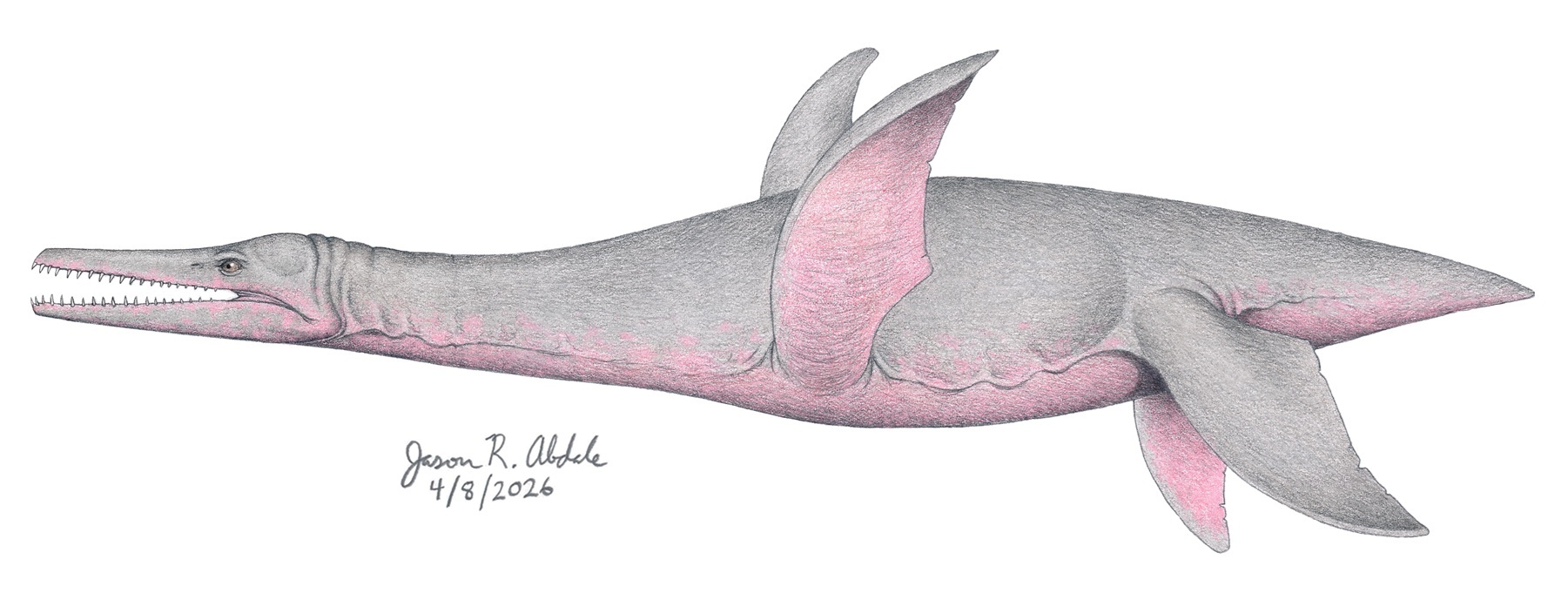
Sulcusuchus erraini. © Jason R. Abdale (April 8, 2026).
I truly enjoy writing my articles and drawing my art, but it’s increasingly clear that I can’t keep this up without your gracious financial assistance. Kindly check out my pages on Redbubble and Fine Art America if you want to purchase merch of my artwork. Consider buying my ancient Roman history books Four Days in September: The Battle of Teutoburg and The Great Illyrian Revolt if you or someone that you know loves that topic, or my ancient Egyptian novel Servant of a Living God if you enjoy action and adventure. Please consider becoming a patron on my Patreon page so that I can continue to purchase the art supplies and research materials that I need. Professional art supplies are pricey, many research articles are “pay to read”, and some academic journals are rather expensive. My Patreon membership is just $1 per month – that’s it. If everybody who likes this drawing donates just one dollar per month, it would go a long way to keeping my blog “Dinosaurs and Barbarians” running and preventing my career in paleo-art from going extinct.
Take care, and as always, keep your pencils sharp.
Bibliography
Clyde, W. C.; Krause, J. M.; De Benedetti, F.; Ramezani, J., Cúneo, N. R.; Gandolfo, M. A.; Haber, P.; Whelan, C.; Smith, T. (2021). “New South American record of the Cretaceous–Paleogene boundary interval (La Colonia Formation, Patagonia, Argentina)”. Cretaceous Research, volume 126 (October 2021): e104889.
https://www.sciencedirect.com/science/article/pii/S0195667121001361.
Gasparini, Zulma Brandoni; Spalletti, Luis (1990). “Un nuevo cocodrilo en depósitos mareales maastrichtianos de la Patagonia noroccidental”. Ameghiniana, volume 27, issue 1-2 (1990). Pages 141-150.
Gasparini, Zulma; De la Fuente, Marcelo (2000). “Tortugas y plesiosaurios de la Formación La Colonia (Cretácico superior) de Patagonia, Argentina”. Revista Española de Paleontología, volume 15, issue 1 (2000). Pages 23-35.
https://www.researchgate.net/publication/285769981_TORTUGAS_Y_PLESIOSAURIOS_DE_LA_FORMACION_LA_COLONIA_CRETACICO_SUPERIOR_DE_PATAGONIA_ARGENTINA.
Gasparini, Zulma; Sterli, Juliana; Parras, Ana; O’Gorman, José Patricio; Salgado, Leonardo; Varela, Julio; Pol, Diego (2015). “Late Cretaceous reptilian biota of the La Colonia Formation, central Patagonia, Argentina: Occurrences, preservation and paleoenvironments”. Cretaceous Research, volume 54 (May 1, 2015). Pages 154-168.
O’Gorman, Jose P.; Aspromonte, Franco R.; Matelo Mirco, Gonzalo (2025). “First record of lithophagy in Sulcusuchus erraini (Plesiosauria; Polycotylidae) with comments on the taphonomic and collect bias in gastroliths”. Historical Biology (August 2025). Pages 1-13.
O’Gorman, José Patricio; Gasparini, Zulma (2013). “Revision of Sulcusuchus erraini (Sauropterygia, Polycotylidae) from the Upper Cretaceous of Patagonia, Argentina”. Alcheringa, volume 37, issue 2 (2013). Pages 163-176.
https://api.naturalis.fcnym.unlp.edu.ar/server/api/core/bitstreams/4afd8e30-03b8-4fb0-a43e-68806cf3f50c/content.
Paulina-Carabajal, Ariana; Méndez, Ariel H.; Ulloa-Guaiquin, Karen; González-Dionis, Javier; Irazoqui, Facundo M. (2025). “The First Record of Theropod Dinosaur Remains from the Angostura Colorada and Coli Toro Formations (Campanian–Maastrichtian) in the Ingeniero Jacobacci Area (Río Negro Province, Argentina)”. Ameghiniana, volume 62, issue 6 (December 2025). Pages 493-504.
https://www.researchgate.net/publication/395965528_THE_FIRST_RECORD_OF_THEROPOD_DINOSAUR_REMAINS_FROM_THE_ANGOSTURA_COLORADA_AND_COLI_TORO_FORMATIONS_CAMPANIAN-MAASTRICHTIAN_IN_THE_INGENIERO_JACOBACCI_AREA_RIO_NEGRO_PROVINCE_ARGENTINA.
Persons, Walter Scott; Street, Hallie P.; Kelley, Amanda (2022). “A long-snouted and long-necked polycotylid plesiosaur from the Late Cretaceous of North America”. iScience, volume 25, issue 10: e105033 (October 21, 2022).
https://www.cell.com/iscience/fulltext/S2589-0042%2822%2901305-0.
Salgado, Leonardo; Parras, Ana; Gasparini, Zulma (2007). “Un plesiosaurio de cuello corto (Plesiosauroidea, Polycotylidae) del Cretácico Superior del norte de Patagonia”. Ameghiniana, volume 44, issue 2 (June 30, 2007). Pages 349-358.
https://www.academia.edu/74154701/Un_plesiosaurio_de_cuello_corto_Plesiosauroidea_Polycotylidae_del_Cret%C3%A1cico_Superior_del_norte_de_Patagonia.
Categories: Paleontology, Uncategorized
 DINOSAURS AND BARBARIANS
Leave a comment