
Kelmayisaurus was an obscure species of large meat-eating dinosaur which lived in northwestern China (the region sometimes referred to as Uyghurstan) during the early to middle Cretaceous Period 130-120 million years ago.
In 1964, fossils belonging to several dinosaur species were discovered in the area of Wuerhu, located within the Junggar (also spelled Jung-Gar, Dsungar, or Zhunga’er) Basin of northern Uyghurstan. Within this area are the rocks of the Lianmuqin (also spelled Lianmugin) Formation, which is the uppermost formation of the Tugulu Group (Xing et al 2020, page 76). The type locality where the fossils were found is classified as “IVPP site 64043”, which is regarded as being deposited by a river delta on the shore of a lake (Xing et al 2020, page 76). The entirety of the Lianmuqin Formation’s strata within this area measures 405 meters thick, and the fossil horizon found within the locality designated “IVPP site 64043” was uncovered within the lower section of the formation (Xing et al 2021, e11476).
The exact dating of the Lianmuqin Formation as a whole and the dating of the exact locality where the fossils have been found are confusing, because different research papers give different dates. A paper from 1991 stated that the formation spanned the entirety of the Early Cretaceous (Chen et al 1991, page 4,068), which would date the entire formation to 144-100 million years ago (MYA). A 2004 paper stated that the formation spanned the Aptian (maybe) and Albian Stages of the middle Cretaceous (Maisch et al 2004, page 625), which would tentatively date the formation to 121-100 MYA. A 2008 paper stated that the Lianmuqin Formation dated to the Barremian Stage, 125-121 MYA (Yang et al 2008, pages 345-363). A 2010 paper said that the rocks of the Lianmuqin Formation spanned from possibly the Valanginian Stage to the Albian Stage (Brusatte et al 2010, page 282), provisionally dating it 139-100 MYA. This assessment was repeated two years later (Brusatte et al 2012, pages 65-66, 70). A 2019 paper stated that the Lianmuqin Formation dated from the lower Aptian Stage to the middle-to-upper Albian Stage (Xi et al 2019, pages 256-286), approximately 120-105 MYA. As you can see, there isn’t much consensus aside from the fact that everybody agrees that the Lianmuqin Formation dates to sometime during the early Cretaceous Period.
Two different date spans are given for the specific locality “IVPP site 64043” within online sources. One website that it’s dated from the late Aptian to the late Albian Stages of the middle of the Cretaceous Period (dates aren’t given here, but this would date it from about 115-100 MYA), while another is it says that it’s dated from 122.5-99.7 MYA, which dates the rocks from the late Barremian to the very end of the Albian Stages (“Wuerho, IVPP site 64043 (Cretaceous of China)”; “Kelmayisaurus petrolicus Dong 1973 (allosauroid)”). By looking at the most common dates given in the various sources, I propose that the rocks of the Lianmuqin Formation as a whole date from the early Hauterivian Stage to the end of the Albian Stage, circa 130-100 MYA. Moreover, it was stated that the specific locality was situated within the lower 175 meters of this formation’s strata, less than half of the formation’s total depth, and should therefore date to the lower end of that timespan. Unfortunately, a more precise stratigraphic description wasn’t given, so we have no idea exactly how far down this fossil layer is situated. It must be noted that fossils of the stegosaur Wuerhosaurus homheni were also found in this locality. Numerous popular media books from the 1990s and 2000s state that Wuerhosaurus lived 135-120 MYA, which is within the lower end of the time span given above, and which serves as plausible dates for the fossil locality. Therefore, I believe that the dates for the locality “IVPP site 64043” should be tentatively and cautiously revised to 130-120 MYA. Rigorous dating methods need to be employed by people who are far more skilled in these matters than myself in order to determine whether this is true.
Among the fossils which were discovered at this site were a left dentary and a piece of the left maxilla from a meat-eating theropod dinosaur (collection ID code: IVPP V4022) (Brusatte et al 2012, pages 65-72). In 1973, these two fragments were given the name Kelmayisaurus petrolicus, meaning “Petroleum lizard from Kelmayi”, due to it being found near the city of Kelmayi (nowadays spelled Kelamayi or, more commonly, Karamay) which had oil wells nearby (Dong 1973, pages 48-50).
There’s a lot about this dinosaur which is open to speculation. Zhiming Dong postulated that Kelmayisaurus was a megalosaur (Dong 1973, pages 48-50). During the 1990s and early 2000s, it was believed that Kelmayisaurus might have been a carnosaur, although it was acknowledged that most aspects of is anatomy were more similar to megalosaurs (Molnar et al 1990, pages 106, 202-203; Holtz et al 2004, pages 73, 99, 567). In 2010, it was stated that Kelmayisaurus‘ remains showed features seen in both megalosaurs and carcharodontosaurs (Brusatte et al 2010, pages 282-283). In 2012, it was stated that Kelmayisaurus was, in fact, a carcharodontosaur and that it was closely related to the African genus Eocarcharia (Brusatte et al 2012, pages 65-66, 69-70).
The fragmentary remains make it difficult to ascertain this creature’s full size. Brusatte et al (2012) estimated that it measured 10-12 meters (33-39 feet) in length (Brusatte et al 2012, page 69).
Other animals which were found at the site where the Kelmayisaurus remains were recovered include the stegosaur Wuerhosaurus, the dromaeosaurid “raptor” Phaedrolosaurus (named based upon a single tooth), the alvarezsaur Tugulusaurus (originally believed to be an ornithomimid), the sauropod Asiatosaurus (which might be related to the Asian sauropod Euhelopus), and a second unidentified sauropod which might be related to Camarasaurus (Dong 1973, pages 45-52). Other animals which were alive elsewhere in China during that time, and which Kelmayisaurus might have shared its world with 130-120 million years ago, were the sauropod Euhelopus (size estimates range from 35-50 feet), the 30 foot long primitive hadrosaur Lanzhousaurus, the 15 foot long nodosaurid ankylosaur Taohelong, several species of titanosaur sauropods, and the pterosaurs Dsungaripterus and Noripterus.
Below is a drawing of what Kelmayisaurus might have looked like. A lot of this illustration is based upon conjecture due to the incompleteness of the remains, and is based upon the remains of other carcharodontosaurid theropods.
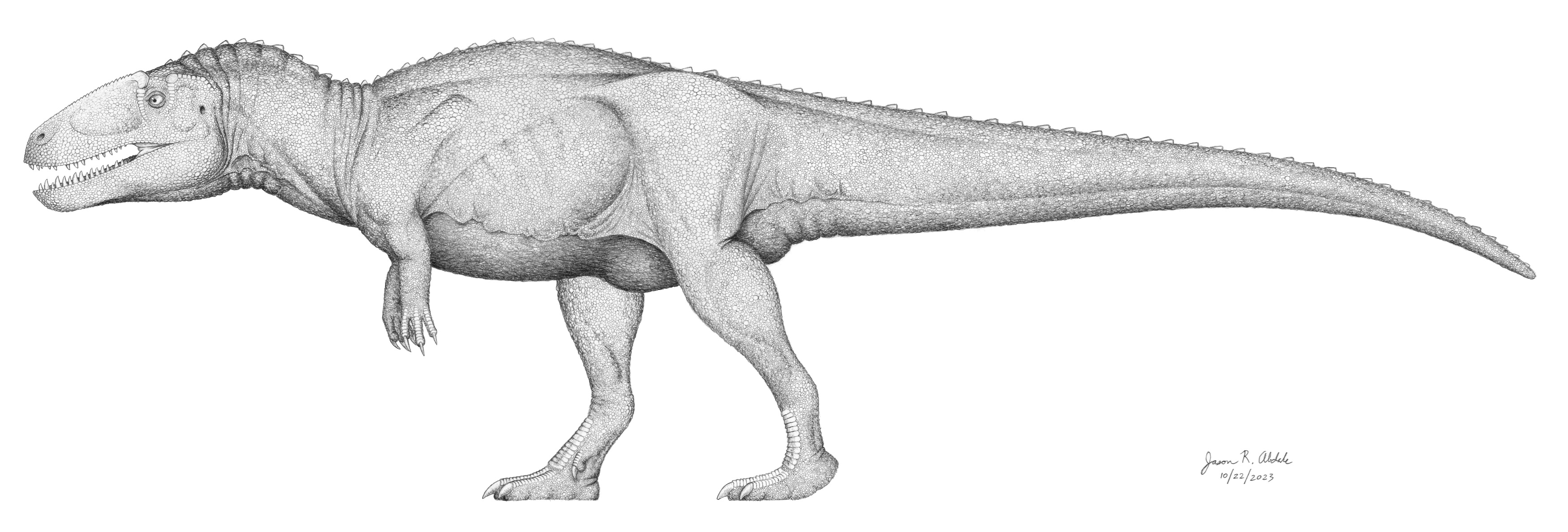
Kelmayisaurus petrolicus. © Jason R. Abdale (October 22, 2023).
If you enjoy these drawings and articles, please click the “like” button, and leave a comment to let me know what you think. Subscribe to this blog if you wish to be immediately informed whenever a new post is published. Kindly check out my pages on Redbubble and Fine Art America if you want to purchase merch of my artwork.
Bibliography
Brusatte, Stephen L.; Benson, Roger B. J.; Xu, Xing (2010). “The evolution of large-bodied theropod dinosaurs during the Mesozoic in Asia”. Journal of Iberian Geology, volume 36, issue 2 (December 2010). Pages 275–296.
https://www.researchgate.net/publication/260714806_The_evolution_of_large-bodied_therood_dinosaurs_during_the_Mesozoic_in_Asia.
Brusatte, Stephen L.; Benson, Roger B. J.; Xu, Xing (2012). “A reassessment of Kelmayisaurus petrolicus, a large theropod dinosaur from the Early Cretaceous of China”. Acta Palaeontologica Polonica, volume 57, issue 1 (March 1, 2012). Pages 65-72.
https://bioone.org/journals/acta-palaeontologica-polonica/volume-57/issue-1/app.2010.0125/A-Reassessment-of-Kelmayisaurus-petrolicus-a-Large-Theropod-Dinosaur-from/10.4202/app.2010.0125.full.
Chen, Yan; Cogne, Jean-Pascal; Courtillot, Vincent; Avouac, Jean-Philippe; Tapponnier, Paul; Wang, Gongque; Bai, Meixiang; You, Hongzi; Li, Ming; Wei, Chunsheng; Buffetaut, Eric (1991). “Paleomagnetic Study of Mesozoic Continental Sediments Along the Northern Tien Shan (China) and Heterogeneous Strain in Central Asia”. Journal of Geophysical Research, volume 96, issue 83 (March 10, 1991). Pages 4,065-4,082.
https://authors.library.caltech.edu/34009/1/90JB02699.pdf.
Dong, Zhiming (1973). “Dinosaurs from Wuerho”. Memoirs of the Institute of Vertebrate Paleontology and Paleoanthropology, Academia Sinica, volume 11 (1973). Pages 45-52.
Holtz, Thomas R.; Molnar, R. E.; Currie, Philip J. (2004). “Basal Tetanurae”. In Weishampel, David B.; Dodson, Peter; Osmólska, H. (eds.). The Dinosauria, 2nd Edition. Berkeley: University of California Press, 2004. Pages 71-110.
Maisch, Michael W.; Matzke, Andreas T.; Sun, Ge (2004). “A new dsungaripteroid pterosaur from the Lower Cretaceous of the southern Junggar Basin, north-west China”. Cretaceous Research, volume 25, issue 5 (October 2004). Pages 625-634.
Molnar, R. E.; Kurzanov, S.M.; Dong, Z. (1990). “Carnosauria”. In Weishampel, D.B.; Dodson, P.; Osmólska, H., eds., The Dinosauria. Berkeley: University of California Press, 1990. Pages 169-209.
Xi, Dangpeng; Wan, Xiaoqiao; Li, Guobiao; Li, Gang (2019). “Cretaceous integrative stratigraphy and timescale of China”. Science China Earth Sciences, volume 62, issue 1 (2019). Pages 256-286.
Xing, Lida; Lockley, Martin G.; Li, Zhongdong; Klein, Hendrik; Chen, Shaojie; Persons IV, W. Scott; Wang, Miaoyan (2020). “Large Scale Dinoturbation in Braided Stream Deposits: Evidence from the Cretaceous Tugulu Group of the Hami Area, Eastern Xinjiang, China”. Biosis: Biological Systems, volume 1, issue 2 (2020). Pages 72-84.
Xing, Lida; Lockley, Martin G.; Jia, Chengkai; Klein, Hendrik; Niu, Kecheng; Zhang, Lijun; Qi, Liqi; Chou, Chunyong; Romilio, Anthony; Wang, Donghao; Zhang, Yu; Persons, W. S.; Wang, Miaoyan (2021). “Lower cretaceous avian-dominated, theropod, thyreophoran, pterosaur and turtle track assemblages from the Tugulu Group, Xinjiang, China: ichnotaxonomy and palaeoecology”. PeerJ, 9: e11476.
https://peerj.com/articles/11476/.
Yang, J. L.; Wang, Q. F.; Lu, H. N. (2008). “Cretaceous charophyte floras from the Jungar Basin, Xinjiang, China”. Acta Micropalaeontologica Sinica, volume 12, issue 25 (2008). Pages 345-363.
Fossilworks. “Kelmayisaurus petrolicus Dong 1973 (allosauroid)”. http://www.fossilworks.org/cgi-bin/bridge.pl?a=taxonInfo&taxon_no=65212. Accessed on June 30, 2023.
Fossilworks. “Wuerho, IVPP site 64043 (Cretaceous of China)”. http://www.fossilworks.org/cgi-bin/bridge.pl?a=collectionSearch&collection_no=49817&is_real_user=1. Accessed on June 30, 2023.
Categories: Paleontology, Uncategorized
 DINOSAURS AND BARBARIANS
Leave a comment