
It’s well known, or at least it should be, that New York, and New York City specifically, were actively involved in the bartering of human chattel for two hundred years. It began with the first bold yet tremulous ventures of trans-Atlantic colonization by the Dutch during the 1620s, and persisted until it was outlawed by the New York state legislature in the 1820s. The story of Manhattan’s role in the African slave trade, and slavery as a whole, is well documented. Less well-known are the stories of slavery within those places around Manhattan’s periphery. This article concerns the history of slavery within my hometown of Flushing in Queens County. The story begins with this settlement of Dutch and later English transplants being enthusiastic supporters of slavery, and ends with the townsfolk being equally enthusiastic opponents of it.
The first slaves arrived in what’s now New York in the year 1626, when the merchants of the Dutch West India Company brought eleven enslaved African men from what’s now the African nations of Angola, Congo, and Sao Tome to their colonial settlement of “New Amsterdam” located upon Manhattan Island’s southern tip. Eighteen years later in 1644, these men were granted their freedom by the Dutch colonial authorities and each one of them received land to live upon and farm, totaling 300 acres. However, there was a catch to all of this. Each of these men was required to deliver a tribute of one pig and 22.5 bushels of corn, wheat, peas, or beans to the authorities of the Dutch West India Company every year, or else they would be re-enslaved (1).

The First Slave Auction at New Amsterdam in 1655, painted by Howard Pyle (1917). Public domain image, Wikimedia Commons.
https://en.wikipedia.org/wiki/File:The_first_slave_auction_at_new_amsterdam_in_1655.jpg.
After establishing their outposts on Governor’s Island and the southern tip of Manhattan, the Dutch spread onto Long Island. During the 17th and 18th Centuries, Long Island was known by a variety of names including Long Island (or Lange Eylandt in Dutch), Nassau Island, Gebrokeland, and Matouwacs, the last of which may have been the name of the island in the native Lenaapé language. One of the settlements which the Dutch established on Long Island was Flushing, founded in 1643 and named in reference to the Dutch port-town of Vlissingen. Although Flushing was a Dutch settlement, even in its early years it had a mixed Dutch and English population. As the 17th Century went on, an increasing amount of pressure was placed by the English upon their Dutch neighbors, until the colony of New Netherlands was taken over by the English in 1664, and was promptly re-named “New York” (2).

Close-up of a map of Long Island during the 17th Century. Note the location of the town of Vlissingen (Flushing). Map of New Netherlands and of English Virginias, from Cape Cod to Cape Canrick. Illustrated by Pieter Goos (1667). Public domain image, Wikimedia Commons.
https://commons.wikimedia.org/wiki/File:Pascaert2.jpg.
After the English took over, slavery increased within the Big Apple. By the year 1730, 42% of the white inhabitants of New York City owned slaves (3). The high rate of slavery was true for nearly all of England’s possessions, including Flushing, if we believe the earliest census records. By the year 1700, Flushing had a population of approximately 500 people, of which about 40 were slaves (4). The number of slaves would increase both in terms of sheer numbers as well as in terms of overall population percentage for the remainder of the 18th Century. From 1701 to 1764, New York saw 4,871 slaves brought to its shores. Most of these men and women didn’t come directly from Africa. Official records state that the majority were brought to New York from the other Thirteen Colonies, or else the records simply vaguely name the point-of-origin as “elsewhere”, which could mean anything, but it was likely the British-owned Caribbean colonies (5). For those engaged in the slave trade, transporting slaves from one colony to another was much more feasible than going directly to the source and transporting them all the way from Africa.
However, don’t get the idea that everyone in Flushing was on-board with keeping Africans enslaved. The call for the wholesale abolishing of slavery, or “abolitionism”, was heard remarkably early in New York’s history, and the town of Flushing, Queens was one of the major early centers for this movement. Interestingly, one of the prime movers for abolitionism within Flushing, and all of New York, were the Quakers. The reason why this is interesting is because Quakers had been actively involved in slavery and the African slave trade for generations, and many of them continued to be even while some of their fellow congregates were calling for slavery’s demise. As an example, in 1684, a Flushing Quaker named John Adams wished to buy a slave, but he didn’t have enough money to purchase him. So, on August 14, 1684, his fellow Flushing Quakers held a fundraiser to assist their congregate in his “necessity” (6).
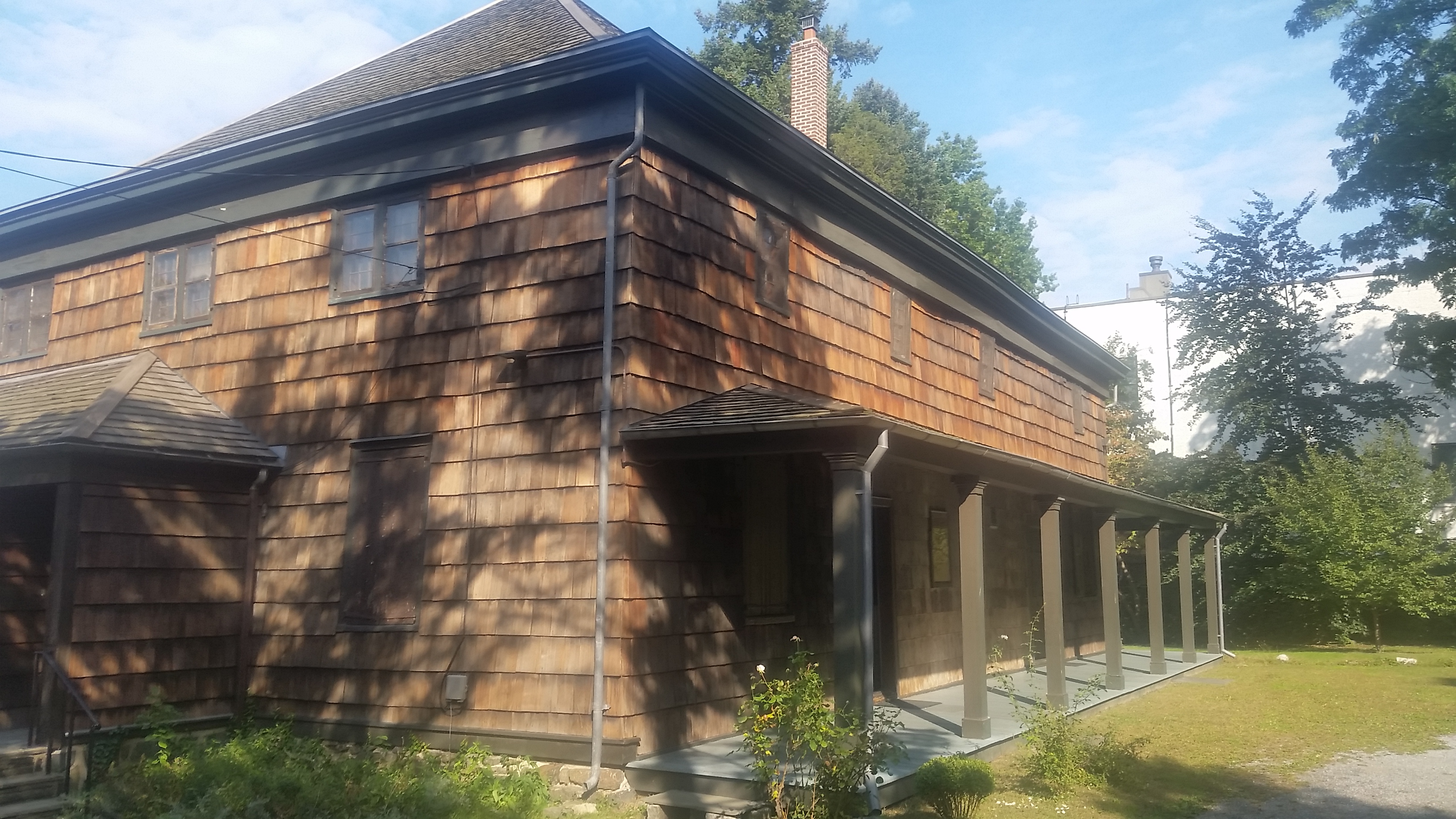
The Quaker meeting house in Flushing, Queens, built in 1694 by John Bowne. Located at 137-16 Northern Boulevard. This church is still in operation. Wikimedia Commons, Creative Commons Attribution-Share Alike 4.0 International license.
https://commons.wikimedia.org/wiki/File:QUAKER_MEETING_HOUSE_02.jpg.
It was during the early 1700s that the outlook on slavery began to change, at least in Flushing. In 1716, a Flushing Quaker named John Farmer called for an end to slavery. Two years later, a pamphlet decrying the evils of slavery was published in the town (7). By no means was Flushing alone in its calls to end slavery. All across the Thirteen Colonies, Quaker communities were stating that slavery was a sin and demanding its termination since the late 1600s. Abolitionist sentiment was especially strong amongst the Quakers of Pennsylvania. Even so, there was considerable resistance. In Pennsylvania, when the Quaker William Southeby denounced slavery and petitioned the Pennsylvania colonial legislature to outlaw it, he was expelled from his congregation in 1716. In 1718, Flushing Quaker William Burling attacked slavery during the annual convention of New York Quakers. However, he held back from calling for slavery’s end due to the belief that it would cause friction within the Church (8).
By the middle of the 18th Century, those who supported abolitionism steadily gained more power and influence to the point where those who opposed them were regarded as enemies of Man and Christ. At a meeting of Flushing Quakers on June 5, 1765, one of their number named Samuel Underhill was chastised for involving himself in the African slave trade (9). In 1767, Flushing’s Quaker community declared that slavery was un-Christian and vowed that they would combat it (10). In 1774, representatives of various Quaker communities throughout New York Colony held a conference in Flushing. During this meeting, it was declared that all Quakers living within New York must grant their slaves their freedom (11). As to how many of them followed up on this declaration, we aren’t sure. Some of New York’s Quakers voluntarily manumitted their slaves, while others chose not to. In 1776, an investigation conducted by Flushing Quakers reported that many of their congregation still owned slaves in defiance of the anti-slavery declaration made two years earlier. Some of them went so far as to justify enslaving Africans (12). Indeed, Elias Hicks, a prominent Quaker preacher from Jericho, Nassau County, NY noted “a great unwillingness in most of them to set their slaves free” (13).
Part of the reason why so many whites justified keeping their black brothers in bondage was the belief that the Africans would exact bloody retribution upon the whites for being enslaved. Even for the people of Queens, this threat seemed ever present. In 1741, New York was rife with rumors of a “negro plot” to carry out a slave uprising, resulting in many slaves being executed. At the same time in both Kings County and Queens County, a large number of slaves were arrested who were suspected as being co-conspirators in this plot (14). On March 6, 1775, the New York Mercury reported, “Several of the negroes at Jamaica, we hear, were last week committed to the jail there for a conspiracy to destroy the whites. Most of the slaves for many miles around ’tis said, are concerned in this plot” (15).
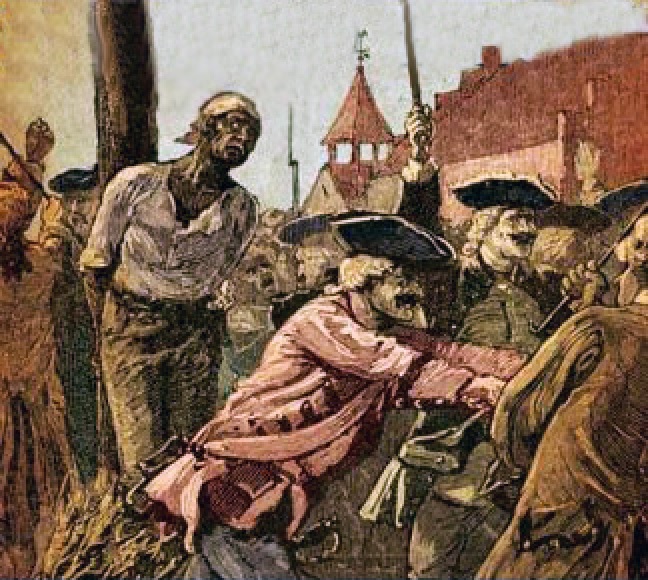
In 1741, a slave is executed by being burned at the stake for his supposed participation in an attempted slave uprising in New York City. Seventeen black men, two white men, and two white women were hanged, and another thirteen black men were burned alive. Public domain image, Wikimedia Commons.
https://commons.wikimedia.org/wiki/File:1741_Slave_Revolt_burned_at_the_stake_NYC.jpg.
Slavery remained very much a part of all of the Thirteen Colonies throughout the majority of the 18th Century. It was only in the decades following America’s independence from the British that this began to change. On September 3, 1783, the American Revolutionary War came to an end with the signing of the Treaty of Paris. With this treaty, the British Empire agreed to officially recognize the United States of America as an independent country and would no longer be subject to British rule. That same year, Massachusetts became the first state in the United States to outlaw slavery when the Massachusetts State Supreme Court declared that slavery was in violation of the principles laid out in the Massachusetts State Constitution.
Yet slavery was still going strong in other northern states like New York. In 1785, the New York Manumission Society was established for the purpose of advocating the gradual abolishment of slavery throughout the state of New York. Among its earliest members were John Jay and Alexander Hamilton, and also Robert Bowne of Flushing (16). However, abolitionists were a tiny minority within New York, because slavery was big business throughout the Empire State, including in Flushing. In 1790, the United States held its first census. Within this census, the town of Flushing was recorded as having a population of 1,607 people. Of this number, 340 were slaves, 21% of the town’s total population. One out of every five people in Flushing was a slave, and there were probably a quantity of free blacks living in the town as well (17).
Most historians of the 19th Century claimed that slaves were better treated in New York, and especially in Flushing with its large pacifist Quaker population, than elsewhere. Even so, slaves did run away from their masters. On April 17, 1760, this advertisement appeared within the New York gazette Postboy, which read as follows: “Ran away from Bernardus Ryder, Flushing, a negro man named Caesar, aged twenty-five; this country born, not a right black — has a little of the yellowish cast; a pretty lusty fellow; talks good English; if frightened stutters very much; has lost one of his front teeth; had on a light-colored Devonshire kersey coat, a soldier’s red jacket, breeches and hat, and a pair of old shoes. 40s. reward if taken on the island, or £3 if taken off the island” (18). On June 13, 1773, the following notice appeared “$5 reward to any one who shall secure him in any of His Majesty’s jails. Run away from Abraham Lawrence, Flushing, a negro man, George, of a yellow complexion. He had on buff colored, half worn velvet breeches, and has bushy hair which he wears tied behind, and commonly wears his hat cocked” (19). On May 10, 1791, a reward notice appeared within the Daily Advertiser: “$20 Reward. Ran away from Flushing two negro men! One Aaron, the property of Jeremiah Vanderbilt, who had on fustian trowsers (sic) and wool hat, and is a good boatman; the other, Polydore, the property of Francis Lewis, who wore a blue cloth jacket and breeches, woolen stockings and wool hat” (20). Moreover, incidents of abuse did occur. One horrendous example took place in 1788 when John Allen of Flushing beat his slave Michael to death on the mere suspicion that Michael had stolen some money from him (21).
On October 22, 1789, the house of Jeremiah Vanderbilt, who served as the Flushing town clerk, was destroyed in a fire, and along with it the majority of the official town records up to that date. It was later revealed that two slaves – Sarah who was owned by Mr. Vanderbilt and another slave named Nellie who was owned by Captain Daniel Braine – had deliberately set fire to the house. The two of them were arrested and charged with arson. They were put on trial on September 8, 1790, both were found guilty, and were sentenced to death by hanging. Sarah’s death sentence was reprieved due to her youth, but her accomplice Nellie kept her appointment with the hangman (22).
As the years rolled on, slavery slowly declined within the North. Populations as a whole were getting bigger, but the number of slaves was getting smaller. In the US census of 1800, Flushing is recorded as having a total population of 1,823, a 13% increase in population from ten years earlier. Of this number, 287 were slaves (15.74% of the population), which is a decrease of 15.6% of the town’s slave population from 1790 (23). Unfortunately, I wasn’t able to find any census records for Flushing or Queens County for the year 1810. Also, regrettably, the US census of 1820 only provides population statistics for Queens County as a whole and not for any of the municipalities within. According to this report, Queens had a total population of 21,519, of which 559 were slaves and 2,658 were free blacks (24). The statistics seem clear – slavery was experiencing a decline within Queens throughout the early 1800s.
Slavery might have died out on its own within New York sooner or later, but a law passed by the New York legislature helped to speed up that process. On March 29, 1799, the government of New York passed a law approving the gradual manumission of all slaves living within New York state. This law had been approved by the New York State Assembly on February 9, 1799 and by the New York State Senate on March 28, and was signed into law the very next day. The law stated that any child born from a slave mother after July 4, 1799 “shall be deemed and adjudged to be born free…And be it further enacted that it shall be lawful for the owner of any slave immediately after the passing of this Act to manumit such slave by a Certificate for that purpose under his hand and seal” (25). Sounds great, right? However, there was a catch. The children would not be automatically granted full and complete freedom. Instead, their status was reclassified as indentured servants, bonded laborers who were still required to perform unpaid labor for their masters for a certain number of years. They would be granted their freedom as soon as they had reached 28 years of age for men and 25 years old for women. This would mean that slaves would still be kept in bondage by the year 1827 at the latest. As to those slaves who were born before July 4, 1799, they too would remain in bondage as indentured servants (26). Such methods were also employed within the South during the era of Reconstruction.
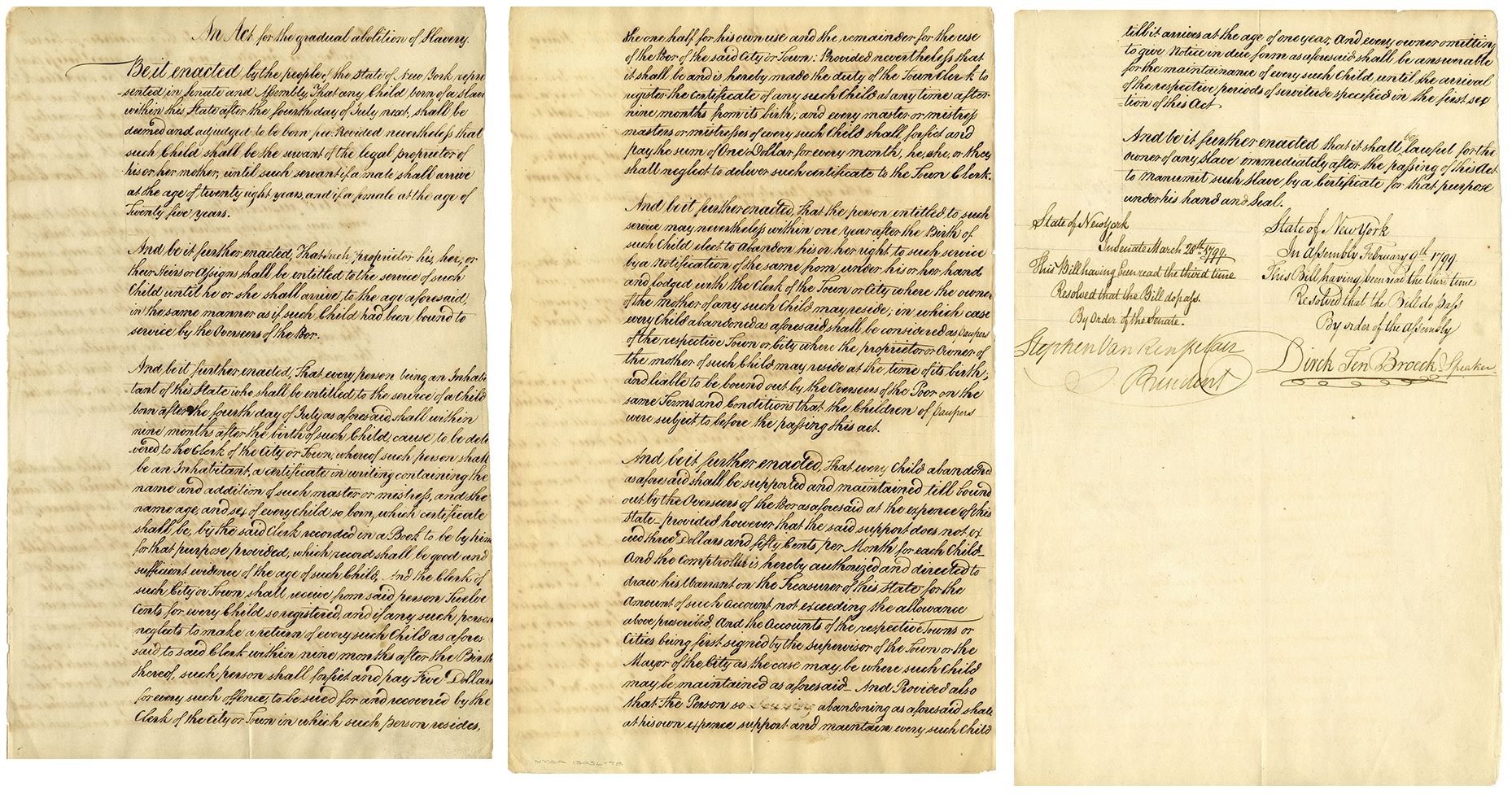
“An Act for the Gradual Abolition of Slavery”, signed into law on March 29, 1799. This law put into place the gradual phasing-out of slavery within New York state. New York State Archives Digital Collections. “An Act for the Gradual Abolition of Slavery, 1799”.
https://digitalcollections.archives.nysed.gov/index.php/Detail/objects/10815.
Due to Flushing’s growing reputation for abolitionist sentiment, it became a frequent destination for ex-slaves during the 1820s. This sudden increase in Flushing’s black population, who descended upon the town from all directions, proved to be increasingly irksome for the town’s resident white population. Accounts written during the second half of the 19th Century regularly paint the ex-slaves who inhabited Flushing as a bunch of raucous lazy lay-abouts who did their level best to irritate and inconvenience everyone around them. Stories are told of how they never did a stitch of work, but were very energetic when it came to participating in loud parties (often taking place at night while everyone else was trying to sleep), public drunkenness, public street brawls, and a total disregard for the law or even general decent behavior. Appeals made by the Flushing Quakers to these people to behave more civilly were soundly ignored. Efforts made by the local government to issue fines and lock up malefactors in the town’s jail for vagrancy, loitering, disturbing the peace, or disruptive and disorderly conduct proved to be ineffective. Therefore, some of Flushing’s young men, who had grown sick of having their sleep disturbed every night by the loud gatherings in the streets, decided to take matters into their own hands, and pelted the blacks during their public gatherings with rotten eggs. This remedy alone proved effective, and Flushing’s streets were quiet at night from then onward, or so the accounts relate (27). Keep in mind that, during the post-Civil War period of Reconstruction, many writers made comments about how Africans couldn’t be entrusted to live their lives without slavery because they literally didn’t know how to live as free men and women. These accounts portray the blacks as lazy loafers and dissolute drunkards. Therefore, we need to take the accounts presented with a grain of salt, as they may be nothing more than products of Reconstruction-rooted social ideology rather than an accurate retelling of things which happened in the past (28).
On July 4, 1827, slavery was officially abolished within all of New York…emphasis on the word “officially”. Unofficially, New York was still very much involved in human bondage. Even into the 1850s, while the “Underground Railroad” was ferrying Southern slaves to freedom in the North, certain unscrupulous New Yorkers maintained their own pipeline ferrying blacks out of the state into the American South, to Cuba, and to Brazil where slavery showed no signs of disappearing. Where there is a market for goods, however illegal they may be, there will always be sellers and buyers (29).
Even once they were in the North, the escaped slaves still weren’t 100% safe. According to Article IV, Section 1 of the U.S. Constitution, “No person held to service or labour in one state, under the laws thereof, escaping into another, shall, in consequence of any law or regulation therein, be discharged from such service or labour, but shall be delivered up on claim of the party to whom such service or labour may be due”. This section concerned the topic of runaway slaves and runaway indentured servants. If a slave escaped from a slave state and moved into a state where slavery had been outlawed, that slave was still a slave, regardless of where he or she was living. The slave was still the property of his master, and the fact that he or she was now living in a state where slavery was illegal didn’t change that. The slave could only be free if the master granted the slave his or her freedom. Furthermore, if any escaped slave was found, he or she needed to be delivered back to where they came from. This was further reinforced with the passage of the Fugitive Slave Act of 1793 and the Fugitive Slave Act of 1850, the latter of which was especially reviled by Northern abolitionists. City, county, and state governments, and even private residents of non-slave states were now required by federal law to cooperate with Southern “slave catchers” and to assist in the capture and return of runaway slaves to their Southern masters. This outraged many Northern abolitionists, saying that they could not, in good conscience, assist in something that went completely against their morals. For the “conductors” on the Underground Railroad, it was no longer sufficient just to have the slaves cross the Mason-Dixon Line from slave to non-slave territory. Even in non-slave states, they needed to keep runaway slaves in hiding to avoid being seized by bounty hunters and slave catchers. There are numerous stories of runaways hiding in secret rooms within people’s houses when inquisitive persons came snooping around. Some conductors on the Underground Railroad tried to get runaway slaves out of America entirely and across the border into Canada (30). The British Empire had outlawed slavery in 1833, and since Canada was British territory, and since American slave catchers had no legal jurisdiction there, any slaves who escaped across the border into Canada would likely be safe. But making a trip from Mississippi to Ontario was a long and perilous undertaking, and many runaway slaves were captured and brought back to their owners before they could finish their escape.
Both before and during the American Civil War, the town of Flushing, Queens was a major “station” along the Underground Railroad due to the town’s prevailing abolitionist sentiment, and Flushing’s Quakers were actively involved in helping slaves escape to the North (31). These included the Bowne family, of whom John Bowne is its most famous member. This is notable because prior generations of the Bowne family had been slave-holders. Also, John Aspinwall, whose house was located near the intersection of Northern Boulevard and Union Street, close to where Flushing High School now stands, was one of those who made it their mission to help enslaved Southern blacks flee to the North and gain their freedom (32).
It would not be until December 1865, when the 13th Amendment to the US Constitution was passed which officially outlawed slavery nationwide, that the threat of enslavement was permanently erased. However, as stated earlier, laws were quickly passed throughout the Southern states replacing slavery with mandatory labor services such as indentured servitude and sharecropping, and the social position of blacks within the South was restricted by the so-called “Black Codes”, which were precursors to the repressive Jim Crow laws (33). However, for the black population of Flushing, the passage of the 13th Amendment and the subsequent passage of the 14th and 15th during the Reconstruction period meant that they now had true freedom. No longer did they need to worry about lurking presence of the slave-catchers. Here, at least, the work of liberty had reached its happy conclusion.
Across 46th Street from Flushing Cemetery is a small park called “The Olde Towne of Flushing Burial Ground”. This was a cemetery which was set up in 1840 for paupers and any others who couldn’t be buried elsewhere. Mostly the people buried here were Native Americans or Africans. According to the NYC Parks Department, it’s believed that the remains of 1,000 people lie buried underneath the grass, and over half of them are less than 5 years old. However, we’ve only been able to learn the names of 320 of them due to these names being given in burial records; as for the rest, their identities are unknown (34). Buried under the turf are the remains of people who lived in Flushing during the late 18th and early 19th Centuries and who very likely were born into slavery or whose parents were. In a way, it’s fitting that this article about slavery within the town of Flushing, New York should conclude with a look at a local graveyard, because that’s exactly where slavery should be – dead and buried.
I hope that you enjoyed this examination of the history of slavery within Flushing, Queens County, New York. If you did, please click the “like” button and leave a comment, if you wish. If you enjoy this and other articles on this website, please become a subscriber so that you can be immediately notified when a new article is posted. I have plans to post other articles concerning the history of Flushing, so stay tuned.
Source Citations:
- NYC Urbanism. “A Short History of Slavery in NYC”. https://www.nycurbanism.com/blog/2019/6/18/a-short-history-of-slavery-in-nyc; New York Public Library. “New York City’s Slave Market”, by Sylviane A. Diouf (June 29, 2015). https://www.nypl.org/blog/2015/06/29/slave-market.
- Dutch New York. PBS, 2009; Waller, Henry D. History of the Town of Flushing, Long Island, New York. Flushing: J. H. Ridenour, 1899. Pages 15-60.
- New York Public Library. “New York City’s Slave Market”, by Sylviane A. Diouf (June 29, 2015). https://www.nypl.org/blog/2015/06/29/slave-market.
- History of Queens County, New York. New York: W. W. Munsell & Co., 1882. Page 78.
- Historical Statistics of the United States, Colonial Times to 1970, Part 1. Washington, DC: US Government Printing Office, 1975. Page 1,173. https://www.census.gov/history/pdf/histstats-colonial-1970.pdf.
- Waller, Henry D. History of the Town of Flushing, Long Island, New York. Flushing: J. H. Ridenour, 1899. Page 94.
- Farnsworth, Cheri. The Big Book of New York Ghost Stories. Guilford: Globe Pequot, 2009. Page 244.
- Rothbard, Murray Newton. Conceived in Liberty. Auburn: Ludwig von Mises Institute, 2011. Pages 672-673.
- Waller, Henry D. History of the Town of Flushing, Long Island, New York. Flushing: J. H. Ridenour, 1899. Page 152.
- Reitano, Joanne. The Restless City: A Short History of New York from Colonial Times to the Present Day, Second Edition. New York: Routledge, 2010. Page 28.
- Copquin, Claudia Gryvatz. The Neighborhoods of Queens. Yale University Press, 2007. Page 217.
- Waller, Henry D. History of the Town of Flushing, Long Island, New York. Flushing: J. H. Ridenour, 1899. Page 152.
- Flushing Meeting Religious Society of Friends. “A History of Flushing Meeting”. https://flushingfriends.org/history/history-of-flushing-meeting/.
- History of Queens County, New York. New York: W. W. Munsell & Co., 1882. Page 91.
- Onderdonk, Henry. Queens County in Olden Times. Jamaica: C. Welling, 1865. Page 48.
- Chernow, Ron. Alexander Hamilton. New York: Penguin Books, 2004. Page 214; Bowne House. “Three Centuries of Activism”. https://www.bownehouse.org/three-centuries-of-activism.
- Heads of Families at the First Census of the United States Taken in the Year 1790: New York. Page 10. https://babel.hathitrust.org/cgi/pt?id=coo1.ark:/13960/t2p564q8g&seq=16.
- History of Queens County, New York. New York: W. W. Munsell & Co., 1882. Page 91.
- Onderdonk, Henry. Queens County in Olden Times. Jamaica: C. Welling, 1865. Page 48.
- History of Queens County, New York. New York: W. W. Munsell & Co., 1882. Page 91.
- History of Queens County, New York. New York: W. W. Munsell & Co., 1882. Page 91.
- Mandeville, Reverend G. Henry. Flushing, Past and Present: A Historical Sketch. Flushing: Home Lecture Committee, 1860. Page 2; Waller, Henry D. History of the Town of Flushing, Long Island, New York. Flushing: J. H. Ridenour, 1899. Pages 166-167.
- US census of 1800, page 27. https://www2.census.gov/library/publications/decennial/1800/1800-returns.pdf.
- US Census of 1820. Page 66. https://www.census.gov/library/publications/1821/dec/1820a.html.
- New York State Archives Digital Collections. “An Act for the Gradual Abolition of Slavery, 1799”. https://digitalcollections.archives.nysed.gov/index.php/Detail/objects/10815.
- New York State Archives Digital Collections. “An Act for the Gradual Abolition of Slavery, 1799”. https://digitalcollections.archives.nysed.gov/index.php/Detail/objects/10815.
- Mandeville, Reverend G. Henry. Flushing, Past and Present: A Historical Sketch. Flushing: Home Lecture Committee, 1860. Page 67; History of Queens County, New York. New York: W. W. Munsell & Co., 1882. Pages 90-91; Waller, Henry D. History of the Town of Flushing, Long Island, New York. Flushing: J. H. Ridenour, 1899. Pages 176-177.
- Reconstruction: America after the Civil War. PBS, 2019.
- New York Public Library. “New York City’s Slave Market”, by Sylviane A. Diouf (June 29, 2015). https://www.nypl.org/blog/2015/06/29/slave-market.
- QNS. “Flushing: Likely stop on Underground Railroad”, by Alexander Dworkowitz (February 28, 2002). https://qns.com/2002/02/flushing-likely-stop-on-underground-railroad/.
- Farnsworth, Cheri. The Big Book of New York Ghost Stories. Guilford: Globe Pequot, 2009. Page 244.
- ABC7. “Exploring the Underground Railroad in Queens”, by Chanteé Lans (February 13, 2023). https://abc7ny.com/underground-railroad-queens-flushing-historical-society/12808756.
- Reconstruction: America after the Civil War. PBS, 2019.
- NYC Parks – Official Website of the New York City Department of Parks & Recreation. “The Olde Towne of Flushing Burial Ground”. https://www.nycgovparks.org/parks/the-olde-towne-of-flushing-burial-ground/history.
Bibliography
Books
Historical Statistics of the United States, Colonial Times to 1970, Part 1. Washington, DC: US Government Printing Office, 1975.
History of Queens County, New York. New York: W. W. Munsell & Co., 1882.
Chernow, Ron. Alexander Hamilton. New York: Penguin Books, 2004.
Copquin, Claudia Gryvatz. The Neighborhoods of Queens. Yale University Press, 2007.
Farnsworth, Cheri. The Big Book of New York Ghost Stories. Guilford: Globe Pequot, 2009.
Mandeville, Reverend G. Henry. Flushing, Past and Present: A Historical Sketch. Flushing: Home Lecture Committee, 1860.
Onderdonk, Henry. Queens County in Olden Times. Jamaica: C. Welling, 1865.
Reitano, Joanne. The Restless City: A Short History of New York from Colonial Times to the Present Day, Second Edition. New York: Routledge, 2010.
Rothbard, Murray Newton. Conceived in Liberty. Auburn: Ludwig von Mises Institute, 2011.
Waller, Henry D. History of the Town of Flushing, Long Island, New York. Flushing: J. H. Ridenour, 1899.
Websites
ABC7. “Exploring the Underground Railroad in Queens”, by Chanteé Lans (February 13, 2023). https://abc7ny.com/underground-railroad-queens-flushing-historical-society/12808756.
Bowne House. “Three Centuries of Activism”. https://www.bownehouse.org/three-centuries-of-activism.
Flushing Meeting Religious Society of Friends. “A History of Flushing Meeting”. https://flushingfriends.org/history/history-of-flushing-meeting/.
Heads of Families at the First Census of the United States Taken in the Year 1790: New York. Page 10.
https://babel.hathitrust.org/cgi/pt?id=coo1.ark:/13960/t2p564q8g&seq=16.
New York Public Library. “New York City’s Slave Market”, by Sylviane A. Diouf (June 29, 2015).
https://www.nypl.org/blog/2015/06/29/slave-market.
New York State Archives Digital Collections. “An Act for the Gradual Abolition of Slavery, 1799”. https://digitalcollections.archives.nysed.gov/index.php/Detail/objects/10815.
NYC Parks – Official Website of the New York City Department of Parks & Recreation. “The Olde Towne of Flushing Burial Ground”. https://www.nycgovparks.org/parks/the-olde-towne-of-flushing-burial-ground/history.
NYC Urbanism. “A Short History of Slavery in NYC”. https://www.nycurbanism.com/blog/2019/6/18/a-short-history-of-slavery-in-nyc.
QNS. “Flushing: Likely stop on Underground Railroad”, by Alexander Dworkowitz (February 28, 2002).
https://qns.com/2002/02/flushing-likely-stop-on-underground-railroad/.
US census of 1800. https://www2.census.gov/library/publications/decennial/1800/1800-returns.pdf.
US Census of 1820. https://www.census.gov/library/publications/1821/dec/1820a.html.
Videos
Dutch New York. Hosted by Barry Lewis. PBS, 2009.
Reconstruction: America after the Civil War. Hosted by Henry Louis Gates, Jr. PBS, 2019
Categories: History, Uncategorized
 DINOSAURS AND BARBARIANS


Leave a comment