
Cricosaurus was a genus of 5-10 foot long marine crocodylomorphs which swam in the shallow seas around Mexico, Argentina, and Germany from the late Jurassic Period to the early Cretaceous Period, approximately 152-132 million years ago.
Cricosarus belonged to a group of marine crocodylomorphs called the thalattosuchians, or “sea crocodiles”, which were particularly abundant in the waters around Europe during the middle and late Jurassic Period. Cricosaurus was one of the most aquatically-adapted of the thalattosuchians, and bore a close resemblance to primitive Triassic ichthyosaurs, or indeed even to some species of fish such as Belonostomus, which lived alongside Cricosaurus in the Tethys Sea which covered prehistoric Europe. Cricosaurus‘ front flippers were very rudimentary, almost vestigial, while the rear limbs were still well developed. It’s possible that Cricosaurus used these rear limbs like sexual claspers to hold onto each other while mating.
The genus Cricosaurus is divided into ten recognized species – there might be a few more, but their identity is doubtful. These are, arranged from oldest to newest:
- Cricosaurus albersdoerferi, from Painten, Bavaria, Germany (152-150 MYA).
- Cricosaurus suevicus, from Nusplingen, Baden-Württemberg, Germany (150 MYA).
- Cricosaurus rauhuti, from Mörnsheim, Bavaria, Germany (149-147 MYA).
- Cricosaurus araucanensis, from Cerro Lotena, Neuquén Province, Argentina (149-145 MYA).
- Cricosaurus saltillensis, from Gomez Farías, Coahuila, Mexico (149-145 MYA).
- Cricosaurus vignaudi (possibly a species of Geosaurus), from Mazatepec, Puebla, Mexico (149-145 MYA).
- Cricosaurus bambergensis, from Wattendorf, Bavaria, Germany (147-145 MYA).
- Cricosaurus elegans, from Daiting, Bavaria, Germany (147-145 MYA).
- Cricosaurus lithographicus, from Zapala, Neuquén Province, Argentina (147-145 MYA).
- Cricosaurus puelchorum, from Arroyo Paulino, Neuquén Province, Argentina (144-142 MYA).
- Cricosaurus schroederi, from Sachsenhagen, Lower Saxony, Germany (139-132 MYA). UPDATE (July 18: 2024): This species has been reclassified as a new genus, Enalioetes schroederi.
As you can see, most of the species come from Germany, but a few are also found in Central and South America. If you think that is a heck of a long way to swim, keep in mind that the Atlantic Ocean was a lot smaller during the Jurassic Period than it is today, and the continents were much closer to each other then than they are today.
Below is a drawing of the species Cricosaurus suevicus, which is one of the more well-known species, which inhabited the Tethys Sea around Europe during the late Jurassic Period 150 million years ago. It shared its tropical saltwater habitat with many other marine reptiles including the marine crocodylomorphs Dakosaurus, Geosaurus, Rhacheosaurus, and Plesiosuchus, the ichthyosaurs Arthropterygius, Brachypterygius, and Ophthalmosaurus, the plesiosaurs Colymbosaurus and Kimmerosaurus, and the massive 35 foot long pliosaur Pliosaurus. A vast diversity of fish species whose well-preserved remains are known from the Solnhofen Limestone provided ample prey for Cricosaurus and the marine reptiles it lived alongside. Meanwhile, flying overhead would have been the pterosaur Rhamphorhynchus and the primitive bird Archaeopteryx.
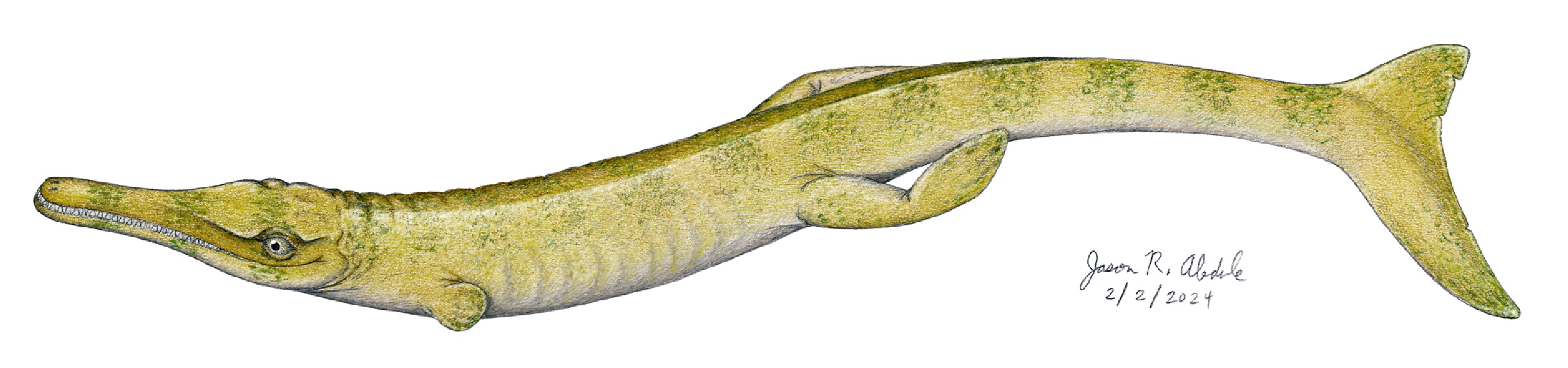
Cricosaurus suevicus. © Jason R. Abdale (February 2, 2024).
If you enjoy these drawings and articles, please click the “like” button, and leave a comment to let me know what you think. Subscribe to this blog if you wish to be immediately informed whenever a new post is published. Kindly check out my pages on Redbubble and Fine Art America if you want to purchase merch of my artwork.
Keep your pencils sharp, everyone.
Categories: Paleontology, Uncategorized


Leave a Reply