
Peloneustes was a 13 foot long pliosaur which swam in the sea around England during the middle of the Jurassic Period 165 million years ago.
The first specimen of this animal was found near the city of Peterborough, Cambridgeshire, England during the 1800s, consisting of the lower jaw, the front half of the upper jaw, a few vertebrae, part of the shoulder and pelvis, and parts of the limbs. It was first described in 1869 as a species of Plesiosaurus, but it was renamed Peloneustes twenty years later. Since the first fossils were discovered, others have been found elsewhere in England within rocks dated to the middle Jurassic. During that time, Europe bore more of a resemblance to the Caribbean or the Polynesian islands of the tropical Pacific.
Peloneustes looked outwardly similar to the polycotylid plesiosaurs which would appear during the middle Cretaceous Period, which included such animals as Polycotylus itself, Dolichorhynchops, and Trinacromerum. However, while Peloneustes certainly bore a striking physical resemblance to these later animals, it was not closely related to them.
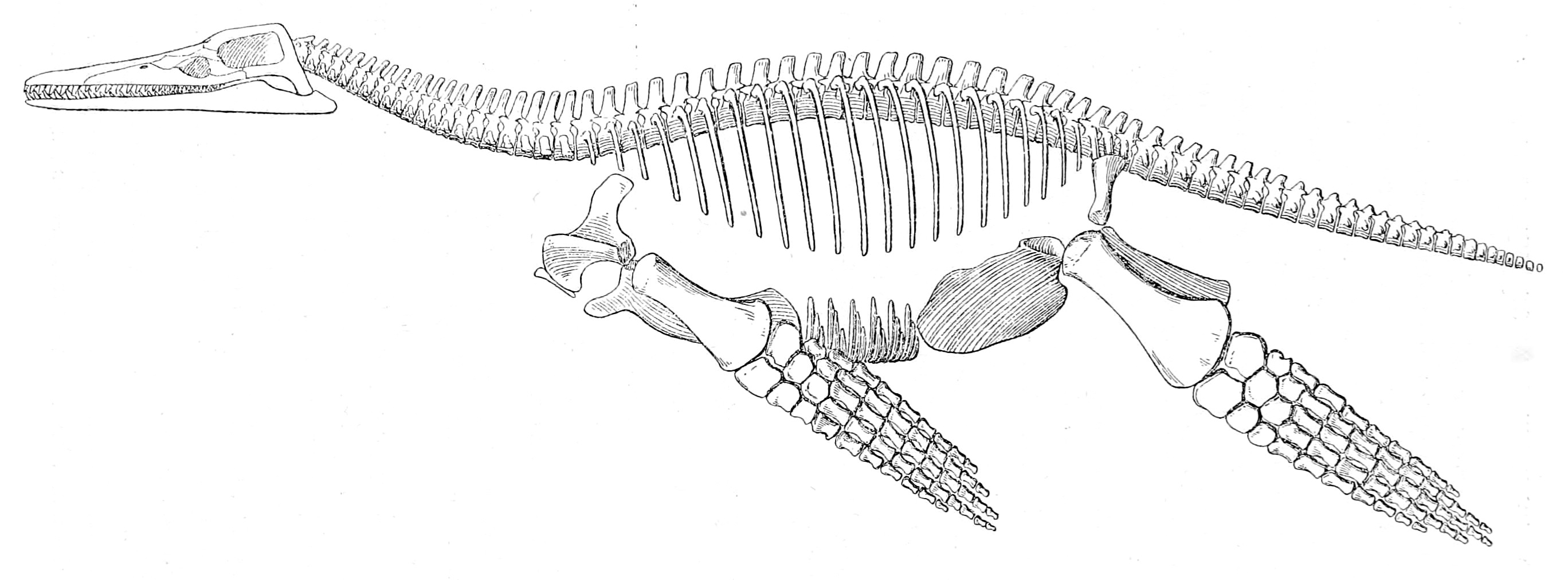
Skeleton of Peloneustes philarchus. Image from Andrews, Charles William. A Descriptive Catalogue of the Marine Reptiles of the Oxford Clay. Based on the Leeds Collection in the British Museum (Natural History), London, Part II. London: The British Museum, 1913. Page 61.
https://archive.org/details/descriptivecatal02brit/page/61/mode/1up.
While the illustration seen above is remarkable, it’s also slightly inaccurate. The head is the wrong shape, and actually bears more of a resemblance to polycotylid plesiosaurs than to the actual shape of the animal’s jaws. Peloneustes had much larger teeth, its upper jaw would have had a tri-lobed structure similar to that seen on other pliosaurs like Pliosaurus and Kronosaurus, the eye socket was larger, and the back of its skull where the temporal fenestrae are located had different contours than illustrated here. Interestingly, one accurate detail is that the back flippers were slightly larger than the front flippers – usually it’s the other way around. As to why this is the case, we don’t know.

Skeleton of Peloneustes philarchus on display at the Tübingen University Museum of Paleontology in Tübingen, Germany. Photo by Ghedoghedo (August 28, 2013). Creative Commons Attribution-Share Alike 3.0 Unported. Wikimedia Commons.
https://commons.wikimedia.org/wiki/File:Peloneustes_philarchus_Tubingen.JPG.
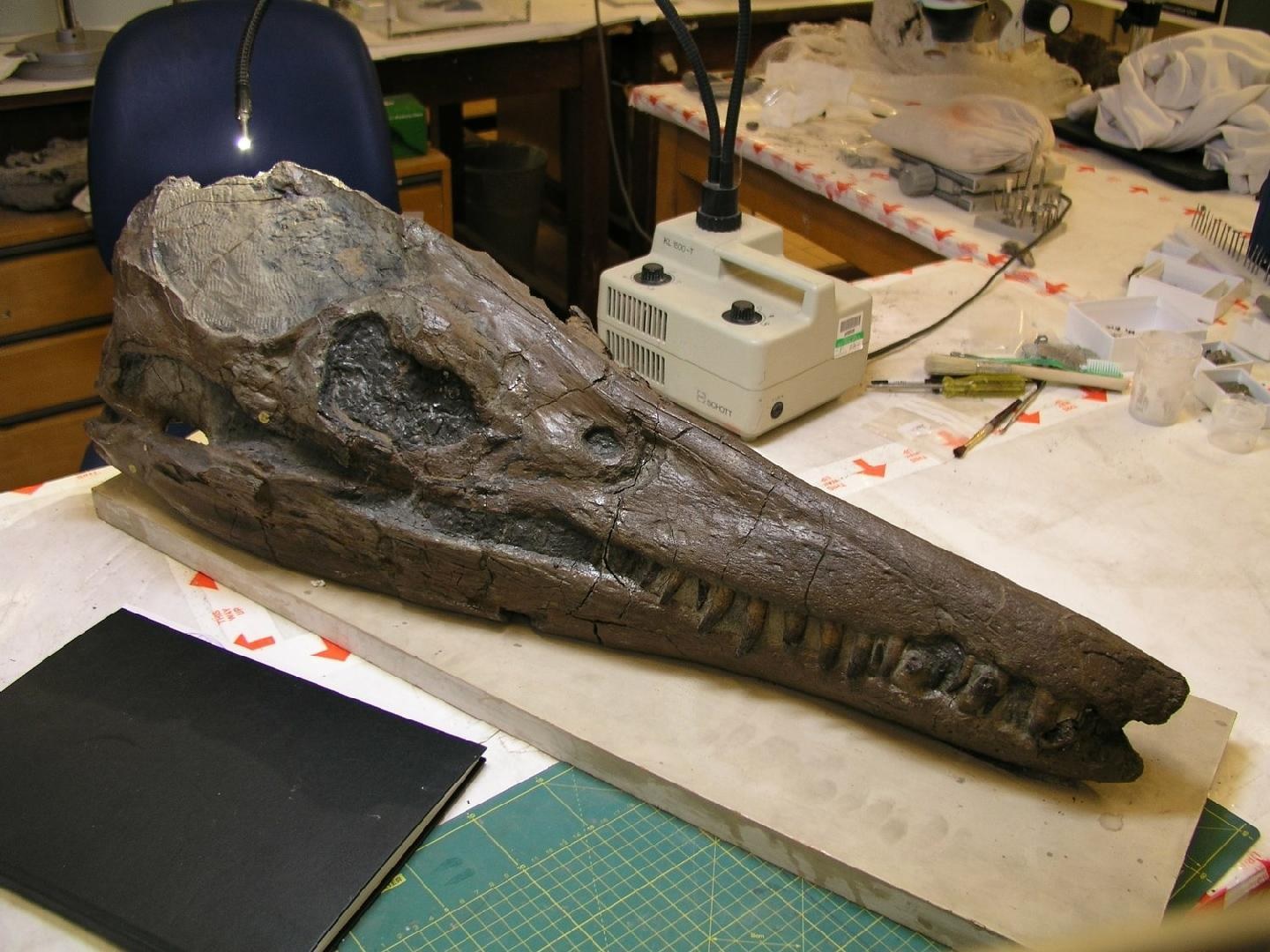
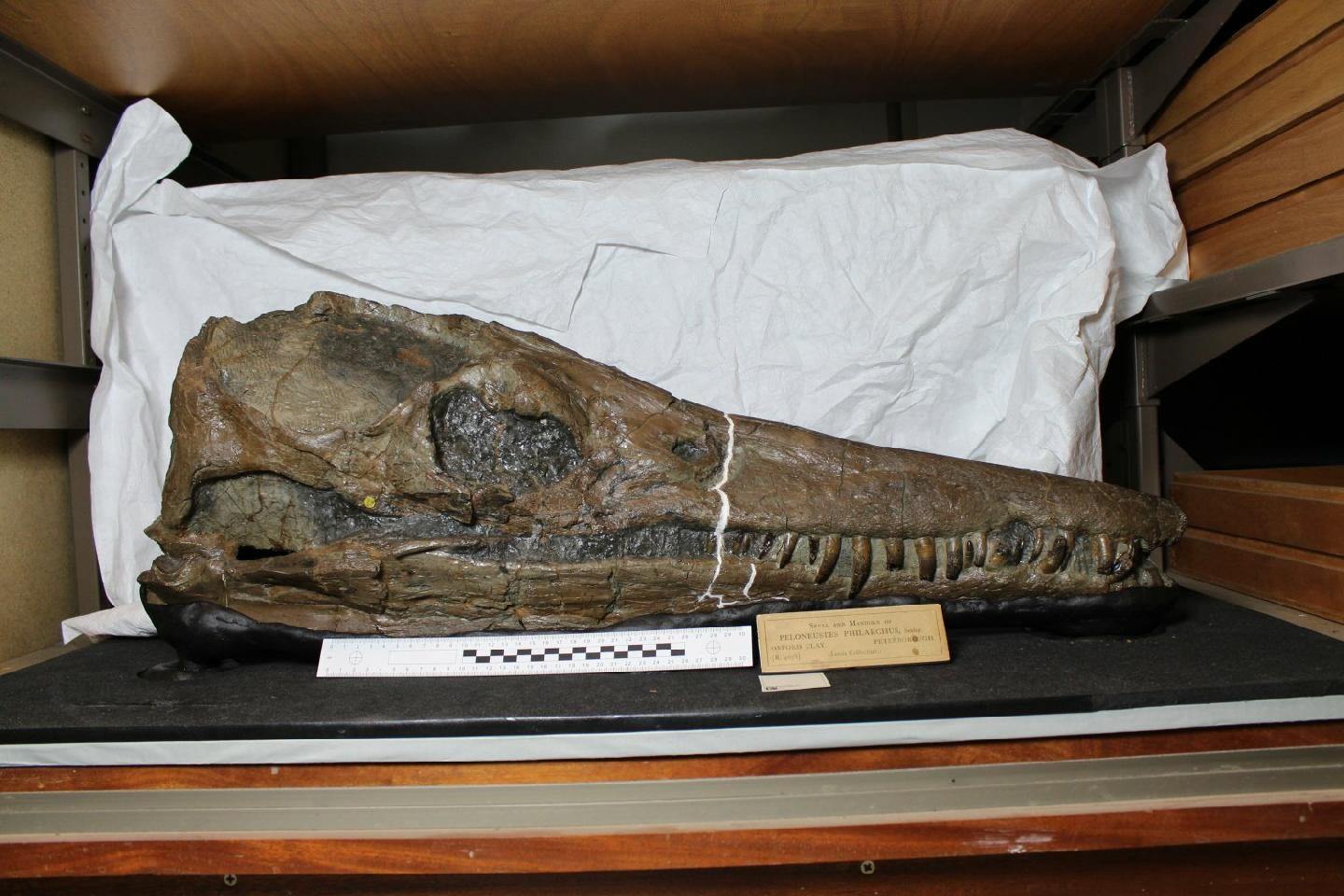
An exceptionally preserved skull of Peloneustes philarchus (collection ID code: NHMUK R4058) held in the Natural History Museum, London, England. Photos by the Trustees of the Natural History Museum (May 10, 2021). Creative Commons Attribution 4.0 International license.
https://data.nhm.ac.uk/dataset/collection-specimens/resource/05ff2255-c38a-40c9-b657-4ccb55ab2feb/record/440565; https://data.nhm.ac.uk/dataset/collection-specimens/resource/05ff2255-c38a-40c9-b657-4ccb55ab2feb/record/440565.
Peloneustes shared its mid-Jurassic marine habitat with many other species of aquatic reptiles including the plesiosaurs Cryptoclidus, Muraenosaurus, and Picrocleidus, the pliosaurs Liopleurodon and Simolestes, the ichthyosaur Ophthalmosaurus, and the marine crocodylomorphs Suchodus, Thalattosuchus, Gracilineustes, and Tyrannoneustes.

Peloneustes philarchus. © Jason R. Abdale (February 10, 2024).
If you enjoy these drawings and articles, please click the “like” button, and leave a comment to let me know what you think. Subscribe to this blog if you wish to be immediately informed whenever a new post is published. Kindly check out my pages on Redbubble and Fine Art America if you want to purchase merch of my artwork.
As always, keep your pencils sharp.
Categories: Paleontology, Uncategorized
 DINOSAURS AND BARBARIANS
Leave a comment