
Caypullisaurus was a 20 foot long ichthyosaur which lived off the coast of Argentina (and possibly elsewhere) during the late Jurassic and early Cretaceous Periods 150-140 million years ago.
In 1989, the front half of a skeleton of a medium-sized ichthyosaur (collection ID code: MACN-N-32) was discovered by Dr. José Bonaparté and his dig team within the Vaca Muerta Formation near Cerra Lotena, Nequén Province, Argentina. The Vaca Muerta Formation dates from the Tithonian Stage of the late Jurassic to the Berriasian Stage of the early Cretaceous. The fossils which were found at Cerra Lotena dated to the early part of the Tithonian Stage of the late Jurassic Period about 150 MYA within the Virgatosphinctes mendozanus ammonite biostratigraphic zone. The fossils consisted of a complete skull measuring over 1.4 meters long, two flippers, a partial shoulder girdle, numerous vertebrae, and several complete and partial ribs. In 1997, Marta S. Fernández named it Caypullisaurus bonapartei in honor of its discoverer. The genus name Caypullisaurus means “lizard spirit of Cay”, the Araucanian god of the sea (Fernández 1997, pages 479-484).
In addition to fossils from the end of the Jurassic Period, Caypullisaurus fossils have been found in rocks dating to the early Cretaceous Period as well. A specimen of Caypullisaurus bonapartei (collection ID code: MOZ 6139) was found in La Yesera del Tromen, Nequén Province, Argentina. In 1999, it was not clear where the fossils were found stratigraphically, with the dates of upper Tithonian to (possibly) Berriasian given, but the stratum was later confirmed to be Berriasian, 144-140 MYA. The specimen, consisting of a skull, dorsal vertebrae, and some ribs, was larger than the holotype with a skull measuring 1.515 meters. Another individual (collection ID code: Tril 22-1X-97-1) consisting of a few dorsal vertebrae and ribs, an ischiopubic bar, and the proximal part of the articulated tarsus was found in rocks definitively dated to the late Tithonian. However, these fossils were not as easily identifiable, and they were listed as “cf. Caypullisaurus”, meaning “similar in shape to Caypullisaurus”. A third specimen (collection ID code: Tril 20-1X-97-1; yes, it’s the same ID code as the second specimen) measuring 2.5 meters long which was also listed as “cf. Caypullisaurus” was found in strata dated to the middle Berriasian, approximately 142 MYA (Spalletti et al. 1999; Fernández 2007, page 369).
Caypullisaurus belonged to the sub-family Platypterygiinae of the family Ophthalmosauridae, and was a close relative of ichthyosaurs like Platypterygius, Brachypterygius, and Athabascosaurus (Fernández 2007, pages 368-375; Fischer et al. 2012: e29234). Caypullisaurus is commonly stated on websites to have measured 7 meters (23 feet) long. However, after looking at the size of the fossil remains and comparing them to those belonging to other ophthalmosaurid ichthyosaurs, notably Platypterygius, I think that this estimate is too large and Caypullisaurus bonapartei (or, more specifically, the holotype individual) actually measured 5.5 meters (18 feet) long. As far as the Berriasian-aged specimen MOZ 6139 goes, by comparing the size of its bones with those of the holotype, the entire individual likely measured 5.95 meters (19.5 feet) long.
Fossils of other large ichthyosaurs have been found elsewhere in rocks dating to the Jurassic/Cretaceous transition which might belong to Caypullisaurus. Fossils similar to Caypullisaurus have been found in Chile within deposits dating to the Hauterivian or Barremian Stages of the early Cretaceous, but their identity remains uncertain (Pardo-Pérez et al. 2009, page 55; Pardo-Pérez et al. 2011, page 171).
Remains of a large ichthyosaur (collection ID code: CPC 307) have also been found within the La Caja Formation in El Sombrero, Coahuilla, Mexico in rocks dating to the later part of the Tithonian Stage of the late Jurassic Period, approximately 146-145 MYA. The date was established due to the presence of the ammonite Crassicolaria massutiniana (Buchy and López-Oliva 2009, page 235; Ölveczká and Rehakova 2022, page 38). Fossils include the skull, the majority of the vertebrae except most of the tail, a few ribs, the right shoulder, and the right front fin. The skull measures 1.6 meters and an overall body length of 5 meters (16.4 feet). The overall shape of the bones suggest that it’s an ophthalmosaurid, possibly a close relative of Brachypterygius (Buchy and López-Oliva 2009, pages 233-238). Could these fossils be a specimen of Caypullisaurus?
In 1940, a fragment of an ichthyosaur upper and lower jaw (collection ID code: UCMP 36394) was found at the mouth of Puerta Canyon, five miles west of the town of Patterson, Stanislaus County, California. The rocks here belong to the Franciscan Formation, which dates to the Tithonian Stage and possibly the upper part of the Kimmeridgian Stage of the late Jurassic Period (Taliaferro 1943, page 125). In 1942, Charles Lewis Camp gave these fossils the name Ichthyosaurus californicus, noting that the jaw fragments belonged to a large animal (Camp 1942, pages 367-368, 370-371). However, due to the specimen’s small size and lack of diagnostic features, the name Ichthyosaurus californicus was classified as a nomen dubium (McGowan 1976, page 670). Due to the size and date of the specimen, it’s possible that this might represent a specimen of Caypullisaurus, or possibly to the similarly-sized Undorosaurus of western Russia which lived during the same time.
Additionally, fragmentary remains of an ophthalmosaurid ichthyosaur (collection ID code: TMP 2009.010.0001) were found in 2004 in British Columbia, Canada within the Fernie Formation. The rock stratum where the fossils were found dated to the early part of the Kimmeridgian Stage of the late Jurassic Period approximately 155 MYA due to the presence of the ammonites Rasenia and Zenostephanus (Sissons et al. 2016, page 2; Rogov and Poulton 2015, pages 7-20). The fossils consisted of fragments of the upper and lower jaws, teeth, a few dorsal vertebrae, pieces of ribs, part of the left humerus, an isolated phalanx, and numerous unidentifiable fragments. Based on the size of the fossils and comparing them to the bones belonging to more well-known ophthalmosaurid ichthyosaurs including Ophthalmosaurus, Arthropterygius, Cryopterygius, and Baptanodon, this as-yet-unidentified animal is estimated to have measured 7-8 meters (22.9-26.25 feet) long (Sissons et al. 2016, pages 34-40). It’s possible that this skeleton might belong to Caypullisaurus bonapartei or perhaps to a different species of Caypullisaurus. Another possible contender is that it’s a specimen of Undorosaurus.
Caypullisaurus lived alongside a multitude of fish and ammonite species, the sea turtles Neusticemys and Notoemys, the ichthyosaurs Arthropterygius, Catutosaurus, and Sumpalla, the marine crocodylomorphs Cricosaurus, Dakosaurus, Geosaurus, and Purranisaurus, and an unidentified large pliosaur which may be Pliosaurus.
Below is my reconstruction of Caypullisaurus bonapartei based upon the holotype specimen and on the skeleton of the related genus Platypterygius.
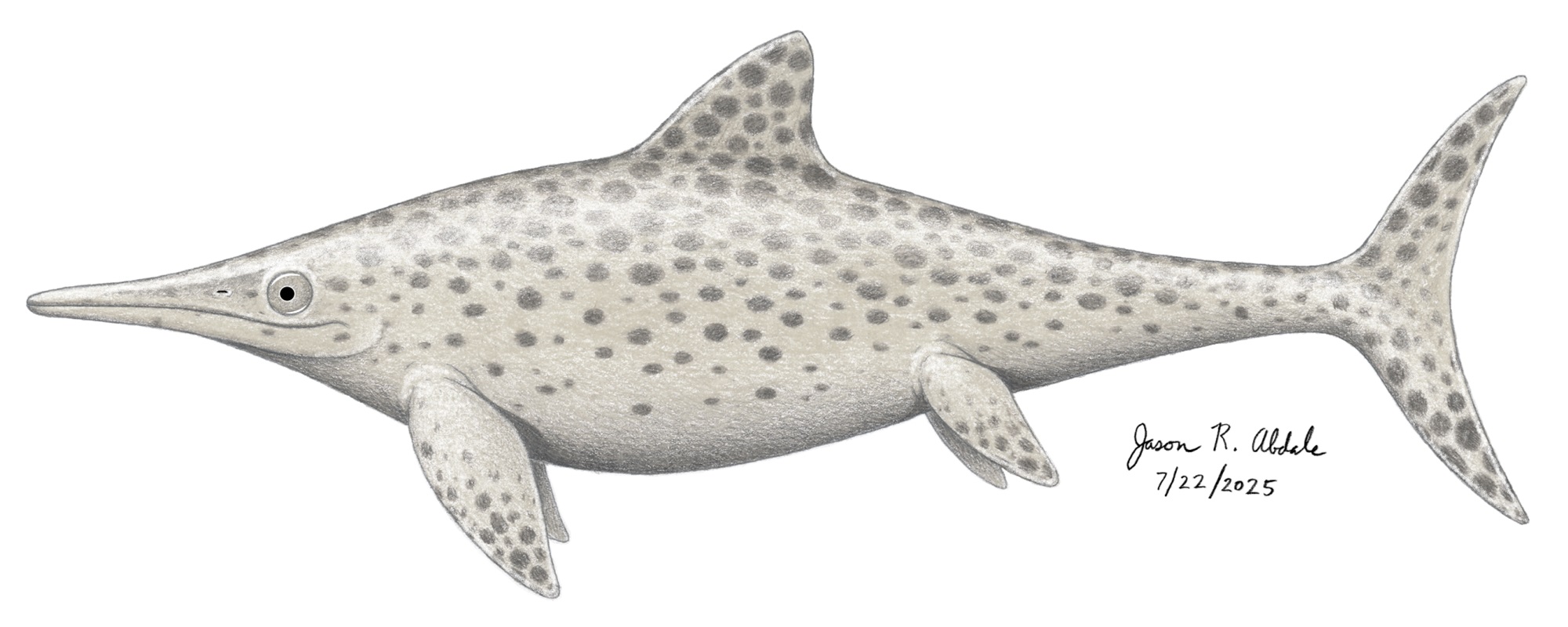
Caypullisaurus bonapartei. © Jason R. Abdale (July 22, 2025).
I truly enjoy writing my articles and drawing my art, but it’s increasingly clear that I can’t keep this up without your gracious financial assistance. Kindly check out my pages on Redbubble and Fine Art America if you want to purchase merch of my artwork. Consider buying my ancient Roman history books Four Days in September: The Battle of Teutoburg and The Great Illyrian Revolt if you or someone that you know loves that topic, or my ancient Egyptian novel Servant of a Living God if you enjoy action and adventure.
Please consider becoming a patron on my Patreon page so that I can afford to purchase the art supplies and research materials that I need to keep posting art and articles onto this website. Professional art supplies are pricey, and many research articles are “pay to read”, and some academic journals are rather expensive. Patreon donations are just $1 per month – that’s it. If everyone gave just $1 per month, it would go a long way to purchase the stuff that I need to keep my blog “Dinosaurs and Barbarians” running.
Take care, and, as always, keep your pencils sharp.
Bibliography
Buchy, Marie-Céline; López-Oliva, José Guadalupe (2009). “Occurrence of a second ichthyosaur genus (Reptilia: Ichthyosauria) in the Late Jurassic Gulf of Mexico”. Boletín de la Sociedad Geológica Mexicana, volume 61, issue 2. Pages 233-238.
https://www.researchgate.net/publication/285954232_Occurrence_of_a_second_ichthyosaur_genus_Reptilia_Ichthyosauria_in_the_Late_Jurassic_Gulf_of_Mexico.
Camp, Charles Lewis (1942). “Ichthyosaur Rostra from Central California”. Journal of Paleontology, volume 16, issue 3 (May 1942). Pages 362-371.
https://www.jstor.org/stable/1298911.
Fernández, Marta S. (1997). “A new Ichthyosaur from the Tithonian (Late Jurassic) of the Neuquen Basin, Northwestern Patagonia, Argentina”. Journal of Paleontology, volume 71, issue 3 (May 1997). Pages 479-484.
Fernández, Marta (2007). “Redescription and phylogenetic position of Caypullisaurus (Ichthyosauria: Ophthalmosauridae)”. Journal of Paleontology, volume 81, issue 2 (2007). Pages 368-375.
https://api.naturalis.fcnym.unlp.edu.ar/server/api/core/bitstreams/f160e0f8-258d-47ba-8880-2f7c64c99813/content#:~:text=Based%20on%20skull%20length%2C%20C,and%20broad%20postorbital%20seg%2D%20ment.
Fischer, Valentin; Maisch, Michael W.; Naish, Darren; Kosma, Ralf; Liston, Jeff; Joger, Ulrich; Krüger, Fritz J.; Pérez, Judith Pardo; Tainsh, Jessica; Appleby Robert M. (2012). “New Ophthalmosaurid Ichthyosaurs from the European Lower Cretaceous Demonstrate Extensive Ichthyosaur Survival across the Jurassic–Cretaceous Boundary”. PLOS One, volume 7, issue 1: e29234 (January 3, 2012).
https://journals.plos.org/plosone/article?id=10.1371/journal.pone.0029234.
McGowan, Christopher (1976). “The description and phenetic relationships of a new ichthyosaur genus from the Upper Jurassic of England”. Canadian Journal of Earth Sciences, volume 13, issue 5 (May 1976). Pages 668-683.
https://pubs.geoscienceworld.org/csp/cjes/article/13/5/668/105440/The-description-and-phenetic-relationships-of-a.
Ölveczká, Diana; Rehakova, Daniela (2022). “Upper Tithonian Crassicollaria Zone: new data on the calpionellid distribution and subzonal division of the Pieniny Klippen Belt in Western Carpathians”. Acta Geologica Slovaca, volume 14, issue 1 (2022). Pages 37-56.
https://www.researchgate.net/publication/362303337_Upper_Tithonian_Crassicollaria_Zone_new_data_on_the_calpionellid_distribution_and_subzonal_division_of_the_Pieniny_Klippen_Belt_in_Western_Carpathians.
Pardo-Pérez, Judith Mariana; Frey, Eberhard; Stinnesbeck, Wolfgang; Rivas, Luis (2011). “Early Cretaceous ichthyosaurs from the Tyndall Glacier in Torres Del Paine National Park, southernmost Chile”. 71st Annual Meeting of the Society of Vertebrate Paleontology, Las Vegas, Nevada (November 2011). Page 171.
https://www.researchgate.net/publication/344210904_Early_Cretaceous_ichthyosaurs_from_Tyndall_Glacier_in_Torres_del_Paine_National_Park_Southernomost_Chile.
Pardo-Pérez, Judith; Frey, Eberhard; Stinnesbeck, Wolfgang; Salazar, Christian; Leppe, Marcelo (2009). “Life and death on the Torres del Pain ichthyosaurs, southern Chile”. Proceedings of 7th Annual Meeting of the European Association of Vertebrate Palaeontologists, Berlin, Germany (July 20-24, 2009). Page 55.
https://www.researchgate.net/publication/344210886_Life_and_Death_of_the_Torres_del_Paine_Ichthyosaurs_Southern_Chile.
Rogov, Mikhail A.; Poulton, Terry P. (2015). “Aulacostephanid ammonites from the Kimmeridgian (Upper Jurassic) of British Columbia (western Canada) and their significance for correlation and palaeobiogeography”. Bulletin of Geosciences, volume 90, issue 1 (January 2015). Pages 7-20.
https://www.researchgate.net/publication/268803858_Aulacostephanid_ammonites_from_the_Kimmeridgian_Upper_Jurassic_of_British_Columbia_Western_Canada_and_their_significance_for_correlation_and_palaeobiogeography.
Sissons, Robin L.; Caldwell, Michael W.; Evenchick, Carol A.; Brinkman, Donald B.; Vavrek, Matthew J. (2016). “An Upper Jurassic ichthyosaur (Ichthyosauria: Ophthalmosauridae) from the Bowser Basin, British Columbia”. Canadian Journal of Earth Sciences, volume 53, issue 1 (January 2016). Pages 34-40.
https://www.researchgate.net/publication/283733979_An_Upper_Jurassic_ichthyosaur_Ichthyosauria_Ophthalmosauridae_from_the_Bowser_Basin_British_Columbia.
Spalletti, Luis A.; Gasparini, Zulma; Veiga, Gonzalo; Schwartz, Ernesto; Fernández, Marta; Matheos, Sergio (1999). “Facies anóxicas, procesos deposicionales y herpetofauna de la rampa marina titoniano-berriasisana en la Cuenca Neuqina (Yesera del Tromen), Neuquén, Argentina”. Revista geológica de Chile, volume 26 (1999). Pages 109-123.
https://www.scielo.cl/scielo.php?script=sci_arttext&pid=S0716-02081999000100006.
Taliaferro, N. L. (1943). “Geologic history and structure of the central Coast Ranges of California”. In Jenkins, O.P. et al., eds. Geologic Formations and Economic Development of the Oil and Gas Fields of California. California Division of Mines Bulletin, number 118, part 2, chapter 5 (April 1943). Pages 119-162.
https://archive.org/details/geologicformatio00calirich/page/119/mode/1up.
Categories: Paleontology, Uncategorized
 DINOSAURS AND BARBARIANS
Leave a comment