
Wellnhopterus was a pterosaur which lived in Texas during the late Cretaceous Period 70-69 million years ago.
On March 22-29, 1986, a paleontological excavation led by Dr. Wann Langston Jr. was underway at a place called Pterodactyl Ridge within the northeastern part of Big Bend National Park in Brewster County, Texas. Fossils of the large azhdarchid pterosaur Quetzalcoatlus had previously been found here, hence the place’s name. It was here on March 27 that a fossil preparator named Robert Rainey found partial pterosaur fossils consisting of the front half of the upper and lower jaws, several neck vertebrae, and a few fragments of limb bones (collection ID code: TMM 42489-2; originally designated as WL 474) (Andres and Langston Jr. 2021, pages 54, 186; Brown et al. 2021, pages 7, 9). However, these bones clearly didn’t resemble the Quetzalcoatlus bones which had been found there before. In his field notes, Dr. Langston Jr. wrote “We came to the end of the snout sooner than expected. This specimen is very different from the previous snouts and jaws in that it is much deeper and shorter (if it is complete, which is uncertain). Further inspection of the neck suggests that the atlas-axis may also be present. If so this is a very important find because it means that the first five out of seven cervicals are intact” (Langston Field Notes, March 27, 1986: 36–37)” (Brown et al. 2021, page 9)
The fossils were found in “Unit 10” of the Javelina Formation, close to the formation’s base (Kellner 2004, page 529; Andres and Langston Jr. 2021, page 186). The Javelina Formation, formerly known as the Tornillo Beds, is found in southwestern Texas and northeastern Mexico and dates to the lower and middle parts of the Maastrichtian Stage, the last stage of the Cretaceous Period. The formation is named in reference to Javelina Creek in the northeastern part of Tornillo Flat. The Javelina Formation unconformably overlies the Aguja Formation which dates to the early and middle Campanian Stage, and it is unconformably overlain by the Black Peaks Formation which straddles the upper Maastrichtian Stage of the Cretaceous Period and the Paleocene Epoch of the Paleogene Period. The gap between the top of the Javelina Formation and the bottom of the overlying Black Peaks Formation is believed to span just a few million years of time (Maxwell et al. 1967, pages 6, 88, 96, 159; Lehman and Coulson 2002, pages 156-172; Woodward and Lehman 2009, page 807; Rivera-Sylva and Carpenter 2014, page 152). Much of the underlying Aguja Formation consists of alternating layers sandstone and marine clay, indicating periods when the Gulf of Mexico expanded and shrank (Maxwell et al. 1967, pages 79, 81-82). By contrast, the Javelina Formation, which is dominated by bentonic clays and lenticular layers of sandstone, often featuring river channel deposits, seems to have been a river flood plain or a riverine estuary environment either on the shore of the Gulf of Mexico or very near to it. Fossil bones and wood have been found here (Maxwell et al. 1967, pages 91-92, 96), including the bones of the giant sauropod dinosaur Alamosaurus, the giant crocodilian Deinosuchus, as well as unidentified remains belonging to ceratopsians, hadrosaurs, and ankylosaurs (Brown 1941, page 104).
There is confusion in the scientific literature as to the date of these fossils. Andres and Myers said that they dated to the upper Maastrichtian (Andres and Myers 2013, page 391), while another report from 2021 stated that the rock was dated to “more than 69 Ma”, give or take 900,000 years (Andres and Langston Jr. 2021, page 186). Considering that the Javelina Formation spans the lower and middle Maastrichtian, the date given by Andres and Langston Jr. in 2021 seems more accurate, and they likely date to 70-69 MYA.
The pterosaur fossils from the Javelina Formation were originally identified in 1991 by the German paleontologist and pterosaur expert Peter Wellnhofer as Quetzalcoatlus sp., meaning “Quetzalcoatlus, species unknown”. At first, these fossils were combined with the fossils of a smaller Quetzalcoatlus specimen, which would later be named Q. lawsoni (Wellnhofer 1991, page 144). Then in 1996, Alexander Kellner and Wann Langston Jr. noted that the fossils which were classified as Quetzalcoatlus sp. came from two different rock layers, one older and the other earlier. Further examination yielded more anatomical differences between the bones found in these two layers. Clearly, these bones which were originally thought to belong to the same species actually belonged to two different species. Kellner and Langston Jr. asserted that the remains which had been found within the lower layer belonged to an as-yet-unidentified pterosaur which had a shorter beak and neck compared to Quetzalcoatlus (Kellner and Langston Jr. 1996, pages 222-231). In 2004, Alexander Kellner noted that the skull from the Javelina Formation possessed “a large nasoantorbital fenestra and bears a sagittal premaxillary crest that extends backwards” (Kellner 2004, page 529). These features were similar to those that were seen in the skulls of tapejarid pterosaurs, and therefore this skull also likely belonged to a tapejarid. If true, then this would represent the youngest member of the family Tapejaridae. Furthermore, this family was found to be the sister group to Azhdarchidae (Kellner 2004, pages 521, 529), which together were grouped into the super-family Azhdarchoidea (Martill and Naish 2006, page 926).
In 2006, the British paleontologists David Martill and Darren Naish noted that the partial skull recovered from the Javelina Formation bore more of a resemblance to the South American pterosaur Tupuxuara than to Quetzalcoatlus. Consequently, it was informally called “the Javelina Tupuxuara” (Martill and Naish 2006, pages 928-929). In 2013, the fossils were placed as a basal member of the family Azhdarchidae (Andres and Myers 2013, pages 388, 390-391; Witton 2013, page 247). In 2018, it was stated to be a member of Azhdarchidae (Longrich et al. 2018: e2001663).
In July 2021, the Brazilian paleontologist Herbert Campos gave these fossils the name Javelinadactylus sagebieli (Campos 2021, page 2,255). Later that same year in December, Brian Andres and Wann Langston Jr. (who was posthumously credited as a co-author) gave the same fossils a different name, Wellnhopterus brevirostris. The genus name was in honor of the German paleontologist Peter Wellnhofer, and the species name brevirostris means “short beak” in Latin (Andres and Langston Jr. 2021, page 185-186). In 2022, Herbert Campos’ article was retracted, with the publishers giving the following statement: “The editors have retracted this article, because the author did not have the ownership of the data reported. This was confirmed by the University of Texas at Austin. In addition, this article described a new species that was based on photographs of specimen TMM 42489-2. This specimen has been described and named, as Wellnhopterus brevirostris, gen. et sp. nov., in a different article that was submitted for publication prior to the submission of this article, and itself was part of a larger study. Hebert Bruno Nascimento Campos agrees to this retraction. The online version of this article contains the full text of the retracted article as Supplementary Information” (https://link.springer.com/article/10.1007/s11756-021-00841-7).
In 2021, Brian Andres placed Wellnhopterus within the azhdarchid sub-family Quetzalcoatlinae as a close relative of Cryodrakon, but basal to Quetzalcoatlus (Andres 2021, page 207). With the discovery of well-preserved fossils in China like Sinopterus and Huaxiapterus, it’s possible that Wellnhopterus could be related to these genera. The skull of Huaxiapterus in particular bears certain similarities to the skull of Wellnhopterus. However, despite outward visual similarity to Huaxiapterus, Rodrigo Pêgas and colleagues stated in 2023 that Wellnhopterus was not a close relative of Huaxiapterus, and was actually more closely related to the azhdarchid genera Aralazhdarcho and Phosphatodraco, but not to Quetzalcoatlus. In fact, Wellnhopterus and Quetzalcoatlus were placed in different sub-families (Pêgas et al. 2023: e14829).
The partial set of jaws measured 80 cm long, preserving the front of both the upper and lower jaws. As to what the back of the skull looked like, it’s anybody’s guess. There is a thin keel of bone extending downwards from the underside of the front of the lower jaw (Andres and Langston Jr. 2021, page 189). Its short neck vertebrae seem to be much closer to the proportions seen in Hatzegopterus than to Quetzalcoatlus (Naish and Witton 2017: e2908). Using Quetzalcoatlus as a template, Mark Witton estimated that Wellnhopterus had a wingspan of 5 meters (Witton 2013, page 249), while Andres and Langston Jr. estimated the wingspan at 3 meters (Andres and Langston Jr. 2021, pages 47, 186).
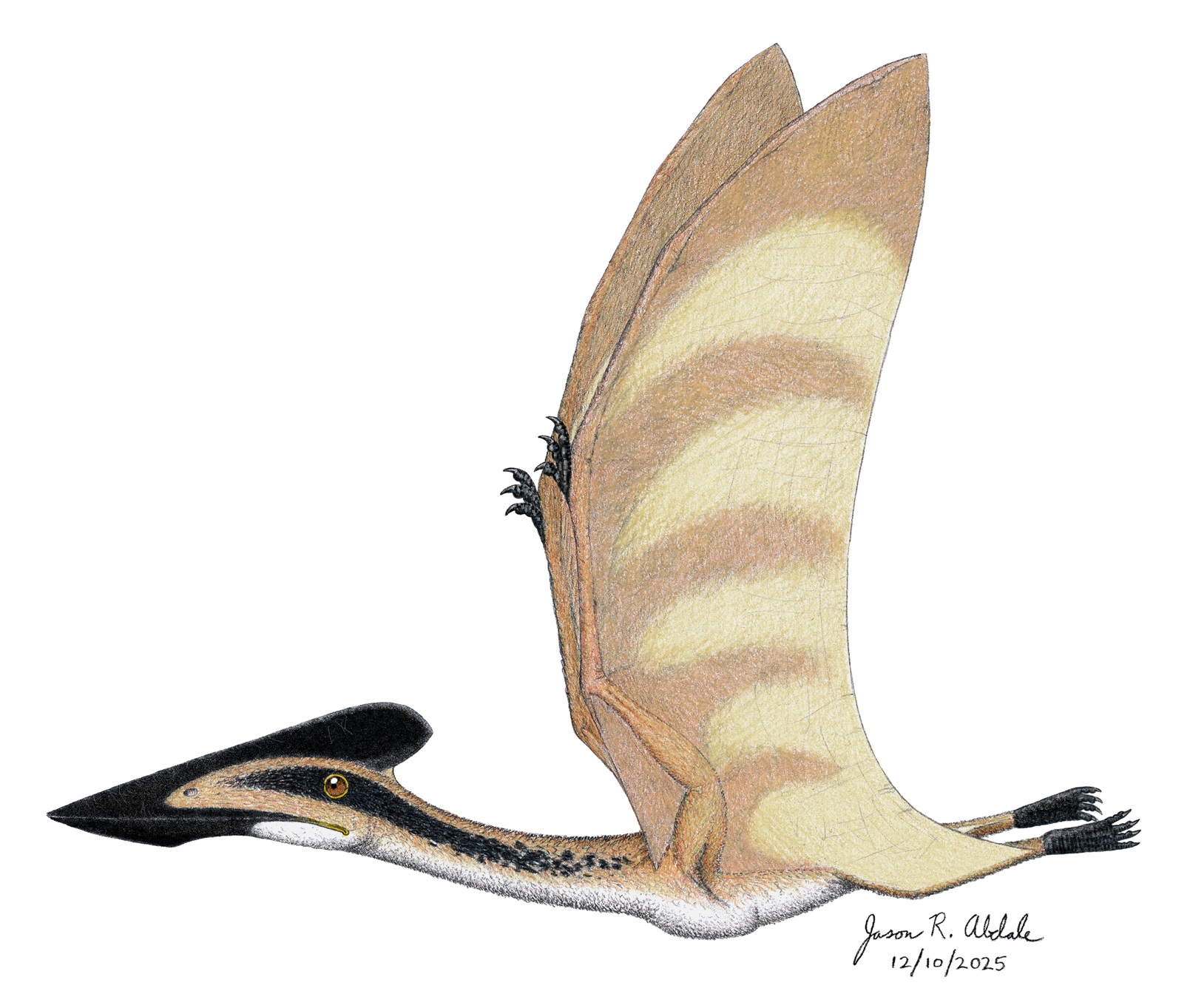
Wellnhopterus brevirostris. © Jason R. Abdale (December 10, 2025).
I truly enjoy writing my articles and drawing my art, but it’s increasingly clear that I can’t keep this up without your gracious financial assistance. Kindly check out my pages on Redbubble and Fine Art America if you want to purchase merch of my artwork. Consider buying my ancient Roman history books Four Days in September: The Battle of Teutoburg and The Great Illyrian Revolt if you or someone that you know loves that topic, or my ancient Egyptian novel Servant of a Living God if you enjoy action and adventure. Please consider becoming a patron on my Patreon page so that I can continue to purchase the art supplies and research materials that I need. Professional art supplies are pricey, many research articles are “pay to read”, and some academic journals are rather expensive. My Patreon membership is just $1 per month – that’s it. If everybody who likes this drawing donates just one dollar per month, it would go a long way to keeping my blog “Dinosaurs and Barbarians” running and preventing my career in paleo-art from going extinct.
Keep your pencils sharp, everybody.
Bibliography
Books
Wellnhofer, Peter. The Illustrated Encyclopedia of Pterosaurs. London: Salamander Books, Ltd., 1991.
https://archive.org/details/illustratedencyc0000well.
Witton, Mark P. Pterosaurs: Natural History, Evolution, Anatomy. Princeton: Princeton University Press, 2013.
Articles
Andres, Brian (2021). “Phylogenetic systematics of Quetzalcoatlus Lawson 1975 (Pterodactyloidea: Azhdarchoidea)”. Journal of Vertebrate Paleontology, volume 41, supplement 1 (December 14, 2021). Pages 203-217.
https://www.tandfonline.com/doi/full/10.1080/02724634.2020.1801703#abstract.
Andres, Brian; Langston Jr., Wann (2021). “Morphology and taxonomy of Quetzalcoatlus Lawson 1975 (Pterodactyloidea: Azhdarchoidea)”. Journal of Vertebrate Paleontology, volume 41, supplement 1 (December 14, 2021). Pages 46-202.
https://www.researchgate.net/publication/356856053_Morphology_and_taxonomy_of_Quetzalcoatlus_Lawson_1975_Pterodactyloidea_Azhdarchoidea.
Andres, Brian; Myers, Timothy S. (2013). “Lone Star Pterosaurs”. Earth and Environmental Science Transactions of the Royal Society of Edinburgh, volume 103, issue 3-4 (2013). Pages 383-398.
https://www.researchgate.net/publication/259437218_Lone_Star_Pterosaurs.
Brown, Barnum (1941). “The Methods of Walt Disney Productions. (An extended abstract of an address given at the Annual Dinner and Meeting, December 11, 1940.)”. Transactions of the New York Academy of Science, volume 3, issue 4 (1941). Pages 100-105.
https://archive.org/details/sim_new-york-academy-of-sciences-transactions_1941-02_3_4/page/100/mode/2up?q=Brown.
Brown, Matthew A.; Sagebiel, J. Chris; Andres, Brian (2021). “The discovery, local distribution, and curation of the giant azhdarchid pterosaurs from Big Bend National Park”. Journal of Vertebrate Paleontology, volume 41, supplement 1 (December 2021). Pages 2-20.
https://www.researchgate.net/publication/356871814_The_discovery_local_distribution_and_curation_of_the_giant_azhdarchid_pterosaurs_from_Big_Bend_National_Park.
Campos, Herbert Bruno Nascimento (2021). “A new azhdarchoid pterosaur from the Late Cretaceous Javelina Formation of Texas”. Biologia, volume 77, issue 8 (July 31, 2021). Page 2,255.
https://link.springer.com/article/10.1007/s11756-021-00841-7.
Kellner, Alexander W. A. (2004). “New information on the Tapejaridae (Pterosauria, Pterodactyloidea) and discussion of the relationships of this clade”. Ameghiniana, volume 41, issue 4 (December 30, 2004). Pages 521-534.
https://www.ameghiniana.org.ar/index.php/ameghiniana/article/download/849/1588/10359.
Kellner, Alexander W. A.; Langston Jr., Wann (1996). “Cranial remains of Quetzalcoatlus (Pterosauria, Azhdarchidae) from Late Cretaceous sediments of Big Bend National Park, Texas”. Journal of Vertebrate Paleontology, volume 16, issue 2 (June 5, 1996). Pages 222-231.
Longrich, Nicholas R.; Martill, David M.; Andres, Brian; Penny, D. (2018). “Late Maastrichtian pterosaurs from North Africa and mass extinction of Pterosauria at the Cretaceous-Paleogene boundary”. PLOS Biology, volume 16, issue 3: e2001663 (March 13, 2018).
https://journals.plos.org/plosbiology/article%3Fid%3D10.1371/journal.pbio.2001663.
Martill, David M.; Naish, Darren (2006). “Cranial crest development in the azhdarchoid pterosaur Tupuxuara, with a review of the genus and tapejarid monophyly”. Palaeontology, volume 49, issue 4 (2006). Pages 925-941.
https://www.academia.edu/1838467/Cranial_crest_development_in_the_azhdarchoid_pterosaur_Tupuxuara_with_a_review_of_the_genus_and_tapejarid_monophyly.
Maxwell, Ross A.; Lonsdale, John T.; Hazzard Roy T.; Wilson, John A. (1967). “Geology of Big Bend National Park, Brewster County, Texas”. The University of Texas, publication no. 6711 (June 1, 1967). Pages 1-320.
https://archive.org/details/geologyofbigbend00maxw/mode/2up.
Naish, Darren; Witton, Mark P. (2017). “Neck biomechanics indicate that giant Transylvanian azhdarchid pterosaurs were short-necked arch predators”. PeerJ, volume 5: e2908 (January 18, 2017).
https://peerj.com/articles/2908/.
Pêgas, Rodrigo V.; Zhoi, Xuanyu; Jin, Xingsheng; Wang, Kai; Ma, Waisum (2023). “A taxonomic revision of the Sinopterus complex (Pterosauria, Tapejaridae) from the Early Cretaceous Jehol Biota, with the new genus Huaxiadraco”. PeerJ, volume 11: e14829 (February 9, 2023).
https://peerj.com/articles/14829/.
Rivera-Sylva, Hector E.; Carpenter, Kenneth (2014). “Mexican Saurischian Dinosaurs”. In Rivera-Sylva, Hector E.; Carpenter, Kenneth; Frey, Eberhard, eds. Dinosaurs and other Reptiles from the Mesozoic of Mexico. Bloomington: Indiana University Press, 2014. Pages 143-155.
https://www.researchgate.net/publication/285749512_Mexican_saurischian_dinosaurs.
Woodward, Holly N.; Lehman, Thomas M. (2009). “Bone histology and microanatomy of Alamosaurus sanjuanensis (Sauropoda: Titanosauria) from the Maastrichtian of Big Bend National Park, Texas”. Journal of Vertebrate Paleontology, volume 29, issue 3 (September 2009). Pages 807-821.
https://www.researchgate.net/publication/233733738_Bone_Histology_and_Microanatomy_of_Alamosaurus_sanjuanensis_Sauropoda_Titanosauria_from_the_Maastrichtian_of_Big_Bend_National_Park_Texas.
Categories: Paleontology, Uncategorized


Leave a Reply