
Uktenadactylus was a genus of pterosaur with a possible 25-30 foot wingspan which lived in North America and Europe during the early and middle Cretaceous Period 125-100 million years ago.
In 1992, a man named Chris Wadleigh found the front end of a pterosaur’s upper jaw (collection ID code: SMU 73058) within a few miles north of Fort Worth, Tarrant County, Texas within rocks from the lower strata of the Paw Paw Formation, which dates to the upper part of the Albian Stage of the middle Cretaceous Period. The rock layer which the fossil was found in dates to approximately 100 MYA. In 1994, this fossil was ascribed to the genus Coloborhynchus, but it was stated that this fossil didn’t belong to the species C. clavirostris which was known from much earlier Berriasian and Valanginian-aged strata from Europe. This was a new species, which was named C. wadleighi in honor of its discoverer (Lee 1994, pages 755-763).
However in 2008, Taissa Rodrigues and Alexander Kellner stated that the genus Coloborhynchus only comprised the type species from Europe, C. clavirostris. As for the fossil found in Texas, this was given a new name, which Rodrigues and Kellner called Uktenadactylus, named after the Uktena, a creature from Cherokee mythology (Rodrigues and Kellner 2008, pages 219-228).
Uktenadactylus apparently didn’t only live in North America, and its geologic range extended back much further than the middle Cretaceous. In the 2000s, a highly-weathered fragment of a pterosaur jaw (collection ID code: IWCMS 2014.82) was found at Sudmoor Point on the southwestern coast of England’s Isle of Wight. The rocks here are from the Wessex Formation, which dates to the Barremian Stage of the early Cretaceous Period about 125 MYA. Here are found the bones of other famous early Cretaceous English dinosaurs such as Iguanodon and Neovenator. In 2015, British paleontologist David Martill assigned this pterosaur fragment to Coloborhynchus sp. (Martill 2015, pages 377-380). In 2020, this fragment was assigned to the genus Uktenadactylus, but a new species name was given to it – U. rodriguesae (Holgado and Pêgas 2020, pages 750-751).
Where did Uktenadactylus fit onto the pterosaur tree? This is difficult to determine because many pterosaur species are known only from the front ends of the jaws because these are the most robust parts of the skeleton. The remainder of pterosaur bones, including the rest of the skull, are very delicate and fragile and rarely fossilize. Based upon the squared shape to the front of its snout, Uktenadactylus seems to be related to the Moroccan pterosaurs Akharhynchus and Sirrocopterus. However, every study conducted since Uktenadactylus was named has concluded that it is a close relative of Coloborhynchus. In 2013, Brian Andres and Tim Myers stated that Uktenadactylus and Coloborhynchus were sister taxa, placed within the family Ornithocheiridae (Andres and Myers 2013, page 388). This was repeated in 2019 (Jacobs et al. 2019, pages 77-88). However in 2020, Holgado and Pêgas stated that Uktenadactylus was the sister taxon to Nicorhynchus, which is also a close relative of Coloborhynchus. All of these genera were grouped into the sub-family Coloborhynchinae of the family Anhangueridae, making it them close relatives of the eponymous Anhanguera from South America (Holgado and Pêgas 2020, page 754).
How big was Uktenadactylus? All sources say that it was closely related to Coloborhynchus, and Coloborhynchus was a big pterosaur. David Martill and David Unwin stated that Coloborhynchus could have had a wingspan of up to 7 meters (23 feet) (Martill and Unwin 2012, pages 1-9). The South American pterosaur Tropeognathus, which is somewhat related to Uktenadactylus, is commonly stated to have had an 8 meter (25 foot) wingspan. Although known from only fragmentary remains, Uktenadactylus was clearly a large animal. Based upon the size of the end of the snout and the size of the tooth sockets and comparing them with the remains of other toothed pterosaurs which we know more about such as Anhanguera and Tropeognathus, Uktenadactylus likely had a wingspan of 7-8 meters (23-26.2 feet), and possibly as high as 9 meters (29.5 feet). If this upper estimate is true, then Uktenadactylus is possibly one of the biggest toothed pterosaurs if not THE biggest of all time, smaller only than the giant toothless azhdarchid pterosaurs of the late Cretaceous.
Below is a reconstruction of Uktenadactylus wadleighi. The body and the rest of the skull is based upon that of Tropeognathus.
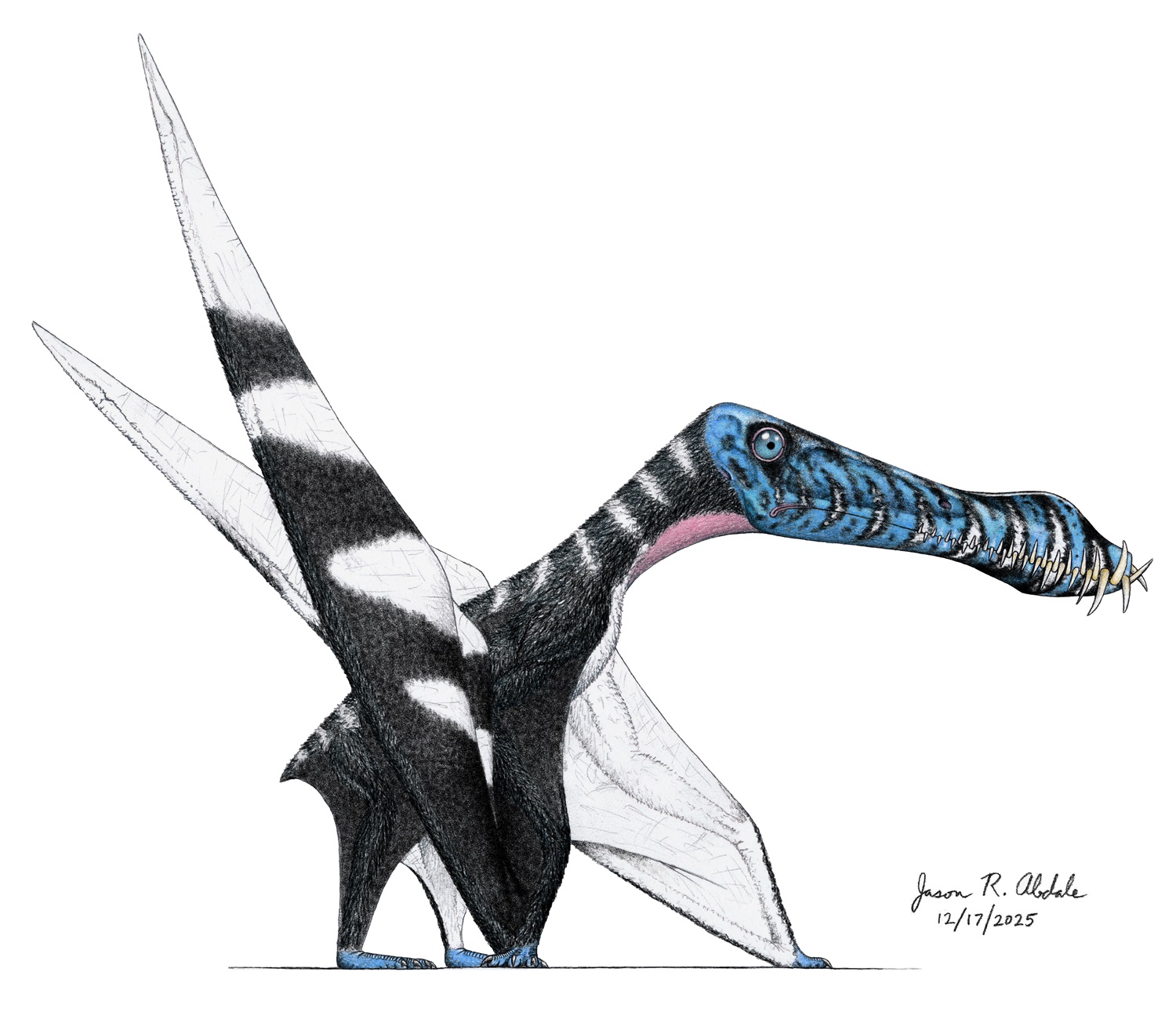
Uktenadactylus wadleighi. © Jason R. Abdale (December 17, 2025).
I truly enjoy writing my articles and drawing my art, but it’s increasingly clear that I can’t keep this up without your gracious financial assistance. Kindly check out my pages on Redbubble and Fine Art America if you want to purchase merch of my artwork. Consider buying my ancient Roman history books Four Days in September: The Battle of Teutoburg and The Great Illyrian Revolt if you or someone that you know loves that topic, or my ancient Egyptian novel Servant of a Living God if you enjoy action and adventure. Please consider becoming a patron on my Patreon page so that I can continue to purchase the art supplies and research materials that I need. Professional art supplies are pricey, many research articles are “pay to read”, and some academic journals are rather expensive. My Patreon membership is just $1 per month – that’s it. If everybody who likes this drawing donates just one dollar per month, it would go a long way to keeping my blog “Dinosaurs and Barbarians” running and preventing my career in paleo-art from going extinct.
Keep your pencils sharp, everybody.
Bibliography
Andres, Brian; Myers, Timothy S. (2013). “Lone Star Pterosaurs”. Earth and Environmental Science Transactions of the Royal Society of Edinburgh, volume 103, issue 3-4 (2013). Pages 383-398.
https://www.researchgate.net/publication/259437218_Lone_Star_Pterosaurs.
Holgado, Borga; Pêgas, Rodrigo V. (2020). “A taxonomic and phylogenetic review of the anhanguerid pterosaur group Coloborhynchinae and the new clade Tropeognathinae”. Acta Palaeontologica Polonica, volume 65, issue 4 (2020). Pages 743-761.
https://www.app.pan.pl/archive/published/app65/app007512020.pdf.
Jacobs, Megan L.; Martill, David M.; Ibrahim, Nizar; Longrich, Nick (2019). “A new species of Coloborhynchus (Pterosauria, Ornithocheiridae) from the mid-Cretaceous of North Africa”. Cretaceous Research, volume 95 (March 2019). Pages 77-88.
Lee, Young-Nam (1994). “The Early Cretaceous Pterodactyloid Pterosaur Coloborhynchus wadleighi from North America”. Palaeontology, volume 37, issue 4 (1994). Pages 755-763.
https://palass.org/sites/default/files/media/publications/palaeontology/volume_37/vol37_part4_pp755-763.pdf.
Martill, David M. (2015). “First occurrence of the pterosaur Coloborhynchus (Pterosauria, Ornithocheiridae) from the Wessex Formation (Lower Cretaceous) of the Isle of Wight, England”. Proceedings of the Geologists’ Association, volume 126, issue 3 (2015). Pages 377-380.
https://pure.port.ac.uk/ws/portalfiles/portal/3567035/First_occurrence_of_the_pterosaur.pdf.
Martill, David M.; Unwin, David M. (2012). “The world’s largest toothed pterosaur, NHMUK R481, an incomplete rostrum of Coloborhynchus capito (Seeley 1870) from the Cambridge Greensand of England”. Cretaceous Research, volume 34 (April 2012). Pages 1-9.
Rodrigues, Taissa; Kellner, Alexander W. A. (2008). “Review of the pterodactyloid pterosaur Coloborhynchus”. Zitteliana, series B, volume 28 (December 31, 2008). Pages 219-228.
https://epub.ub.uni-muenchen.de/12017/1/zitteliana_2008_b28_15.pdf.
Categories: Paleontology, Uncategorized
 DINOSAURS AND BARBARIANS
Leave a comment