
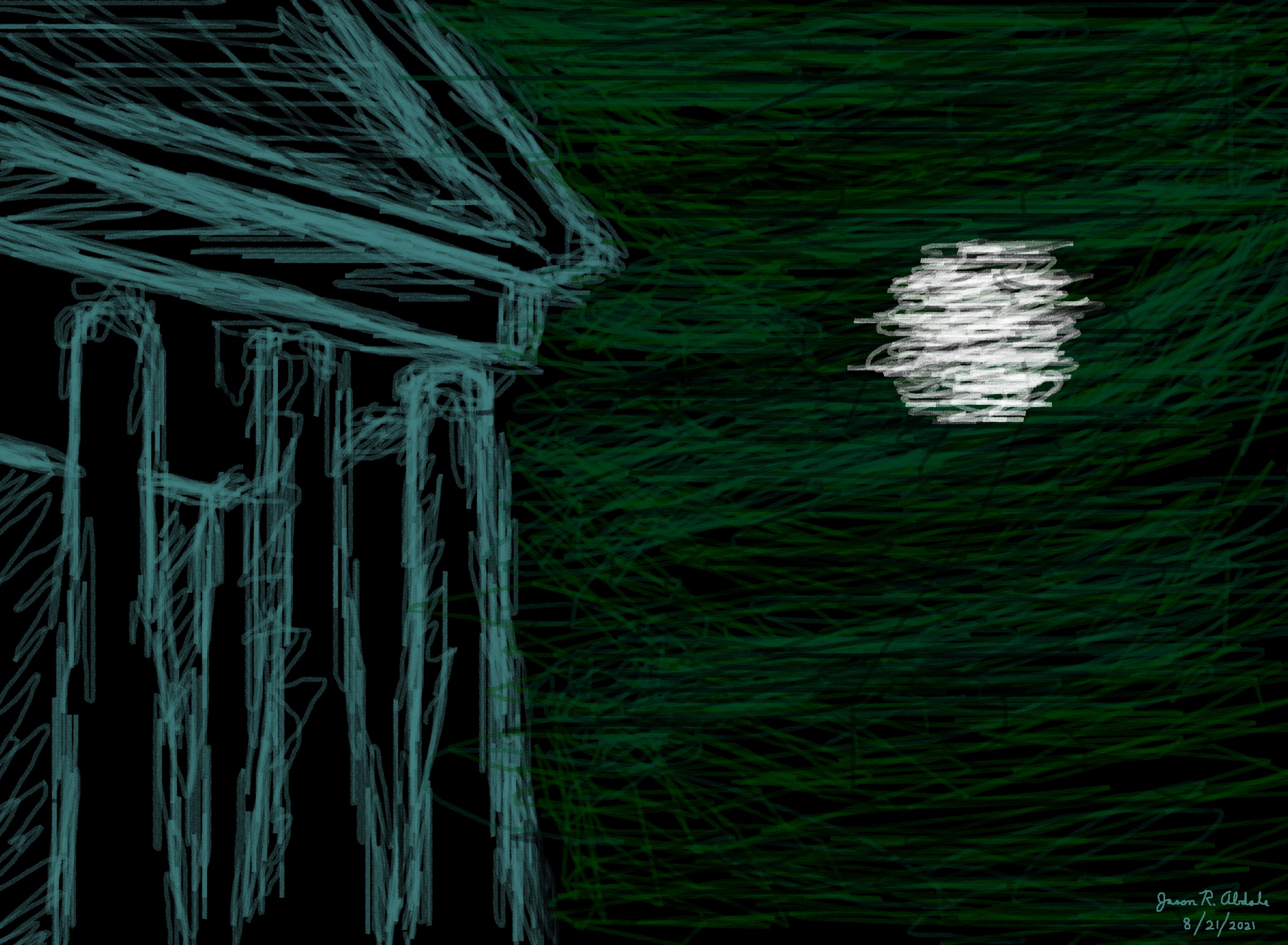
Manes, Lares, and Lemures. © Jason R. Abdale (August 21, 2021).
When is the most fearful time of year, a time of ghosts, ghouls, and monsters? One might naturally say “Halloween, of course” with a certain undertone of irritation. After all, isn’t it incredibly obvious? Well, that may be the case nowadays, yet it might surprise you to learn that October 31 wasn’t the only day on the calendar when the imps of perdition reigned supreme. The day before May 1 was also regarded as especially ominous and portentous. You see, May Eve, as April 30 was known, was Walpurgisnacht, a night when the powers of Darkness made themselves known to the mortal world of Mankind, and uncountable terrors were let loose upon the earth. But just how much truth is there to all of this? Was May Eve regarded by Early Modern Europeans as a sort of proto-Halloween, or are all of the tales concerning witchcraft, dark magic, and occultism nothing more than the products of modern imaginations that have been superimposed upon earlier times? Let’s dig into the real history behind what happened on April 30th.
Firstly, where does the name come from? Walpurgisnacht is named after Saint Walpurga, an Anglo-Saxon Christian missionary who lived during the 8th Century AD. Nobody knows when she was born, although the date 710 AD is often thrown around, and she is said to have died on February 25 in either 777 or 779 AD. In 748 AD, she was dispatched from her convent in Devon to preach to the pagans in southern Germany. It was during the voyage that the first miracle associated with her occurred. On the passage, the ship was struck by a violent storm. Sister Walpurga knelt on the deck and prayed, and the storm promptly stopped and the sea was calm once more. Many more miracles and wonders were associated with her over the years, until finally, she died after years of service to the Church. She was first buried in Heidenheim, but the workers desecrated her grave. Thereupon, she appeared in a vision to the Bishop Oktar of Eichstätt, which spurred him to order her remains moved to his city. Not long after her re-entombment, word began to spread that her grave had become the site of miracles. It was said that an oil trickled out of her bones which could cure sicknesses, and pilgrims flocked to her grave to be healed. In 870 AD, she was officially canonized as a saint. Her feast day is May 1, and the night before is referred to in German as Walpurgisnacht (New Advent. “St. Walburga”).
Seems straight-forward enough – a typical medieval hagiography. So where does all this rot about devils and witches come from? This doesn’t come around until much, much later. The earliest reference to this that I can find comes from Johann Wolfgang von Goethe’s tragic play Faust, which was published in 1808 – over a thousand years after Saint Walpurga died. This work of German literature appears to have kicked off all of the associations with witchcraft and devil-worship with April 30. The majority of texts which talk about this subject pop up during the 19th Century. I haven’t been able to find any that date earlier than this. However, this might have some rather mundane origins. It was said that during the evangelization of the pagans of Europe, those who resisted being converted to Christianity would gather in secret in remote places to continue worshiping the old gods. Over the years, simple tales about these pagan holdouts were increasingly embellished and exaggerated into witches’ sabbats and convocations of the profane (Mellor 1900, page 84).
Superstitions about the dark powers which emerged on April 30 seem to have been most powerfully felt within Germany. (McWhorter 1868, page 748). According to Reverend W. S. Lach-Szyrma, “’Tis commonly say’d, in Germany, that the Witches doe meet in the night before the first day of May upon an high mountain called the Blocksberg [also called Mount Brocken], where they together with the Devils doe dance and feast and the common People doe the night before ye said day fetch a certain thorn and stick it at their house door believe that the witches can then doe them no harm” (Lach-Szyrma 1882, page 185). Another anecdote gives a fuller description of this night’s sinister activities: “It is a popular belief among the peasants of the present day, that on Walpurgis-nacht (May-day night) all the witches in the country are wont to assemble on the summit of the Blocksberg, a mountain situate[d] in the Hartz, on the frontiers of Thuringia and Brunswick, and which can be seen sixteen miles off. Thither, you are told, witches and sorcerers throughout the whole Thuringian district are in the habit of riding, at midnight on the first of May, through the air on broom-sticks, oven-forks (Ofen-gabeln), and he-goats, and that when they have reached the mountain-top, they hold a feast there with the devil—the entire assembly dancing through the night, along with his Satanic majesty, round about a young buck” (Mayhew 1864, pages 391-392). Images of Modest Mussorgsky’s “Night on Bald Mountain” portrayed in the 1940 film Fantasia spring to mind at this description.
Yet Germany wasn’t the only place where April 30 was surrounded with dread and all things spooky. In England on the night of April 30, no cats were allowed to come inside the house, because they might be a witch in animal form (Thorpe 1852, page 137). In Lancashire specifically, April 30 was formerly called “Mischief Night”, for on that evening all of the youths of the county perpetuated all manner of pranks. Usually there was no malice in it, and it was noted in 1876 that the local police largely put an end to such conduct (Thiselton Dyer 1876, page 217). This is similar to how Halloween was referred to as “Devil’s Night” and was seen as an excuse by juvenile delinquents to commit acts of vandalism on other people’s property (The Haunted History of Halloween).
A couple of sources state that April 30 was known in Britain as Roodmas (Murray 1921, page 109), or Toodmas (though this last spelling is probably an error) (Rudwin 1929, page 739). However, Reverend R. Montague Summers asserts that this is a mistake, as Roodmas refers to May 3 and is a festival which honors the Christian cross (Summers 1929, page 164).
On the Isle of Man, it was believed that witches and fairies roamed the earth on April 30 far more so than they usually did and were especially prone to making mischief. On this day, the doors to people’s homes were barricaded with a great multitude of flowers (especially primroses), which were believed to dissuade the fairies from entering. To scare away witches, fairies, and other bad spirits, the dried vegetation on the heaths and hillsides was set ablaze, accompanied by a great profusion of blasting trumpets (Tod 1868, page 195; Somers 1853, page 247). The idea of wassailing – making noise to drive away evil spirits – seems common throughout much of Western Europe.
In Ireland, there was a superstition in which farmers drove their cattle onto the fields of their neighbors in order to eat each other’s grain rather than eat their own, it was said that if they didn’t do this on April 30, then witches would have power over their cattle for a full year following (Thiselton Dyer 1876, page 222). On May Eve, cows were made to jump over fires as a way to protect milk from being stolen by the fairies (Crocker 1862, page 155). This is similar to, or perhaps a part of, the ancient Celtic rituals of Beltane, celebrated on May 1. The principal event which took place on Beltane was the lighting of the Beltane bonfire. On this day, large bonfires were set ablaze in honor of Bel the sun god. These bonfires were often erected upon hilltops and other prominent places where they could be easily seen, or else within the center of the village. Depending on which area and which time period you’re talking about, either one or a pair of bonfires would be erected. The druid priests would annunciate their prayers and incantations over the fires, asking the gods and spirits to protect crops, livestock, and the people, and to encourage growth and fertility. Afterwards the cattle were driven either around a single bonfire in a circle, or were driven between the two bonfires in there being pairs. In either case, the sources are unanimous in that this was done as a measure to grant them divine protection against disease (Leslie 1866, pages 120-121, 128, 133-134; MacGregor 1878, pages 426-427). It’s also similar to the ancient Roman festival known as the Palilia, which was held on April 21, very close to May Eve. This was a feast day in honor of the goddess Pales, the protector of livestock and the patron goddess of shepherds. On this day, a series of bonfires were erected made from hay and straw – in other words, livestock fodder. Accompanied by the shrill noise of flutes and the banging crash of cymbals, the sheep were compelled to run three times in between burning fires, and the shepherds did this also. All of this was part of a series of purificatory rituals which were carried out on this day to safeguard the sheep and their caretakers from sickness (Ovid, Fasti, book 4, “April 21”; Smith 1859, pages 849-850).
Goethe may have been the first author to do some creative writing about the devilish goings-on which happened on the night of April 30, but he certainly wouldn’t be the last, especially when it came to Gothic literature. The early 20th Century writer H. P. Lovecraft mentions “May Eve” and all of its sordid satanic baggage multiple times within his works, notably within “The Very Old Folk”, “The Dreams in the Witch House”, “The Shadow Over Innsmouth”, and my personal favorite, “The Dunwich Horror”. Bram Stoker’s short story “Dracula’s Guest” takes place on May Eve, and in the 1931 film adaptation of Dracula, the unfortunate Thomas Renfield meets the undead count on May Eve.
But all of that’s in the past, right? Well…old traditions die hard. Today, in the Czech Republic, there is an annual “Burning of the Witches” held on the night of April 30, in which an effigy of a witch is burned on a bonfire. It was felt that witches brought cold weather and all of the misfortunes that came with it (hunger, sickness, and death), and by burning the witch, not only do you break their spell on the land, but you bring back warmth to a cold harsh world (“The Burning of the Witches, April 30”). Man, this takes The Lion, the Witch, and the Wardrobe to a whole other level!
Even if traditions did die out at some point, they might come back to life many years later. Look at May Eve’s twin brother Halloween. After being buried by the Catholic Church for hundreds of years, it gradually trickled back into society during the 19th Century and it came absolutely roaring back to life during the 20th. And let’s not forget the resurrection of the ancient Celtic festival of Beltane on May 1, which has gradually come back into fashion, albeit in a very tamed form. While we may have the “Burning Man” festival nowadays deep in the Nevada desert every August, I don’t think anybody’s going to be locking up any Scottish police officers inside giant flaming man-shaped wicker effigies anytime soon, but given the way that the world’s going these days, that may change. Maybe one day we’ll see witches’ covens gathering upon the summit of Mount Brocken once again.
I truly enjoy writing my articles and drawing my art, but it’s increasingly clear that I can’t keep this up without your gracious financial assistance. Kindly check out my pages on Redbubble and Fine Art America if you want to purchase merch of my artwork. Consider buying my ancient Roman history books Four Days in September: The Battle of Teutoburg and The Great Illyrian Revolt if you or someone that you know loves that topic, or my ancient Egyptian novel Servant of a Living God if you enjoy action and adventure. Please consider becoming a patron on my Patreon page so that I can continue to purchase the art supplies and research materials that I need. Professional art supplies are pricey, many research articles are “pay to read”, and some academic journals are rather expensive. My Patreon membership is just $1 per month – that’s it. If everybody who likes this drawing donates just one dollar per month, it would go a long way to keeping my blog “Dinosaurs and Barbarians” running and preventing my career in paleo-art from going extinct.
Bibliography
Books
Leslie, Lieutenant-Colonel Forbes. The Early Races of Scotland and their Monuments, Volume I. Edinburgh: Edmonston and Douglas, 1866.
Mayhew, Henry. German Life and Manners, Volume II. London: W. H. Allen & Co., 1864.
Murray, Margaret Alice. The Witch-Cult in Western Europe: A Study in Anthropology. Oxford: Clarendon Press, 1921.
Ovid. Fasti, book 4, “April 21”. Translated by A. S. Kline (2004).
https://www.poetryintranslation.com/PITBR/Latin/OvidFastiBkFour.php.
Smith, William, ed. Dictionary of Greek and Roman Antiquities, Second Edition. London: Walton and Maberly, 1859.
Summers, Montague. A History of Witchcraft of Demonology. London: Kegan Paul, Trench, Trubner & Co., Ltd., 1929.
Thiselton Dyer, Reverend T. F. British Popular Customs, Present and Past. London: George Bell and Sons, 1876.
Thorpe, Benjamin. Northern Mythology, Volume III. London: Edward Lumley, 1852.
Tod, S. M. Glover’s Illustrated Guide and Visitors’ Companion through the Isle of Man. Douglas: Matthew Glover, 1868.
Articles
Lach-Szyrma, Reverend W. S. (1882). “May Day”. The Antiquary (May 1882). Pages 185-188.
MacGregor, “Robert R. Beltane”. Belgravia: An Illustrated London Magazine (June 1878). Belgravia: An Illustrated London Magazine, volume 35 (March to June 1878). Pages 426-431.
McWhorter, George C. (1868). “Whitsuntide”. Harper’s New Monthly Magazine, volume 36, issue 216 (May 1868).
Mellor, E. W. (1900). “The Harz Mountains, with Brunswick and Hildesheim”. The Journal of the Manchester Geographical Society, volume 16, numbers 4-6 (April to June 1900). Pages 69-105.
Rudwin, Maximilian J. (1929). “The Synagogue of Satan”. The Open Court, volume 43, number 883 (December 1929). Pages 728-748.
Somers, Caroline (1853). “May Doings in Mona”. The New Monthly Belle Assemblée: A Magazine of Literature and Fashion, volume 38 (January to June 1853). Pages 247-248.
Websites
New Advent. “St. Walburga”.
https://www.newadvent.org/cathen/15526b.htm.
My Czech Republic. “The Burning of the Witches, April 30”.
https://www.myczechrepublic.com/culture/czech-holidays-and-traditions/the-burning-of-the-witches-april-30/.
Videos
The Haunted History of Halloween. Narrated by Harry Smith. The History Channel, 1997.
Categories: History, Uncategorized


Very nice! I just researched and published an essay on the same topic and I still feel as though I learned quite a bit from this article! This also pairs well with the excellent three part series about May Day you published a few years ago.