
Most ceratopsians, or horn-faced dinosaurs, were medium to large-sized beasts often measuring 20-30 feet long. However, many others were much smaller. One of these was a 6 foot long pygmy-sized ceratopsian called Leptoceratops which inhabited North America at the very end of the Cretaceous Period.
In 1910, a paleontological expedition was carried out within Alberta, Canada along the banks of the Red Deer River. This area is well-known to be rich in Cretaceous-aged fossils, especially from the Dinosaur Park Formation and Oldman Formation, both of which date to the Campanian Stage of the late Cretaceous Period. Here are found iconic late Cretaceous Canadian dinosaurs like Gorgosaurus, Daspletosaurus, Centrosaurus, Chasmosaurus, Styracosaurus, Corythosaurus, Parasaurolophus, and Troodon. One of the lesser-studied rock formations in this area is the Scollard Formation (formerly named the Edmonton Formation), which overlies the aforementioned Dinosaur Park and Oldman Formations and straddles the Cretaceous-Paleogene boundary. The lower part of this formation dates to the Maastrichtian Stage, the final stage of the Cretaceous Period – the same time as creatures like Triceratops and Tyrannosaurus. In 1910, two small partial skeletons were found within the Maastrichtian-aged rocks of the Scollard Formation which clearly belonged to ceratopsian dinosaurs. The first skeleton consisted of part of the skull, a right lower arm and hand, parts of the hind legs, twenty-four tail vertebrae, and two more isolated vertebrae. The second specimen which was slightly larger consisted of a partial front leg, four dorsal vertebrae, three sacral vertebrae, and one caudal vertebra. In 1914, the famous paleontologist Barnum Brown officially named this creature Leptoceratops gracilis.
Since its discovery, several complete or near-complete skeletons of Leptoceratops have been found, making it one of the most well-known small ceratopsians from North America. In 1947, the legendary fossil hunter Charles M. Sternberg found three more Leptoceratops specimens within the Scollard Formation along the Red Deer River, including a complete skeleton. By 2013, nine specimens of Leptoceratops were found within the Scollard Formation, all of which date to the very end of the Cretaceous Period 66 MYA.
However, Leptoceratops was not restricted to Alberta. In 1992, in Montana, the back part of the skull of a Leptoceratops was found within the middle layers of the Hell Creek Formation, dated approximately 67 MYA. It was reported during a paleontology conference in 2019 that three separate localities were discovered in Montana within the lower third of the Hell Creek Formation containing Leptoceratops, ranging from hatchlings to adults.
Due to numerous complete and near-complete skeletons which have been found since the early 20th Century, we know a lot about Leptoceratops’ anatomy. So far, no skin fossils have been found of Leptoceratops. One possibility is that it might have had an ornamentation of long bristles or quills on the upper ridge of its tail, which is known from Psittacosaurus. Numerous paleo-art reconstructions made in recent years frequently show such ornamentation on small ceratopsians. However, Psittacosaurus, which is a very primitive ceratopsian dinosaur, is the only ceratopsian which is known to have had this feature. As to the practice of adorning other ceratopsians, even advanced ones with similar features, this is just speculation and creative license.
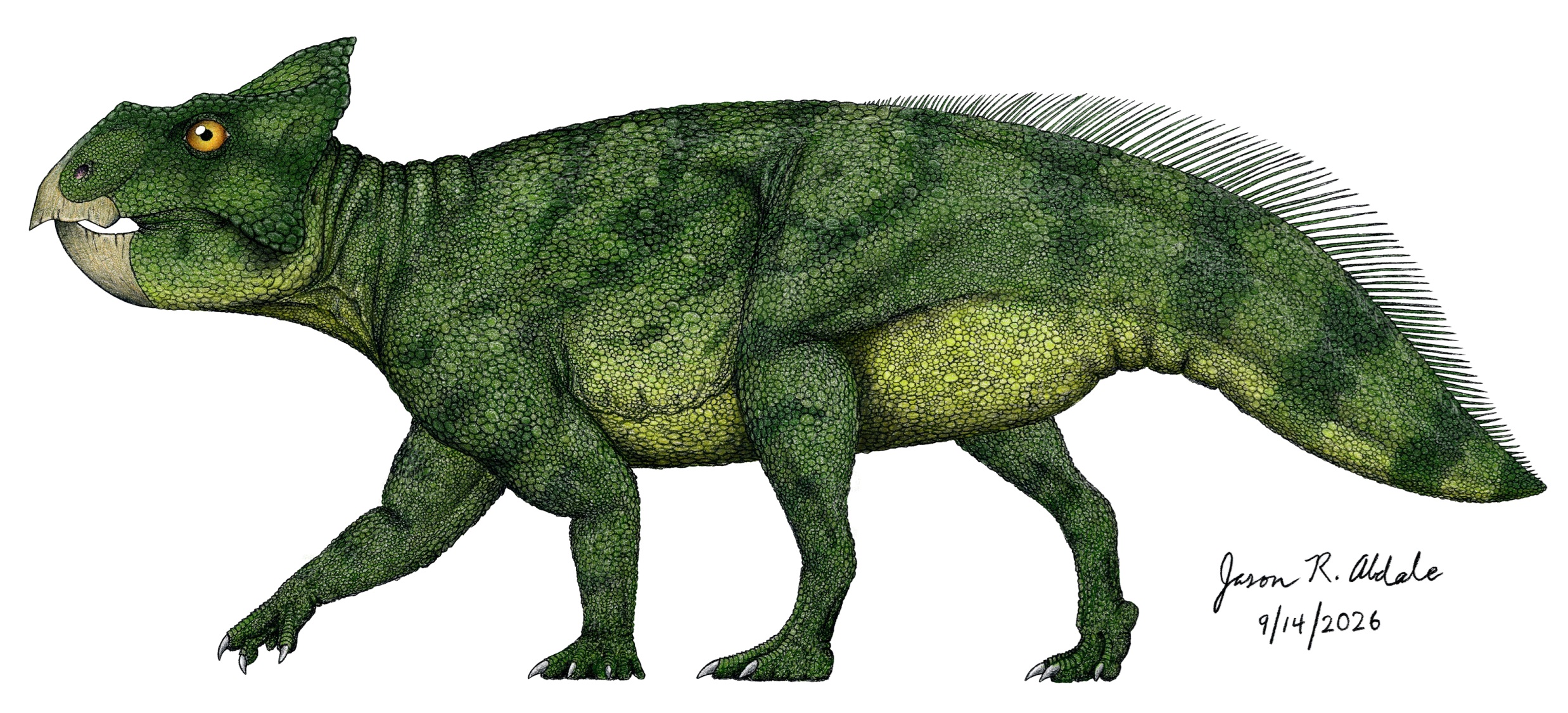
Leptoceratops gracilis. © Jason R. Abdale (September 14, 2026).
I truly enjoy writing my articles and drawing my art, but it’s increasingly clear that I can’t keep this up without your gracious financial assistance. Kindly check out my pages on Redbubble and Fine Art America if you want to purchase merch of my artwork. Consider buying my ancient Roman history books Four Days in September: The Battle of Teutoburg and The Great Illyrian Revolt if you or someone that you know loves that topic, or my ancient Egyptian novel Servant of a Living God if you enjoy action and adventure. Please consider becoming a patron on my Patreon page so that I can continue to purchase the art supplies and research materials that I need. Professional art supplies are pricey, many research articles are “pay to read”, and some academic journals are rather expensive. My Patreon membership is just $1 per month – that’s it. If everybody who likes this drawing donates just one dollar per month, it would go a long way to keeping my blog “Dinosaurs and Barbarians” running and preventing my career in paleo-art from going extinct.
Keep your pencils sharp, everyone.
Categories: Paleontology, Uncategorized


Leave a comment