
Bungartius was a prehistoric saltwater fish measuring over 6 feet long which lived in what’s now North America during the late Devonian Period 362-360 million years ago.
On September 16, 1936, Peter Anthony Bungart, who worked in the Department of Geology and Paleontology at the Cleveland Museum of Natural History, found a concretion along the Rocky River in Cuyahoga County, Ohio. This concretion (collection ID code: CMNH 6666) came from the Cleveland Shale Member of the Ohio Shale Formation, which dates to the end of the Devonian Period 362-360 million years ago. It contained several bony plates from a placoderm fish. It was believed that they belonged to a creature called Mylostoma. Then on June 22, 1943, a more complete specimen, and a larger one at that (collection ID code: CMNH 7573), was found by Peter Bungart and David H. Dunkle which showed that this creature, whatever it was, was definitely not Mylostoma. These plates were of such a distinctive shape that it was felt that they warranted a new name. In 1947, David H. Dunkle named this creature Bungartius perissus, named in honor of its discoverer Peter Bungart (Dunkle 1947, pages 103-112).
Most people know about placoderms through the media’s hyper-focus on Dunkleosteus, which measured possibly 10-15 feet long, depending on who you ask. However, Dunkleosteus was exceptional in many respects, notably its size. Most placoderm fish were small, often less than 2 feet long. So as far as placoderms go, anything bigger than 2 feet is relatively uncommon, anything bigger than 4 feet is exceptional, and anything 6 feet or larger is very rare indeed. How big was Bungartius? Without full body fossils, it’s impossible to say for certain. The maximum length of the upper jaw in the bigger of the two specimens was 40.5 cm (15.9 inches), with a length along the midline of the skull being 33 cm (12.9 inches). The midline of the pectoral girdle / medio-dorsal shield was 20.2 cm (7.95 inches) (Dunkle 1947, page 111).
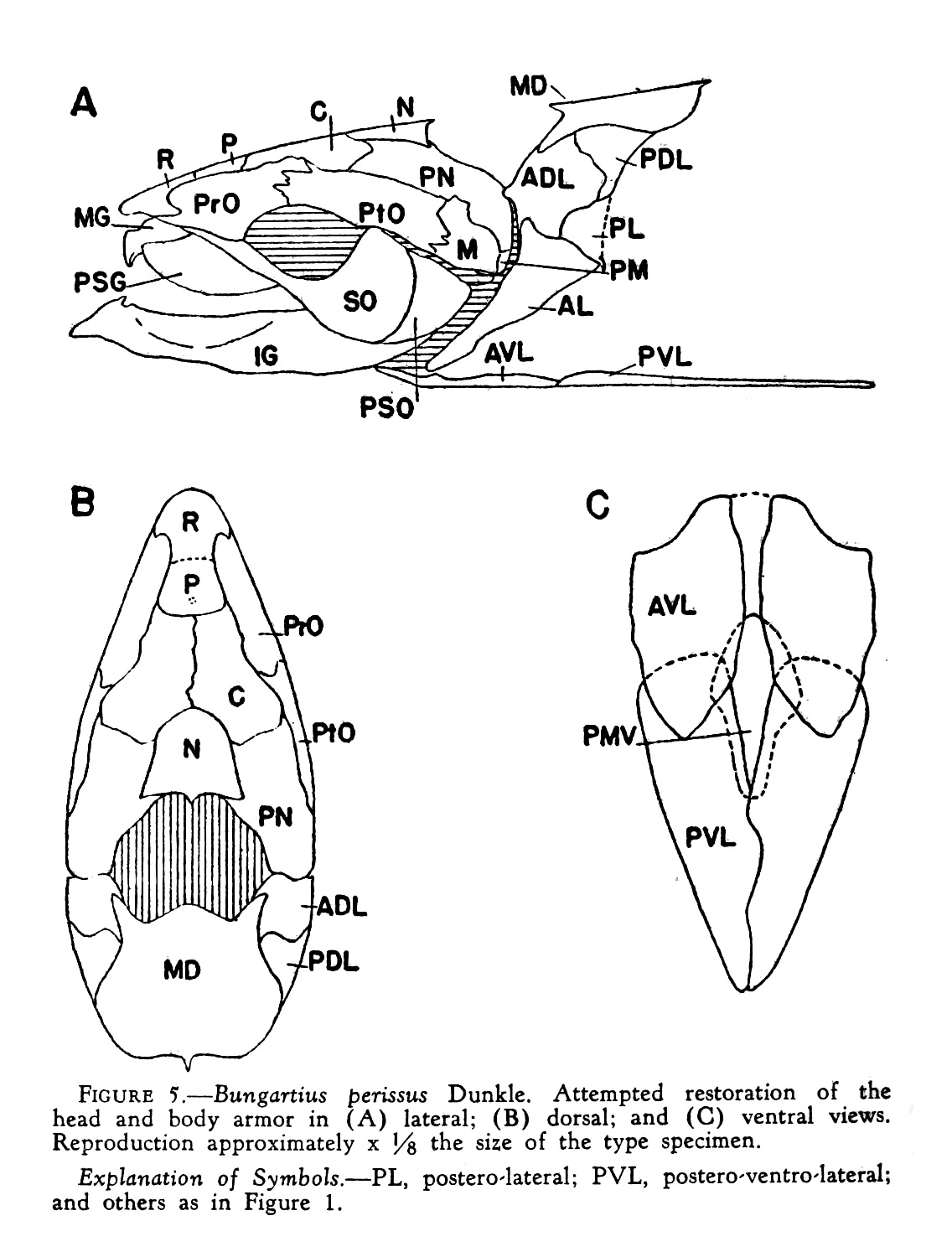
Reconstruction of the armor plates of Bungartius perissus: A) Left lateral view of the skull, pectoral girdle, and ventral plates; B) Overhead view of the skull and pectoral girdle; C) Ventral plates. Dunkle 1947, page 114.
Where does Bungartius fit onto the placoderm tree? The medio-gnathal bones of Bungartius are similar, at least in overall proportions, to those of the placoderm Dinognathus. But Dinognathus, whose name means “terrible jaw”, seems to have been adapted to eating mollusks and other hard-shelled prey, which Bungartius wasn’t (Dunkle 1947, page 113). If anything, Bungartius’ jaws were shaped like a pair of scissors and were better suited for slicing rather than cracking or crushing (Anderson 2009, pages 321-342). Likewise, Dunkle deemed it unlikely that Bungartius belonged to the placoderm group called the selenosteids because their bones’ texture and arrangement were too dis-similar (Dunkle 1947, page 113). It’s possible that Bungartius may have been a relative of Titanichthys, the largest-known placoderm, commonly said to have measured 14 feet long or longer. However, the bones in these two genera are only vaguely similar to each other, so if they are related, then they must have been quite distantly related. Dunkle concluded that, for the moment, Bungartius’ exact placement within Placoderma was uncertain (Dunkle 1947, pages 113-115; 117).
All of this talk of Bungartius’ pedigree brings me back to size. If Bungartius was vaguely related to Titanichthys and if it had a similar body shape (and again, this is subject to debate), then scaling for size, a full-grown Bungartius, or at the least the largest individual found so far, measured 2.05 meters (6.75 feet) long.
The best parallel that I could find for its size and shape is the Shortfin Mako Shark (Isurus oxyrinchus). This is confirmed to be the fastest shark alive today, with recorded speeds of 46 miles per hour (74 kilometers per hour). If Bungartius was shaped in a similar way, it would have been a very fast and powerful swimmer.
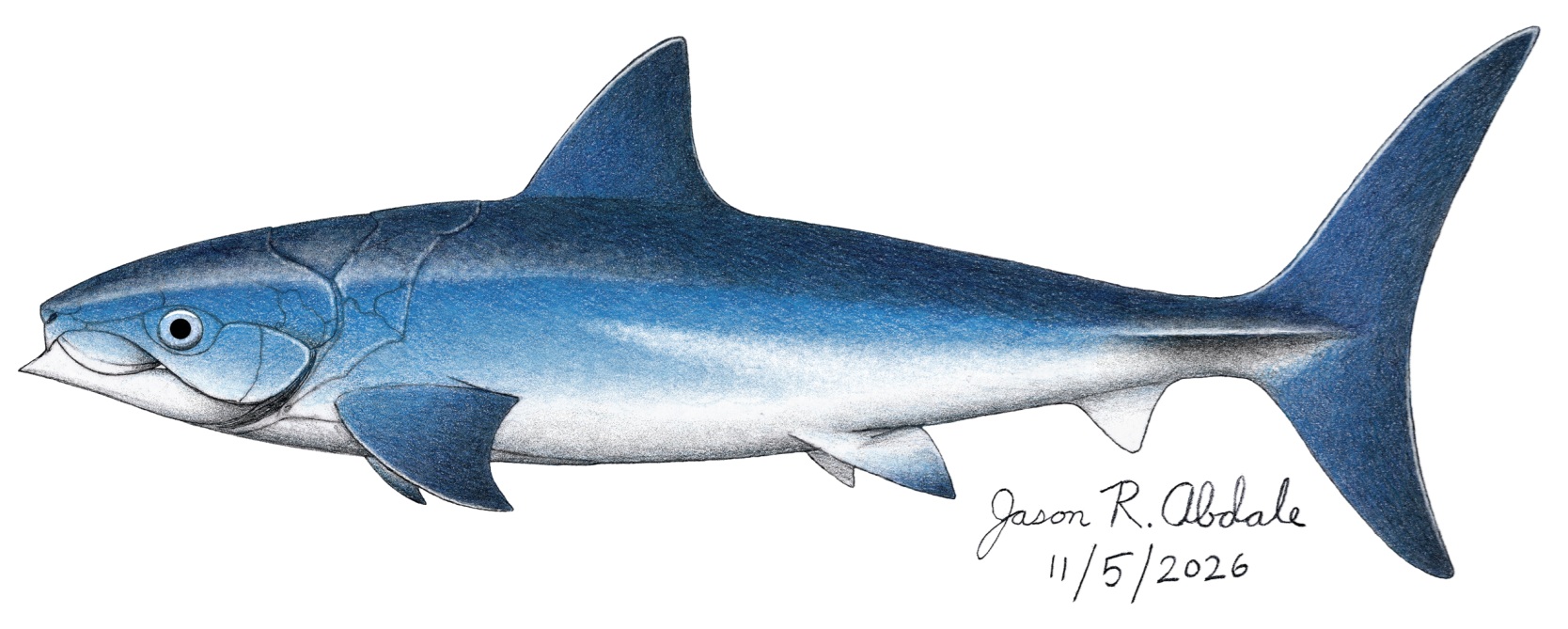
Bungartius perissus. © Jason R. Abdale (November 5, 2026).
I truly enjoy writing my articles and drawing my art, but it’s increasingly clear that I can’t keep this up without your gracious financial assistance. Kindly check out my pages on Redbubble and Fine Art America if you want to purchase merch of my artwork. Consider buying my ancient Roman history books Four Days in September: The Battle of Teutoburg and The Great Illyrian Revolt if you or someone that you know loves that topic, or my ancient Egyptian novel Servant of a Living God if you enjoy action and adventure. Please consider becoming a patron on my Patreon page so that I can continue to purchase the art supplies and research materials that I need. Professional art supplies are pricey, many research articles are “pay to read”, and some academic journals are rather expensive. My Patreon membership is just $1 per month – that’s it. If everybody who likes this drawing donates just one dollar per month, it would go a long way to keeping my blog “Dinosaurs and Barbarians” running and preventing my career in paleo-art from going extinct.
Keep your pencils sharp, everyone.
Anderson, Philip S. L. (2009). “Biomechanics, functional patterns, and disparity in Late Devonian arthrodires”. Paleobiology, volume 35, issue 3 (2009). Pages 321-342.
Dunkle, David H. (1947). “A new genus and species of arthrodiran fish from the Upper Devonian Cleveland Shale”. Scientific Publications of the Cleveland Museum of Natural History, volume 8, issue 10 (May 1, 1947). Pages 103-117.
https://archive.org/details/scientificpublic69clev/page/n443/mode/2up.
Categories: Paleontology, Uncategorized


Leave a Reply