
Camarasaurus, “the chambered lizard”, was a sauropod dinosaur from the Morrison Formation of western North America, dated to the late Jurassic Period about 157 to 147 million years ago. The animal gets its name from the numerous openings within its skull. Camarasaurus belonged to a group of sauropods called the “macronarians” which means “large nostrils”. As such, Camarasaurus was more closely related to Brachiosaurus than to the “diplodocid” sauropods like the eponymous Diplodocus and its relatives.
The Morrison Formation was home to numerous sauropod species, including Apatosaurus, Barosaurus, Brachiosaurus, Diplodocus, and Haplocanthosaurus. Some of these names might be more familiar to the ear than the name Camarasaurus. However, in terms of sheer population numbers, Camarasaurus tops the list. More skeletons of Camarasaurus have been found within the Morrison Formation than any other sauropod, and this has led scientists to claim that it was therefore the most common sauropod dinosaur alive during that time.
There are currently three species of Camarasaurus known from the late Jurassic rocks of North America: Camarasaurus grandis, Camarasaurus lentus, and Camarasaurus supremus. Camarasaurus grandis was the oldest of the three, being found within the middle to late Kimmeridgian Stage about 155-153 MYA. After this appeared Camarasaurus lentus, which is found within the late Kimmeridgian about 153-152 MYA; C. grandis and C. lentus co-existed with each other for a short time. Finally, both species were replaced by Camarasaurus supremus, the largest of the three species, and it also was alive during the last stages of the Morrison Formation from the late Kimmeridgian to the middle Tithonian Stage about 152-147 MYA. Of these three species, we have more fossils from C. lentus than from the other two.
There might be a fourth species of Camarasaurus called C. lewisi. It was discovered in 1967 in Mesa County, Colorado within the rocks of the Brushy Basin Member of the Morrison Formation. In 1988, Utah paleontologist Jim Jensen named it as a new genus of sauropod called Cathetosaurus. However in 1996, Cathetosaurus was classified as a junior synonym of Camarasaurus. To this day, it is unknown which diagnosis is correct, as different paleontologists have different opinions on the matter. Regardless if the animal is Camarasaurus or Cathetosaurus, C. lewisi was pretty small as late Jurassic sauropods go; most estimates place it at just 40-50 feet long.
As far as size goes, Camarasaurus was a tad on the small side for a sauropod. Both Camarasaurus grandis and Camarasaurus lentus measured only 50 feet long. Unlike C. grandis and C. lentus which are known from a plethora of specimens, largest of the three species, Camarasaurus supremus, is known from much fewer remains. Both C. grandis and C. lentus measured 15 meters (49.2 feet) long and had a femur measuring 1.5 meters in length. Camarasaurus supremus is not known from a complete skeleton, but its femur measured 1.8 meters long. If C. supremus was proportioned the same as C. grandis and C. lentus, if we scale the size of the femur in proportion to body size, this results in C. supremus having a total length of 18 meters (59 feet).
Camarasaurus‘ relatively small size (that is, compared with the other larger sauropods that it shared its habitat with) and meaty build likely made it one of the preferred targets for a mob of Allosaurus to take down. The reason why Camarasaurus was the most common species of its kind might be due partly to its smaller-than-average size (smaller stomachs mean more food to go around for everyone, and by extent leads to having larger populations) and partly to its apparently generalist diet. Creatures which have a specialized diet are often hit hard when catastrophes arise, whereas dinosaurs that are more adaptable and flexible in terms of what they eat come out more favorably.
Note: The original drawing that was posted to this article, which was dated to August 5, 2012, was removed because it was anatomically inaccurate and in general was of poor quality. The drawing that you see below is an updated version.

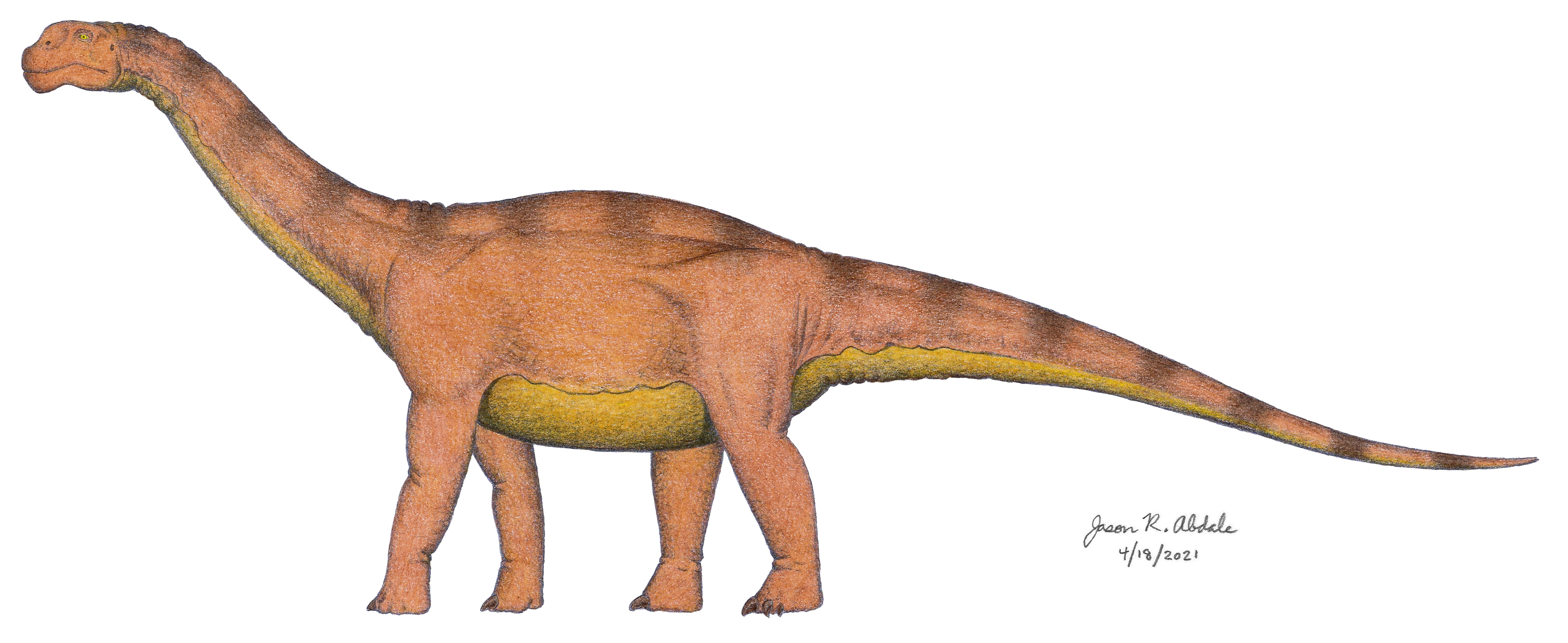
Camarasaurus supremus. © Jason R. Abdale. April 18, 2021.
Keep your pencils sharp, people.
Categories: Paleontology, Uncategorized
 DINOSAURS AND BARBARIANS
Cool!
By the way. can I feature this artwork in PaleoNews #8? I would provide links to this blog as well as any other websites you would like me to and most definitely credit you.
Yeah, sure you can use my Camarasaurus drawing. Thanks for spreading the word about my website and about my artwork. Hopefully, it will lead to some commissions.
It will be featured in PaleoNews #9, which is set for April 3rd. Thanks for allowing me to use it!
PaleoNews #9 has just been posted! Please tell me if anything related to the artwork is wrong and I will fix it. Thanks again for allowing me to use your artwork!
Looks fine, except that you mis-spelled the dinosaur’s name. It’s Camarasaurus, not Camarosaurus. Other than that, great. I appreciate you giving me a shout-out.
Oops! I’m going to fix that right now. That’s why my username is thetetanuraeguy not the neosauropodguy XD