
Note: This article was originally published in August 2015. It has since been heavily updated and republished in October 2026.
Introduction
The Hell Creek Formation of the north-central United States is famous for its skeletons of large iconic dinosaurs from the very end of the Cretaceous Period such as Ankylosaurus, Edmontosaurus, Ornithomimus, Pachycephalosaurus, Triceratops, and Tyrannosaurus. However, the Hell Creek Formation contained a diverse array of animal life, and new discoveries keep popping up all the time. Even after nearly 150 years of excavation, we are still unearthing new things. One of the most surprising and unusual creatures to come from here was a bird-like theropod dinosaur which is noteworthy not only for its appearance but also its size. it is named Anzu wyliei.
Discovery
During the early 1920s, Charles W. Gilmore, a paleontologist from the Smithsonian Institute in Washington, DC, was prospecting for fossils in Alberta, Canada. While on this trip, he would discover several new species of dinosaurs, including a strange creature known only from a pair of incomplete hands. These hands had long slender fingers, which was highly unusual for theropods known at the time. He officially named and described them as Chirostenotes pergracilis in 1924 (Lambert 1990, page 275; “Splitting Chirostenotes”).
Chirostenotes was originally believed to be a member of the enigmatic family Elmisauridae whose members consist of only one genus, Elmisaurus. This animal lived in Mongolia during the late Cretaceous Period about 80 MYA, and the only evidence that we have of its existence is one incomplete foot and a hand found in 1970. Scientists recognized that the hands of Chirostenotes and Elmisaurus looked similar, and so Chirostenotes was placed into that family (Lessem and Glut 1993, pages 109, 176). By 1990, Elmisauridae was recognized as an invalid family name, and it was discarded (Lambert 1990, page 60). Chirostenotes is now classified as a member of the family Caenagnathidae, named after the related genus Caenagnathus (Lambert 1990, page 48). The caenagnathids were a group of bird-like theropod dinosaurs who belonged to a much larger group called the oviraptorosaurs, who are well-known from Asia. Their presence in North America only adds further proof to a faunal exchange between Asia and North America. Caenagnathids are distinguished from oviraptorids by their feet, which look more like those of the ornithomimids, more commonly-known as “ostrich dinosaurs” (Lambert 1990, page 119). This suggests that the oviraptorosaurs evolved from the ornithomimids. According to current phylogenic analysis, the ornithomimids are more primitive than the oviraptorosaurs, so this hypothesis might be plausible.
For a while, Chirostenotes was known only from rocks dated to the Campanian Stage of the Cretaceous Period. Beginning in the 1990s, fossils of an oviraptor-ish animal were found in rocks dated to the Maastrichtian Stage – the Hell Creek Formation, where no oviraptorosaurs had been found before. In 1994, an article was published about a section of a lower jaw discovered with the famed Tyrannosaurus “Sue”. This bone, which formed the back of the lower jaw, was 25% larger than the holotype specimen of Caenagnathus. This individual was suspected to be the largest oviraptorosaur known from North America, but its identity was unclear (“The Hell Creek Oviraptorosaur — What Does It Mean For Chirostenotes pergracilis?”).
In 1995, a pair of fragmentary skeletons from the Hell Creek Formation were described by Russell and Triebold which were termed “the Triebold specimens”. They were housed within the Carnegie Museum of Natural History in Pittsburgh. In 1998, Fred Nuss discovered two partial skeletons in South Dakota, and a third specimen was found by Tyler Lyson in North Dakota. By 2006, it was clear that each of these incomplete specimens belonged to the same species. In 2011, Matt Lamanna, Hans Sues, Emma Schachner and Tyler Lyson stated that this new Hell Creek caenagnathid was very similar to the known material from Chirostenotes, though they didn’t actually go as far as to say that it was a new species (“The Hell Creek Oviraptorosaur — What Does It Mean For Chirostenotes pergracilis?”).
In the summer of 2013, a team from the Burpee Museum of Natural History (a museum already famous for its discovery of the Nanotyrannus specimen “Jane”) led by Steve Simpson discovered the remains of a caenagnathid near the small town of Ekalaka, Carter County, Montana. It consisted of a partial skeleton, including leg bones, vertebrae, and ribs; there might be more of this animal still buried in the sediment, including the skull. Originally, it was believed that they found the remains of another juvenile Tyrannosaurus. Thomas Holtz from the University of Maryland quickly rushed to the site and identified the specimen as a caenagnathid oviraptor. In a letter to Burpee Museum board of directors, Holtz stated that this specimen was even larger than the Triebold specimens, about 15-20% larger, making it possibly the largest oviraptorosaur known from North America. The specimen was named “Pearl” in honor of Pearl City, Illinois, where Steve Simpson and many of his students come from. The discovery was officially announced in November 2013 (“Feathered meat-eating 6 foot dinosaur found in Montana”; “Rare Egg thief lizard discovered on Montana public land”). In March 2014, it was officially named Anzu wyliei, named after a bird-like demon from ancient Sumerian mythology and Wylie J. Tuttle, the grandson of one of the Burpee Museum’s donors (Lamanna et al. 2014: e0125843). The media promptly dubbed it “the chicken from Hell” (“New ‘Chicken from Hell’ Dinosaur Discovered”; “Dinosaur dubbed ‘chicken from hell’ was armed and dangerous”).
Description
As of 2014, Anzu wyliei is known from at least seven individuals, all incomplete. However, from examining all of the fossils, we have approximately 75-80% of the skeleton of this creature (“Scientists Discover a Large and Feathered Dinosaur that Once Roamed North America”). From what we can gather, it measured 12 feet long and about 5 feet tall at the hips and it may have weighed in the realm of 440-660 pounds, making it the largest oviraptorosaur known from North America (Lamanna et al. 2014: e0125843; Atkins-Weltman et al. 2021, pages 95-104).
Like all oviraptorosaurs, Anzu had a toothless beak. However, it’s been noted that the jaws of caenagnathids were very thinly constructed and they probably did not have a powerful bite compared to the oviraptorids (Currie et al. 1993, pages 2,255-2,272). Even so, perhaps Anzu’s most distinctive feature is its unique profile due to its high semi-circular crest. It had a relatively short tail compared to body size, and it was almost certainly covered with feathers, although it’s impossible at the moment to determine how extensive the covering was or what color it was.
Life
Anzu was probably an omnivore. According to Lamanna et al. (2014), “Anzu and other caenagnathids may have favored well-watered floodplain settings over channel margins, and were probably ecological generalists that fed upon vegetation, small animals, and perhaps eggs” (Lamanna et al. 2014: e0125843).
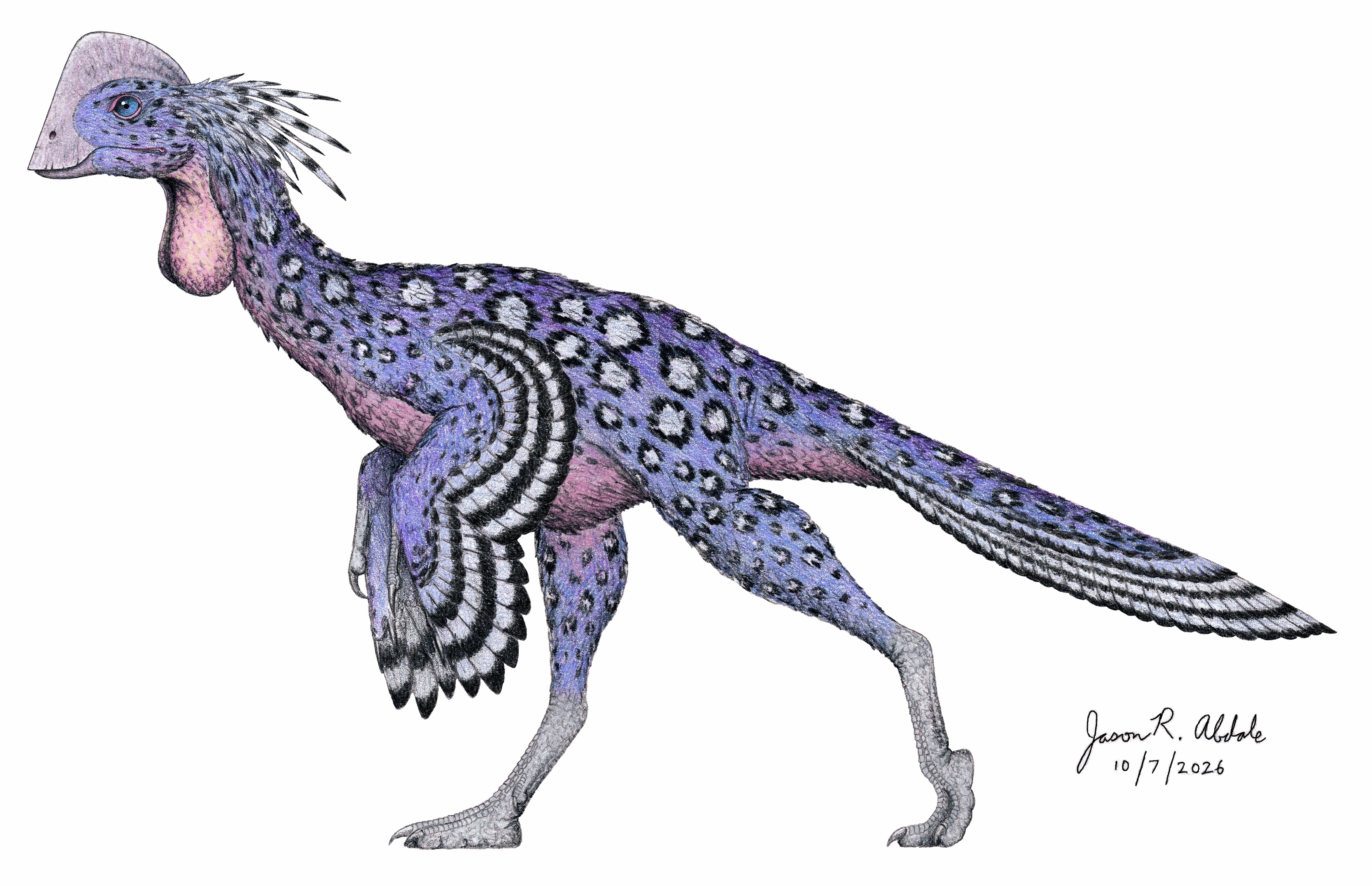
Anzu wyliei. © Jason R. Abdale (October 7, 2026).
Post-Script
I truly enjoy writing my articles and drawing my art, but it’s increasingly clear that I can’t keep this up without your gracious financial assistance. Kindly check out my pages on Redbubble and Fine Art America if you want to purchase merch of my artwork. Consider buying my ancient Roman history books Four Days in September: The Battle of Teutoburg and The Great Illyrian Revolt if you or someone that you know loves that topic, or my ancient Egyptian novel Servant of a Living God if you enjoy action and adventure. Please consider becoming a patron on my Patreon page so that I can continue to purchase the art supplies and research materials that I need. Professional art supplies are pricey, many research articles are “pay to read”, and some academic journals are rather expensive. My Patreon membership is just $1 per month – that’s it. If everybody who likes this drawing donates just one dollar per month, it would go a long way to keeping my blog “Dinosaurs and Barbarians” running and preventing my career in paleo-art from going extinct.
Keep your pencils sharp.
Bibliography
Books
Lambert, David. The Dinosaur Data Book. New York: Avon Books, 1990.
Lessem, Don; Glut, Donald F. The Dinosaur Society Dinosaur Encyclopedia. New York: Random House, Inc., 1993.
Articles
Atkins-Weltman, Kyle; Snively, Eric; O’Connor, Patrick (2021). “Constraining the body mass range of Anzu wyliei using volumetric and extant-scaling methods”. Vertebrate Anatomy Morphology Palaeontology, volume 9, issue 1 (September 28, 2021). Pages 95-104.
https://journals.library.ualberta.ca/vamp/index.php/VAMP/article/view/29375/21430.
Currie, Philip J.; Godfrey, Stephen J.; Nessov, Lev (1993). “New caenagnathid (Dinosauria: Theropoda) specimens from the Upper Cretaceous of North America and Asia”. Canadian Journal of Earth Sciences, volume 30, issue 10 (October 1993). Pages 2,255-2,272.
https://cdnsciencepub.com/doi/abs/10.1139/e93-196.
Lamanna, Matthew C.; Sues, Hans-Dieter; Schachner, Emma R.; Lyson, Tyler R. (2014). “A New Large-Bodied Oviraptorosaurian Theropod Dinosaur from the Latest Cretaceous of Western North America”. PLOS One, volume 10, issue 4: e0125843. (March 19, 2014).
https://journals.plos.org/plosone/article?id=10.1371/journal.pone.0092022.
Websites
Bureau of Land Management. “Rare Egg thief lizard discovered on Montana public land”, by Mark Jacobsen (November 26, 2013).
http://www.blm.gov/mt/st/en/info/newsroom/2013/november/rare__egg_thief_lizard.html.
National Geographic. “New ‘Chicken from Hell’ Dinosaur Discovered”, by Christine Dell’Amore (March 19, 2014).
https://www.nationalgeographic.com/animals/article/140319-dinosaurs-feathers-animals-science-new-species.
Smithsonian Magazine. “Scientists Discover a Large and Feathered Dinosaur that Once Roamed North America”, by Kirstin Fawcett (March 19, 2014).
https://www.smithsonianmag.com/smithsonian-institution/scientists-discover-discover-large-feathered-dinosaur-once-roamed-north-america-180950130/.
The Billings Gazette. “Feathered meat-eating 6 foot dinosaur found in Montana” (November 30, 2013).
http://billingsgazette.com/news/state-and-regional/article_285b4bce-312f-5fec-85eb-f3e30abc0006.html.
The Bite Stuff. “Splitting Chirostenotes”, by Jaime A. Headden (January 28, 2011).
https://qilong.wordpress.com/2011/01/28/splitting-chirostenotes/.
The Bite Stuff. “The Hell Creek Oviraptorosaur — What Does It Mean For Chirostenotes pergracilis?”, by Jaime A. Headden (January 22, 2012).
https://qilong.wordpress.com/2012/01/22/the-hell-creek-oviraptorosaur-should-or-shouldnt-it-be-chirostenotes-pergracilis/.
The Guardian. “Dinosaur dubbed ‘chicken from hell’ was armed and dangerous”, by Ian Sample (March 19, 2014).
https://www.theguardian.com/science/2014/mar/19/dinosaur-chicken-hell-anzu-wyliei.
Categories: Paleontology, Uncategorized


Leave a comment