
Ornitholestes, “the bird thief”, was a small meat-eating dinosaur which lived in western North America during the late Jurassic Period about 154 million years ago. Since its discovery in the year 1900, Ornitholestes has come to be regarded as the quintessential small Jurassic carnivore, prowling through the scrub and undergrowth like a jackal on the hunt for prey, all the while trying hard not to be spotted by its larger carnivorous contemporaries. It has frequently appeared in children’s books on dinosaurs and prehistoric life (often depicted running after and leaping into the air to catch low-flying Archaeopteryx-like birds), and it made its TV debut in the 1999 BBC series Walking With Dinosaurs. Yet for an animal which appears as frequently as it does in paleo media, we know surprisingly little about it.
Fossils of this small carnivore were first found in July 1900 at Bone Cabin Quarry near Medicine Bow, Wyoming. The stratum was in the Brushy Basin Member of the Morrison Formation, dated to the Kimmeridgian Stage of the late Jurassic Period about 154 MYA. The skeleton was incomplete and badly crushed, but it did include a nearly complete skull which was missing the top of the nose. In 1903, Henry Fairfield Osborne of the American Museum of Natural History named it Ornitholestes hermanni, “Hermann’s bird thief”, named in honor of Adam Hermann, the AMNH’s chief fossil preparator. The skeleton is on public display at the American Museum of Natural History in New York City (collection ID code: AMNH FARB 619).
Although the skeleton is incomplete, most sources both online and in print state that Ornitholestes measured 6 feet long or perhaps slightly longer. The eye sockets were unusually large, suggesting that Ornitholestes had big eyes and was therefore possibly nocturnal. The skull seems to have been well-built, but the legs were not designed for the hot pursuit. It’s likely that Ornitholestes was an ambush hunter rather than a speedy runner chasing after prey. In the 1980s, Gregory Paul hypothesized that Ornitholestes possessed a small blade-like horn on the end of its nose similar to Ceratosaurus. This claim was based upon the observation that a piece of the animal’s nasal bone appeared to project upwards, forming the base of a bony fin which ornamented the top of its upper jaw. This feature was seen in Walking with Dinosaurs. However, subsequent examination of the skull showed that the nasal bone was in that position because it was dislodged from the rest of the skull, which, as said before, had been badly crushed. The claw on the second toe was proportionally larger compared to the other claws on its feet. This is the same claw which served as the infamous “killing claw” on “raptor” dinosaurs which include the dromaeosaurids and the troodontids. Because of this feature, John Ostrom (the man who named Deinonychus) suspected that Ornitholestes might be an ancestor to the raptors, but this idea was never pursued further due to the limited remains. Another skeleton with a complete foot would be ideal to settle this debate.
When it was found, Ornitholestes was classified as a coelurosaur, and that’s still the classification it has today, but this is problematic. In the old days, the term “coelurosaur” was a catch-all term which encompassed any small theropod just the same as the term “carnosaur” originally included all large theropods. Nowadays, we know that dinosaur family relationships are a lot more complicated than just “all the small ones go in one pile, and all the big ones go in another pile”. In 2013, an article was published stating that Ornitholestes was a basal maniraptoriform, the group which contains ornithomimosaurs, oviraptorosaurs, therizinosaurs, and raptors, and therefore might have been the common ancestor of all of these groups. An abstract published in 2021 asserted that Ornitholestes was a primitive oviraptorosaur based upon fourteen anatomical features which are only seen in oviraptorosaurs. However, no further info about this has been published since then.
So far, only two specimens of Ornitholestes have been unearthed. The first is the holotype specimen on display in the American Museum of Natural History in New York City. The second was a partial skeleton which was put up for auction by Sotheby’s in Paris, France on September 30, 2014. There was very little information posted online about this specimen: the skeleton was found in Wyoming, it measured 2.32 meters (7.6 feet) long, and that was all. Different web pages listed the skeleton’s age as either 154 or 150 MYA. Therefore, I reached out directly to Sotheby’s as well as to Paul Fraser Collectibles, who provided the skeleton, and asked them what they could tell me about it. I especially had questions about the skeleton’s provenance (where it was found, when it was found, who found it, etc.). I was informed by a representative from Sotheby’s that the lot for the Ornitholestes skeleton was “PF1421, lot #49”, and it didn’t sell at auction, possibly because nobody was willing to pay the bare minimum bid of $350,000 for it. Hopefully this partial skeleton will find a home in a museum somewhere rather than in someone’s living room.
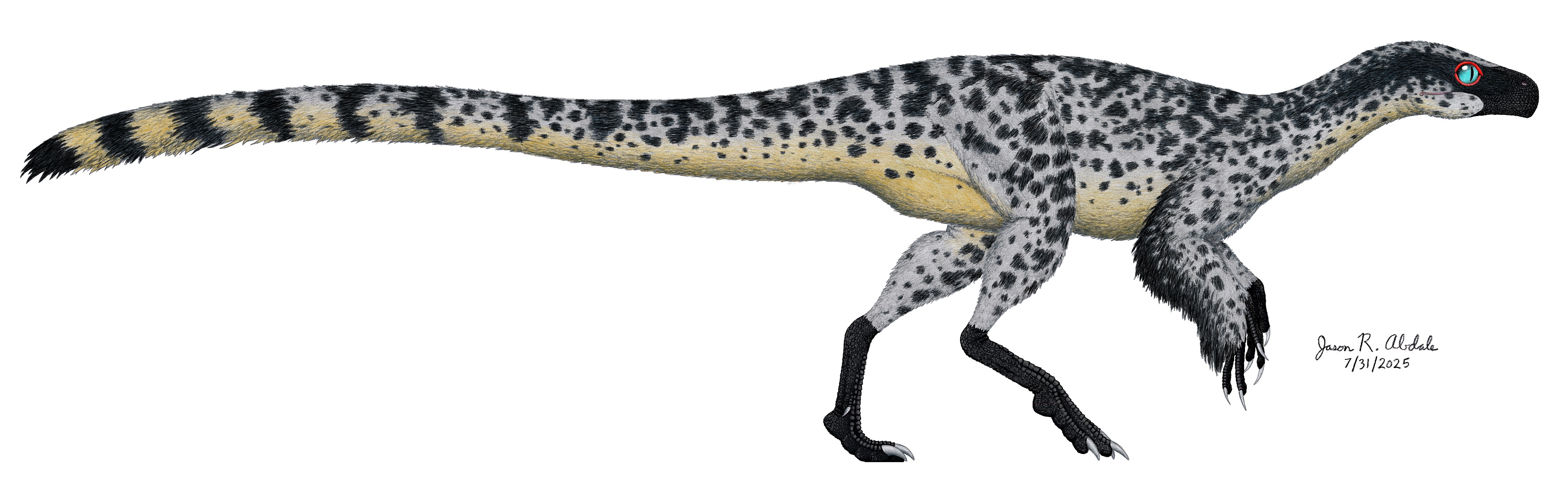
Ornitholestes hermanni. © Jason R. Abdale (July 31, 2025).
I truly enjoy writing my articles and drawing my art, but it’s increasingly clear that I can’t keep this up without your gracious financial assistance. Kindly check out my pages on Redbubble and Fine Art America if you want to purchase merch of my artwork. Consider buying my ancient Roman history books Four Days in September: The Battle of Teutoburg and The Great Illyrian Revolt if you or someone that you know loves that topic, or my ancient Egyptian novel Servant of a Living God if you enjoy action and adventure.
Please consider becoming a patron on my Patreon page so that I can afford to purchase the art supplies and research materials that I need to keep posting art and articles onto this website. Professional art supplies are pricey, and many research articles are “pay to read”, and some academic journals are rather expensive. Patreon donations are just $1 per month – that’s it. If everyone gave just $1 per month, it would go a long way to purchase the stuff that I need to keep my blog “Dinosaurs and Barbarians” running.
Take care, and, as always, keep your pencils sharp.
Categories: Paleontology, Uncategorized
 DINOSAURS AND BARBARIANS
Leave a comment