
Aerotitan was a pterosaur which lived in South America during the late Cretaceous Period 70 million years ago.
The only fossil of this creature, consisting of just the front end of the upper jaw, was discovered in the early 2000s within Argentina’s Allen Formation, which dates to the late Cretaceous Period. It was officially named in 2012.
Aerotitan was a member of the pterosaur family Azhdarchidae, which includes creatures like Quetzalcoatlus and Hatzegopterus. Analysis of the fossils shows that Aerotitan was a very close relative of Mistralazhdarcho, whose fossils have been found in France within rocks dating to the Campanian/Maastrichtian boundary. Based upon the size of the specimen, and comparing it to other azhdarchid pterosaurs, Aerotitan had a wingspan of just 16 feet (5 meters). However, it is unknown if the individual was a juvenile or if it was fully-grown.
Below is a reconstruction of what Aerotitan might have looked like, based upon Quetzalcoatlus and Mistralazhdarcho.
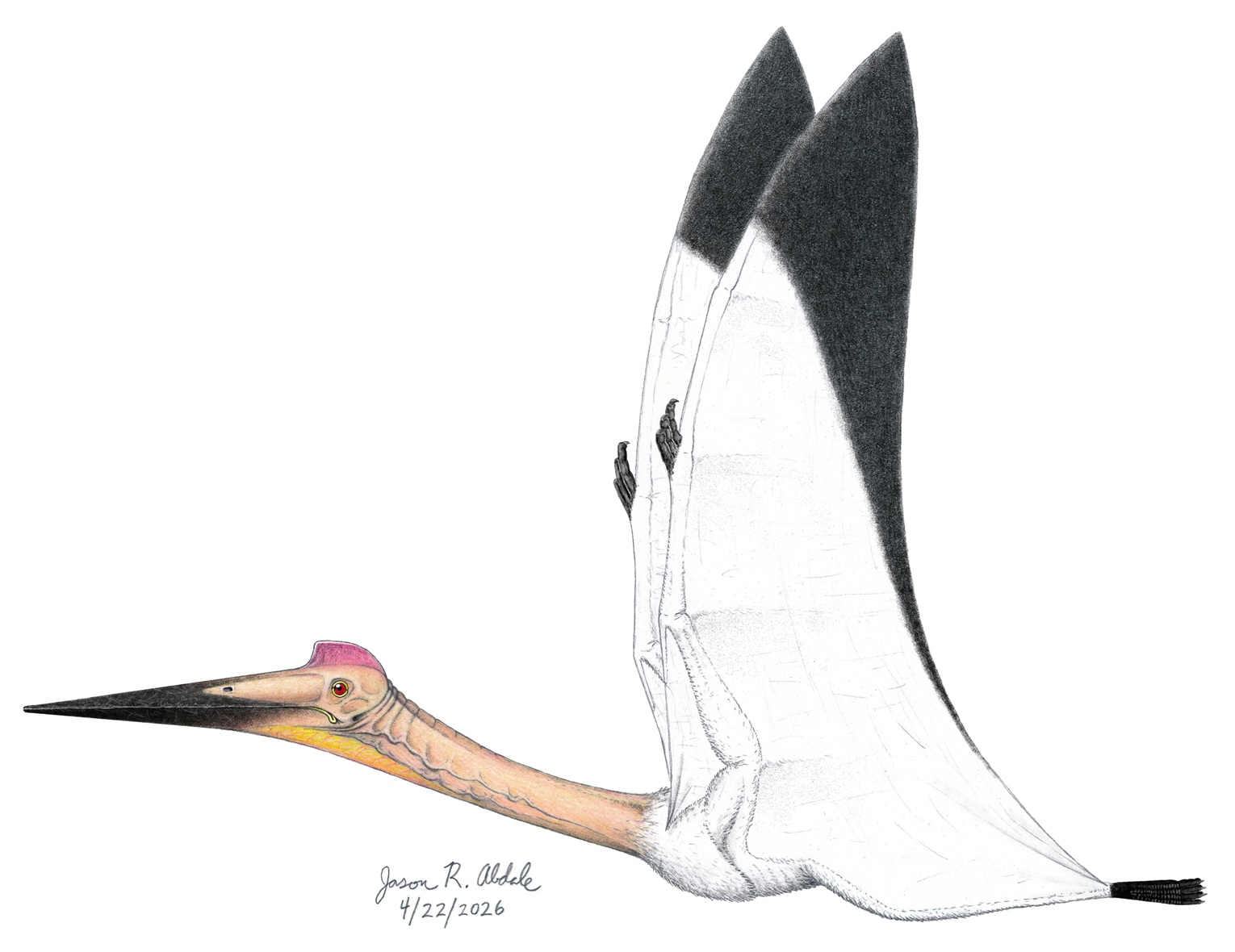
Aerotitan sudamericanus. © Jason R. Abdale (April 22, 2026).
I truly enjoy writing my articles and drawing my art, but it’s increasingly clear that I can’t keep this up without your gracious financial assistance. Kindly check out my pages on Redbubble and Fine Art America if you want to purchase merch of my artwork. Consider buying my ancient Roman history books Four Days in September: The Battle of Teutoburg and The Great Illyrian Revolt if you or someone that you know loves that topic, or my ancient Egyptian novel Servant of a Living God if you enjoy action and adventure. Please consider becoming a patron on my Patreon page so that I can continue to purchase the art supplies and research materials that I need. Professional art supplies are pricey, many research articles are “pay to read”, and some academic journals are rather expensive. My Patreon membership is just $1 per month – that’s it. If everybody who likes this drawing donates just one dollar per month, it would go a long way to keeping my blog “Dinosaurs and Barbarians” running and preventing my career in paleo-art from going extinct.
Take care, and as always, keep your pencils sharp.
Categories: Paleontology, Uncategorized


Leave a Reply