
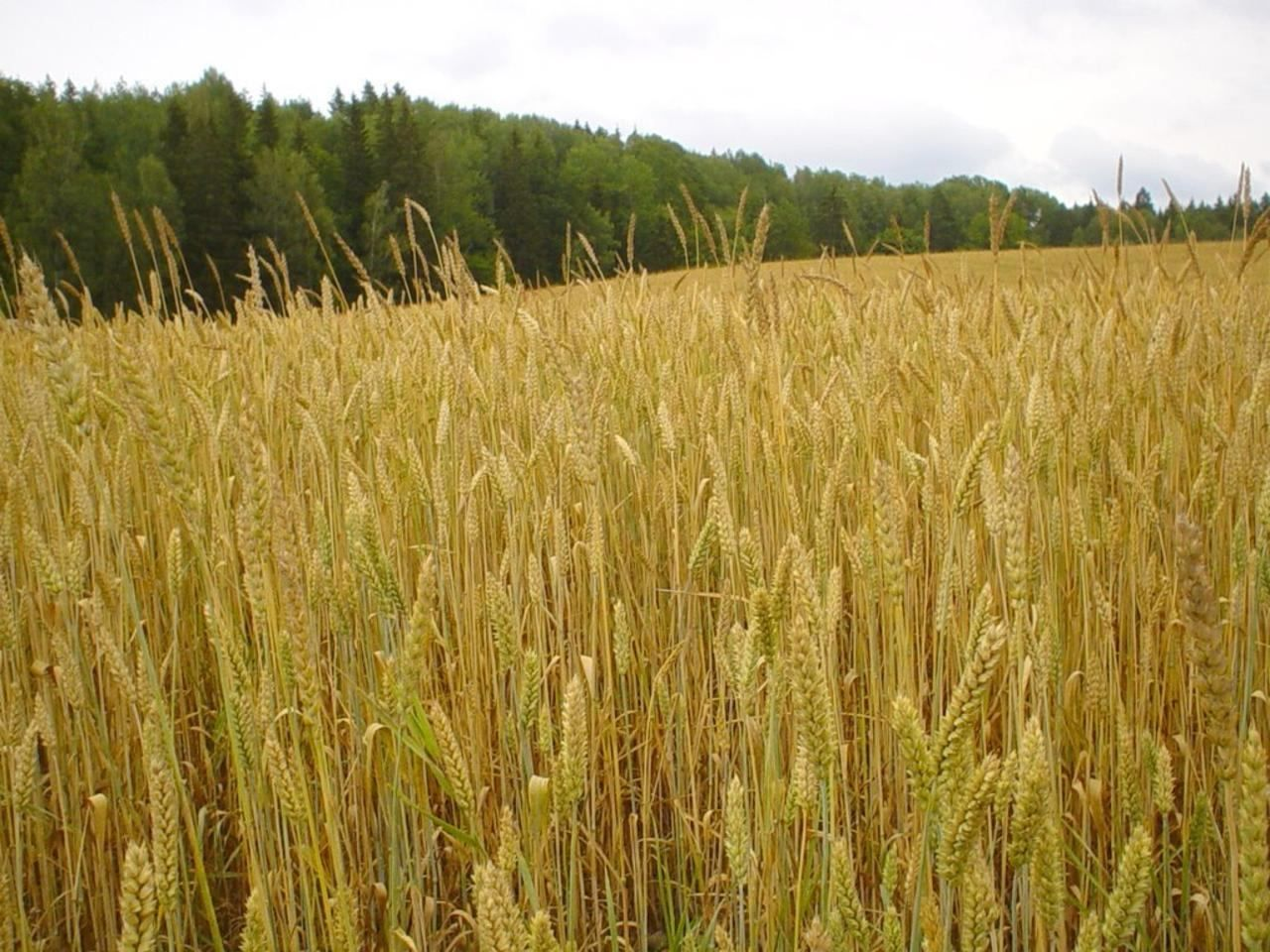
Wheat in a field. Public domain image, Wikimedia Commons. https://commons.wikimedia.org/wiki/File:Wheat_in_field.jpg.
April 25 was the date of an ancient Roman festival called the Robigalia. Robigo was the god of wheat blight…yes, the Romans had gods and goddesses for practically everything. For an agriculture-based civilization like the Romans, diseases which destroyed your crops would mean famine, starvation, and death for the coming year, so staying on the good side of the forces of Nature was crucial for your survival.
According to Marcus Terentius Varro, “The Robigalia ‘Festival of Robigus’ was named from Robigus ‘God of Rust’; to this god sacrifice is made upon the cornfields, that rust may not seize upon the standing corn” (Varro, On the Latin Language, book 6, verse 16).
Wheat blight, or “rust”, so named because of the rusty orange color which appeared on the plants, was a major disease which decimated grain crops like wheat, barley, rye, and oats. In ancient, medieval, and early modern times, nobody knew what it was, how it was caused, or how it was spread. It wasn’t until 1767 when the Italian scientists Gasparo Fontana and Giovanni Targioni Tozzetti discovered that wheat blight was caused by the fungus Puccinia graminis. Even in modern times, rust outbreaks can obliterate crops, especially since the fungus is showing signs of becoming increasingly resistant to conventional fungicides.
Of course the ancient Romans knew nothing about chemical fungicides. For them, safeguarding their crops was best done through propitiating the gods. In ancient times, there was a sacred grove dedicated to Robigo which lay along the main road between Rome and Nomentum (modern-day Menlana), which stood about 14 miles to the northeast (Ovid, Fasti, book 4, April 25). Verrius Flaccus states that the grove stood five miles outside of Rome’s walls on the Via Claudia (Hastings 1928, page 822). It was here that religious rites were carried out in Robigo’s honor.
The best description given of the rituals to appease Robigo is given by the poet Ovid. Wearing white robes, prayers and invocations are made to Robigo to spare their crops. Ovid says the following words were spoken: “Scaly Mildew, spare the blades of corn and let their tender tips quiver above the soil. Let the crops grow, nurtured by favourable stars until they’re ready for the sickle. Your power’s not slight: the corn you blight the grieving farmer gives up for lost. Wind and showers don’t harm the wheat as much, nor gleaming frost that bleaches the yellow corn, as when the sun heats the moist stalks. Then, dreadful goddess, is the time of your wrath. Spare us, I pray, take your blighted hands from the harvest, and don’t harm the crop: it’s enough that you can harm. Grip harsh iron rather than the tender wheat, destroy whatever can destroy others first. Better to gnaw at swords and harmful spears; they’re not needed when the world’s at peace. Let the rural wealth gleam now, rakes, sturdy hoes, and curved ploughshare. Let rust stain weapons, and whoever tries to draw his sword from its sheath, let him feel it wedded there by long disuse. Don’t you hurt the corn, and may the farmer’s prayer to you always be fulfilled by your absence” (Ovid, Fasti, book 4, April 25). Incense was burned and wine was poured upon the altar. Then the entrails of a dog and a sheep were burned upon the altar. Sacrifices of sheep or lambs were common in the ancient world, so that’s nothing unusual, but why a dog? According to Ovid, “There’s a dog they call Icarian, and when it rises the dry earth is parched, and the crops ripen prematurely. This dog is set on the altar to signify the starry one, and the only reason for it is because of the name” (Ovid, Fasti, book 4, April 25). Ovid is here referring to the constellation of Canis Major which contains Siris, known as “the Dog Star”. The Romans referred to it as “the Icarian dog” because legend says that a dog discovered the fallen body of Icarus when he fell to his death after flying too close to the sun. However, curiously, the constellation of Canis Major appears in the sky in August, not April, so why are the Romans sacrificing to Robigo now? (“Ovid: Fasti – Index D-J”).
Please check out my “Today in Ancient Rome” series for more articles on the ancient Roman calendar. You can find the whole list by clicking here!
I truly enjoy writing my articles and drawing my art, but it’s increasingly clear that I can’t keep this up without your gracious financial assistance. Kindly check out my pages on Redbubble and Fine Art America if you want to purchase merch of my artwork. Consider buying my ancient Roman history books Four Days in September: The Battle of Teutoburg and The Great Illyrian Revolt if you or someone that you know loves that topic, or my ancient Egyptian novel Servant of a Living God if you enjoy action and adventure. Please consider becoming a patron on my Patreon page so that I can continue to purchase the art supplies and research materials that I need. Professional art supplies are pricey, many research articles are “pay to read”, and some academic journals are rather expensive. My Patreon membership is just $1 per month – that’s it. If everybody who likes this drawing donates just one dollar per month, it would go a long way to keeping my blog “Dinosaurs and Barbarians” running and preventing my career in paleo-art from going extinct.
Bibliography
Hastings, James, ed. Encyclopaedia of Religion and Ethics, Volume IX. New York: Charles Scribner’s Sons, 1928.
Ovid. Fasti, book 4, April 25.
https://www.poetryintranslation.com/PITBR/Latin/OvidFastiBkFour.php#anchor_Toc69367862.
Varro, Marcus Terentius. On the Latin Language, book 6, verse 16. Translated by Roland G. Kent. London: W. Heinemann, 1938.
Poetry in Translation. “Ovid: Fasti – Index D-J”.
https://www.poetryintranslation.com/PITBR/Latin/OvFastIndexDEFGHIJ.php#Dog.
Categories: History, Uncategorized


Leave a Reply