
The Ambarvalia was an ancient Roman festival held on May 29 in honor of the war god Mars and to Ceres, the goddess of agriculture and the patron goddess of farmers. The word Ambarvalia means “I go around the field”, and it involved the farmer calling upon the goddess to protect his fields and livestock pastures by leading a bull, a sow, and a sheep three times around the field that he wanted safeguarded. When this was done, all three of the animals were sacrificed to Ceres and Mars, accompanied by additional offerings of milk, honey, and wine.
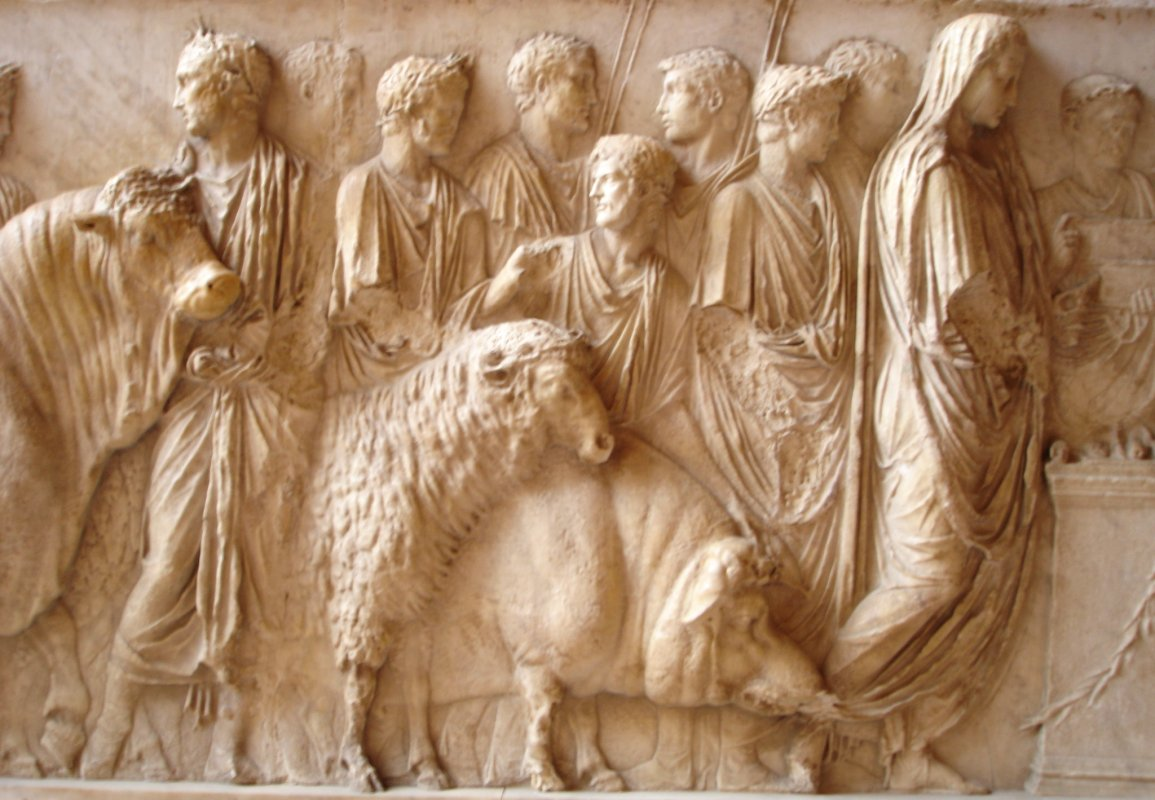
Suovetaurilia (sacrifice of a pig, a sheep and a bull) to the god Mars. Relief from a Roman marble sarcophagus dated to the first half of the 1st Century BC. Louvre Museum, Paris, France. Photograph by Marie-Lan Nguyen (January 6, 2005). Public domain image, Wikimedia Commons.
https://commons.wikimedia.org/wiki/File:Suovetaurile_Louvre.jpg.
Ceres was an agriculture goddess, and in an agriculture-based society where nearly every aspect of life revolved around your farms and fields, making sure that you stayed on Ceres’ good side was crucial for your survival. But why is Mars, a war god, also being honored on this day? In addition to being a war god, Mars was also regarded as a protector god, specifically a protector of lands. This might have actually been his original role, which was subsequently expanded to protecting Rome’s lands, which was likewise expanded to safeguarding Roman territory with sword and shield, and thus he gradually transformed from a protector deity to a god of battles.
The Ambarvalia was held every year on May 29 (Fowler 1899, page 124). We have two detailed descriptions from ancient Roman literature of the activities that occurred on this day. The first comes from the Georgics of the ancient Roman poet Virgil…
In primis venerare deos atque annua magnae
sacra refer Cereri laetis operatus in herbis
extremae sub casum hiemis, iam vere sereno.
Tum pingues agni et tum mollissima vina,
tum somni dulces densaeque in montibus umbrae.
Cuncta tibi Cererem pubes agrestis adoret;
cui tu lacte favos et miti dilue Baccho,
terque novas circum felix eat hostia fruges,
omnis quam chorus et socii comitentur ovantes,
et Cererem clamore vocent in tecta; neque ante
falcem maturis quisquam supponat aristis,
quam Cereri torta redimitus tempora quercu
det motus incompositos et carmina dicat.
“Above all, worship the gods, and pay great Ceres her yearly rites, sacrificing on the glad sward, with the setting of winter’s last days, when clear springtime is now come. Then lambs are fat and wine is most mellow; then sweet is sleep, and thick are the shadows on the hills. Then let all your country folk worship Ceres; for her wash the honeycomb with milk and soft wine, and three times let the luck-bringing victim pass round the young crops, while the whole choir of your comrades follow exulting, and loudly call Ceres into their homes; nor let any put his sickle to the ripe corn, ere for Ceres he crown his brows with oaken wreath, dance artless measures, and chant her hymns” (Virgil, Georgics, I: 338-350).
The second description of these events is provided by Cato the Elder in his De Agri Cultura, “On Agriculture”, in which he refers to the sacrifices of a pig, sheep, and bull as a suovetaurilia, which is a portmanteau of sus (“pig”), ovis (“sheep”) and taurus (“bull”) (Gagarin 2010, page 101).
“The following is the formula for purifying land: Bidding the suovetaurilia to be led around, use the words: ‘That with the good help of the gods success may crown our work, I bid thee, Manius, to take care to purify my farm, my land, my ground with this suovetaurilia, in whatever part thou thinkest best for them to be driven or carried around’. Make a prayer with wine to Janus and Jupiter, and say: ‘Father Mars, I pray and beseech thee that thou be gracious and merciful to me, my house, and my household; to which intent I have bidden this suovetaurilia to be led around my land, my ground, my farm; that thou keep away, ward off, and remove sickness, seen and unseen, barrenness and destruction, ruin and unseasonable influence; and that thou permit my harvests, my grain, my vineyards, and my plantations to flourish and to come to good issue, preserve in health my shepherds and my flocks, and give good health and strength to me, my house, and my household. To this intent, to the intent of purifying my farm, my land, my ground, and of making an expiation, as I have said, deign to accept the offering of these suckling victims; Father Mars, to the same intent deign to accept the offering of these suckling offering’. Also heap the cakes with the knife and see that the oblation cake be hard by, then present the victims. When you offer up the pig, the lamb, and the calf, use this formula: ‘To this intent deign to accept the offering of these victims’…If favourable omens are not obtained in response to all, speak thus: ‘Father Mars, if aught hath not pleased thee in the offering of those sucklings, I make atonement with these victims’. If there is doubt about one or two, use these words: ‘Father Mars, inasmuch as thou wast not pleased by the offering of that pig, I make atonement with this pig’” (Cato the Elder, De Agri Cultura, 141).
So what have we got from all of this? In ancient Rome, May 29 was a day dedicated to honoring and propitiating Ceres and Mars. The people carrying out the prayers and sacrifices wear a crown made of oak leaves. Then, libations of milk, wine, and honey are poured in honor of Ceres and Mars. After this, the sacrificial victims of a pig, sheep, and bull were led three times around the perimeter of the field where the crops were growing to safeguard them against disease, drought, bad weather, being eaten by wild animals, and the ravages of war. While this perambulation is taking place, prayers and psalms are continuously being chanted, calling upon both Ceres and Mars to look upon them favorably and to not let any harm come to their lands and their crops. During the first time around, the person calls upon the manes, the spirits, to purify the land. The second time around, the person calls upon the god Mars to safeguard himself, his household, his lands, and his livestock against sickness, famine, destruction, and bad weather. The third time around, the person calls upon the goddess Ceres and asks her to allow his crops to flourish and yield a bountiful harvest. Once this is done, the animals are brought before the altar to be sacrificed. Offerings of cakes are laid upon the altar, and then the animals are slain with the person asking the gods to accept his sacrifices.
These rituals survived into the medieval period and even into modern times as part of the Roman Catholic liturgical calendar. This was known as “rogation”, and it typically took place before Ascension Thursday when Jesus Christ was physically transported to Heaven forty days after his resurrection. In Italy, the local priest led the members of his parish around the field. In England, it was the custom among the people to make a circuit of the parish boundary and beg God to preserve and safeguard their lands and to ensure that their crops were bountiful (Fowler 1899, page 127; Tudor Monastery Farm, episode 3).
Please check out my “Today in Ancient Rome” series for more articles on the ancient Roman calendar. You can find the whole list by clicking here!
Bibliography
Cato the Elder. De Agri Cultura. Translated by W. D. Hooper and H. B. Ash. Cambridge: Harvard University Press, 1934.
https://penelope.uchicago.edu/Thayer/E/Roman/Texts/Cato/De_Agricultura/home.html.
Fowler, William Warde. The Roman Festivals of the Period of the Republic: An Introduction to the Study of the Religion of the Romans. London: Macmillan and Co., Ltd., 1899.
Gagarin, Michael. The Oxford Encyclopedia of Ancient Greece and Rome, Volume 1. Oxford: Oxford University Press, 2010.
Virgil. Eclogues. Georgics. Aeneid: Books 1-6. Translated by H. R. Fairclough. Revised by G. P. Goold. Cambridge: Harvard University Press, 1916.
https://www.loebclassics.com/view/virgil-georgics/1916/pb_LCL063.123.xml.
Tudor Monastery Farm. Episode 3. BBC, 2013.
https://www.youtube.com/watch?v=yXVzSkfPX4g&list=PLjgZr0v9DXyK9Cc8PG0ZhDt2i2eQ_PEvg.
Categories: History, Uncategorized


Leave a Reply