
Introduction
Pikes are some of the largest carnivorous freshwater fish today. Some species grow to be 5 feet long and are the dominant predators in their watery world. Pikes belong to the family Esocidae, which also includes blackfish and mud minnows. Until relatively recently, the oldest-known member of the pike family was Palaeoesox, literally “ancient pike”, which lived in Europe during the middle of the Eocene Epoch about 45 million years ago and which was named by the German paleontologist Ehrhard Voigt in 1934. However, discoveries which were made in North America pushed the appearance of the esocids much further back, as far as the late Cretaceous Period 84 million years ago. In 1992, these fossils were given the names Estesesox and Oldmanesox.
Discovery
The holotype specimen of Estesesox, which was an almost-complete dentary (collection ID code: UCMP 53709), was found in the Powder River Basin in eastern Wyoming within the upper part of the Lance Formation. Additionally, more fossils which remarkably consisted just of palatines and dentaries were found within the Lance Formation in Wyoming, the Hell Creek Formation in Montana, and the Oldman, Foremost, and Milk River Formations of southern Alberta, Canada. Cumulatively, the fossils found within these various geological formations span from the early Campanian to the late Maastrichtian Stages of the late Cretaceous Period. The oldest of these was found within the upper part of the Milk River Formation which dates to the early Campanian Stage during a time known as the “Aquilian”, which is a term applied to faunal rather than geological stages, and dates to about 84-82 MYA. Specimens from the Oldman and Foremost Formations date to the middle Campanian 79-75 MYA. Those from the Lance and Hell Creek Formations date to the end of the Maastrichtian Stage 67-66 MYA. In 1992, these specimens were officially named Estesesox foxi. The genus name means “Estes’ pike”, named in honor of the paleo-ichthyologist Richard Estes. The species name is in honor of the paleontologist Richard C. Fox of the University of Alberta for his work on late Cretaceous fish (Wilson et al. 1992, pages 840-841; Fowler 2017: e0188426).
Description
The genus diagnosis for Estesesox was given as follows: “Differing from all other Esocidae in the following features: depressible teeth in several rows at front of dentary but only depressible teeth (no fixed teeth) posteriorly on dentary; lateral opening of foramen for branch of trigeminal nerve near tooth bases and oriented transversely rather than posteriorly; proportion of dentary anterior to trigeminal foramen large (nearly one half); ventral margin of dentary concave (but not markedly excavated) ventrally” (Wilson et al. 1992, page 841).
In 1964, Richard Estes believed that some of the bones which were found belonged to another species of prehistoric fish named Platacodon nanus, which was believed to be a sciaenid, the family which includes drumfish (Estes et al. 1969, page 12; Estes and Berberian 1970, page 4). The classification of these fossils belonging to Platacodon was repeated in Bryant in 1989. In 1992, it was stated that they, in fact, didn’t belong to Platacodon and actually belonged to a separate genus. Compounding this confusion is that Platacodon’s validity has since come into doubt (Wilson et al. 1992, page 841).
The family Esocidae is divided into three groups: pikes (Esox), blackfish (Dallia), and mud minnows (Umbra and Novumbra). Some hints are given within Wilson et al. (1992) as to where Estesesox likely fits: “Classification in the Esocidae is based on numerous detailed similarities to dentaries and palatines of Esox, the only recent genus in the family, including depressible teeth with distinctive, C-shaped tooth bases, multiple parallel tooth rows on the palatine, wedge-like shape of the anterior end of the palatine, and elongate dentary with low coronoid process. However, some of these features (e.g., depressible teeth, numerous parallel tooth rows on the palatine) are present also in Palaeoesox (Nelson, 1972, fig. 19), which in addition has several umbrid synapomorphies. Estesesox, however, lacks the ventrally excavated dentary and relatively large mandibular sensory canal of all umbrids including Palaeoesox…Dentaries of Estesesox foxi have many similarities to dentaries of various species of Esox. For example, although the dentaries are often somewhat broken ventrally, it appears that the mandibular sensory canal in E. foxi extended at least as far anteriorly as the trigeminal foramen, as in Esox but unlike umbrids, in which the mandibular canal is much larger in diameter and enclosed in bone only for the posterior quarter of the dentary. Presence of several tooth rows near the symphysis, with the most medial tooth row continuing to the rear of the dentary, is another similarity to Esox. However, Esox typically has three or fewer symphyseal tooth rows” (Wilson et al. 1992, pages 841-842). There was also a foramen within the lower jaw which was similar to that seen in Esox and Novumbra, but not to Dallia (Wilson et al. 1992, page 843). Estesesox also had longer jaws compared to Palaeoesox (Wilson et al. 1992, page 843). However, Estesesox did not possess enlarged canine teeth like modern pikes (Wilson et al. 1992, page 842). It’s likely that Estesesox is a basal genus of the family Esocidae or the super-family Esocoidei, and therefore had a mixture of anatomical features of all of the groups within. Both mud minnows and blackfish have a similar build, so it’s possible that Estesesox bore a closer outward resemblance to these than to pikes with the exception of having longer pike-like jaws.
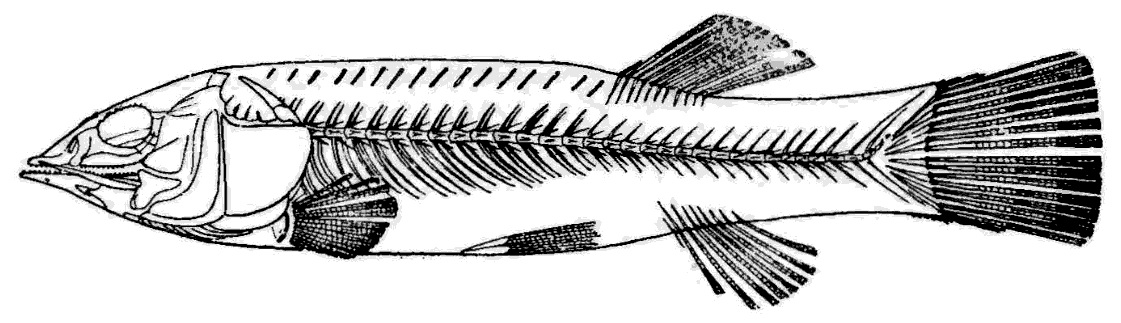
Palaeoesox fritzschei, from the middle Eocene of Germany, circa 45 MYA. Estesesox likely looked similar, but Estesesox had longer jaws.
https://www.google.com/books/edition/%D0%A1%D0%B8%D1%81%D1%82%D0%B5%D0%BC%D0%B0_%D1%80%D1%8B%D0%B1/eCXYEAAAQBAJ?hl=en&gbpv=1&dq=Palaeoesox&pg=PA245&printsec=frontcover.
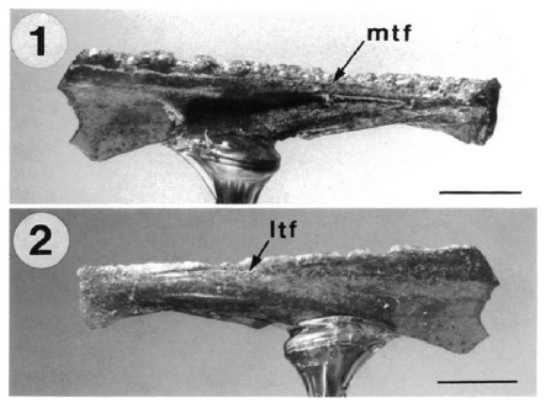
Holotype specimen of Estesesox foxi (collection ID code: UCMP 53709). Scale bar = 2 mm. Wilson, Mark V. H.; Brinkman, Donald B.; Neuman, Andrew G. (1992). “Cretaceous Esocoidei (Teleostei): Early radiation of the pikes in North American fresh waters”. Journal of Paleontology, volume 66, issue 5 (September 1992). Page 841.

Referred left dentary of Estesesox foxi (collection ID code: UALVP 15265). Scale bar = 2 mm. Wilson, Mark V. H.; Brinkman, Donald B.; Neuman, Andrew G. (1992). “Cretaceous Esocoidei (Teleostei): Early radiation of the pikes in North American fresh waters”. Journal of Paleontology, volume 66, issue 5 (September 1992). Page 841.
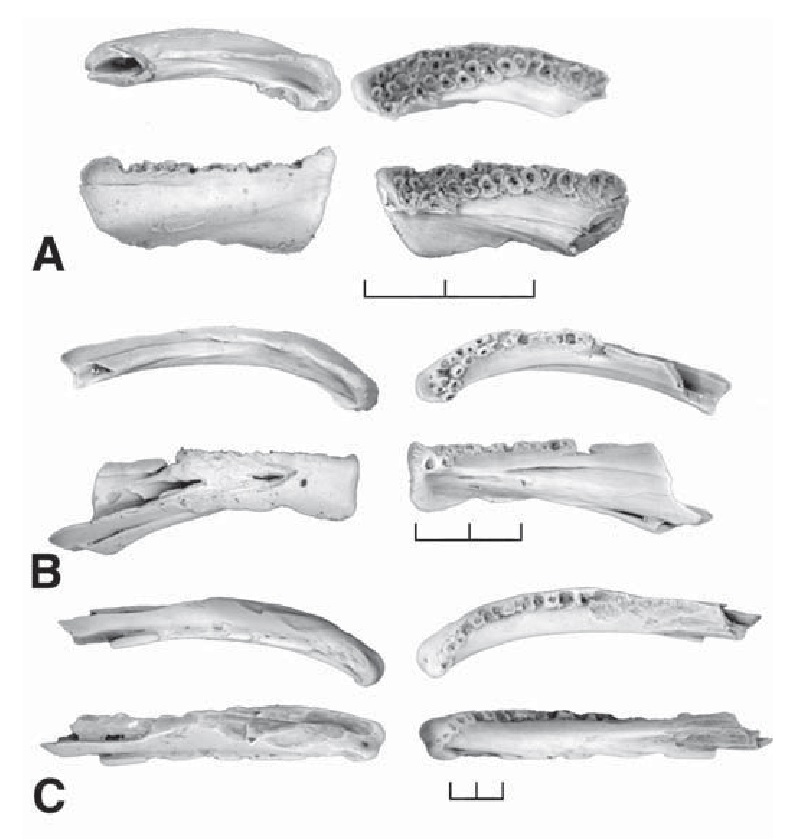
Esocoid dentaries. (A) Dentary of Estesesox foxi in ventral, occlusal, lateral, and medial views; specimen UCMP198885/ V99369. (B) Dentary of Estesesox sp. in ventral, occlusal, lateral, and medial views; specimen UCMP198885/99369. (C) Dentary of Oldmanesox in ventral, occlusal, lateral, and medial views; specimen UCMP 198880/V87151. Scale bars equal 2 mm. Brinkman, Donald B.; Newbrey, Michael G.; Neuman, Andrew G. (2014). “Diversity and paleoecology of actinopterygian fish from vertebrate microfossil localities of the Maastrichtian Hell Creek Formation of Montana”. Geological Society of America Special Papers, number 503 (2014). Page 257.
Although Estesesox foxi specifically isn’t found within the Hell Creek Formation, remains which have been uncovered there are similar enough that scientists have classified them as Estesesox sp., meaning “species unknown”. According to Donald Brinkman and colleagues, “Estesesox sp. (UCMP 198885/99369). The second species of Estesesox has a dentary with fewer rows of teeth anteriorly and has larger teeth. In the presence of larger teeth, it is similar to Oldmanesox but differs from that genus from the Hell Creek Formation in that obvious gaps for replacement teeth are absent, and the lateral opening of the trigeminal foramen is large and located just below the tooth row. On the basis of these differences, particularly the size and position of the lateral opening of the trigeminal foramen, this dentary is referred to as Estesesox sp.” (Brinkman et al. 2014, page 257). Estesesox sp. was also present within the Horseshoe Canyon Formation of Alberta, Canada, which dates from the late Campanian to middle Maastrichtian Stages approximately 73-68 MYA. The identification is based upon a single dentary (collection ID code: TMP 2009.137.0009) found within early Maastrichtian strata. The difference between this specimen and Estesesox foxi was that the teeth on the dentary from the Horseshoe Canyon Formation were larger (Larson et al. 2010, page 1,165).
Although pikes are some of the largest extant freshwater fish, their prehistoric progenitors were far smaller. According to McCormick et al. (2019), “All of the Cretaceous esociform fossil remains come from small fishes about the size of living species of Mudminnows” (McCormick et al. 2019, page 203). The modern-day “mudminnow” (genus Umbra) isn’t related to minnows at all, despite its name. In fact, mudminnows are more closely related to pikes. Being a basal member of the family Esocidae, Estesesox may have looked similar to them. There are five extant species of mudminnows: the Olympic Mudminnow (Novumbra hubbsi) which grows to 3 inches long, the Oregon Mudminnow (Novumbra oregonensis) which is slightly larger at 3.5 inches, the Central Mudminnow (Umbra limi) and European Mudminnow (Umbra krameri) which both grow to 4 inches, and the largest, the Eastern Mudminnow (Umbra pygmaea), which grows to 6 inches. Mudminnows are remarkably resilient fish, able to survive in conditions that would kill other freshwater fish species, including very high or very low water temperatures and reduced levels of dissolved oxygen in the water (“Mighty Mudminnows”).
Life
What was Estesesox like as a living animal? To understand this, we must naturally turn to its extant relatives, pikes and mudminnows. Pikes and mudminnows prefer living in still or slow-moving clear water with lots of underwater plants. Both pikes and mudminnows prefer cool water, but mudminnows are tolerant of above-average or below-average temperatures and also of low oxygen and acidic conditions. Both pikes and mudminnows have the ability to undulate their fins to hover in one spot, and then burst forwards to swallow prey. Mudminnows feed on worms, insect larvae, and crustaceans. Pikes are voracious predators (for that reason, they are sometimes nicknamed “water wolves”), and it is not unusual for them to scarf down large-sized prey which can barely fit inside their stomachs. However, since Estesesox likely measured about 3-6 inches long, it’s likely that it fed on the things which mudminnows commonly feed upon.
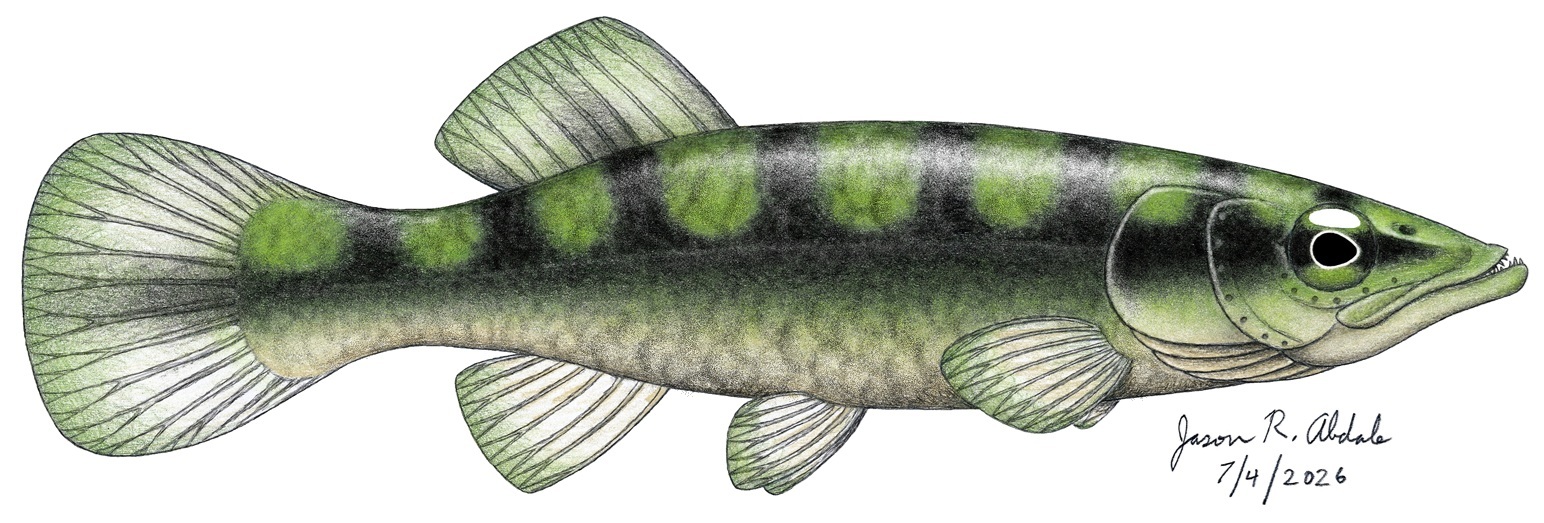
Estesesox foxi. © Jason R. Abdale (July 4, 2026).
Post-Script
I truly enjoy writing my articles and drawing my art, but it’s increasingly clear that I can’t keep this up without your gracious financial assistance. Kindly check out my pages on Redbubble and Fine Art America if you want to purchase merch of my artwork. Consider buying my ancient Roman history books Four Days in September: The Battle of Teutoburg and The Great Illyrian Revolt if you or someone that you know loves that topic, or my ancient Egyptian novel Servant of a Living God if you enjoy action and adventure. Please consider becoming a patron on my Patreon page so that I can continue to purchase the art supplies and research materials that I need. Professional art supplies are pricey, many research articles are “pay to read”, and some academic journals are rather expensive. My Patreon membership is just $1 per month – that’s it. If everybody who likes this drawing donates just one dollar per month, it would go a long way to keeping my blog “Dinosaurs and Barbarians” running and preventing my career in paleo-art from going extinct.
Keep your pencils sharp, everyone.
Sources
Books
Bryant, Laurie Jean. Non-Dinosaurian Lower Vertebrates across the Cretaceous-Tertiary Boundary in Northeastern Montana. Berkeley: University of California Press, 1989.
Estes, Richard. Fossil Vertebrates from the Late Cretaceous Lance Formation, Eastern Wyoming. University of California Press, 1964.
Articles
Brinkman, Donald B.; Newbrey, Michael G.; Neuman, Andrew G. (2014). “Diversity and paleoecology of actinopterygian fish from vertebrate microfossil localities of the Maastrichtian Hell Creek Formation of Montana”. In Wilson, G. P.; Clemens, W. A.; Horner, J. R.; Hartman, J. H., eds. Through the End of the Cretaceous in the Type Locality of the Hell Creek Formation in Montana and Adjacent Areas. Geological Society of America Special Papers, number 503 (2014). Pages 247-270.
https://www.researchgate.net/publication/286399960_Diversity_and_paleoecology_of_actinopterygian_fish_from_vertebrate_microfossil_localities_of_the_Maastrichtian_Hell_Creek_Formation_of_Montana.
Crothers, Joel; Eberl, Jaelyn; Brinkman, Donald; Wurtz, Alyssa; Heckert, Andrew B.; Hunt-Foster, ReBecca K.; Foster, John R.; Dirkes, Ida C.; Dunn, Renee (2026). “An actinopterygian-dominated fish fauna from the Upper Cretaceous Williams Fork Formation, northwestern Colorado, and evidence for provinciality across Laramidia at the Campanian/Maastrichtian boundary”. Cretaceous Research, volume 182 (January 2026): 106313.
https://www.sciencedirect.com/science/article/pii/S0195667126000029.
Estes, Richard; Berberian, Paul (1970). “Paleoecology of a Late Cretaceous Vertebrate Community from Montana”. Breviora: Museum of Comparative Zoology, number 343 (January 30, 1970). Pages 1-35.
https://www.biodiversitylibrary.org/item/25366#page/341/mode/1up.
Estes, Richard; Berberian, Paul; Meszoely, Charles A. M. (1969). “Lower Vertebrates from the Late Cretaceous Hell Creek Formation, McCone County, Montana”. Breviora: Museum of Comparative Zoology, number 337 (December 30, 1969). Pages 1-33.
https://www.biodiversitylibrary.org/item/25366#page/191/mode/1up.
Fowler, Denver W. (2017). “Revised geochronology, correlation, and dinosaur stratigraphic ranges of the Santonian-Maastrichtian (Late Cretaceous) formations of the Western Interior of North America”. PLOS One, volume 12, issue 11: e0188426 (November 22, 2017).
https://journals.plos.org/plosone/article?id=10.1371/journal.pone.0188426.
Larson, Derek W.; Brinkman, Donald B.; Bell, Phil R. (2010). “Faunal assemblages from the upper Horseshoe Canyon Formation, an early Maastrichtian cool-climate assemblage from Alberta, with special reference to the Albertosaurus sarcophagus bonebed”. Canadian Journal of Earth Sciences, volume 47, issue 9 (September 2010). Pages 1,159-1,181.
https://www.researchgate.net/publication/233521049_Faunal_assemblages_from_the_upper_Horseshoe_Canyon_Formation_an_early_Maastrichtian_cool-climate_assemblage_from_Alberta_with_special_reference_to_the_Albertosaurus_sarcophagus_bonebedThis_article_is_.
McCormick, Frank H.; Grande, Terry; Theile, Cheryl; Warren Jr., Melvin L.; López, J. Andrés; Wilson, Mark V. H.; Tabor, Roger A.; Olden, Julian D.; Kuehne, Lauren M. (2019). “Chapter 19 – Esociformes: Esocidae, Pikes, and Umbridae (Mudminnows)”. In Warren Jr., Melvin L.; Burr, Brooks M., eds. Freshwater Fishes of North America. Baltimore: Johns Hopkins University Press, 2019. Pages 193-260.
https://www.fs.usda.gov/rm/pubs_journals/2020/rmrs_2020_mccormick_f001.pdf.
Wilson, Mark V. H.; Brinkman, Donald B.; Neuman, Andrew G. (1992). “Cretaceous Esocoidei (Teleostei): Early radiation of the pikes in North American fresh waters”. Journal of Paleontology, volume 66, issue 5 (September 1992). Pages 839-846.
https://www.researchgate.net/publication/258440126_Cretaceous_Esocoidei_Teleostei_Early_radiation_of_the_pikes_in_North_American_fresh_waters.
Websites
North American Native Fish Association. “Mighty Mudminnows”, by Michael Lucas (2012).
https://www.nanfa.org/fif/mudminnow.shtml. Accessed on July 7, 2026.
Categories: Paleontology, Uncategorized


Leave a comment