
Ctenacanthus, meaning “comb spine”, was a prehistoric proto-shark which lived from the late Devonian Period to the early Permian Period 370-270 million years ago.
The genus Ctenacanthus was named by the famous Swiss ichthyologist Louis Agassiz in 1837 for fossilized fin spines found within Carboniferous-aged deposits near Bristol, England and in Wales (Agassiz 1837, pages 10-12). His diagnosis for the genus is as follows, translated from French: “Ctenacanthus specimens are immense, highly compressed fin spines with a broad base, though their internal cavity is smaller than that of Oracanthus. The portion of these spines that was embedded in the flesh appears to have been quite substantial. Along the posterior margin, there are a few small spines. The surface is ornamented with longitudinal striae—more closely spaced than those found in Hybodus—that are pectinate [comb-like]; that is, they are notched transversely and project as tooth-like structures. These projections alternate between adjacent rows, yet, due to their oblique orientation, they appear to form continuous lines” (Agassiz 1837, page 10). In cross-section the spine was either triangular or U-shaped, with the front edge of the dorsal fin slotting into the cavity on the spine’s back edge (Davis 1882, plates XLIV, XLV).
Louis Agassiz named several species of Ctenacanthus in his original report: C. major, C. tenuistriatus, C. brevis, and C. ornatus (Agassiz 1837, pages 10-12). Since its discovery, nearly 100 species names have been ascribed to the genus Ctenacanthus, to the point where it became a waste-basket taxon for any moderate-sized Paleozoic fish which had prominent dorsal spines (Maisey 1981, page 1; Maisey 1984, page 1). In fact in 1891, Arthur S. Woodward called out his fellow paleontologists for this, saying that spines of this shape almost certainly belong to several different genera (Woodward 1891, page 98). Even now, despite John Maisey’s laudable efforts during the early 1980s, it’s still not entirely clear just how many species are truly valid – a possible research project for an aspiring PhD student, perhaps?
The oldest species which I’ve been able to locate from my admittedly cursory research was Ctenacanthus vetustus, which is known from the Huron Shale Member, the oldest subdivision of the Ohio Shale Formation, which dates to the early part of the Famennian Stage of the late Devonian Period around 370 million years ago (“Ohio Shale-Huron Shale, USA”). However, it’s possible that there’s another earlier species which escaped my notice. The majority of species date to the Carboniferous Period (Hay 1902, pages 326-328). The last of the line was apparently Ctenacanthus amblyxiphias, which has been found in late Carboniferous strata in Nebraska (Eastman 1903, page 186) and in early Permian strata in Wyoming (Branson 1916, pages 654-655) and Texas (Cope 1891, page 449). The exact date for the Texas specimens was not provided, but it might be concurrent with the Kaibab Formation of Arizona which dates to the “Leonardian” phase of the early Permian (Hodnett et al. 2012, pages 381-395). If so, this would give C. amblyxiphias a total date range of about 306-270 MYA (“Missourian”; “Leonardian”).
Ctenacanthus and its close relatives were outwardly similar to the hybodonts, the first true sharks (Davis 1882, page 333). However, the spines of the ctenacanthids were much larger in proportion to body size compared to those of the hybodonts. A well-preserved specimen of the ctenacanthid Dracopristis hoffmanorum gives us a very good idea of the overall body shape of these creatures, including large dorsal fins with very large spines, large flappy pectoral fins, pelvic fins which were nearly as big, a small stubby anal fin, and a bi-forked tail which, at a glance, seems a little too small in relation to its body. The image presented is a creature which was agile and maneuverable, able to make tight turns and change directions quickly, but was also somewhat ungainly and unwieldy. This was not a streamlined predator built for powered charges at high speed. This was a creature that seems better suited as a slow cruiser but one capable of bursts of energy as it doggedly pursued small prey amidst the reefs and shallows. Examination of the teeth of ctenacanthids leads paleontologists to propose that the species Ctenacanthus concinnus in particular was an opportunist and a generalist with a varied diet, snapping up whatever came its way (Grief et al. 2025a: 240936). The ctenacanthids had massively-built skulls and assuredly had very strong bites. A modern-day analog of Ctenacanthus, at least in terms of its head structure and bite force, would probably be the Bull Shark or the Tiger Shark which are also known for having a powerful bite and being voracious predators.
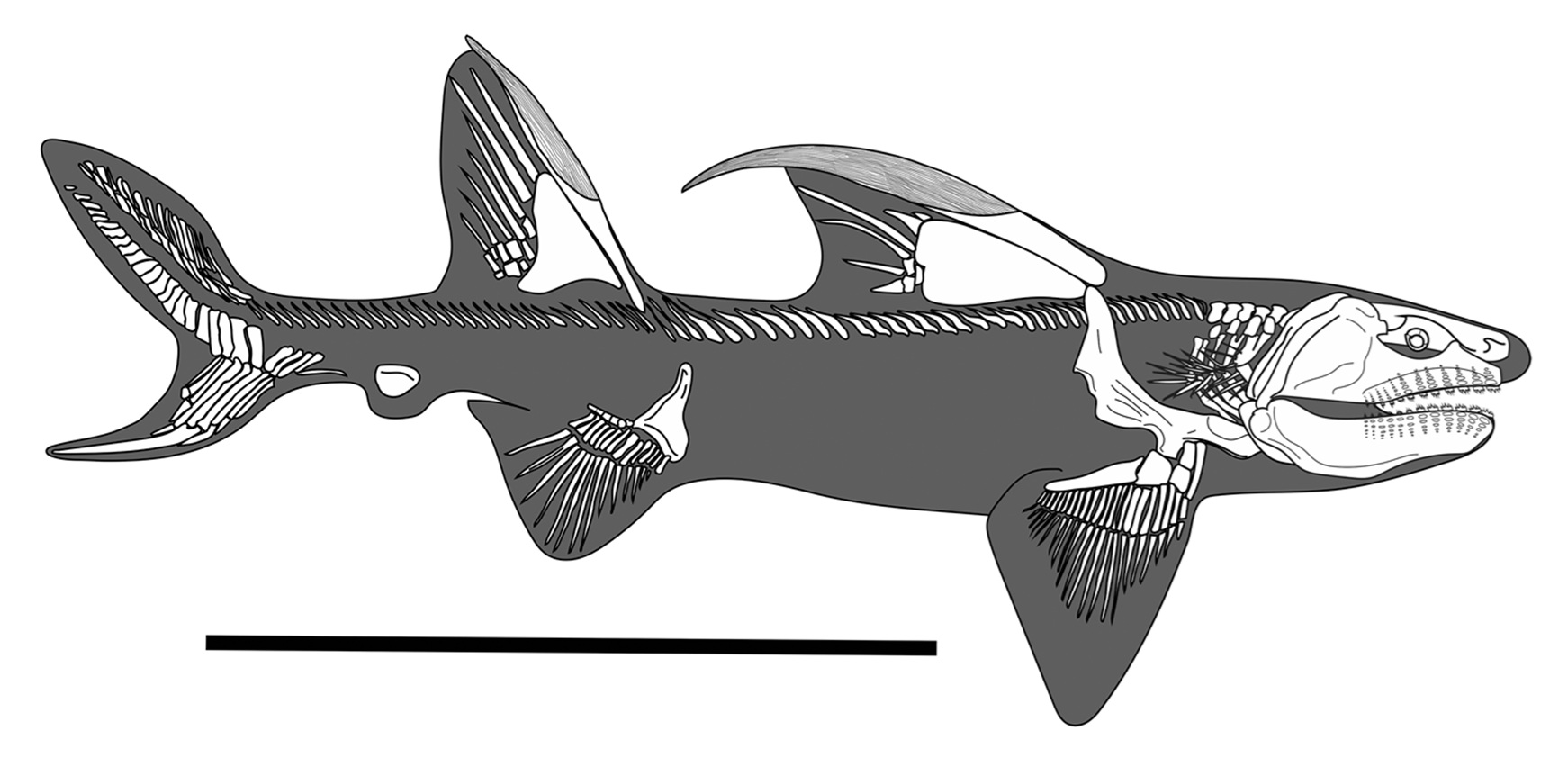
Skeleton of Dracopristis hoffmanorum, a relative of Ctenacanthus which lived during the late Carboniferous Period. Scale bar = 1 meter. Hodnett et al. 2021, page 409.
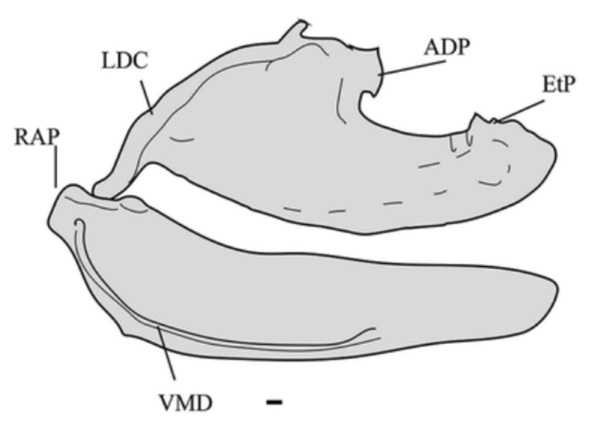
Skull of Ctenacanthus concinnus. Scale bar = 1 cm. Hodnett et al. 2021, page 406.
Ctenacanthus was big for a Devonian fish, but some species within the genus were bigger than others. The late Devonian species Ctenacanthus concinnus, whose fossils are found in Morocco and in the Cleveland Shale (Grief et al. 2025a: 240936), is believed to have measured around 4.1 meters (13.45 feet) on average, with some unusually large specimens estimated at a whopping 5.7 meters (18.7 feet) (Greif et al. 2025b, page 44). Using the above illustration of the skeleton of Dracopristis hoffmanorum (which measured slightly over 2 meters long) and its accompanying scale bar, and comparing it to the illustration of the skull of Ctenacanthus concinnus, this would mean that C. concinnus likely measured 1.9 meters (6 feet) long, less than half the size given within other publications. However, it’s possible that the skull did not come from a fully-grown individual. The largest species of all may have been Ctenacanthus tumidus (originally Cladodus tumidus) (Newberry 1889, page 172), which lived alongside C. concinnus. It may have been an astounding 5 meters (16.4 feet) long (Ginter 2010, page 152), making it one of the largest fish, if not THE largest, within its environment.
As impressive as Ctenacanthus was, it wasn’t invulnerable. A specimen of the 9 foot long predatory placoderm fish Holdenius was found with a skeleton of a Ctenacanthus lying next to it bitten clean in half. However, it seems that the proto-shark got the last laugh, because its anterior dorsal fin spine had been driven straight up into the placoderm’s upper jaw and into its brain, instantly killing it (Hlavin 1990, pages 192-195; Brett and Walker 2002, page 104). Let that be a lesson, kids – don’t bite off more than you can handle.
The drawing below represents Ctenacanthus concinnus, found within the Cleveland Shale Member of the Ohio Shale Formation, which dates to the end of the Devonian Period 362-360 MYA. The body shape is based upon Dracopristis hoffmanorum, with the head shape of Ctenacanthus concinnus, both of which are illustrated previously.
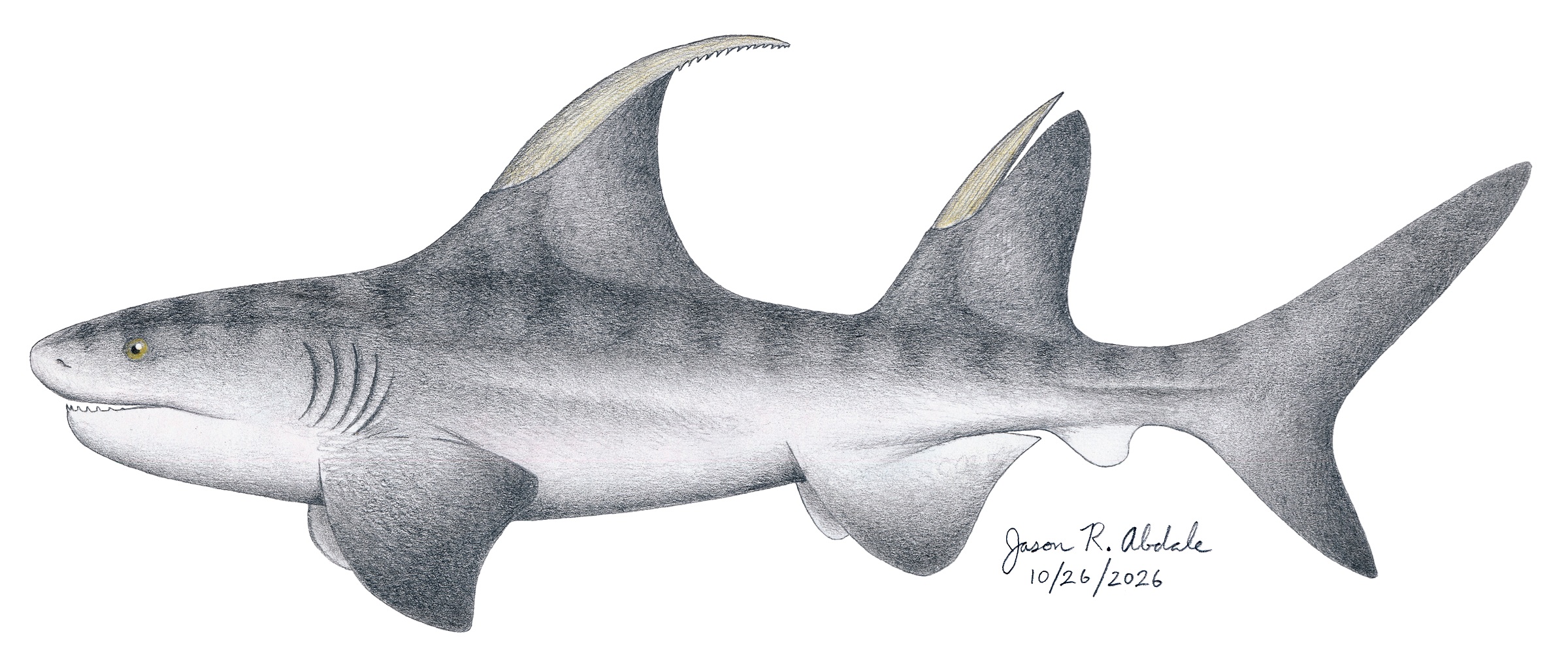
Ctenacanthus concinnus. © Jason R. Abdale (October 26, 2026).
I truly enjoy writing my articles and drawing my art, but it’s increasingly clear that I can’t keep this up without your gracious financial assistance. Kindly check out my pages on Redbubble and Fine Art America if you want to purchase merch of my artwork. Consider buying my ancient Roman history books Four Days in September: The Battle of Teutoburg and The Great Illyrian Revolt if you or someone that you know loves that topic, or my ancient Egyptian novel Servant of a Living God if you enjoy action and adventure. Please consider becoming a patron on my Patreon page so that I can continue to purchase the art supplies and research materials that I need. Professional art supplies are pricey, many research articles are “pay to read”, and some academic journals are rather expensive. My Patreon membership is just $1 per month – that’s it. If everybody who likes this drawing donates just one dollar per month, it would go a long way to keeping my blog “Dinosaurs and Barbarians” running and preventing my career in paleo-art from going extinct.
Keep your pencils sharp, everyone.
Bibliography
Books
Newberry, John Strong. The Paleozoic Fishes of North America. Washington, DC: United States Government Printing Office, 1889.
https://books.google.com/books?id=qlv-Mk0_DigC&newbks=0&printsec=frontcover&source=gbs_ge_summary_r&cad=0#v=onepage&q&f=false.
Woodward, Arthur Smith. Catalogue of the Fossil Fishes in the British Museum (Natural History), Part II. London: Longmans & Co., 1891.
https://www.google.com/books/edition/Catalogue_of_the_Fossil_Fishes_in_the_Br/a69TiLCdrlQC?hl=en&gbpv=1&dq=Ctenacanthus&pg=PA103&printsec=frontcover.
Articles
Agassiz, Louis (1837). “De genre Ctenacanthus”. Contenant l’Histoire de l’Ordre de Placoïdes. Recherches sur les poissons fossiles. Vol. 3. Neuchâtel: Petitpierre. Pages 10-12.
https://www.biodiversitylibrary.org/page/3725216#page/24/mode/1up.
Branson, E. B. (1916). “The Lower Embar of Wyoming and its Fauna”. Journal of Geology, volume 24, issue 7 (October 1, 1916). Pages 639-664.
https://www.journals.uchicago.edu/doi/epdfplus/10.1086/622383.
Brett, Carlton; Walker, Sally (2002). “Predators and Predation in Paleozoic Marine Environments”. Paleontological Society Papers, volume 8. Pages 93-118.
https://www.researchgate.net/publication/266267446_Predators_and_Predation_in_Paleozoic_Marine_Environments.
Cope, E. D. (1891). “On the Characters of Some Paleozoic Fishes”. Proceedings of the United States National Museum, volume 14 (1891). Pages 447-463.
https://www.biodiversitylibrary.org/page/7543469#page/515/mode/1up
Davis, James W. (1882). “On the Fossil Fishes of the Carboniferous Limestone Series of Great Britain”. The Scientific Transactions of the Royal Dublin Society, volume 1, series 2 (1882). Pages 327-548.
https://www.google.com/books/edition/The_Scientific_Transactions_of_the_Royal/TRU_AQAAMAAJ?hl=en&gbpv=1&dq=Ctenacanthus&pg=PA333&printsec=frontcover.
Eastman, C. R. (1903). “Carboniferous fishes from the central western States”. Bulletin of the Museum of Comparative Zoology at Harvard College, volume 39, issue 7 (1903). Pages 163-226.
https://field.biodiversitylibrary.org/page/4199248#page/220/mode/1up.
Ginter, Michał (2010). “Teeth of Late Famennian ctenacanth sharks from the Cleveland Shale”. In Elliott, David K.; Maisey, John G.; Yu, Xiaobo; Miao, Desui, eds. Morphology, Phylogeny and Paleobiogeography of Fossil Fishes. Munich: Verlag Dr. Friedrich Pfeil, 2010. Pages 145-158.
Greif, Merle; Calandra, Ivan; Lautenschlager, Stephan; Kaiser, Thomas M.; Mezane, Mohammed; Klug, Christian (2025a). “Reconstruction of feeding behaviour and diet in Devonian ctenacanth chondrichthyans using dental microwear texture and finite element analyses”. Royal Society Open Science, volume 12, issue 1 (January 29, 2025): 240936.
https://royalsocietypublishing.org/rsos/article/12/1/240936/93048/Reconstruction-of-feeding-behaviour-and-diet-in.
Greif, Merle; Hodnett, John-Paul Michael; Klug, Christian (2025b). “Late Devonian apex predators: Anatomy and ecology of Ctenacanthus concinnus from the Anti-Atlas”. 9th International Congress on Palaeontological Heritage (September 24-28, 2025). Pages 44-46.
https://www.researchgate.net/publication/395952642_Late_Devonian_apex_predators_Anatomy_and_ecology_of_Ctenacanthus_concinnus_from_the_Anti-Atlas.
Hay, Oliver Perry (1902). “Bibliography and Catalogue of the Fossil Vertebrata of North America”. Bulletin of the United States Geological Survey, number 179. Washington, DC: United States Government Printing Office, 1902.
https://www.google.com/books/edition/Bibliography_and_Catalogue_of_the_Fossil/ZmqWKhTAeqYC?hl=en&gbpv=1.
Hlavin, W. J. (1990). “Arthrodire-ctenacanth shark”. In Boucot, A. J., ed. Evolutionary Paleobiology of Behavior and Coevolution. Amsterdam: Elsevier, 1990. Pages 192-195.
Hodnett, John-Paul M.; Elliot, David K.; Olson, Tom J.; Wittke, James H. (2012). “Ctenacanthiform sharks from the Permian Kaibab Formation, northern Arizona”. Historical Biology, volume 24, issue 4 (June 14, 2012). Pages 381-395.
https://www.tandfonline.com/doi/full/10.1080/08912963.2012.683193.
Hodnett, J.-P. M.; Grogan, E. D.; Lund, Richard; Lucas, Spencer G.; Suazo, T.; Elliott, D. K.; Pruitt, J. (2021). “Ctenacanthiform sharks from the Late Pennsylvanian (Missourian) Tinajas Member of the Atrasado Formation, Central New Mexico”. New Mexico Museum of Natural History and Science Bulletin, volume 84 (2021). Pages 391-424.
https://www.researchgate.net/publication/350889762_CTENACANTHIFORM_SHARKS_FROM_THE_LATE_PENNSYLVANIAN_MISSOURIAN_TINAJAS_MEMBER_OF_THE_ATRASADO_FORMATION_CENTRAL_NEW_MEXICO.
Maisey, John G. (1981). “Studies on the Paleozoic selachian genus Ctenacanthus Agassiz. No. 1, Historical review and revised diagnosis of Ctenacanthus, with a list of referred taxa”. American Museum Novitates, number 2718 (November 19, 1981). Pages 1-22.
https://digitallibrary.amnh.org/items/4d9c8200-3e86-4311-ba85-3c2f74cf16a3.
Maisey, John G. (1984). “Studies on the Paleozoic selachian genus Ctenacanthus Agassiz. No. 3, Nominal species referred to Ctenacanthus”. American Museum Novitates, number 2774 (January 27, 1984). Pages 1-20.
https://archive.org/details/studiesonpaleoz2774mais/studiesonpaleoz2774mais/mode/1up.
Websites
GeoWhen Database. “Leonardian”.
https://timescalefoundation.org/resources/geowhen/stages/Leonardian.html.
GeoWhen Database. “Missourian”.
https://timescalefoundation.org/resources/geowhen/stages/Missourian.html.
Mindat. “Ohio Shale-Huron Shale, USA”.
https://www.mindat.org/paleo_strat.php?id=12451.
Categories: Paleontology, Uncategorized


Leave a Reply