
Orodus was a prehistoric saltwater fish which lived from the late Devonian Period to the middle Permian Period 380-278 million years ago.
The genus Orodus was officially named by the famous Swiss ichthyologist Louis Agassiz in 1838. It became the namesake member of the family Orodontidae and the order Orodontiformes. Orodus and its relatives were members of the sub-class Holocephali, a group of cartilaginous fish whose only living members are the chimaeras. Today, chimaeras are deep sea species, but prehistoric holocephalians were much more diverse in their choice of habitats, with some inhabiting shallow coastal reefs and others swimming out in the open ocean. Orodus appears to have been one of these open-water holocephalians with a body similar in shape to a modern-day swordfish or marlin, minus the long beak.
Orodus is mostly known for its short stubby teeth, which is, in fact, what the genus is named after. The name Orodus means “mountain tooth” because the teeth are low except for a short triangular point in the middle, resembling a mountain in profile. The shape of the teeth indicates that Orodus had a durophagous diet – that is, one which emphasized eating hard-shelled creatures. It’s likely that it fed on small nautiloids and ammonites which were found out in open water, using great bursts of speed to catch these small jet-propelled cephalopods and crushing them in its strong nutcracker-like jaws.
Since its discovery, thirty-two species of Orodus have been named, largely based upon minor differences in tooth structure. The oldest of these species, O. devonicus of western New York, dates to the Frasnian Stage of the late Devonian Period around 380-372 MYA. The majority of species of Orodus lived during the Carboniferous Period, which came afterwards, and nearly all of them have been found within the center of North America in the states of Iowa, Missouri, Illinois, Indiana, and Ohio. The last species, O. ipeunaensis, lived in Brazil’s Irati Formation during the middle Permian Period about 278 MYA.
Although mostly known from teeth, we do have at least one well-preserved partial skeleton of the species Orodus greggi (collection ID code: FMNH PF 2201) which not only shows the general outline of the body, but also preserves the texture of its skin which shows that Orodus was covered in tiny diamond-shaped scales. It’s possible that, like many chimaera fish today, Orodus slowly cruised through the ocean by flapping its pectoral fins up and down, but when it needed to move fast, it used its broad swordfish-like tail.
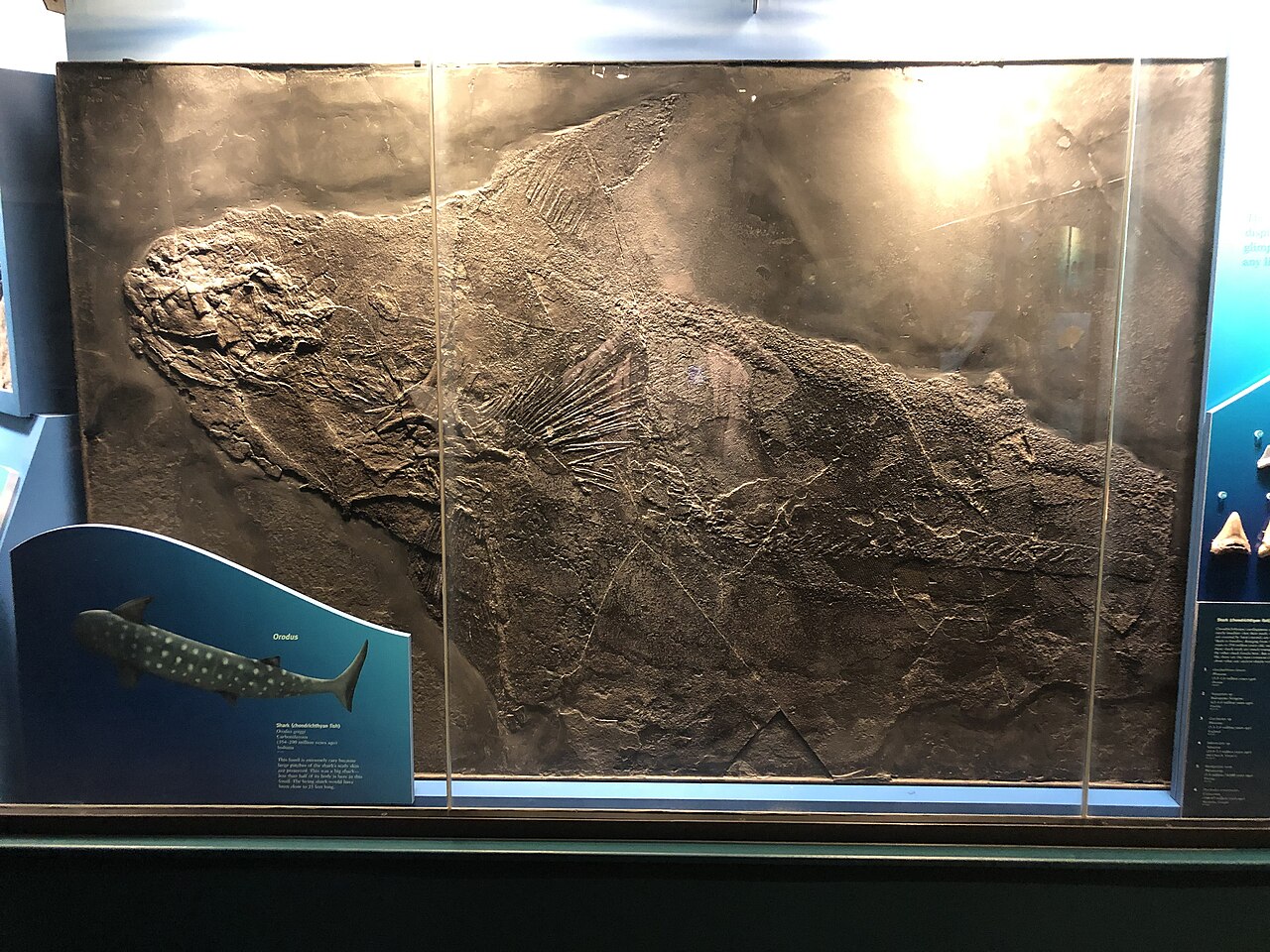
Partial skeleton of Orodus greggi found in Indiana, and on display at the Field Museum of Natural History in Chicago Illinois (collection ID code: FMNH PF 2201). Public domain image, Wikimedia Commons.
https://commons.wikimedia.org/wiki/File:Full_body_orodus_photo.jpg.
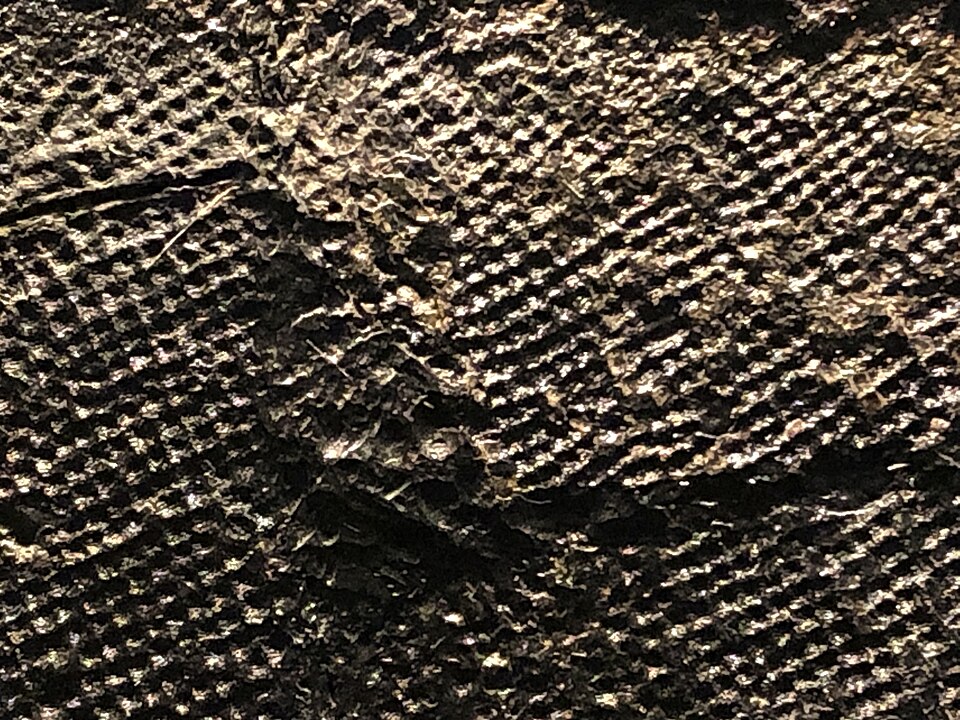
A close-up of the scales of Orodus greggi (collection ID code: FMNH PF 2201). Public domain image, Wikimedia Commons.
https://commons.wikimedia.org/wiki/File:Orodus_scales.jpg.
Below is an illustration of the species Orodus greggi, named in 1981 by Rainer Zangerl. Its fossils have been found in North America (especially Indiana) within strata dated to the Moscovian Stage of the late Carboniferous Period 315-307 MYA. It measured 12 feet long.
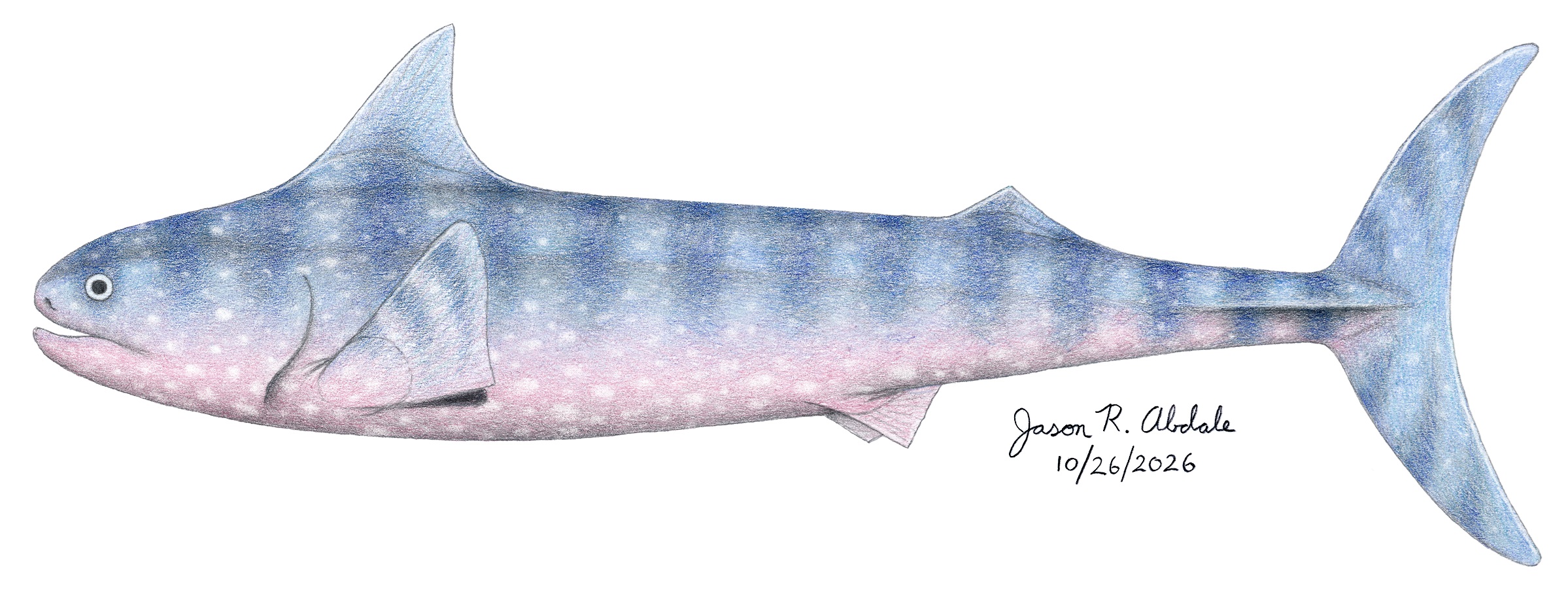
Orodus greggi. © Jason R. Abdale (October 26, 2026).
I truly enjoy writing my articles and drawing my art, but it’s increasingly clear that I can’t keep this up without your gracious financial assistance. Kindly check out my pages on Redbubble and Fine Art America if you want to purchase merch of my artwork. Consider buying my ancient Roman history books Four Days in September: The Battle of Teutoburg and The Great Illyrian Revolt if you or someone that you know loves that topic, or my ancient Egyptian novel Servant of a Living God if you enjoy action and adventure. Please consider becoming a patron on my Patreon page so that I can continue to purchase the art supplies and research materials that I need. Professional art supplies are pricey, many research articles are “pay to read”, and some academic journals are rather expensive. My Patreon membership is just $1 per month – that’s it. If everybody who likes this drawing donates just one dollar per month, it would go a long way to keeping my blog “Dinosaurs and Barbarians” running and preventing my career in paleo-art from going extinct.
Keep your pencils sharp, everyone.
Categories: Paleontology, Uncategorized


Leave a Reply