
Diplacanthus, meaning “double spine”, was a genus of acanthodian fish which lived from the middle to late Devonian Period approximately 400-360 million years ago.
The acanthodians are commonly referred to as “spiny sharks”, partly due to the multitude of stiff spines on the leading edge of each of their fins, and partly due to the group’s placement within the class Chondrichthyes which includes sharks, rays, and chimaeras. However, current evidence suggests that acanthodians and sharks are not closely related. In fact, research conducted in the 2010s proposed that the group Acanthodii is paraphyletic, meaning that the group is cobbled together from members of different families who are not close relatives, and therefore the entire group needs to be re-evaluated. Is anyone working on a paleontology PhD interested in doing this for their dissertation?
The acanthodians first appeared during the middle of the Silurian Period around 435 million years ago, give or take, but it was during the early Devonian Period that the group dramatically expanded. Originally marine, some of them gradually adapted to freshwater. The majority of acanthodians were small, with most of them measuring just 2 to 6 inches long, small enough for a home aquarium! However, the species Acanthodes splendidus, which lived during the early Permian Period within Germany’s Meisenheim Formation, measured 2.5 feet long. The group Acanthodii went extinct at the end of the Permian Period 252 MYA, making them yet another victim of the Permian Mass Extinction.
Within Acanthodii is the order Diplacanthiformes, which appeared during the beginning of the Devonian Period around 415 MYA. One of the genera within this order is the eponymous Diplacanthus, meaning “double spine” due to the pair of spiny dorsal fins on the animal’s back. The genus was named by the famous Swiss ichthyologist Louis Agassiz in 1843 from Devonian-aged fossils from the Old Red Sandstone Formation in Scotland, which spans from the end of the Silurian Period to the beginning of the Carboniferous Period, about 420-358 MYA. Since then, fossils which have been ascribed to Diplacanthus have been found elsewhere. Numerous species have been named over the years, but nowadays, only four species are currently recognized within the genus Diplacanthus:
- D. crassissimus (possibly the same as D. striatus) – Scotland (Old Red Sandstone Formation); middle to late Devonian, 385-375 MYA.
- D. horridus – Quebec, Canada (Escuminac Formation); middle to late Devonian, 385-375 MYA.
- D. kleesmentae – Belarus (Lepel Beds Formation); upper Emsian Stage, early Devonian Period, ca. 400 MYA.
- D. tenuistriatus – Scotland (Old Red Sandstone Formation); middle Devonian, 393-383 MYA.
Below is a reconstruction of Diplacanthus crassissimus, which measured just 3 inches long. Fossils of this creature have been found within freshwater and brackish water deposits within the Old Red Sandstone Formation in strata which date to the middle to late Devonian Period 385-375 MYA.
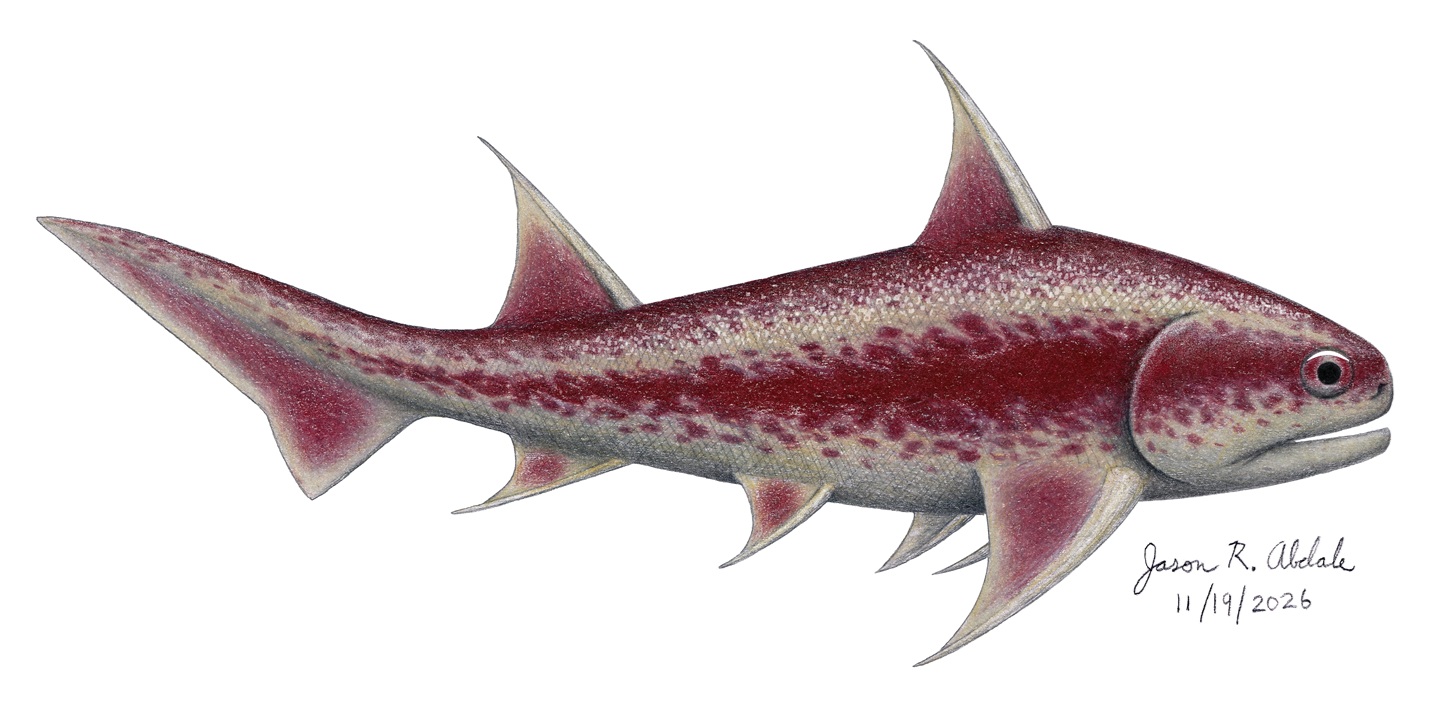
Diplacanthus crassissimus. © Jason R. Abdale (November 19, 2026).
I truly enjoy writing my articles and drawing my art, but it’s increasingly clear that I can’t keep this up without your gracious financial assistance. Kindly check out my pages on Redbubble and Fine Art America if you want to purchase merch of my artwork. Consider buying my ancient Roman history books Four Days in September: The Battle of Teutoburg and The Great Illyrian Revolt if you or someone that you know loves that topic, or my ancient Egyptian novel Servant of a Living God if you enjoy action and adventure. Please consider becoming a patron on my Patreon page so that I can continue to purchase the art supplies and research materials that I need. Professional art supplies are pricey, many research articles are “pay to read”, and some academic journals are rather expensive. My Patreon membership is just $1 per month – that’s it. If everybody who likes this drawing donates just one dollar per month, it would go a long way to keeping my blog “Dinosaurs and Barbarians” running and preventing my career in paleo-art from going extinct.
Keep your pencils sharp, everyone.
Categories: Uncategorized, Paleontology


Leave a Reply