
Tegeolepis was a 3 foot long prehistoric saltwater fish which lived at the end of the Devonian Period 362-360 million years ago. It was a primitive member of the group Actinopterygii, or “ray-finned fishes”. In life it vaguely resembled a barracuda, and it possibly had a similar lifestyle and filled a similar ecological niche.
In the 1880s, Dr. William Clark, a physician, naturalist, and fossil hunter from Berea, Ohio discovered a fossil fish (collection ID code: AMNH 230) at Brooklyn, Cuyahoga County, Ohio within the Cleveland Shale Member of the Ohio Shale Formation (Gardiner 1963, page 300). These rocks date to the end of the Devonian Period 362-360 million years ago (Becker et al. 2020). In 1888, John S. Newberry named it Actinophorus clarkii. He described it as follows: “Tiled-scaled ganoids of medium size, long and slender; body cylindrical; head pointed, bony; teeth numerous, conical, acute; fins without fulcra, delicate, many-rayed; scales narrow quadrangular, thin…Fish slender, about 2 feet in length by 2 ½ inches in diameter at the pectoral fins; head conical, pointed, well ossified, 7 to 8 inches long; branchiostegals numerous; pectoral fins broadly conical, somewhat falcate, 3 inches long by 1 ½ inches wide, containing about 60 fine parallel ossified rays, anal fin 18 inches from muzzle, relatively small, triangular in outline; caudal fin strongly heterocaudal. The affinities of this fish are apparently with Acrolepis, but it differs from the fishes of that genus by the absence of fulcra from the fins, and the thinner and more quadrangular scales” (Newberry 1888, page 179).
It was soon afterwards revealed that the genus name Actinophorus was already taken by a scarab beetle named in 1799 by the Austrian naturalist Christian Creutzer (“Actinophorus”; Creutzer 1799, pages 79-80; Miller 1889, page 713; Gardiner 1963, page 299; Bousquet 2016, page 124). You can’t have two different animals with the same name, so in 1889, Samuel A. Miller re-named Actinophorus clarkii to Tegeolepis clarkii. The genus name was derived from the ancient Greek words tegeos “roof” and lepis “scale” because the ganoid scales resembled rows of roof tiles (Miller 1889, page 717). In 1891, the species name was corrected from clarkii to clarki, which was more grammatically accurate (Woodward 1891, page 487). Despite the name-change in 1889, the older name Actinophorus continued to be used in some scientific publications for several decades (Woodward 1891, pages 486-487; Claypole 1895, pages 20-25; Eastman 1907, page 19; Eastman 1908, page 285; Cushing et al. 1931, page 38).
Not long after the first fossil of Tegeolepis was found, Dr. William Clark uncovered a second specimen which, though incomplete, was also about one-third larger. The specimen, which was preserved lying on its back, belly up, included the body from the head to the pelvic fins. The teeth were conical with no serrations and were slightly recurved. The upper jaw was significantly longer than the lower jaw, giving it a pronounced overbite, and the front of the upper jaw curved slightly downwards. The large sickle-shaped pectoral fins were positioned two inches from the back of the mandible and each sported sixty-eight very thin rays, each of which forked into two about one-third of their length from the fin’s base, and each of these in turn forked into two about one-third of the way from the fin’s trailing edge. The pectoral fins and pelvic fins were spaced fifteen inches distant from each other. The pelvic fins, while substantially smaller than the pectoral fins, were constructed in a similar way, with each fin having twenty rays. The entire body was covered in very small rhomboidal scales similar to those seen in palaeoniscoid fishes. In fact, Tegeolepis might have been a close relative of the palaeoniscoids, or possibly even a member of that group (Claypole 1895, pages 20-25; Woodward 1891, pages 486-487).
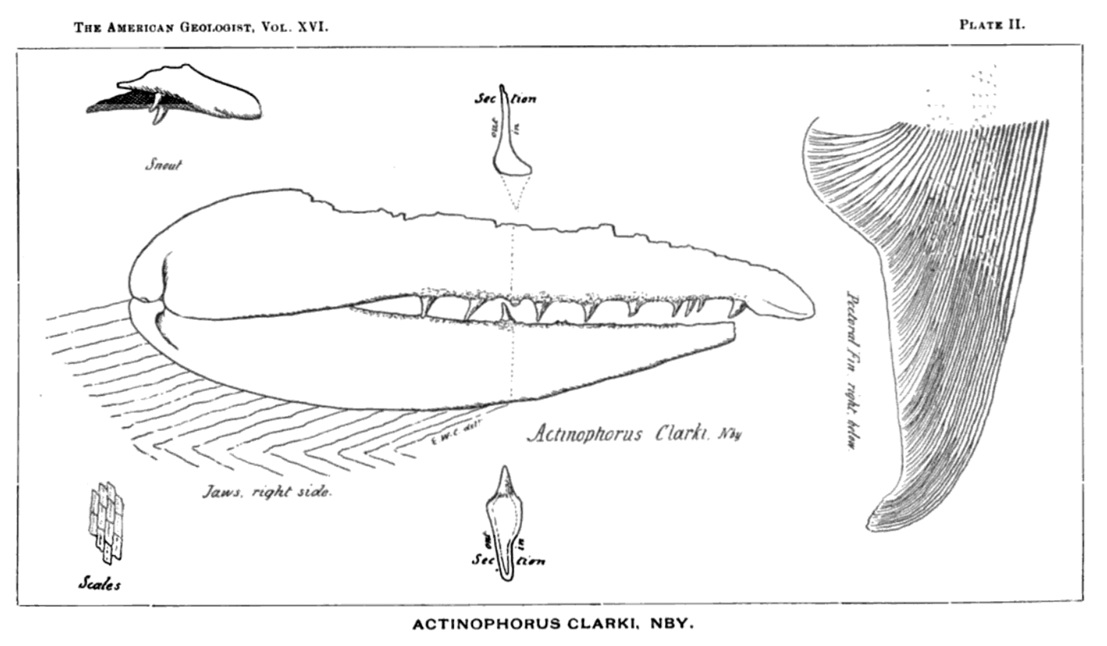
Illustrations of fossils of Tegeolepis clarki (originally named Actinophorus clarki), including the upper and lower jaws, the front of the upper jaw, the scales, and the pectoral fin. Claypole 1895, Plate II.
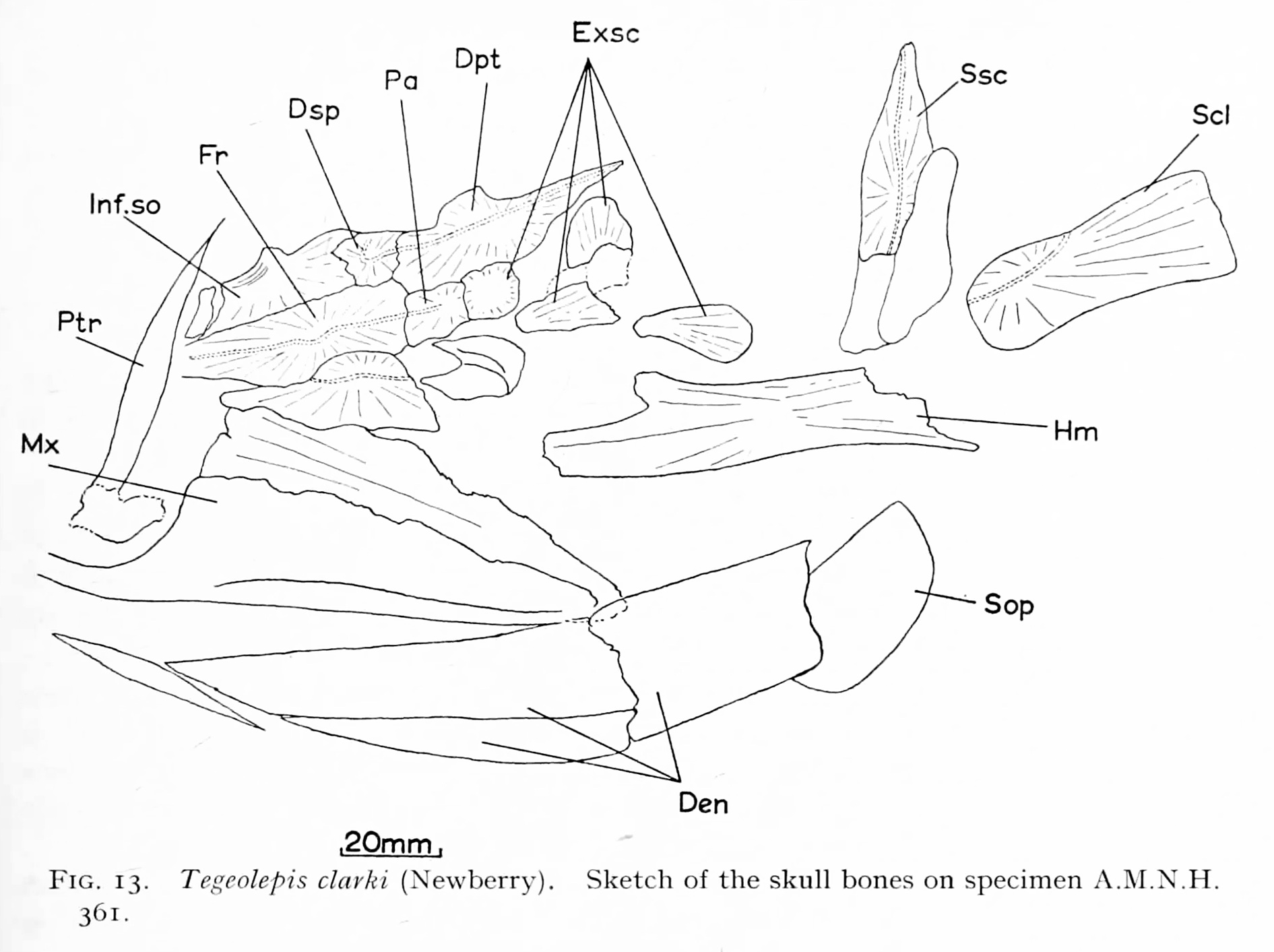
Disarticulated skull of Tegeolepis clarki (collection ID code: AMNH 361). Gardiner 1963, page 301.
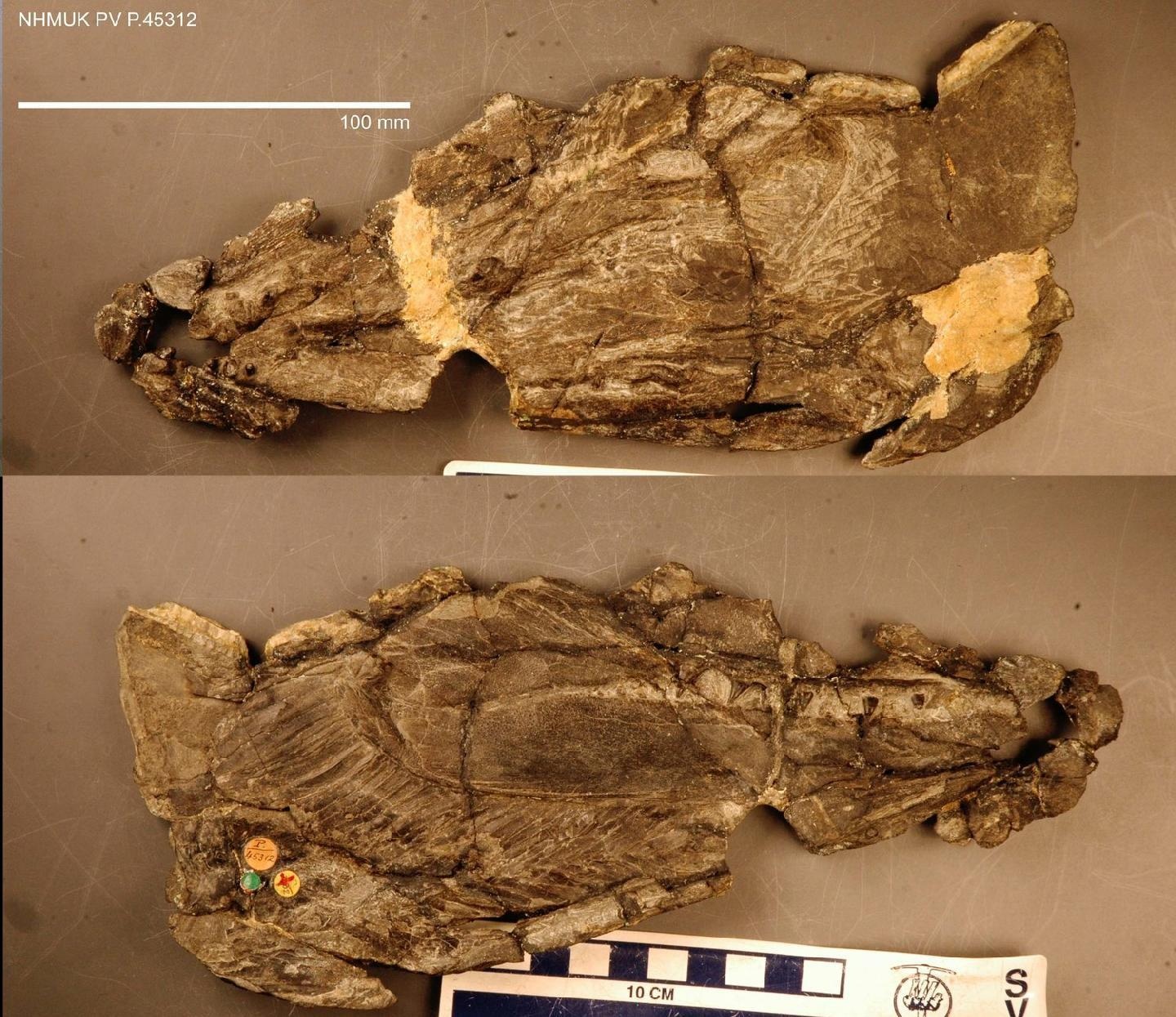
Partial skull of Tegeolepis clarki (collection ID code: NHMUK PV P.45312), found at Berea, Ohio by Dr. William Clark. Currently housed within the Natural History Museum (formerly the British Museum of Natural History), London, UK. Image © The Trustees of the Natural History Museum, London. Creative Commons License Attribution 4.0 International.
- https://data.nhm.ac.uk/dataset/collection-specimens/resource/05ff2255-c38a-40c9-b657-4ccb55ab2feb/record/5122875.
- https://data.nhm.ac.uk/media/50b79fd8-84db-4c3c-9978-9efcf935ef9e.
- https://creativecommons.org/licenses/by/4.0/.
Tegeolepis’ overall size has grown slightly over the years. At first, John S. Newberry stated that it measured almost 2 feet long (Newberry 1888, page 179), then E. W. Claypole said it measured between 36-40 inches long (Claypole 1895, pages 24), then Brian Gardiner said that it measured almost 1 meter long (Gardiner 1963, page 300), and finally an online report stated that it measured 1 meter long (“Weird Fish for the Win”), although the last of these might be due to press-writers rounding up or inflating sizes. Arthur James Boucot stated in 1990 that Tegeolepis measured 2 meters long (Boucot 1990, page 287), but no other author gives such a large measurement and it can probably be discounted. As for myself, I’m going to play it safe and say that Tegeolepis measured 3 feet long, or just a smidge under 1 meter.
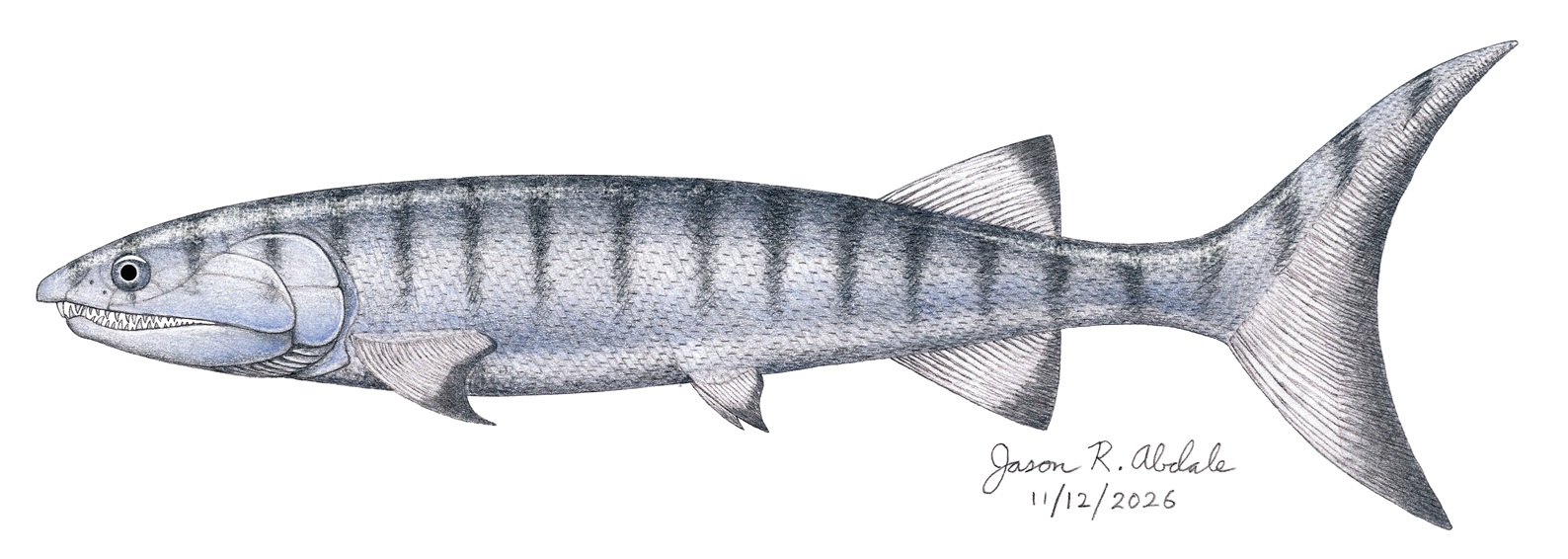
Tegeolepis clarki. © Jason R. Abdale (November 12, 2026).
Both Arthur S. Woodward and E. W. Claypole stated that Tegeolepis was a palaeoniscoid fish (Woodward 1891, page 487; Claypole 1895, page 25). Woodward stated that Tegeolepis was a close relative of the 10 inch long Apateolepis from New South Wales, Australia (Woodward 1891, pages 486-487). In 1945, Alfred Romer coined the family name Tegeolepidae, which included only Tegeolepis (Romer 1945). In 1963, Brian Gardiner posited that Apateolepis might be a member of this same family, but he wasn’t sure (Gardiner 1963, page 299). In 2021, it was announced that a new fish was discovered – Austelliscus ferox from the middle Devonian of Brazil – which was a close relative of Tegeolepis (Figuerora et al. 2021: 20200766).
I truly enjoy writing my articles and drawing my art, but it’s increasingly clear that I can’t keep this up without your gracious financial assistance. Kindly check out my pages on Redbubble and Fine Art America if you want to purchase merch of my artwork. Consider buying my ancient Roman history books Four Days in September: The Battle of Teutoburg and The Great Illyrian Revolt if you or someone that you know loves that topic, or my ancient Egyptian novel Servant of a Living God if you enjoy action and adventure. Please consider becoming a patron on my Patreon page so that I can continue to purchase the art supplies and research materials that I need. Professional art supplies are pricey, many research articles are “pay to read”, and some academic journals are rather expensive. My Patreon membership is just $1 per month – that’s it. If everybody who likes this drawing donates just one dollar per month, it would go a long way to keeping my blog “Dinosaurs and Barbarians” running and preventing my career in paleo-art from going extinct.
Keep your pencils sharp, everyone.
Bibliography
Books
Boucot, A. J. Evolutionary Paleobiology of Behavior and Coevolution. Elsevier: Amsterdam, 1990.
https://www.google.com/books/edition/Evolutionary_Paleobiology_of_Behavior_an/wFPgBAAAQBAJ?hl=en&gbpv=1.
Creutzer, Christian. Entomologisches Versuche. Wien: Karl Schaumbourg und Comp., 1799. Pages 1-142.
https://archive.org/download/entomologischeve00creu/entomologischeve00creu.pdf.
Miller, S. A. North American Geology and Palaeontology for the Use of Amateurs, Students, and Scientists. Cleveland: Press of the Western Methodist Book Concern, 1889.
https://www.biodiversitylibrary.org/item/57495#page/7/mode/1up.
Romer, Alfred Sherwood. Vertebrate Paleontology, 2nd Edition. Chicago: University of Chicago Press, 1945.
Woodward, Arthur Smith. Catalogue of the Fossil Fishes in the British Museum (Natural History), Part II. London: Longmans & Co., 1891.
https://www.google.com/books/edition/Catalogue_of_the_Fossil_Fishes_in_the_Br/a69TiLCdrlQC?hl=en&gbpv=1.
Articles
Becker, Ralph Thomas; Marshall, J. E. A.; Da Silva, Anne-Christine; Agterberg, F. P.; Gradstein, Felix M.; Ogg, James G. (2020). “The Devonian Period”. Geologic Time Scale 2020. Pages 733-810.
Bousquet, Yves (2016). “Litteratura Coleopterologica (1758–1900): A guide to selected books related to the taxonomy of Coleoptera with publication dates and notes”. ZooKeys, volume 583 (April 2016). Pages 1-776.
https://www.researchgate.net/publication/301645940_Litteratura_Coleopterologica_1758-1900_A_guide_to_selected_books_related_to_the_taxonomy_of_Coleoptera_with_publication_dates_and_notes.
Claypole, E. W. (1895). “Actinophorus clarki, Newberry”. The American Geologist, volume 16 (July 1895). Pages 20-25.
https://www.google.com/books/edition/The_American_Geologist/9Dy8AAAAIAAJ?hl=en&gbpv=1&dq=Coccosteus+mandible&pg=PA21&printsec=frontcover.
Cushing, H. P.; Leverett, Frank; Van Horn, Frank R. (1931). “Geology and Mineral Resources of the Cleveland District, Ohio”. Bulletin of the United States Geological Survey, number 818. Washington, DC: United States Government Printing Office 1931. Pages 1-133.
https://www.google.com/books/edition/Geology_and_Mineral_Resources_of_the_Cle/pacLAAAAMAAJ?hl=en&gbpv=1.
Eastman, Charles R. (1907). “Devonic Fishes of the New York Formations”. Memoirs of the New York State Museum, volume 10 (1907). Pages 1-224.
https://www.google.com/books/edition/Memoirs_of_the_New_York_State_Museum/RIvpAAAAMAAJ?hl=en&gbpv=1&dq=Glyptaspis+verrucosus&pg=PA147&printsec=frontcover.
Eastman, Charles R. (1908). “Devonian Fishes of Iowa”. Annual Report of the Iowa Geological Survey, volume 18 – 1907 (1908). Pages 29-365.
https://www.google.com/books/edition/Devonian_Fishes_of_Iowa/bX8ZAAAAYAAJ?hl=en&gbpv=1&dq=Diplognathus&pg=PA181&printsec=frontcover.
Figueroa, Rodrigo Tinoco; Weinschütz, Luiz Carlos; Friedman, Matt (2021). “The oldest Devonian circumpolar ray-Finned fish?” Biology Letters, volume 17, issue 3 (March 1, 2021): 20200766.
https://royalsocietypublishing.org/rsbl/article/17/3/20200766/62907/The-oldest-Devonian-circumpolar-ray-finned-fish.
Gardiner, Brian George (1963). “Certain Palaeoniscoid Fishes and the Evolution of the Snout in Actinopterygians”. Bulletin of the British Museum (Natural History) Geology, volume 8, issue 6 (July 1963). Pages 257-325.
https://www.biodiversitylibrary.org/page/36370884#page/451/mode/1up.
Newberry, J. S. (1888). “On the Fossil Fishes of the Erie Shale of Ohio”. Transactions of the New York Academy of Sciences, volume 7 (April 30, 1888). Pages 178-180.
https://www.biodiversitylibrary.org/item/46036#page/195/mode/1up.
Websites
College of Literature, Science, and Arts – University of Michigan. “Weird Fish for the Win” (November 19, 2024).
https://lsa.umich.edu/earth/news-events/all-news/search-news/weird-fish-for-the-win.html.
Mindat. “Actinophorus”.
https://www.mindat.org/taxon-3238411.html.
Categories: Paleontology, Uncategorized


Leave a Reply