
Diplognathus, literally “double jaw”, was a saltwater placoderm fish which lived in what’s now North America at the end of the Devonian Period 362-360 MYA.
In 1877, the fossil hunter Jay Terrell discovered the front half of a lower jaw (collection ID code: AMNH 12) near Sheffield, Lorain County. Ohio. The rocks here belonged to the Huron Shale Member, the lowest/oldest unit of the Ohio Shale Formation (Newberry 1878, pages 188-189). Afterwards, it was corrected that the fossil actually came from the Cleveland Shale Member, the highest/youngest member of the Ohio Shale Formation (Newberry 1889, pages 130, 160; Dunkle and Bungart 1943, page 73). This jaw was quickly identified as belonging to a placoderm fish. These were fish which had bony plates forming their skulls and pectoral girdle, but the remainder of their skeleton was made from cartilage. Also, they didn’t have teeth. Instead, their jawbones themselves acted as teeth, often fashioned into sharp blades for slicing through prey. Some placoderm jaws had a few pointy projections along their edges, serving as analogs for teeth, but this particular jaw which had been found at Sheffield were unlike any placoderm jaws seen so far – the entire length of the jaws were adorned with recurved spikes of bone. This partial dentary bone measured 18 inches long and 2 inches side at its widest point. The front of the lower jaw was bent outwards, meaning that the complete pair of lower left and right jaws were forked at the front. In 1878, John S. Newberry named these jaws Diplognathus mirabilis (Newberry 1878, pages 188-189). The genus name Diplognathus literally means “double jaw” because the front of the lower jaw was split into a V-shaped fork. The species name mirabilis means “miraculous” because these jawbones were unlike any other placoderm jaws found up to that point.
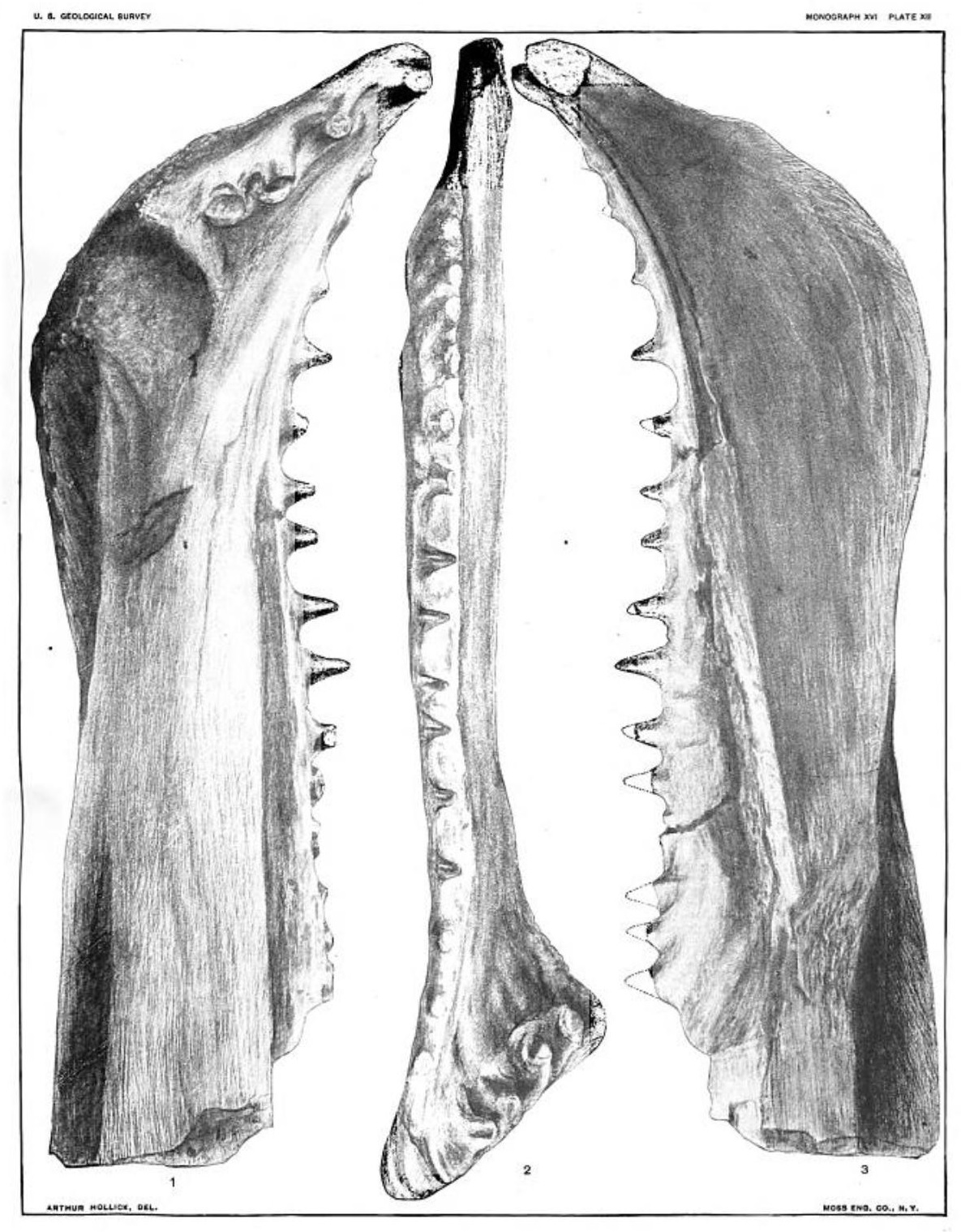
Right mandible (anterior half) of Diplognathus mirabilis (collection ID code: AMNH 12) found in 1877. 1) Medial view; 2) Dorsal view; 3) Lateral view. Newberry 1889, plate XII.
In 1886, Jay Tyrell discovered a left and right dentary bone near the same place where found the original fossil. These measured 12 inches long, and they also differed slightly in their proportions, so they came from two individuals, both of which were approximately the same size (Newberry 1889, page 160). It also showed that the front of the lower jaw did not extend laterally, as John S. Newberry initially thought in 1878, thereby rendering the animal’s name meaningless. The front end of the jaw had been deformed and bent outwards during the fossilization process.
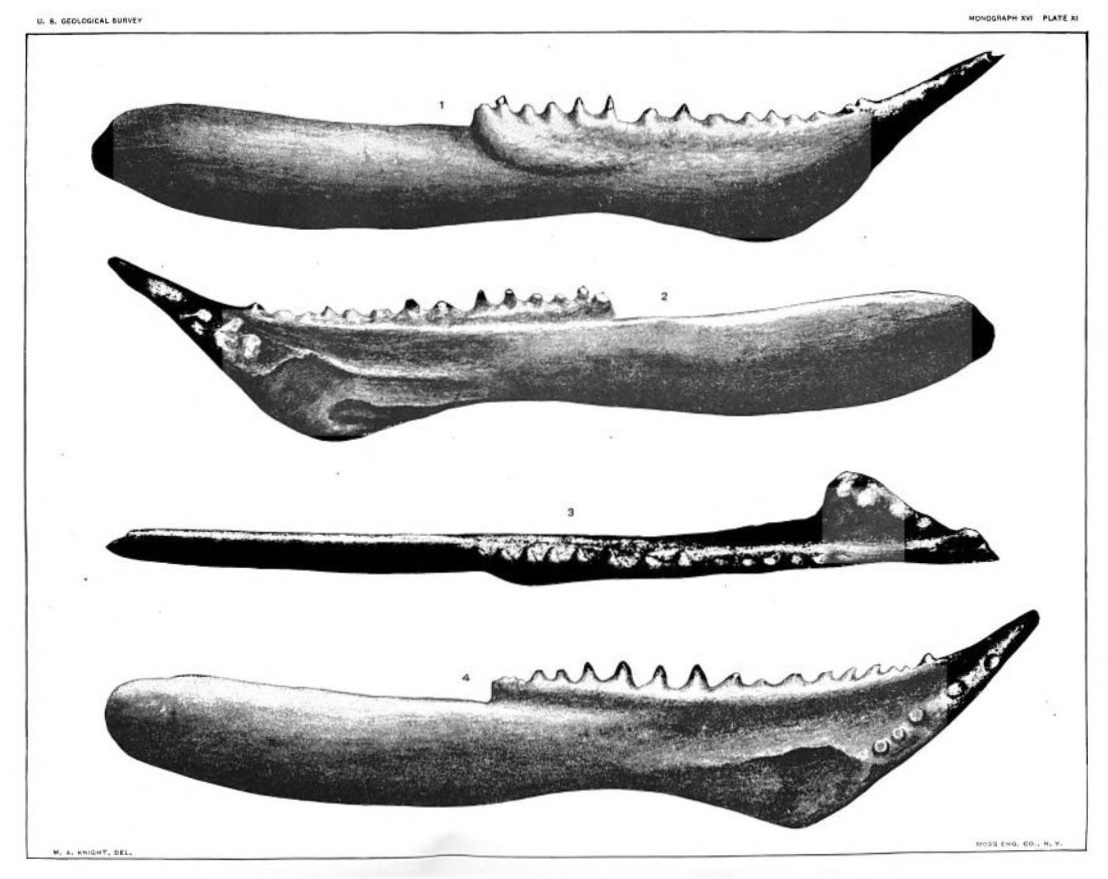
Left and right mandibles of Diplognathus mirabilis found in 1886. 1) Right dentary, lateral view; 2) Right dentary, medial view; 3) Right dentary, dorsal view; 4) Left dentary of another individual, medial view, scaled to the same size as the right dentary. Newberry 1889, plate XI.
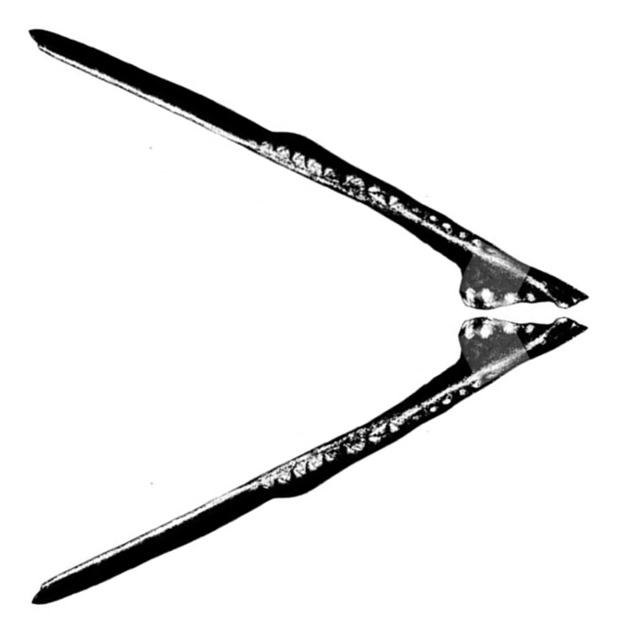
Complete left and right mandibles of Diplognathus mirabilis, dorsal view pointing to the right, modified from Newberry 1889, plate XI. This illustration shows the approximate shape of the skull, and also shows the symphyseal flanges where the ligament attached which connected the front of the left and right lower jaws. The eyes would have had a forward-facing angle, giving Diplognathus improved depth perception compared to fish with sideways-facing eyes.
On June 27, 1940, a fourth specimen (collection ID code: CMNH 7255) was found two miles west of East Liberty, Logan County, Ohio approximately thirty-five feet above the base of the Ohio Shale Formation within the Huron Shale Member. Intriguingly, the specimen, although thoroughly disarticulated, appears to have been a complete individual – not just the bones of the skull and pectoral girdle, but also of the body as well. Unfortunately, the remainder of the body was so badly preserved that it was impossible to collect and preserve it (Dunkle and Bungart 1943, pages 73, 84).
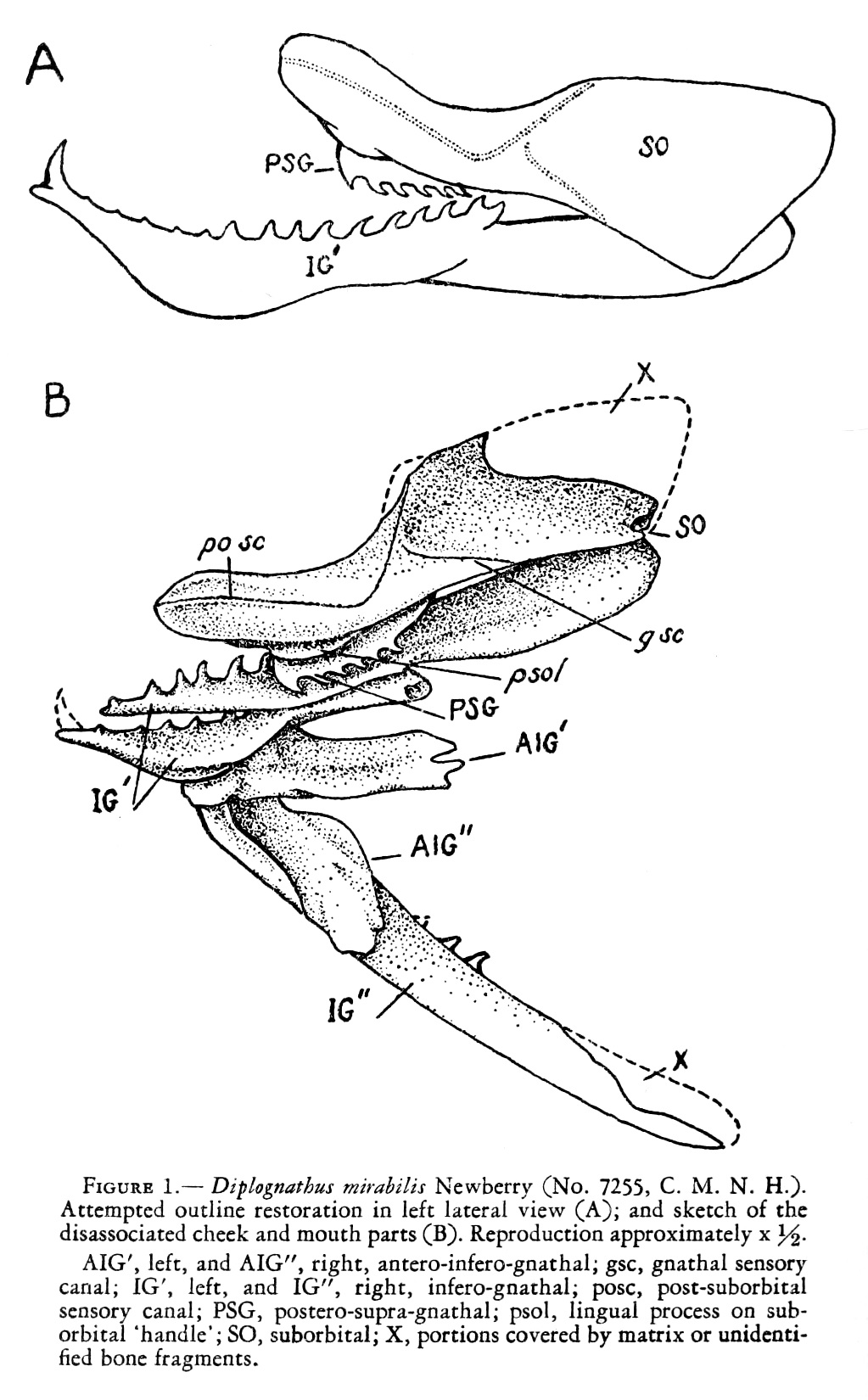
Specimen of Diplognathus mirabilis found in 1940 (collection ID code: CMNH 7255). Dunkle and Bungart (1943), page 74.
In 2005, a new specimen (collection ID code: CMNH 50215) was uncovered in Alpena, Michigan on the property of a cement factory owned by Lafarge North America, Inc. It was found on a rubble slope either within the upper part of the Paxton Member (dated to the Frasnian Stage) or the lower part of the Lachine Member (Famennian Stage) of the Antrim Shale Formation. It was very similar to Diplognathus mirabilis, but there were a few subtle differences. These included “differences in the gnathal elements and a relatively larger orbit. The inferognathal is characterized by a relatively equal depth along its length with a steep and short adsymphyseal region. The posterior superognathal occupies the majority of the occlusal region with a short anterior superognathal. The autopalatine groove on the suborbital plate is equally elongate resulting in a relatively long anterior process or ‘handle’ portion of the suborbital plate” (Carr and Jackson 2005, page 110). In 2005, it was named Diplognathus lafargei, in honor of the Lafarge North America, Inc. cement company who owned the land that the fossil was found on.
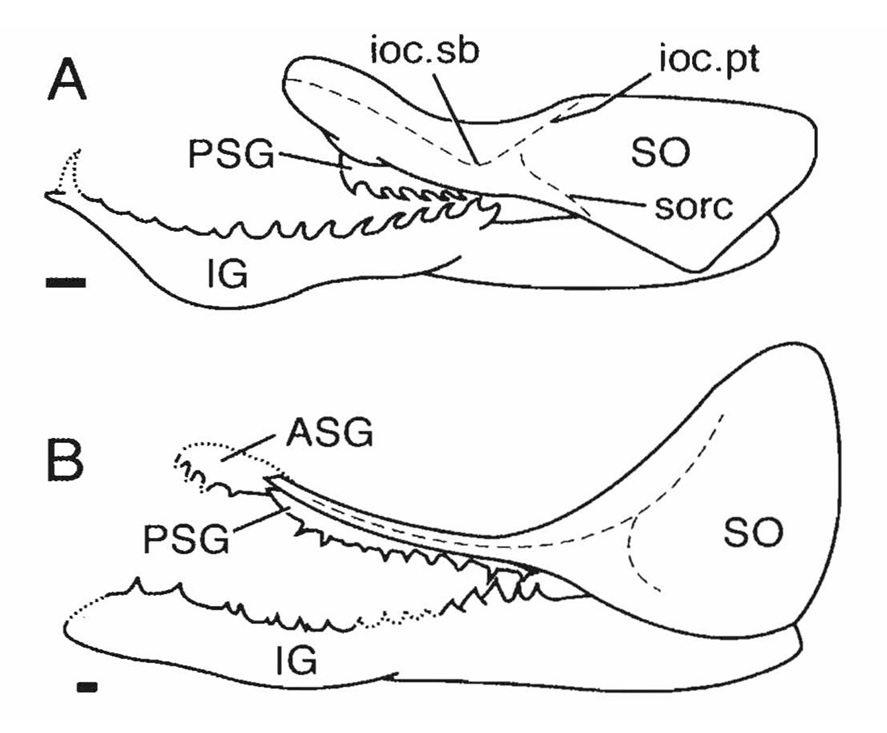
Jaws of (A) Diplognathus mirabilis (CMNH 7255) and (B) Diplognathus lafargei (CMNH 50215). Scale bar for A = 10 mm. Scale bar for B = 1 mm. Carr and Jackson 2005, page 111.
The most prominent feature of Diplognathus are the large denticles emerging from its jaws which outwardly resembled teeth. John S. Newberry surmised that these “teeth” were ideal for catching small slippery fish (Newberry 1878, pages 188; Newberry 1889, page 159). Due to a prominent dip in the lower margin of the eye socket, Diplognathus likely had large eyes, and D. lafargei had proportionally larger eyes than D. mirabilis (Carr and Jackson 2005, pages 110, 112). This, coupled with the fact that the eyes were angled forwards, infers that Diplognathus possessed a moderate degree of stereoscopic vision. It must have been a formidable predator, yet it wasn’t invulnerable. The mandible showed evidence of having been wrenched from the rest of the skull violently “and is perhaps the record of an unequal contest between Diplognathus as Dinichthys” (Newberry 1878, page 189).
What sort of a fish was Diplognathus? It was mooted during the late 1800s that Diplognathus was a member of Dinichthydae (Newberry 1889, page 160). Newberry wrote in his original description of Diplognathus “Only the anterior half of the mandible of this remarkable fish has yet been found. We therefore have but an imperfect knowledge of its structure and relations. It is evident, however, that it was allied to Dinichthys, since the general form of the mandible is similar” (Newberry 1878, page 189). However, after I read various documents relating to placoderms, Dinichthydae seems to have been a catch-all assignment to most toothy placoderms of various sizes during the late 1800s and early 1900s, and therefore ought not to be taken seriously.
It was also noted that there were similarities between Diplognathus and to another placoderm named Trachosteus (Case 1898, page 409; Hussakof 1906, pages 138, 149). Trachosteus had small recurved “teeth” in both its upper and lower jaws (Dean 1909, page 272). John S. Newberry wrote in 1889 “The mandibles of Trachosteus, so far as shown in the only specimens known, are strikingly similar to those of Diplognathus, and as in these specimens the anterior extremity is wanting, I at one time had a suspicion that it would be necessary to unite these two genera, but on comparing their mandibles found that there were marked differences, which proved they could not be united” (Newberry 1889, page 161).
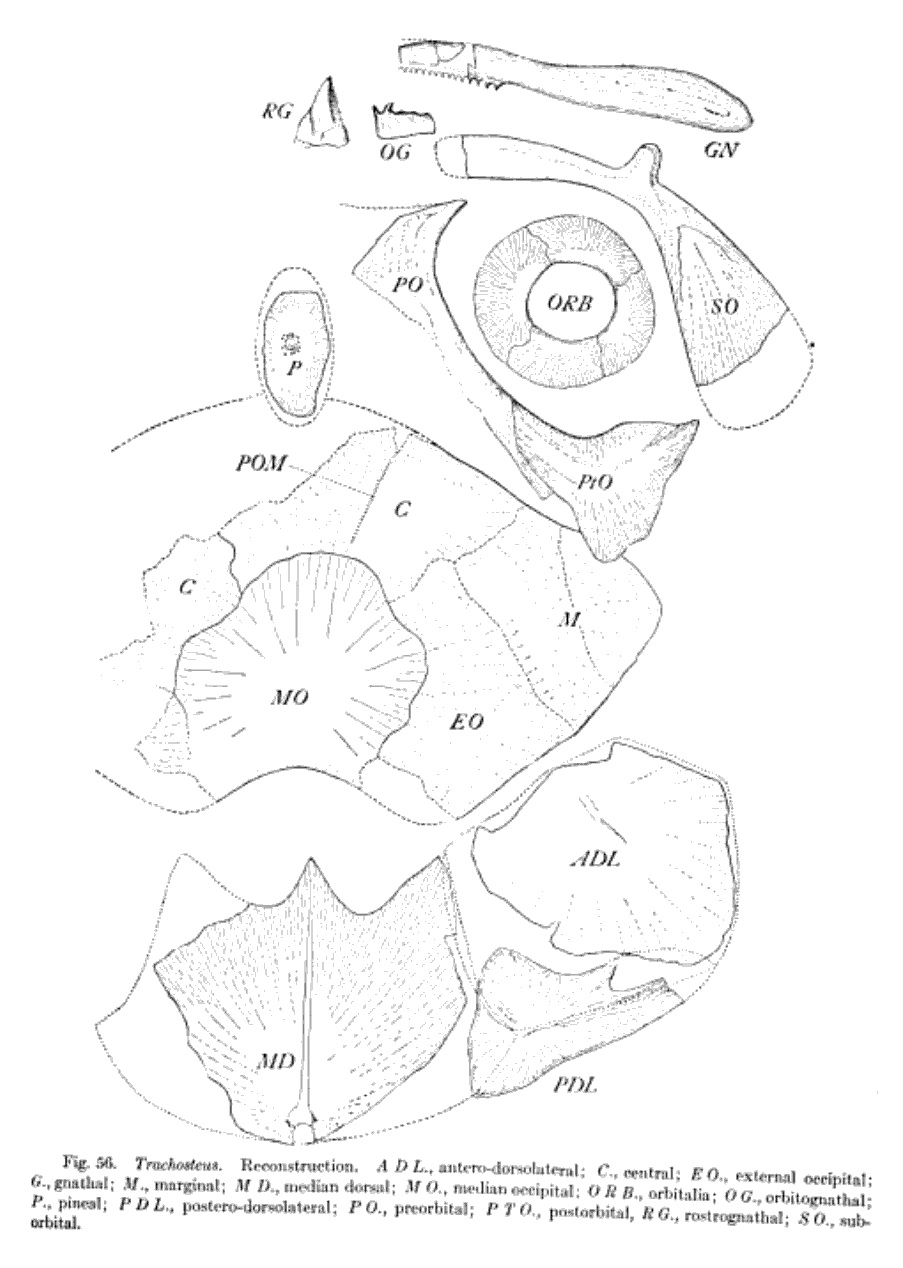
Bones of Trachosteus clarki. Dean 1909, page 273.
Another possibility was that it was a relative of Mylostomus (Newberry 1889, page 158; Eastman 1908, pages 181, 285; Hay 1929, pages 657-658). In fact, Charles Eastman described Diplognathus as “really only an extreme modification of the Mylostomid type” (Eastman 1908, page 181). However, Mylostoma was a swimming nutcracker, with the fronts of both the upper and lower jaws featuring large strongly-built denticles while the remainder of the jaws were toothless. The jaws of Diplognathus look nothing like Mylostoma or any of its relatives.
In 1901, Bashford Dean said that Diplognathus belonged to the family Selenosteidae along with the genera Selenosteus, Stenosteus, and possibly Callognathus (Dean 1901, page 120). The justification for this was brief. When he wrote of Selenosteus, he said “Mandible bearing dental cusps along the anterior fourth of its margin, and with symphyseal teeth, somewhat as is Diplognathus” (Dean 1901, page 100). This claim of Diplognathus being a selenosteid was repeated by Sir Edwin Ray Lankester in 1909, but without any reasons given (Lankester 1909, page 263). The selenosteids were typically small, often measuring around 3 feet long. If Diplognathus was a selenosteid (and again, this is not definite), then it was gigantic by comparison.
In 1919, Leverett Allen Adams summed up Diplognathus as “A very peculiar off-shoot of the coccosteid type” (Adams 1919, page 125). This, I think, is reaching too far. Coccosteus and its relatives are well-known placoderms due to a multitude of fossils found. We even have well-preserved specimens showing what the entire body looked like, and these served as the basis for reconstructions of placoderms for many decades. The jaws of Diplognathus look absolutely nothing like the jaws of Coccosteus, so thisn hypothesis can be discounted.
Newberry posited that these jaws possibly belonged to another mysterious placoderm called Glyptaspis (Newberry 1889, pages 158, 160-161). This creature is known from only a few ventral plates which were found during the 19th Century, and no other fossils of this animal have been found since then. There was no actual justification for assigning the jawbones of Diplognathus to Glyptaspis except for “Well, we’ve not the jaws of one and the belly plates of another, so let’s lump ‘em together!”
Diplognathus may have been a member of the placoderm family Hadrosteidae (Orlov 1959, page 151). This family was named after Hadrosteus rapax, which was named by Walter Gross in 1932 for fossils found in Bad Wildungen, Germany (Gross 1932, pages 1-61). Hadrosteus was the sole member of Hadrosteidae for decades, until it was proposed that Diplognathus might be a member of this family as well. In fact, in 1967, the Russian paleoichthyologist Dmitry Vladimirovich Obruchev cautiously proposed that Hadrosteus and Diplognathus might be the same animal (Obruchev 1967). However, based upon what we know of the two, while the lower jaw of Hadrosteus looks vaguely similar to that of Diplognathus, the upper haw is a different story entirely.
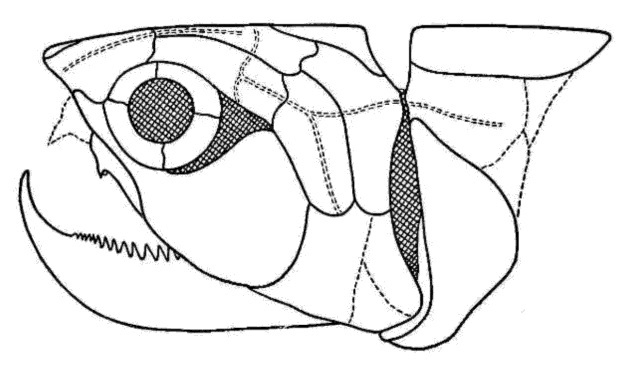
Head and pectoral girdle of Hadrosteus rapax, which might have been related to Diplognathus mirabilis. Orlov 1959, page 151.
By the late 1970s, it seemed that the task of determining where exactly Diplognathus fit into the placoderm tree was a lost cause. In 1978, Robert H. Denison placed Diplognathus as “Arthrodira incertae sedis” (Denison 1978). In 2005, Robert Carr and Gary Jackson assigned Diplognathus broadly to Aspinothoracidi (Arthrodira) incertae sedis (Carr and Jackson 2005, page 109).
How big was Diplognathus? This is an impossible question to answer, because we only have partial remains of its upper and lower jaws. Comparisons to other placoderms are also equally fraught with difficulty because Diplognathus doesn’t appear to be related to any other known placoderm! Placoderms had skulls made of hard bone but the rest of their skeletons were made of soft cartilage, which very rarely fossilizes. For that reason, while we know what their heads looked like, the rest of their bodies are often subject to conjecture. However, we do have a small number of exceptionally preserved body fossils here and there, and based upon these, we have to make inferences about what their relatives may have looked like. Regrettably, there are no body fossils of Diplognathus, either D. mirabilis or D. lafargei. Therefore, we cannot even make an educated guess about its body shape based upon what we know of other genera. If you go online, you will see a wide range of hypothetical reconstructions of this animal, some which are more shark-like, others that are more barracuda-like, and yet others in other shapes of body and fins. I found one hypothetical reconstruction on the website DeviantArt which represented the entire creature which the jaws CMNH 7255 belonged to measuring 110 cm (43.3 inches). However, there’s also a larger specimen, which may have measured 3 meters (10 feet) long! Of course, all of these measurements are conjectural and should not be taken as truth.
Below is my own reconstruction of Diplognathus mirabilis. Did it actually look like this? I have no idea! Your guess is as good as mine.
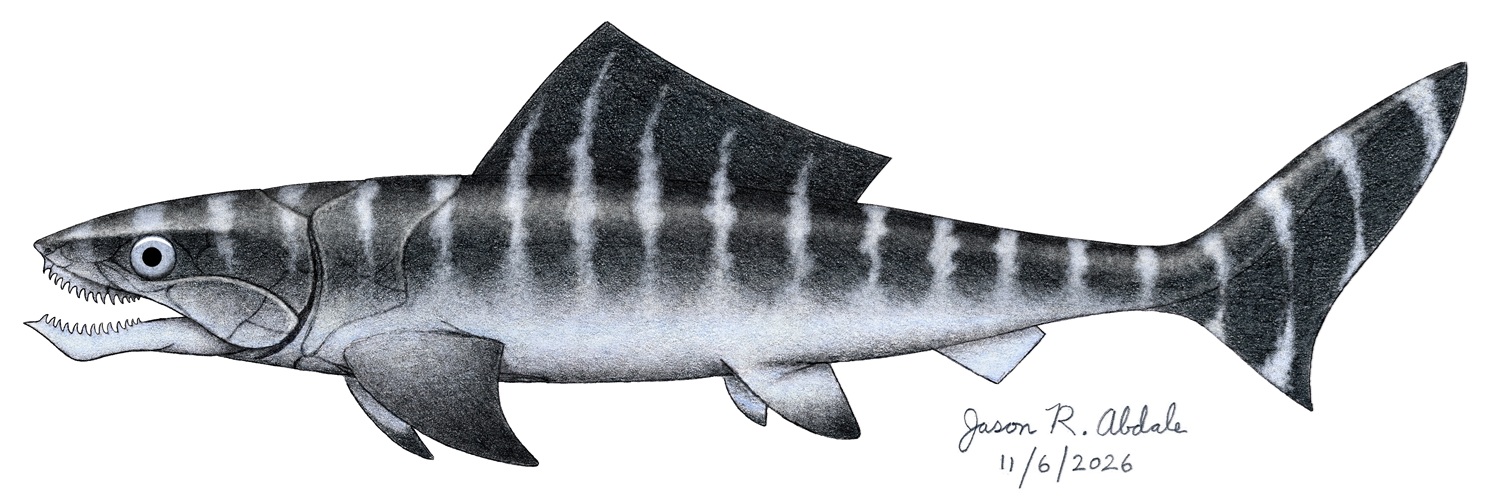
Diplognathus mirabilis. © Jason R. Abdale (November 6, 2026).
I truly enjoy writing my articles and drawing my art, but it’s increasingly clear that I can’t keep this up without your gracious financial assistance. Kindly check out my pages on Redbubble and Fine Art America if you want to purchase merch of my artwork. Consider buying my ancient Roman history books Four Days in September: The Battle of Teutoburg and The Great Illyrian Revolt if you or someone that you know loves that topic, or my ancient Egyptian novel Servant of a Living God if you enjoy action and adventure. Please consider becoming a patron on my Patreon page so that I can continue to purchase the art supplies and research materials that I need. Professional art supplies are pricey, many research articles are “pay to read”, and some academic journals are rather expensive. My Patreon membership is just $1 per month – that’s it. If everybody who likes this drawing donates just one dollar per month, it would go a long way to keeping my blog “Dinosaurs and Barbarians” running and preventing my career in paleo-art from going extinct.
Keep your pencils sharp, everyone.
Books
Denison, R. H. Handbook of Palaeoichthyology, Volume 2: Placodermi. Stuttgart: Gustav Fischer Verlag, 1978.
Hay, Oliver Perry. Second Bibliography and Catalogue of the Fossil Vertebrata of North America, Volume I. Washington, DC: Carnegie Institution of Washington, 1929.
https://www.google.com/books/edition/Second_Bibliography_and_Catalogue_of_the/heMMAAAAIAAJ?hl=en&gbpv=1&dq=Diplognathus&pg=PA658&printsec=frontcover.
Jordan, David Starr. The Genera of Fishes and a Classification of Fishes. Stanford: Stanford University Press, 1917.
https://dn790003.ca.archive.org/0/items/generaoffishesco00jord/generaoffishesco00jord.pdf.
Lankester, Sir Edwin Ray. A Treatise on Zoology, Part IX: Vertebrata Craniata. London: Adam and Charles Black, 1909.
https://www.google.com/books/edition/A_Treatise_on_Zoology/AqdDAQAAMAAJ?hl=en&gbpv=1.
Obruchev, D. V. Fundamentals of Paleontology: A Manual for Paleontologists and Geologists of the U.S.S.R., Volume XI. Jerusalem: Israel Program for Scientific Translations, 1967.
Orlov, Yuri Aleksandrovich. Fundamentals of Paleontology, Volume 11: Jawless Vertebrates, Fish. 1959.
https://www.google.com/books/edition/%D0%9E%D1%81%D0%BD%D0%BE%D0%B2%D1%8B_%D0%BF%D0%B0%D0%BB%D0%B5%D0%BE%D0%BD%D1%82%D0%BE%D0%BB%D0%BE%D0%B3%D0%B8%D0%B8/P7n-AgAAQBAJ?hl=en&gbpv=1&dq=Hadrosteus+rapax&pg=PA151&printsec=frontcover.
Articles
Adams, Leverett Allen (1919). “A Memoir on the Phylogeny of the Jaw Muscles in Recent and Fossil Vertebrates”. Annals of the New York Academy of Sciences, volume 28 (January 15, 1919). Pages 51-166.
https://www.google.com/books/edition/Collected_Papers/c4UuAAAAIAAJ?hl=en&gbpv=1&dq=Diplognathus&pg=PA125&printsec=frontcover.
Carr, Robert K.; Jackson, Gary L. (2005). “Diplognathus lafargei sp. nov. from the Antrim Shale (Upper Devonian) of the Michigan Basin, Michigan, USA”. Revista Brasileira de Paleontologia, volume 8, issue 2 (May-August 2005). Pages 109-116.
https://www.researchgate.net/profile/Robert-Carr-9/publication/235923970_Diplognathus_lafargei_sp_nov_from_the_Antrim_Shale_Upper_Devonian_of_the_Michigan_Basin_Michigan_USA/links/0fcfd5143725fab6ab000000/Diplognathus-lafargei-sp-nov-from-the-Antrim-Shale-Upper-Devonian-of-the-Michigan-Basin-Michigan-USA.pdf?origin=scientificContributions&__cf_chl_tk=UPLkeSYkCi.SZSfToyZ3tb.9pwYcx3UjlFADwp.WFhM-1793271062-1.0.1.1-o1D.wSRgSRwIq4uMLEkq0Tx9oL4.NF4.5XPY.3QrRmk.
Case, E. C. (1898). “Studies for Students – The Development and Geological Relations of the Vertebrates. Part 1. The Fishes”. The Journal of Geology, volume 6, issue 4 (May-June 1898). Pages 393-416.
https://www.google.com/books/edition/The_Journal_of_Geology/AX_zAAAAMAAJ?hl=en&gbpv=1&dq=Diplognathus&pg=PA409&printsec=frontcover.
Dean, Bashford (1901). “Palaeontological Notes”. Memoirs of the New York Academy of Science, volume 2, part 3 (1901). Pages 85-129.
https://babel.hathitrust.org/cgi/pt?id=nyp.33433090912266&seq=44&q1=Diplognathus.
Dean, Bashford (1909). “Studies on Fossil Fishes (Sharks, Chimaeroids, and Arthrodires)”. Memoirs of the American Museum of Natural History, volume 9, part 5 (February 1909). Pages 212-287.
https://www.google.com/books/edition/Studies_on_Fossil_Fishes_sharks_Chim%C3%A6ro/HNMqAAAAYAAJ?hl=en&gbpv=1&dq=Trachosteus&pg=PA272&printsec=frontcover.
Dunkle, David H.; Bungart, Peter A. (1943). “Comments on Diplognathus mirabilis Newberry”. Scientific Publications of the Cleveland Museum of Natural History, volume 8, issue 7 (December 31, 1943). Pages 73-84.
https://archive.org/details/scientificpublic69clev/page/n412/mode/1up?q=Diplognathus.
Eastman, Charles R. (1908). “Devonian Fishes of Iowa”. Annual Report of the Iowa Geological Survey, volume 18 – 1907 (1908). Pages 29-365.
https://www.google.com/books/edition/Devonian_Fishes_of_Iowa/bX8ZAAAAYAAJ?hl=en&gbpv=1&dq=Diplognathus&pg=PA181&printsec=frontcover.
Hussakof, Louis (1906). “Studies on the Arthrodira”. Memoirs of the American Museum of Natural History, volume 9, part 3 (May 1906). Pages 106-154.
https://www.google.com/books/edition/Studies_on_the_Arthrodira/fLkyAQAAMAAJ?hl=en&gbpv=1&dq=Diplognathus&pg=PA122&printsec=frontcover.
Gross, W. (1932). “Die Arthrodira Wildungens”. Geologische und paläontologische Abhandlungen, volume 19, issue 1 (1932). Pages 1-61.
Newberry, J. S. (1878). “Description of New Palaeozoic Fishes”. Annals of the New York Academy of Sciences, volume 1 (April 9, 1878). Pages 188-192.
https://www.google.com/books/edition/Application_of_Organic_Acids_to_the_Exam/ItfBGrWuoREC?hl=en&gbpv=1&dq=Diplognathus&pg=PA183-IA6&printsec=frontcover.
Newberry, John S. (1889). “The Paleozoic Fishes of North America”. Monographs of the United States Geological Survey, volume 16 (1889). Pages 11-340.
https://www.google.com/books/edition/The_Paleozoic_Fishes_of_North_America/qlv-Mk0_DigC?hl=en&gbpv=1.
Categories: Paleontology, Uncategorized


Leave a Reply