
Stegotrachelus was a 6 inch long palaeoniscoid fish which lived in what’s now the Shetland Islands of Scotland during the middle Devonian Period around 385 million years ago.
The fossils of this fish were discovered in the early 20th Century by the Scottish geologist Thomas Matthew Finlay within the Old Red Sandstone Formation, which spans from the end of the Silurian Period to the beginning of the Carboniferous Period, about 420-358 MYA. These particular fossils were found on the Shetland Islands on Dunrossness and in the Ness of Sound within strata dating to the middle of this formation, during the Givetian Stage of the middle Devonian Period 388-382 million years ago. In 1926, Arthur S. Woodward and Errol Ivor White named it Stegotrachelus finlayi. The genus name comes from the ancient Greek words στέγος (stégos) “roof” and τράχηλος (trákhēlos) “neck/throat”, and it refers to the plates covering the neck and gill region. The species name was given in honor of Thomas Finlay who discovered the fossils (Woodward and White 1926, pages 565-566; Scrutton et al. 1979, page 346).
Stegotrachelus grew to a maximum size of 16 cm (6 inches), but the multitude of individuals which were found showed that its average size was 12 cm (4.72 inches). Its body was covered with rows of thick enamel-covered square scales resembling mosaic tiles. The arrangement of the rows of scales is regular, except for at the base of the tail where the orientation of the scales abruptly changes direction. It had very large eyes in proportion to head size, and its jaws were lined with tiny (almost microscopic) conical evenly-spaced teeth. The rays of the fins are very slender and closely packed together, and are segmented along their length. The upper lobe of the caudal fin is slightly longer than the lower lobe, deeply forked, with the section in between the upper and lower lobes rounded (Woodward and White 1926, pages 567-570).

Fossil of Stegotrachelus finlayi. Image from Beardmore, Susan R. (2021). “Shifting continents and a Devonian lake full of fish: The extraordinary geological history of the Shetland Geopark”. Geoconservation Research, volume 4, issue 1 (June 2021). Pages 158-169.
https://commons.wikimedia.org/wiki/File:Stegotrachelus.jpg.
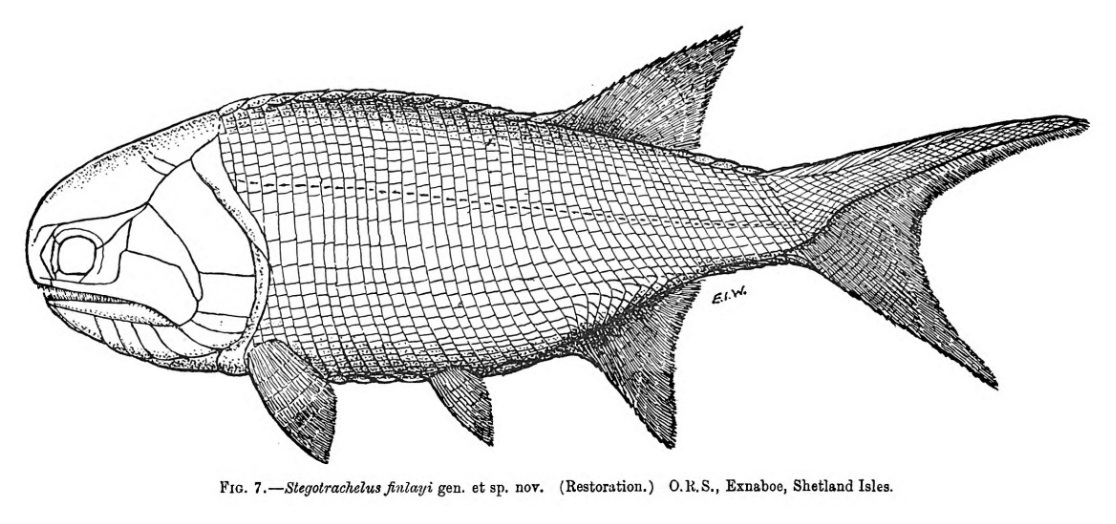
Body of Stegotrachelus finlayi, illustrated by Errol Ivor White. Woodward and White 1926, page 569.
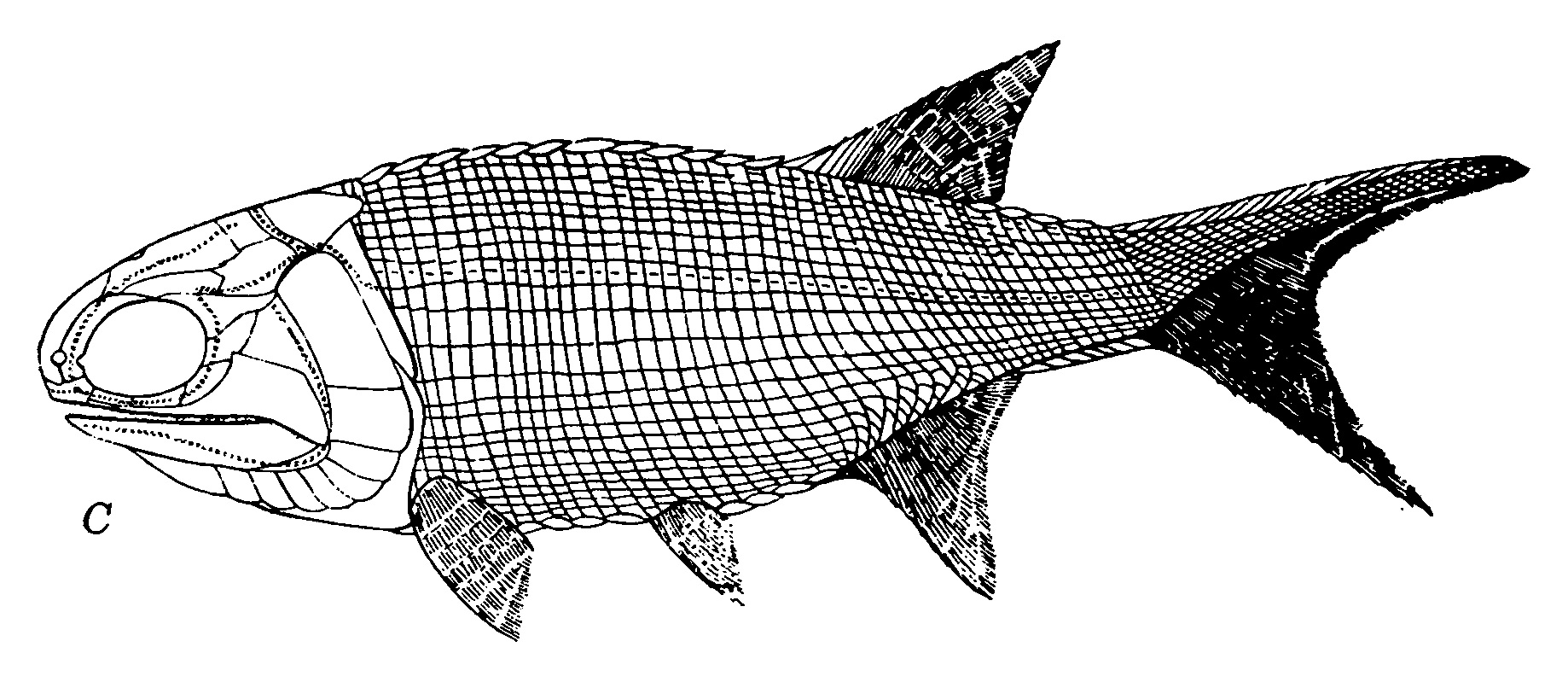
Body of Stegotrachelus finlayi, reconstructed after Lehman 1966. Image from Olson, Everett C. Vertebrate Paleozoology. New York: Wiley-Interscience, 1971. Page 548.
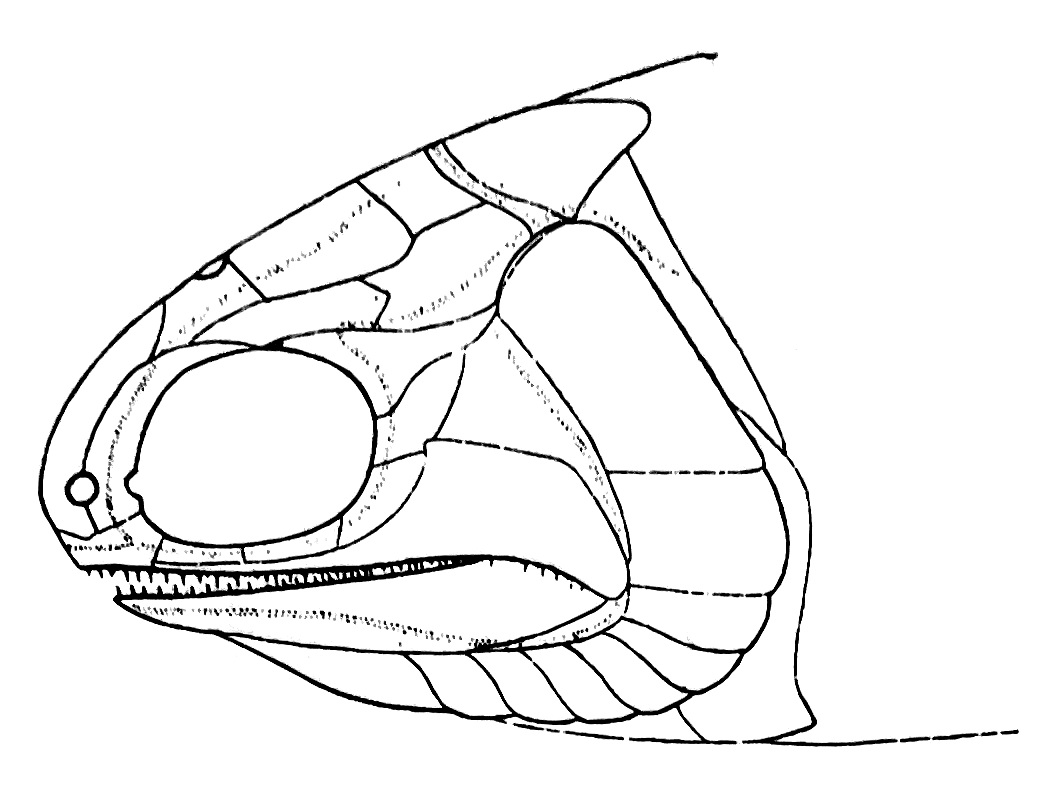
Skull of Stegotrachelus finlayi. Image from Olson, Everett C. Vertebrate Paleozoology. New York: Wiley-Interscience, 1971. Page 556.
Stegotrachelus was identified as a member of the family Palaeoniscidae, and at the time that it was named, it was the oldest-known member of the family (Woodward and White 1926, page 566). It was most similar to Rhadinichthys (lived from the late Devonian to early Permian) based upon the teeth and position of the dorsal fin, but differs from Rhadinichthys in its stouter overall body shape, the articulation of the base of the rays of its pectoral fins, the reflexation of the scales above the anal fin, and the shape of the caudal fin (Woodward and White 1926, pages 570-571). In 1933 and 1942, Walter Gross suggested that Stegotrachelus finlayi was the same animal as Moythomasia perforata (Gross 1933, 1942), but this was refuted by Dorothy Rayner in 1951 (Rayner 1951, page 55). In 1963, Brian Gardiner coined the name Stegotrachelidae which he stated included Stegotrachelus, Moythomasia, and Kentuckia (Gardiner 1963, page 294).
Woodward and White noted that fossils of Stegotrachelus were found “in considerable numbers”, and was likely abundant within its environment, although still not as abundant as the prehistoric lungfish Dipterus which was the most common fish from that strata (Woodward and White 1926, pages 566-567). Its large eyes indicate that Stegotrachelus was probably nocturnal.
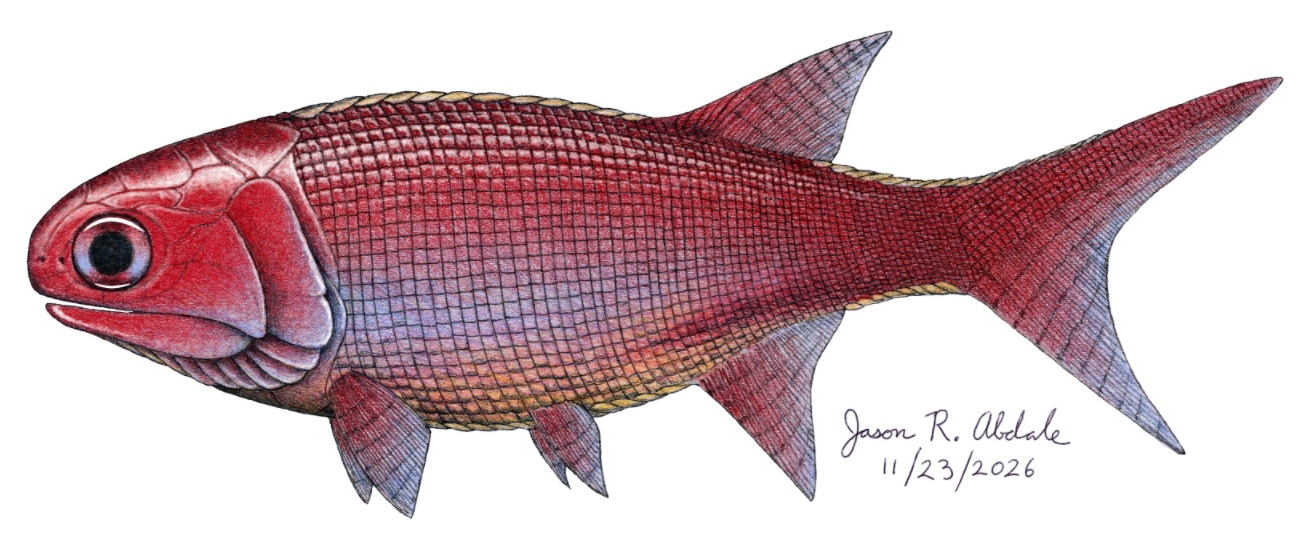
Stegotrachelus finlayi. © Jason R. Abdale (November 23, 2026).
I truly enjoy writing my articles and drawing my art, but it’s increasingly clear that I can’t keep this up without your gracious financial assistance. Kindly check out my pages on Redbubble and Fine Art America if you want to purchase merch of my artwork. Consider buying my ancient Roman history books Four Days in September: The Battle of Teutoburg and The Great Illyrian Revolt if you or someone that you know loves that topic, or my ancient Egyptian novel Servant of a Living God if you enjoy action and adventure. Please consider becoming a patron on my Patreon page so that I can continue to purchase the art supplies and research materials that I need. Professional art supplies are pricey, many research articles are “pay to read”, and some academic journals are rather expensive. My Patreon membership is just $1 per month – that’s it. If everybody who likes this drawing donates just one dollar per month, it would go a long way to keeping my blog “Dinosaurs and Barbarians” running and preventing my career in paleo-art from going extinct.
Keep your pencils sharp, everyone.
Bibliography
Gardiner, Brian George (1963). “Certain Palaeoniscoid Fishes and the Evolution of the Snout in Actinopterygians”. Bulletin of the British Museum (Natural History) Geology, volume 8, issue 6 (July 1963). Pages 257-325.
https://www.biodiversitylibrary.org/page/36370884#page/451/mode/1up.
Gross, W. (1933). “Die Wirbeltiere des rheinischen Devons”. Abhandlungen der Preußischen Geologischen Landesanstalt, volume 154 (1933). Pages 5-84.
Gross, W. “Die Fischfauna des baltischen Devons und ihre biostratigraphische Bedeutung”. Korrespondenzblatt des Naturforscher-Vereins zu Riga, volume 64 (1942). Pages 373-436.
Rayner, Dorothy H. (1951). “On the cranial structure of an early palaeoniscd Kentuckia gen. nov.”. Transactions of the Royal Society of Edinburgh, volume 62, issue 1 (1951). Pages 53-83.
Scrutton, Colin Thomas; Bassett, Michael G.; House, Michael Robert, eds. (1979). The Devonian System: A Palaeontological Association International Symposium, Bristol, UK, September 1978.
https://www.google.com/books/edition/The_Devonian_System/ebyzAAAAIAAJ?hl=en&gbpv=1&bsq=Stegotrachelus+Givetian&dq=Stegotrachelus+Givetian&printsec=frontcover.
Woodward, Arthur Smith; White, Errol Ivor (1926). “The Old Red Sandstone of Shetland, Part 1: South-Eastern Area. With an Account of the Fossil Fishes of the Old Red Sandstone of the Shetland Islands”. Transactions of the Royal Society of Edinburgh, volume 54, part 3, number 12 (June 16, 1926). Pages 553-572.
https://babel.hathitrust.org/cgi/pt?id=mdp.39015012185495&seq=693&view=1up.
Categories: Paleontology, Uncategorized


Leave a Reply