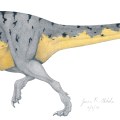
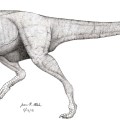
Dromaeosaurus albertensis was a six-foot carnivore which lived in western North America during the Late Cretaceous Period. It is a distant cousin of Deinonychus and Velociraptor. Only one fragmentary skeleton was found in Alberta, Canada, although its teeth have been… Read More ›
Uncategorized
Pachycephalosaurus
Pachycephalosaurus wyomingensis was the last and largest of the so-called “dome-headed” dinosaurs. It measured fifteen feet long and lived 68-66 million years ago, right at the very end of the age of dinosaurs. Its fossils have been found in Wyoming… Read More ›
Two Triassic Pycnodont Fishes: Brembodus and Eomesodon
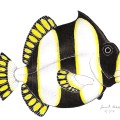
Here are color pencil drawings of two genera of prehistoric fish. Their fossils have been found in central Europe in rocks dating to the late Triassic Period. Both of these fish belong to a group called the pycnodonts, and it… Read More ›
Onderdonk House – Brooklyn, New York
At the beginning of September, I visited the Vander-Ende Onderdonk House, located in Brooklyn, New York. I’m very interested in colonial American history, and I’m surprised by how much from that time period can be found within the five boroughs… Read More ›
Garvies Point Museum and Preserve
I want to talk to you about one of my favorite places in the whole world. It’s called the Garvies Point Museum and Preserve, located on the North Shore of Long Island in the town of Glen Cove, Nassau County,… Read More ›
Albertosaurus
Albertosaurus, named after the province of Alberta, Canada, is one of the most well-known theropod dinosaurs. It is a distant relative of T. rex which lived in western North America approximately 75 million years ago (MYA). It was also one… Read More ›
Archaeopteryx
In a previous post, I talked a little bit about the “raptor” dinosaurs and how they had feathers. Here is a drawing of Archaeopteryx, long reputed to be the earliest-known bird. It lived during the late Jurassic Period in what… Read More ›
Tyrannosaurus rex body
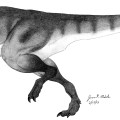
It’s no secret that Tyrannosaurus rex had a large head – it measured five feet long! However, I’ve noticed that many paleo-artists have a tendency to make T. rex’s head too big in proportion to the rest of its body…. Read More ›
The Presence and Usage of Osteoderms in Dinosaur Paleo-art
Many times, paleo-artists take a feature that was found in a few species and ascribe it to entire groups. One of these trends is to portray osteoderms on the bodies of dinosaurs in their artwork. The word osteoderm literally means… Read More ›
Map of the Germanic tribes, circa 15 BC
This is one of the pictures which appears in my book. It is a map of the various tribes which existed in ancient Germania at around the year 15 BC. The picture that’s shown in the book is a little… Read More ›