
With the harvest season in full swing, it’s time to give thanks to the gods for the bounty that they provided. In ancient Rome, one such festival took place on the Ides of November (November 13) and it was dedicated to the goddess Feronia.
If the name Feronia appears unfamiliar to you, that’s no fault on your part – she’s not one of the most recognizable names in the ancient Roman pantheon. In fact, she wasn’t even a native Roman deity. Feronia appears to have been a goddess native to central Italy and was worshiped by the Latins and the central Italic tribes such as the Sabines and Samnites, but she doesn’t seem to have been held in any special regard by the ancient Romans (Fowler 1899, pages 252-253; Taylor 1923, pages 5, 13, 48, 50). Dionysius of Halicarnassus reports that the Greeks gave Feronia titles including Anthophoros “Flower Bearer”, Philostephanos “Lover of Garlands”, and, curiously, Persephonê (Dionysius of Halicarnassus, Roman Antiquities, book 3, chapter 32), equated with the Greek goddess of the same name who presided over the Underworld and who also oversaw the growing of crops in Spring. From these names, it seems that Feronia was a local goddess of Spring. Her importance seems to have been supplanted in later years by the goddesses Venus and Flora (Dury 1886, page 204). It’s also possible that she was merged with the goddess Juno, Queen of the Gods (Cardinali 1889, pages 147, 150).
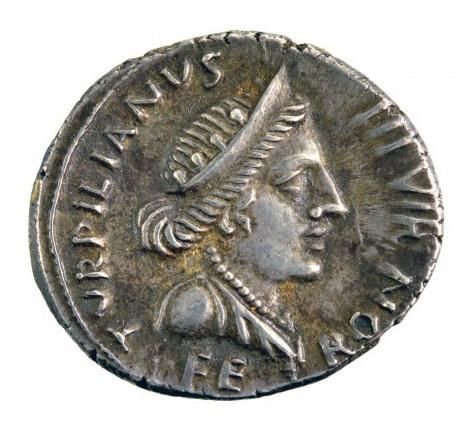
A silver denarius bearing an image of the goddess Feronia. Wikimedia Commons. https://commons.wikimedia.org/wiki/File:Feronia.jpg.
Within central Italy, Feronia had several places which were sacred to her. Of these, the most important (and possibly the oldest) was a sacred grove of trees known as the Lucus Feroniae located close to the bank of the Tiber River at the base of a hill called Monte Soracte. The place was just a few miles away from the town of Capena within southern Etruria. It’s possible that a spring was located within these woods. Springs were places of special veneration for ancient peoples, and therefore it shouldn’t be a surprise that such a spring would be held in reverence. The Roman poet Horace stated that, while on a trip, he washed his face and hands in Feronia’s stream (Horace, Satires, book 1, satire #5). Sir William Gell states that there is a spring which is the source of the Grammiccia River, which flows near the ancient towns of Feronia and Capena before it merges into the Tiber River. This spring is known as Felonica, which might be a variant of Feronia, and therefore this might be the sacred spring which is mentioned within Horace’s verses (Gell 1846, page 242). The Roman historian Titus Livius (more commonly known in English sources simply as Livy) states that the local people would offer up the first fruits of the year to her at this grove (Livy, From the Founding of the City, book 26, chapter 11). However, not everything was fun and games. There is a legend that, during Rome’s early history, a group of Roman merchants who had been attending the annual feast of Feronia were arrested by the Sabine authorities and were robbed while in their custody. This provided King Tullus Hostilius of Rome with the excuse that he needed to declare war on the Sabines and he defeated them in battle (Livy, From the Founding of the City, book 1, chapter 30; Dionysius of Halicarnassus, Roman Antiquities, book 3, chapter 32).
In 211 BC during Hannibal’s invasion of Italy in the Second Punic War, Hannibal’s troops looted Feronia’s temple at the base of Monte Soracte, which contained a vast quantity of gold and silver. However, fearing divine vengeance, they left behind a large amount of aes rudi, raw copper, in place of the gold and silver that they took (Livy, From the Founding of the City, book 26, chapter 11; Dury 1886, page 204).
In 196 BC, the temple of Feronia was struck by a bolt of lightning (Livy, From the Founding of the City, book 33, chapter 26).
During the reign of Caesar Augustus, Rome’s first emperor, a town was established at Feronia’s sacred grove named in honor of this goddess. The town was given the status of a colonia, a home for retired veterans, and it was officially named Colonia Julia Felix Lucoferonensis. However, this long-winded name doesn’t appear to have lasted for very long, and it was known simply as Feronia from the reign of Emperor Tiberius onwards (Taylor 1920, pages 29, 31). The Greek geographer Strabo, who lived and wrote during Tiberius’ reign, states that a feast was held here dedicated to Feronia. Of the rituals which took place here, Strabo says the following: “Her sacred precinct is in the place; and it has remarkable ceremonies, for those who are possessed by this goddess walk with bare feet through a great heap of embers and ashes without suffering; and a multitude of people come together at the same time, for the sake not only of attending the festal assembly, which is held here every year, but also of seeing the aforesaid sight” (Strabo, Geography, book 5, chapter 2, section 9).
In addition to the principal holy place at Monte Soracte, Feronia had temples dedicated to her at Terracina, Trebula Mutusca, and Luna (formerly known as Losna) (Dury 1886, page 204; Leland 1892, page 57).
The only record that we have of Feronia’s feast day comes from the Calendar of the Arval Brethren, dated to approximately 29-21 BC, which states that the Ides of November (November 13) was the day marked for her veneration with the words FERONIAE IN…MP. This partial inscription is often stated to have originally said Feroniae in campo, “Feronia in the field”. This inscription is categorized under the Corpus Inscriptonium Latinarum (CIL for short), “the Body of Latin Inscriptions”, under Volume VI, inscription #2295 (Fowler 1899, page 253; Taylor 1923, page 53; “Lucus Feroniae in Campo Martio”). But if Feronia was a goddess of Spring, then why is her principal feast day in the middle of Autumn? The fact that Feronia’s feast day is included on a calendar of holy days used by the Arval Bretheren might be a clue. The Arval Brethren or Arval Brothers (Fratres Arvales) were a select order of twelve Roman priests whose job was to propitiate the gods and spirits in order to assure a good Autumn harvest (“Arval Brothers”). If Feronia was a goddess associated with new growth, then perhaps the Feronia festival was given at the end of the harvest season in thanks to her for providing a rich Spring crop. If that’s the case, then the Feronia festival would have been just one of several festivals at the end of the Roman calendar dedicated to the harvest, such as the Brumalia winter festival dedicated to Ceres and Bacchus which lasted from November 24 to December 17.
Feronia has a special connection to Roman slaves, and especially to those who had been granted their freedom. Her temple at Terracina was used as a location to officially grant slaves their freedom. Here, they would receive the pilleus, the Phrygian cap, a symbol of liberty. A seat within this temple had upon it the following inscription: BENE MERITI SERVI SEDEANT, SURGANT LIBERI, “Well-merited servants sit, then arise free” (Taylor 1923, page 53). In the year 217 BC, female ex-slaves, the libertini, made offerings of money to Feronia (Livy, From the Founding of the City, book 22, chapter 1). An inscription at Nepet states that a former slave of the emperor Claudius dedicated five altars to the goddess Feronia (Taylor 1923, pages 52, 99). It’s never explicitly stated in any of the ancient sources that Feronia was the patron goddess of freed slaves, but I think we can put 2 and 2 together. But why? Why on earth would a local nature goddess be associated with granting slaves their freedom? There’s no way that we can say. Was it because escaped slaves hid within the woods which were under her protection? Was it because a certain slave owner decided for whatever reason to free his slaves on the Ides of November, and that date just stuck from then onwards? We just don’t know – the ancient sources don’t explain the reasons. They seldom do.
So, on the Ides of November, be sure to thank Feronia for blessing your fields with a bountiful Spring crop so that you could have a bountiful Autumn harvest. And remember – be kind to your slaves.
I truly enjoy writing my articles and drawing my art, but it’s increasingly clear that I can’t keep this up without your gracious financial assistance. Kindly check out my pages on Redbubble and Fine Art America if you want to purchase merch of my artwork. Consider buying my ancient Roman history books Four Days in September: The Battle of Teutoburg and The Great Illyrian Revolt if you or someone that you know loves that topic. Also, please consider becoming a patron on my Patreon page so that I can afford to purchase the art supplies and research materials that I need to keep posting art and articles onto this website.
Please check out the rest of my “Today in Ancient Rome” series for more articles on the ancient Roman calendar. You can find the whole list by clicking here!
Bibliography
Primary Sources
Dionysius of Halicarnassus. Roman Antiquities, book 3, chapter 32.
https://penelope.uchicago.edu/Thayer/E/Roman/Texts/Dionysius_of_Halicarnassus/3B*.html.
Horace. Satires, book 1, satire #5.
https://www.poetryintranslation.com/PITBR/Latin/HoraceSatiresBkISatV.php.
Livy. From the Founding of the City.
https://en.wikisource.org/wiki/From_the_Founding_of_the_City.
Strabo. Geography, book 5, chapter 2, section 9.
https://penelope.uchicago.edu/Thayer/E/Roman/Texts/Strabo/5B*.html.
Books
Duruy, Victor. History of Rome and of the Roman People, from its Origin to the Invasion of the Barbarians, Volume 1. Translated by W. J. Clarke. Boston: Dana Estes and Company, 1886.
Fowler, William Warde. The Roman Festivals of the Period of the Republic: An Introduction to the Study of the Religion of the Romans. London: Macmillan and Co., Ltd., 1899.
Gell, Sir William. The Topography of Rome and its Vicinity. London: Henry G. Bohn, 1846.
Leland, Charles Godfrey. Etruscan Roman Remains in Popular Tradition. London: T. Fisher Unwin, 1892.
Taylor, Lily Ross. Local Cults in Etruria. Rome: American Academy in Rome, 1923.
Articles
Taylor, Lily Ross (1920). “The Site of Lucus Feroniae”. The Journal of Roman Studies, volume 10, issue 1 (1920). Pages 29-36.
Websites
Britannica. “Arval Brothers”.
https://www.britannica.com/topic/Arval-Brothers.
Lacus Curtius. “Lucus Feroniae in Campo Martio”.
https://penelope.uchicago.edu/Thayer/E/Gazetteer/Places/Europe/Italy/Lazio/Roma/Rome/_Texts/PLATOP*/Feronia.html.
The Ohio State University. “CIL 6.2295 – ‘Fasti Arvalium,” fragment of a calendar of the Arval Brothers (‘Arvales Fratres’), ca. 29-21 BCE, with later Augustan addition”.
https://kb.osu.edu/items/f4d4c794-5d3c-415f-806b-2263aedad290.
Categories: History, Uncategorized


Leave a Reply